80% of OpenAI and Anthropic's Revenue Comes From 1% of Customers
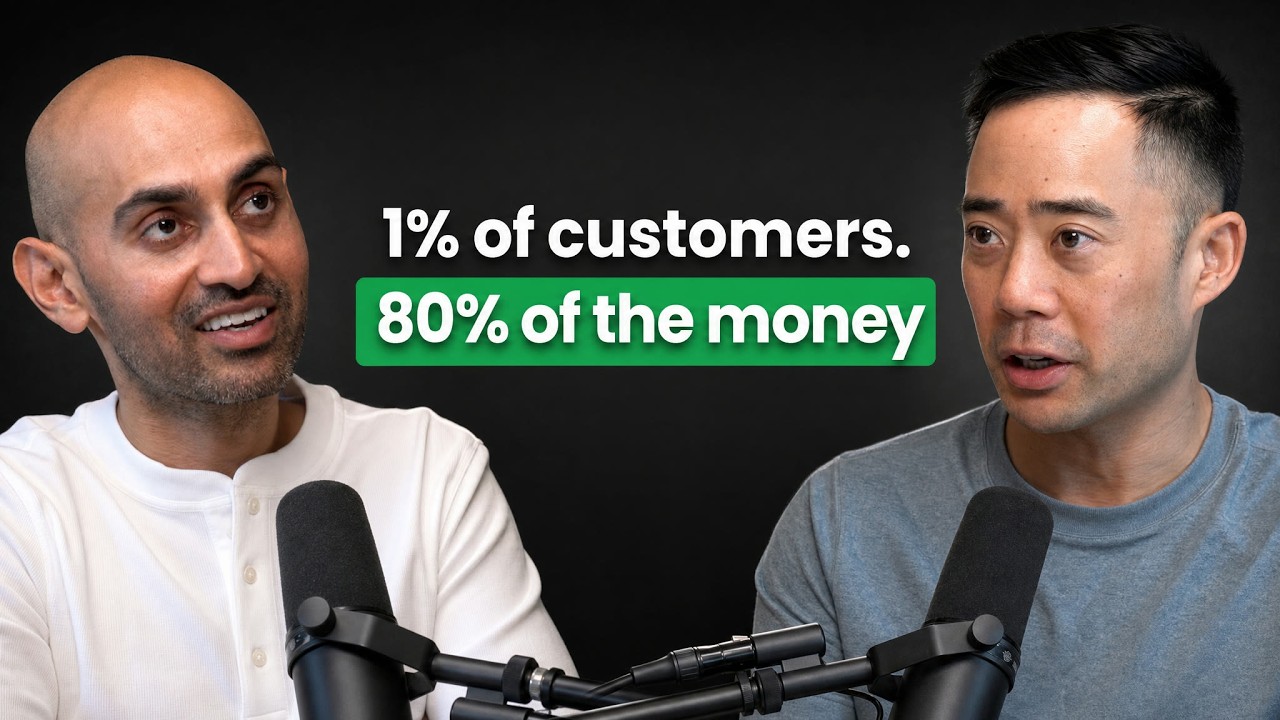
In this conversational interview, Eric Siu and Neil Patel examine the financial and strategic dynamics of leading AI firms. They reveal that roughly 80% of OpenAI’s and Anthropic’s revenue is generated by the top 1% of their customers, highlighting a concentration risk that is especially pronounced among large tech corporations such as Microsoft, Meta, and Amazon. The discussion expands to the competitive landscape, noting how Meta is building its own models, NVIDIA’s investment in both OpenAI and Hugging Face, and the broader move toward open‑source AI. They then shift to AI’s impact on productivity, citing Tomasz Tunguz’s analysis that AI raises the floor of content quality by significantly improving weaker posts while having modest effects on top‑performing ones. Next, they explore hiring trends: hyperscalers are still adding headcount at a rapid pace (up to 133% YoY in H1 2026), whereas mid‑growth firms have slowed hiring, though demand for “AI‑pilled” talent remains high. The conversation moves to product‑market fit, emphasizing that frequent user conversations (10+ per week) dramatically shorten the time to achieve fit, as shown by Y Combinator batch data, and they illustrate this with the health‑tech startup Levels. They also discuss the limits of direct customer feedback, referencing Steve Jobs and the evolution of consumer expectations (e.g., Apple’s upcoming foldable devices). Finally, they share a brief anecdote about Instagram algorithm quirks as a lesson in consistent marketing, and close with a promotional plug for Eric’s agency, Single Grain.
Chapters
Did you know that 80% of Anthropic and OpenAI's revenues come from 1% of the customers?
It's way less than 1%, but yeah.
Yeah, so this is actually new data from Ramp, right? So they have a lot of credit card data. So you can see here, top 1% of businesses, right? And then you have everyone else. This is the majority of their revenue. And then you have the next 9% and then everyone else. This is the standard Pareto principle.
Yeah, but for them it's even skewed because there's only so many large corporations and there's a lot of people who'll give them, I don't know what their fees are, $20 a month?
What's the lowest entry? Is it $20?
$20, yeah. Yeah. So there's a lot of people that'll pay $20. There's a fraction of 1% that can spend millions of dollars with them. And that fraction of a percent is where they're making all their revenue.
And this is really risky if you're one of these companies, right? Because it's like this concentration risk, I've never seen this before, right? The companies in the top 1% skew heavily towards the tech sector. So you have like a Microsoft, for example, right? You have a Meta, for example, you have Amazon, which they're kind of building their own models. Meta's built a model that is already like a, like 5.6 equivalent from like a ChatGPT standpoint. And so here's the thing, if you look at NVIDIA, they just bought Hugging Face for $13 billion. If they're in on Hugging Face, which is an open source company, right?
They're also one of the investors too. I don't know if you knew that.
In what?
In Hugging Face. NVIDIA is one of the earlier investors.
NVIDIA also has money in OpenAI and I'm sure in Anthropic too, but they're going to just go for everything, right? And so you have Meta going open source, you have NVIDIA going open source as well. So then what happens to these companies, right? I still think they're gonna be fine, but the question is, is Anthropic a multi-trillion-dollar company right now?
They're supposedly trying to go public at over $2 trillion.
$2 trillion, yeah, bigger than SpaceX is.
Yeah.
Yeah, so I don't know, like it's risky, but hey, I still love using these products, don't get me wrong. I'm just like, this is kind of a little scary, so.
I agree with you, it's extremely scary, but their client concentration isn't bad. Think of a services business, so flip it around. Don't look at the majority of their revenue coming from 1% of the customers. The way bankers will look at this is that 1% isn't 5 companies or 10 companies. So when you look at how much of their revenue comes from the majority of the companies that actually they generate revenue from, the concentration isn't as bad.
So what Neil's saying is it's not that bad. Also, these companies are fairly stable. My thing is, as the other models, like if in a year Nvidia's models are pretty much up there, right? I think there's always, again, there's always going to be room for frontier models like Anthropic and OpenAI, but as Meta is basically catching up, right?
Yes.
All the money they're spending. Like first, maybe a year ago everyone's like, what's Mark Zuckerberg doing right now? It's like, oh damn, they're actually catching up, so.
Yeah, 'cause the way people look at it, like let's say someone in finance, yes, 99% of their revenue comes from people who pay small amounts, all right, or 1% of their revenue comes from people who pay, what was it? 80% of the revenue comes from—
80% comes from 1%.
So they'll look at 20% of their revenue comes from 99%, they'll be like, okay, here's that 99%, we don't have to worry about that. They'll look at the 80% And then within that 80%, it's not like one company makes up 20%. It's still a large number because they have millions of customers and that large number, it's spread out. Yes, you can have some outliers in there, but I bet you it'd be very rare if Anthropic had more than, call it 10% of their revenue coming from one customer if I had to guess.
Yep, we'll see how it plays out, but I wanted to call something, this piece out. So this is AI productivity as it relates to writing. So content generation, for example, okay? So Tomasz Tunguz, the VC that is still Redpoint Ventures or Theory VC now? Okay. So he wrote a post, AI Productivity Doesn't Mean What I Thought It Means. So if you look at this chart over here, Neil, what this is explaining is the post that he's written. He has a blog, he's been writing for a while, right? And so you can see what AI is actually doing is it's helping the weakest posts gain, right? The strongest posts aren't getting that much better, but the weakest posts out there, they're becoming significantly better. So it means it's just raising the floor a lot higher. And what he's learning from this is that it actually means that We're doing— it raised the ceiling of the same amount of work, which means it actually still increases human effort. It doesn't shrink human effort.
Yes.
So we're going to be doing more still.
Yeah, I think we're entering into a new era where people are less of the narrative of AI is going to kill human labor. There's going to be no need for human labor. I don't know what's going to happen 10 years from now, but people were making this bet in the short run, which is like, oh, we're going to have mass unemployment over the next few years. And you have really smart people on both sides, and I don't know who's right. I just know I haven't seen it with the companies we work with. work with, and we work with a lot of large enterprises, I can't name one off the top of my head that really is laying off because of AI. Even in engineering, most of the companies I know are actually hiring, they're not laying off.
Did you see the post from Iconiq on headcount? So Iconiq's a VC firm, right? And so they were talking about, here, let me just pull this up for you. So basically, if you're a hyperscaler right now, you're adding a lot more headcount, right? So you're adding 133% more headcount in the first half of 2026. But if you're in the 50 to 100% of growers, right, in terms of your growth rate, you've cut your hiring by almost in half. And so it just depends on kind of where you're at. If you're a hyperscaler, you're going to be adding a lot more headcount, but—
Cut your hiring or cut your staff by half?
Your staff.
So they're firing.
Yeah.
Okay.
So no, sorry, sorry. This is headcount growth.
This is headcount growth. Headcount growth. So they're cutting how many new jobs they're looking for. So instead of looking for 100 jobs, if they're only growing at 40% a year, they're now only looking for 50 jobs. So they've slowed down hiring. Or open roles.
So I'll explain because it's probably a little hard to see. So I'm showing a chart over here and basically the hyperscalers are at the very top in the red. So you can see in 2023, 2024, it actually went down. The growth rate went from 119% to 65%. People are like, oh my God, you know, AI is going to destroy a bunch of jobs, right? 2025, it shoots back up to 112%. And then 2026 first half is 133%. This is the hyperscalers up top. Now, if you're in the 50 to 100% growth rate band, you're in the yellow over here. Am I making sense so far? Yes. Okay, 2023, 2022, 2023, so 47%. Then in 2024, it goes to 35%. And then 2025, it goes to 46%. And the first half of 2026, 25%. So you can see these lower bands over here are actually hiring less. And it kind of maps to some of these conversations I've been having with other entrepreneurs where they're talking about the language they're using is like not hiring as quickly, right? But when you look at the news from all the big companies out there, they're hiring a lot more.
As Benioff put it on TV, he was with Dario, the Anthropic CEO, and I think it was on Cramer. He was talking about, hey, AI's crushing all this stuff and staff and all that. He's like, everyone, they were talking about how they're hiring like crazy. All of them are on Slack. All of them are using Salesforce. And he's just like, they're all a few blocks and they're adding more seats and increasing usage year over year, not decreasing it. Yeah.
And Salesforce has good free cash flow. By the way, the SaaS-pocalypse, man, is going up. Yeah, see, it's a good bet. But anyway, so—
I still think it's not over. I think it'll take like another 6 months to— 6 months for things to adjust to a year.
Well, we had said this is a year trade.
Yeah.
So, okay, but I want to go a little deeper into this and we can continue on. So if you look at, if you're growing at less than 25%, your headcount growth is 3%. So minus 1 point, okay? If you're 25 to 50%, your headcount growth is 5%. Wait, sorry to interrupt. What do you mean minus 1 point?
point because you're at 3%, you're still growing at 3%. I don't understand the mindset.
Because a year before, the growth rate was 4%. And then this year so far, year to date is 3%. Okay.
So it shrunk down. You're still growing, but you're only growing at 3% instead of 4%.
Yes, correct. And so like mostly they're not adding as much. Right. And so this one over here, by the way, you look at it went from 16%.
What's the percentages?
Sorry.
This one.
Sorry. This one's if you're growing at 25 to 50% as a company, you Went from 16% last year and then this year to date so far you're at 10%. So you dropped 6 points, which is pretty significant.
So you're growing your headcount by 10%.
Correct.
But it's 10% on a bigger number as well.
That's correct. Well, I mean, we don't know what the whole sample size looks like.
Yes.
But yeah, yeah.
Okay, read the rest if you don't mind.
And then if you're growing at 50 to 100%, you were 46% last year and now it's 25%. So down 21 points.
Were they growing at 25% the year before? Because I'm assuming their growth is slowing down and that's also causing—
We don't know that data. Yeah, but we have to pull the iconic report. This is like SaaStr did a did this, but like you can see that the hyperscalers are more or less continuing to push more. But I just think it's interesting that when we talk to friends that have, you know, maybe companies that are growing at a decent rate, the language is still very much, we're not looking to add as much, but they are looking to add more AI-pilled talent. I'll tell you that much. Everybody is.
So yeah. Yeah.
Anyway, that's that. So let's move back over here. So Real quick, if you want to acquire customers faster and more efficiently this year with the latest strategies and tactics, then check out singlegrain.com. That is my ad agency. Again, www.singlegrain.com. Check it out. And if it seems like a fit, we'll get in touch and help you with a free marketing plan. Let me show you this, Neil. What do you think is the one X factor to getting to product market fit? And do you want to define what product market fit is? And then I'm going to show you some data.
So Eric Ries in The Lean Startup and Sean Ellis back in the day, they had this thing where it came to product market fit. You would look at how many people, how many of your customers were extremely satisfied and couldn't live without your product, and they would run a survey. It's probably a terrible way of defining it, but based on the data, depending on how many of your people really love it and can't live without your product, you tend to have something called product market fit. fit. And in essence, what they're really looking at is if a product has really high usage and people keep needing to use it, you're more likely to have product market fit than if you don't have that.
In essence, really product market fit is just people find your product useful.
Yes.
And the majority of people find your product useful. And Y Combinator has this batch outcome data. Okay, so Y Combinator, they backed Airbnb, they backed Dropbox, other companies that you—
A lot of them. Yeah.
So When you think about this, companies that entered a batch, so a batch is like a class, okay, for startups joining, right? So companies that entered a batch with 10+ user conversations per week found product-market fit within 6 months on average, okay? Now, on the flip side, companies with fewer than 2 user conversations per week took 18+ months or never found it. So it's the frequency of user conversations, it's the most predictable variable for a PMF, product-market fit timeline. And this is interesting 'cause there's a company that I backed called Levels, they do the continuous glucose monitor, When I talked to the CEO, I can tell he was doing a customer call with me, right? Just the way he was asking me questions. I was like, how many of these have you done? He said 4,000 right now. Did they necessarily, you know, hit rocket ship growth? Not necessarily, but I do think they found product market fit. But that's the amount it takes. And this is one thing I'm training our engineers on right now. It's like, hey guys, it's not just ship a bunch of stuff. You actually have to talk to our team internally. You have to talk to customers as well. And that's not something you're used to doing. But now that you can do more, you're expected to know how to talk to customers. You're expected to know how to do marketable moments as well. But most people don't know that you actually need to talk to people. I remember Neil, back when I first met him, when I would call him, his voicemail would go to, this is Neil from Kissmetrics, right? So he was actually talking to customers all the time. You want to talk about that?
Yeah, I always talked to— I even, I still talk to them right now. And the reason being is if you talk to customers versus don't talk to them, you're only going to learn so much. Your team can tell you one thing, a customer is going to tell you something else. It doesn't mean the customer's right, Actually, I genuinely believe in most cases, not all the customer's right. And in some cases, your team's going to be right, but people have different viewpoints. And if you don't talk to people, you won't understand what is the real truth and what needs to be changed and what needs to be fixed. And that's why I love talking to people. But you talk, if you go back to when Steve Jobs was around, he would talk about how if you ask your customer what kind of phone they may want or device, They'll tell you something, but it's not really what they want because they don't always know what they want. So, you have to be careful when you get feedback as well because sometimes the feedback is based on their limited understanding of that subject and it could be skewed. Like, back when the iPhone first came out, if someone were to ask me what kind of phone would I want, I'd be like, Oh, the BlackBerry. It's really cool. That is what I would want. Like, uh, like a, uh, before the iPhone came out, right? I would be like, a BlackBerry, you don't need anything more than that. You have a mouse, you have apps, you have a keyboard. This is great. If you look actually at an iPhone, I don't want a BlackBerry anymore. An iPhone is great, but I couldn't envision that until I actually saw the product. Um, and by the way, you know, Apple has a new phone coming out on Wednesday.
It's Are you getting it?
The foldable? Yeah, I know.
Not the flip phone, the foldable. You're right.
Yeah. I don't know if I'm going to get it.
Well, I'm Chinese, so I might get it because Chinese people get it. I'm just kidding. I would probably still— I'm used to— here's the thing. This is interesting, right, Neil? Because back in the day when the iPhone first came out, I had a BlackBerry and I was looking— when the iPhone came out, I'm like, why would I need this? This is so stupid, right? So what might happen is when this foldable phone comes out, we might look at it like it's really stupid and we'll probably still end up getting it anyway.
I may get it. I'm curious because a lot of these phones are made in China and whoever the manufacturers are, somehow they always have leaks and you can actually see what it looks like. I don't care for the design as much. I hope it looks better than what people are showing online. So we're going to have to wait and see, but they already have the molding. I'm curious to see how it works. And I'm curious to see if you can watch a movie better. I'm curious to see the size when it folds and fits in your pocket. I'm more interested. And what Huawei has, the foldable—
Huawei?
Huawei.
I'm more—
wow, my bad. I'm more interested in their foldable tablet. And if Apple comes out with the foldable tablet, which they're saying is a few years from now, that I would buy.
It doesn't look like this, does it? It looks—
That's what it supposedly looks like.
I'm looking because you're dimensionist and I saw it trending on, on X. And so I'm like, oh, that's what it looks like. Um, so to me, I don't know what it is.
That's not that appealing from a design perspective. I don't know why.
You know what I mean? This looks like a Chinese phone to me. I mean, it is built in China.
Yeah. Like, it's like they're trying to create an iPad out of a phone.
It does look like an iPad. It's an iPad phone.
But I don't— do you really want that?
No, I have an iPad right here. Yeah. I'm good on this.
Yeah. So it's like, I don't know if I'm gonna buy it. Well, 'cause I don't really use my phone for anything other than emails.
The way you feel. Like that? Yeah, I don't know about that. This is my first time seeing it.
Yeah, so, 'cause I only use my phone for phone calls, sometimes doom scrolling on Instagram, but not that often. Funny enough, a lot of the people who log in from my Instagram, you know, like my employees doom scroll on my account and I can tell because—
'Cause the algorithm changes.
Yeah. And I was like, what are all these car videos? Or like, what are all these Fitness videos. Like, you know me, dude. Am I really that into fitness?
No, no.
So then I get the most random things and I can tell who did it. 'Cause sometimes like there'll be, um, uh, videos of women. I'm like, oh, I'm like, I know who it is 'cause they're single.
Right? That's funny.
And then some of them are like cooking and I'm like, oh, I know who did this as well. Yeah.
That's funny. So you can tell who last used it basically.
Yes. 'Cause they accidentally forget to switch back to their account.
Yeah. That's funny.
And then the best is when some of my videos start turning into Portuguese and I'm like, I know who's doing this.
Yeah, that's funny. So that's the lesson. Keep being consistent. That's how you win at marketing.
Yep.
All right. Goodbye.









