AI in ads divide consumers, Should you constantly tweak after algorithm updates?, and more
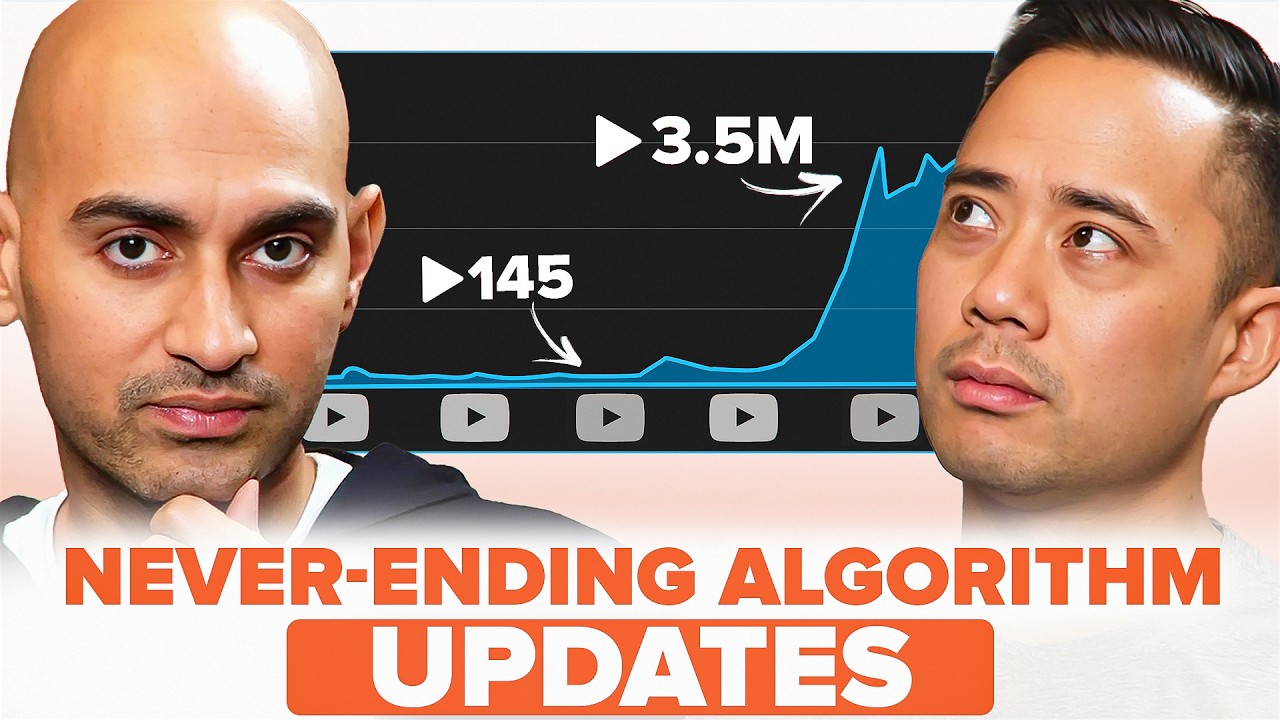
Neil Patel and Eric Siu break down consumer attitudes toward AI in ads by generation, share an experiment where articles labeled "written by AI" saw dropped read-time, and discuss whether you should tweak campaigns after algorithm updates.
Chapters
Did you see the interview? I think it was on Ad Age, how AI in ads is dividing consumers.
No.
So Gen Z and baby boomers, who usually don't agree much, are aligned on their feeling towards AI in ads, with 45% of Gen Zers and 44% of boomers opposing it. They're saying people don't want that, right? When you look at millennials, 28% of them oppose AI in ads. And 30% of Gen Xers also oppose AI in ads. So a large chunk of people want more ads that are authentic, real, humanized. They don't want AI being used.
Yeah, I mean, I don't really have an opinion on this. I personally don't mind. What do you think?
I honestly don't care if you use AI for ads or even content or any part in marketing. We're just seeing data that if you use AI, and the quality isn't there or it's not as up to date, it just doesn't work.
Yeah, well, because the quality is not there. It goes back to quality content again, which we were talking about earlier.
Or let me rephrase. When I'm talking about quality, I'm not talking about with the visual creative, like how sharp the image is or how cool the campaign looks. Like if people just feel it's not authentic and real, I'm not talking about AI where it's like using crazy effects that people are like, oh, a human didn't create this. I'm just saying like if people don't feel it's authentic, we're just seeing ads not do as well. It doesn't matter how highly produced or how badly produced they are.
They had a new version of that Midjourney or anywhere, it showed this gal talking on like a TED Talk and that looks so realistic. That one situation where I just don't care, like I can't tell and that's good enough to me. You know what I mean?
Yes, but if the content that comes out isn't quality from her mouth, no one's going to care.
Of course, yes.
And that's the assumption people have. Because when we did a test with 1.8 million visitors, we took a third of the visitors and we put written by AI. So the article was all written by humans, but we just took a third of them and put written by AI. The read time dropped by roughly a half.
Wow.
And the author bio was at the top. So instead of the author bio, for a third of the visitors, it just said written by AI.
Wait, how did this test work?
So we took 1.8 million visitors on a few websites, multiple websites in different industries, and we put—
The author.
The author was always at the top. So we took websites where they had the author information at the top. We changed it to author bio from, you know, 100% of the traffic to just put written by AI. And literally the read time just drastically went down.
And these sites let you test this?
Yes.
Wow. What was your justification to say, hey, just let us try it?
No, it was a group of sites that we all run marketing experiments together.
Okay, got it.
And then another third said written by AI. So technically one-third was the author bio, one-third was written by AI, one-third was written by AI and modified by, and then they put the human name. The written by AI modified by human had a drop in read time, not as substantial, but it was a decent percentage. The written by AI had the biggest drop.
Wow, that's fascinating.
Same article though. It was the article written by a human. There was no AI used. It was just, we just changed the author bio. And the lesson we learned from this is people just have the assumption that AI produces crap content. That's not necessarily the case. But if you look at the quality of the content that AI is producing right now, from ChatGPT to Gemini—
It's just not as good.
Yeah. And in the future as it improves, maybe people will be okay with it, but in today's environment, they're not okay with it.
I got to take a minute to tell you about the Agency Owners Association. This is a peer group for agency owners. Think YPO or EO, but for agency owners. And I just wanted to read you a couple of testimonials. So this first one comes from Carrie, and we asked her, what do you like most about the group? She said, having a group of people to discuss and bounce ideas. The leads are great too. Yes, we share leads in this group as well. This one from Aliyan, he says, the ability to really post whatever I want and need, and the group responds. Great experienced members. Getting a lot of insights from conversations with the other members, getting a lot of value from sessions from Eric, getting advice from others as well. And so if you want to grow your agency faster and you want a peer group to do so, just go to marketingschool.io/agency. This is a group that both Neil and I created, and our hope here is to create a vibrant community of agency owners and do a lot more with it in the future. So again, marketingschool.io/agency, and we'll see you inside.
Dude, people obsess way too much about algorithm updates when something goes wrong. And I put in our sheet as well. They're just like, oh, I need to go make some change. What's the next change I should do to recover from it? And I'm not saying that you shouldn't constantly make tweaks after algorithm update. If you're not doing what's best for users and there's just blatant issues like having medical content with no author bio written by a doctor and you're using AI to write medical content, yeah, you should go and fix that even before the algorithm updates or after, whatever you choose. But those are just blatant, obvious issues. If you're doing what's right for the users and you're doing what's the best practices, some algorithm updates you're going to get less traffic, some you're going to get more traffic, but consistently year over year, you should see some nice gains.
I just, you know, the people that you and I have seen, we have a lot of friends that have these publisher sites. I remember I had a guy in my EO forum back in the day and he had like a rap website and he got millions of visitors per month. And all they focused on was just creating helpful content that other people couldn't create and that's how they got that traffic. Or even with the survival website, we'll call it a survival website, right? You know, it wasn't based on any hardcore SEO, it was just based on creating good content. It's just focused on being helpful. And when you, for example, when you look at YouTube, by the way, YouTube is like the purest thing where it's like, if the content's good, it's going to get views. If it's not good, it's just not going to get views, right? It's the same concept.
I totally agree. Funny enough, in our analysis, YouTube had the highest lifetime value for B2C customers.
Really? Yes. Wow.
I think a lot of it has to do with long-form content.
I believe, I think the opportunity with YouTube is long-form. And it's funny, we had a guy last week. So I told you, right? We have this consultant working on our YouTube right now. And he's like, your YouTube channel's pathetic, right? He's like, your packaging's bad, all these things, da, da, da, da, da. And all he does is he will do the research and like someone like you and I will just step in and he'll be like, okay, here's what you're creating. So I can come into the meeting not knowing what I'm creating. And then he's done everything for me for packaging and everything. And good to go, right? He's like, yeah, that's bad. You need to focus on long form, forget about short form. And I tend to agree with that. I think the money is in the long form because you actually get to build a relationship with people at scale.
I don't know if you experienced this, speaking of YouTube and, you know, you met this guy, he's working with a few other pages that have millions of views. I don't know if you get this, but like I was at an event last week, I was in Kansas City, someone comes up to me, he's like, Dude, this is the best YouTube marketer. He's the one who really boosted Alex Hormozi's views. What's his name? I forgot the guy's name. And he's telling me about it, so I text Alex. Like, hey dude, is this the guy that does all your YouTube stuff? Is he legit or is he not? And he's just like, I don't use him. He's like, what the heck? He's like, I did an interview with him.
Dude, so many people lie about this stuff. I'll let you finish first.
Yes, and that's what I was getting at. Everyone lies about this crap.
Yeah.
And what they don't realize is people eventually will check and call you out and they're just like, uh-huh. And then he texted back, or actually his notifications were silent. He does the same thing as you. It was during the day. So I clicked notify. So then he sees it, he texts me back, he's like, dude, I don't use this. I've never used this guy on my YouTube.
You click notify, that's funny.
I do that with you too.
You do?
Yeah. So like if it's during the day and your notifications are silent and it's something that I want to know, I'll just click notify.
That's never worked on me. You know why? My notifications are off. So I've never seen—
It vibrates.
No, my thing doesn't vibrate.
At all?
No. There's no sound, nothing. Try texting, try doing it right now. Neil's trying to text me right now.
Okay, let's try this out. So let's go to Eric.
And while Neil does this, I'll just mention Josh. Josh, actually the guy that helps us, he actually is hanging out with these people in person, so it's legit. Nothing.
Yeah, I just clicked notify, but your screen shows up.
Yeah, but there's no notification. It turned on, but that was it. So now I know if it turns on, it's probably you. But, but we had this YouTube— sorry, this Twitter ghostwriter before. He's like, oh, you know, I work with Sahil Bloom. I work with all these people and da da da. And then I checked with Sahil. I was like, hey, have you worked with this guy? He's like, I have no idea who this person is. So you have to be careful who you— who you got to be careful about these claims because people use like— it's almost like false, false clout almost at the end of the day. So yeah. What are you doing now?
Someone's coming to me right now, texting me. They have this business, $3 million in revenue. I'm not going to mention the name. $200,000 in profit. And they have debt on their books and they want $1 million. And I was like, so you have a declining business and you want 5 times your money?
See, this is why guys, when we have meetings, it's a no-phone thing because sometimes things just take you out of the meeting.
But here's the thing. No, dude, this is just business for everyone to listen, right?
Yes, yes.
If someone has, call it half a million in debt and they're doing $200,000 in profit and they're struggling because their interest payments are high—
They should give it to you for free and you would take it off them if you wanted.
I'll give them the debt amount and maybe a little bit more for their legal costs. I'm not going to give them 5x for their business. I'll give them 3x, something like that. The rest they're on their own.
Yeah, 3x. So 3x, you give them $600,000 just so you'll clear out the $500,000. Maybe they get $100,000 for the legal costs.
Yeah, maybe $700,000 max.
Yeah.
That's assuming I can clean up the business. The biggest thing I've learned about doing M&A, most businesses, and I bet you're in the same camp, and I don't mean this in a bad way, most businesses don't know how to manage their P&L. And I don't think you manage your P&L either.
Go on.
So at the beginning of the year, you'll set a budget or a forecast. These are the numbers we need ahead in revenue. This is the numbers we need ahead in profit. And you're forecasting based on all the clients you think you can renew, the clients that will churn, how many leads you get, your average sales cycle, what you close on a monthly basis, thinking about seasonality as well. And now you got your rough year projection. Doesn't always work out that way, but you're also including things like upsells, downsells, all those types of things. So we do forecasting. Companies do it too. So we get a lot of businesses coming to us and like, yeah, we're going to do $5 million this year. Okay, what's your profit going to be? It's going to be $1 million. All right, you're operating at 20%. M&A takes time, 6+ months for us to close a deal. We also drag it on so you can see how the business is doing over time. Like we tend not to close in 3 months. Some of the deals we could rush if we choose to, and some of them we have, but we tend to take our time so we can actually get to know the entrepreneur, get to know the business, the leadership, the list goes on and on. And what we found is a lot of times, a lot of times people would be like, oh, we didn't hit our numbers for the year. We're at $4 million. Oh, what's your profit? Or our profit is $100 grand. How'd you go from operating at 20% to barely anything? And the issue you have is when a lot of businesses don't close revenue, they'll keep the headcount. And I know that sounds cruel.
Yeah.
But you need to manage your P&L. Well, if you didn't close all this business or you lost a lot of customers, do you need all the headcount? Are you managing the headcount? You can't always operate at 20% when you go from 5 to 4, because some expenses like leadership you can't cut and they tend to be the more expensive costs. When you're at scale, it's much easier to maintain the margins, but we see this issue all the time of businesses just not operating and managing their P&L correctly.
So, 2 thoughts on this. One, forecasts, yes, you should do them. But more often than not, they're just— a lot of times they're just wrong. You just never know what's going to happen.
No, you can actually forecast very accurately.
No, because the last couple of years we forecasted, right? We forecasted it was going to be this and it was totally not. And then this year we were more conservative. Then like this year we totally blew it out of the water, right? And so, you kind of like, yes, you can forecast, right? But sometimes it's not as predictable. I'm not saying don't do it. I'm not saying it's useless. I'm just saying sometimes it's off, right? And then the second thing, let me finish on the second thing. The second thing is we do tend to manage on the P&L. I will say before, maybe a couple years ago, no, because I was a little too rosy about things. Now it's just like, no. But to your point, you're absolutely right about management. So we're just like, no, we got to keep the management there. But other roles, we're more down to kind of make the cuts that are necessary.
But your reason your forecasting is off is you probably don't have the best CFO. That's the real issue. I'm telling you, forecasting is way more predictable.
I'm going to send this clip to him.
Yes, you can send it to your CFO.
I'm going to send this clip to him.
This is the real problem. Your CFO is probably not that good. I'm not trying to be mean, but I'm just telling you reality.
But I'm going to send this clip to him.
Your forecasting should not be that off. You've been in business more than 10 years.
Yeah.
Your forecasting is very predictable. Your traffic and lead vet count doesn't just drastically change overnight.
It— so, okay, let's talk about this for a second. It's really important that your CFO be— I'm not going to say anything about my situation. I'm just going to say it's really important that your CFO is strategic, that they're telling you what they're thinking strategically and you're not driving them all the time because they should know more than you do in terms of financial strategy, right? You would agree with that?
Yeah.
Yeah. And even then, you're very involved with finances, right? My point is, if you're going to have someone at that level, they better be better than you and you better be able to spar with them back and forth. Because if you can't, they're not that good enough.
I'm not that involved in finance in my company. I may have a call with the CFO once a month.
No, but in general, you're very good with numbers and you're very on top of how your numbers are doing at a high level.
I'm telling you though, your numbers should be very predictable when it comes to finance.
I'm not disagreeing with you, by the way.
You shouldn't be off by like 10% or anything like that. That's too drastic.
I am totally not disagreeing with you. This is a great clip. I'm totally going to share it.
Right?
Because this is— Like, we're kind of actively talking about this in front of everyone, but I think it's, um, the biggest mistake you can make is if someone is not, um, if you need someone to be strategic and they're not quite there, you need to make sure that they're in the right seat. They could be the right person, but they could be in the wrong seat. This is a situation where it's like, let's say hypothetically he's not good, right? Or she's not good. Then maybe there needs to be someone hired above.
Also with forecasting, when you're really tiny, like doing $1 million or $2 or $3 million in revenue, Forecasting can be a little bit more challenging, but you're not that small.
No, no, no.
Yeah. And you've been in business long enough. You're not a startup in growth mode. I understand you're still growing, but your business is much more predictable.
Yeah, yeah, yeah.
When you're a startup doing $1 million, $2 million, $3 million, you get venture funding and you're pouring it for more growth. I totally get how forecasting can just be drastically off, but that is not your business. I'm telling you, you have a CFO problem.
Yeah, well, he's not a CFO.
Let's be clear on that.
But this is a good clip. All right, next topic. Yeah.
I was going to ask you, what do you pay them? But I'm like, well, it's probably going to be obvious because you probably don't have a big finance team.
No.
So then people will know who the person is. So I'm like, we'll avoid that question.
Yes, yes, yes. The number one challenge for businesses is hiring. And more specifically, the number one thing I get asked for all the time is, Eric, where can I go find an amazing marketer? And the reality is right now, when you think about the world, we have inflation. That also means wage inflation right now. And it means that when it comes to hiring talent, you can't spend as much as you would have in the last couple of years because it's just become too cost prohibitive. And so we've partnered with one of the best offshore recruiting firms when it comes to marketing. They've been a great asset for us, and I believe that they will be a great asset for you. All you have to do is go to marketingschool.io/hire. Again, it's marketingschool.io/hire to learn more. You can fill out the form there and we're going to place you with the best marketing hires that we can help you find.
Did you see that Perplexity is running an ad tonight, as at least of the recording?
Oh, tonight's the Niners versus the Jets.
Yes, on Monday Night Football.
Oh wow, you're going to be at dinner during that.
Yeah.
Yeah.
It's kind of crazy to think about that Perplexity's running an ad and they're using humor with AI and all these kind of things. They're like, yes, this is this advanced technology. Oh, but wait, we still need to pay for marketing and we still need to figure out how to do this.
I don't think that's a good use of money.
I don't either. I think this is one of the worst uses of money and they're just going to get burned on it and it's not going to do crap for their business.
Biggest ad yet will air during Monday Night Football. I just don't see what this is going to do to help users.
No, it's not going to do anything.
It's called perplexity.
It's just wasting money.
And they did an ad with Jim Harbaugh. He's the coach of the LA Chargers. I don't know if you saw that. He's drinking like a Perplexity water bottle.
They're just wasting money straight up.
This is not like Perplexity. This is a situation where you just wasted money. Your marketer, your head marketer is not that good. I'm sorry.
Yes.
So that is it for today. Please don't forget to rate, review, subscribe. Go to marketingschool.io/agency. You can no longer just sign up for it. It's application only now. And if it does look like it's a good fit, we'll have someone from our team reach out. And, um, see if it's a good fit for the group. So that is it for today, and we will see you tomorrow. Bye.









