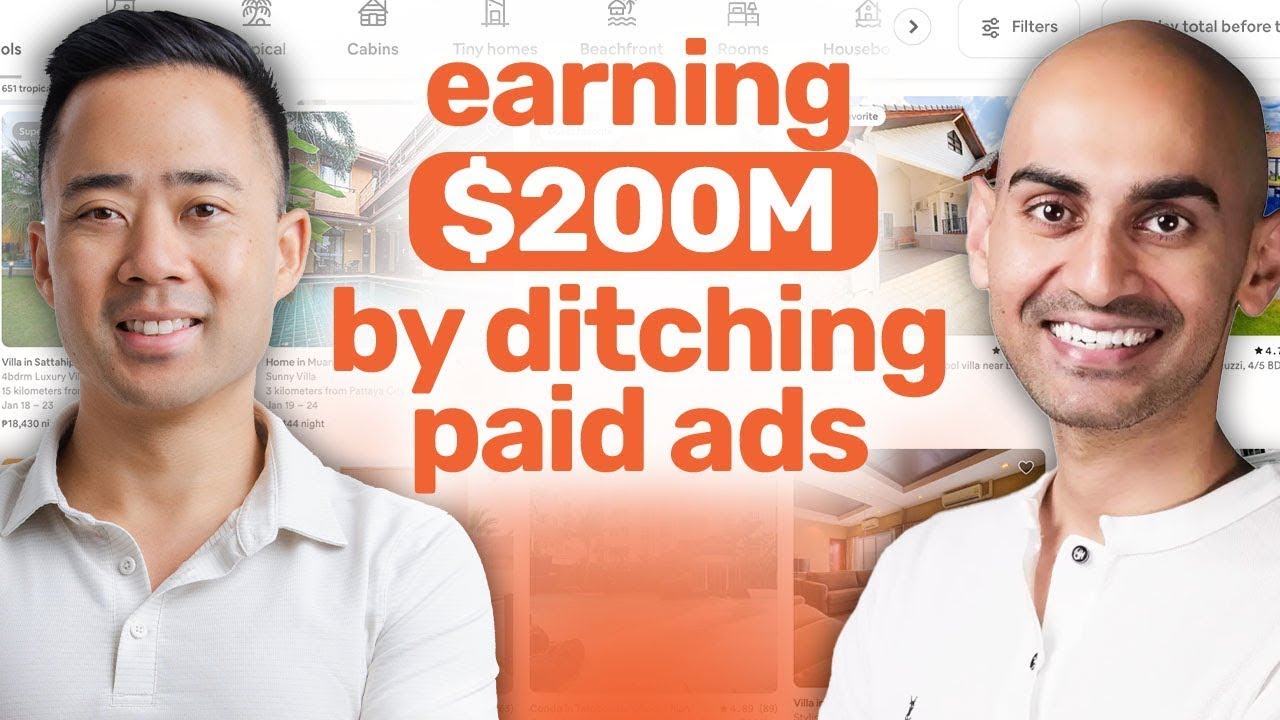
In this episode Eric Siu and Neil Patel discuss several current marketing trends. They start by highlighting Olipop’s dramatic revenue growth after abandoning paid ads in 2021 and investing heavily in TikTok creator partnerships, noting the brand’s 1.6 billion hashtag views and a jump from $31 M to $200 M in revenue by 2023. They then examine Airbnb’s strategic shift from a $1 B search‑ad budget toward brand marketing, citing CEO Brian Chesky’s comments that performance marketing should balance supply and demand rather than simply buying customers. The hosts debate whether these moves signal a broader industry trend away from search‑centric spend. Next, they present data on falling click‑through rates (CTR) across 10 M queries over three years, discussing title‑year tactics, position‑based CTR changes, and the limited impact of keyword‑rich URLs. They critique “parasite SEO,” arguing it’s essentially gray‑hat guest posting that offers short‑term gains but lacks long‑term value. The conversation shifts to creative growth hacks: offering free tools (AnswerThePublic, Ubersuggest) and using AI to produce comparison‑style, low‑competition long‑tail content that drives leads. Finally, they showcase Prime’s novel influencer‑athlete partnership model—Logan Paul, KSI, and NFL star Patrick Mahomes—explaining how the deal amplifies both the athlete’s and the brand’s reach. Throughout, they intersperse data points, quotes, and personal opinions, ending with a call for listener feedback on the podcast format.
Chapters
So for this episode, we are going to be talking about the latest marketing trends. And guess what? I'm going to start us off first. So Neil, there's this trend right now where you see companies like Airbnb and you see companies like Olipop. You know Olipop? Like the sparkling water drink? You know what I'm talking about?
Yep.
Okay. So guess their revenue from 2021. What do you think it was?
I don't know. Go with the $7 million. Okay.
$30 million. Now guess their 2023 revenue.
$300 million?
Close. I guess the way I said that made it, you know. Yeah, yeah, $200 million, $200 million, right? Yep. And so here's the thing, this is a tweet from Alex Garcia over here, and we can actually react to this one. This is almost like a reaction as well. Do you see my screen? Okay, you can see my screen. So, okay, so here's what happened. Their revenue 2021, $31 million, and then 2023, $200 million. And it says they did what no other DTC brand would do. They ditched paid ads in 2021. And instead they went all in on creator partnerships and organic content on TikTok. So they hired a creator named Sarah Crane who took over the Olipop account, blah, blah, blah. So you can see a TikTok account over here if you're watching on YouTube has 324K followers. And you can see Sarah Crane, who I believe is a full-time employee over here. You can see she's the one making the content, which I think is really smart because she's not off making her own thing. And then the other thing I want to call out here is we continue to look through the screen, then I'm going to go over to Airbnb, is you can see for Olipop, they have a hashtag called #OlipopPartner. And you can see all the partners that were doing all the shoutouts, 1.6 billion views, right? And so do I think this is the only thing that led them to go to $200 million or so? Absolutely not. But I think it's interesting because there's like this, you know, as I'm reading more and more things, it's like, hey, there's this growing trend of of people shifting their spend away from search or whatever, right? Now, here's the other thing I'm going to pull up. So Airbnb says it's focused on brand marketing instead of search and it's working, right? Says it's focused on brand instead of search. And so they were spending like a billion a year. We've talked about this on the pod before.
But they also started off early on spending a ton of money on performance and it's driven results. And they still spend a ton of money on Google Ads, by the way. I don't care what they say.
I can look it up. Point being, you have their CFO in here. He's like, yeah, we've been cutting our spend 28% quarter on quarter. They're still spending $229 per quarter, right? But the question is on what?
That's a lot cut away in marketing. That is not a small budget.
Yep. I mean, look, we have to look at their reports at the end of the day. But look, the CEOs has said this, right? Brian Chesky has said, hey, look, we got to cut away from search or whatever. And then you see like this, You know, Olipop's not really spending on search. And so I think it's interesting. I think it's something to talk about. It's like, is this going to be a growing trend? I don't think it's going to happen immediately, but I think we're starting to see people like, you know, the sentiment maybe shift a little bit right now.
So to also give you perspective, Eric, according to Statista, in 2023, Microsoft spent roughly $900 million on advertising. Now that doesn't include all marketing, but that's probably the largest chunk.
So they're like the same on ad spend, but not marketing spend, I should say.
In revenue in 2022, Microsoft did $198.3 billion.
Yep. The last thing I'll—
Airbnb revenue, when you look at their stock price, I don't know why Google's just messing with it, It's quartered, $3.41, $2.48, $1.82, $1.9. So let's call it somewhere around $10 million, $10, $11 million that they're doing a year in revenue. Big difference percentage-wise, right? Percentage, I actually agree with them cutting back on marketing spend. They actually spend a lot on marketing when you look at a percentage of revenue.
Here's, I'm just going to call out these quotes and then we're going to, we can finally talk about this. The quote here says, our brand marketing results are delivering excellent results overall with a strong rate of return. And it's been so successful that we're actually expanding to more countries. And so he says, Brian Chesky, CEO of Airbnb, says, we think of performance marketing as more of a way to laser into balanced supply and demand rather than a way to just purchase a large amount of customers. So Airbnb isn't thinking of marketing as a way to buy customers because more than 90% of traffic to its platform arise directly. unaided by search advertising, Airbnb Chief Executive Brian Chesky said on the call.
Yeah. I can see why they're adjusting marketing. They spend too much on marketing for a percentage of their revenue. Yep.
Look, is this going to be a growing trend? I don't know. Like, I think just looking at Olipop and looking at Airbnb, I think it's going to be a small growing trend. I don't think it's going to be crazy because I think search is still a very, very— it's a profitable arbitrage for most people.
Yep.
Cool. All right. What else? You got something over here too. Started off.
I'll talk about, let's talk about—
Click-through rates falling.
Okay, so as you can see here, we analyzed 10 million results over 3 years, same queries. We saw click-through rates fall by 2.83% last 3 years. And we found a few different interesting things. One, you know, and Eric used to talk about this a lot and it worked really well for a while in which if you put the year in your title, like, you know, how to rank number 1 on Google 2022, 2023 version or 2024 version, you know, it did really well. It got more clicks. We're seeing now when you add the year, it doesn't do much, but we think it's because marketers have abused and overused it. We also found that the number 1 spot on Google used to get 25.91% of the clicks. The number 1 listing now gets 27.13%. Again, this is only for 10 million queries, but that's a positive sign. Position 2 increases 16.98% from from a previous of 15.32%. We also noticed that the click-through rates, you know, if they're low on page 1, like 8 through 10, you know, was all really low. Doesn't really make a difference from previous to now. URLs with the same search term still have roughly a 39.29% higher click-through rate. This isn't exact match domain. This is if your URL contains the keyword. So it could be like neilpatel.com/ How to rank on, how-to-rank-on-Google, right? If the keyword was how to rank on Google. People prefer still positive titles over negative ones. It doesn't increase click-through rates by much, but it still helps. And people don't care if your title tag is a question or a statement, click-through rates are roughly the same. But overall we saw that it wasn't too bad, right? Like everyone's like, ah, SEO's dying, we got to be worried. Yes, SG is coming out and things will change, but overall it wasn't too bad. You know what's funny?
Let's move on to the next one over here. Let's talk about this here. This is why parasite SEO is crap, right? SEOs start making up all these phrases and then all of a sudden it's like, oh, it's this new trend. And so Neil and I were talking on the phone maybe a couple days ago or so, and we're just talking about, dude, have you heard about this? People are just, they've been talking about parasite SEO for like a year or so. And then when you start to look into it, parasite SEO is basically like guest blog posting or commenting.
Guest posting.
It's like, dude, what are you talking about? And then there's so many people making these videos. I'm just like, dude, Why don't you like just go, go, like instead of trying to create new trends, go focus on driving traffic and revenue for your business instead.
Dude, I totally agree. Like, oh, we need Google to talk about this and give a description. Who cares? Just go focus on your business. Like none of this stuff is making that much of an impact.
And here's the thing too, like we've always talked about this since the inception of this podcast that the way you want to do SEO is yes, do white hat, but look at how people do black hat but then think about how you can do that in a white hat way, right? Parasite SEO, like when you say the word parasite, by default, you're like talking about gray hat, black hat type of stuff, right? And we're not saying that stuff doesn't work, but what we found, because we've been in the SEO space for a long time and a lot of people come and go in the SEO space, it's the long-term stuff that generally works out. It's just like when you think about doing business, is it better to start like a drug cartel or is it better to start like a legit business? You're going to run through a lot of problems with the law and like other people if you have to start a drug cartel, right? It's better to start a legit business and build something for the long term and let it compound over decades. That's how we look at SEO as well.
Yep. Another thing, speaking of Google, is, you know, when you look at marketing 10 years ago, we saw that only 31.4% of companies were actively leveraging digital marketing. But if you fast forward today, the numbers increased to 96.1%. Now, this data is a little bit biased Because I was surveying people on my blog to find out, surveyed thousands and thousands and thousands of people. But keep in mind, these people are reading articles on marketing on my website. So it may not be 96.1%, it's probably going to be higher. But back in the day, I also surveyed people through my blog. That's how I had 31.4% number. So it just gives you a relatively perspective why there's roughly 3 times more competition. And what we've been seeing is a lot of people trend-wise just believe you can still spend money on marketing, paid ads, do SEO the same way, email marketing, and you're going to get the same old results. That's not the case. You know, Andrew Chen talks about the shitty law of click-throughs. I could be missing—
The law of shitty click-through rates.
The law of shitty click-through rates.
There you go. Go read that.
And in other words, the first banner ad had massive click-through rates, but now everyone's used to banner ads. They have banner blindness. Click-through rates aren't as good. It doesn't mean SEO, pay-per-click, et cetera doesn't work. It's more so that the results just aren't as good as they used to be. So what does that mean you need to do? You can still do the performance marketing channels and you should because it could be highly profitable, but you got to think outside the box. So for example, I give away AnswerThePublic and Ubersuggest for free. That's a way of thinking outside the box to get a lot of users. And yes, I have some paid plans, but the majority of the software you can use for free. And it helps us generate over 100,000 leads a month. On the flip side, Eric did something similar, but not with the concept of releasing a free tool. He used AI to create, I think, comparison-based articles and articles on other topics, long-tail terms that people type in that could be highly relevant for a lead, but may not get as much traffic. And the last screenshot I saw from his Google Search Console, I believe it was somewhere around 17,000 clicks or impressions that he's gotten from these articles by leveraging AI. He's doing something unique and different that a lot of people aren't. In other words, he's thinking outside the box. A lot of people are using AI to create content, but they're using it to create blog posts. Eric's not doing that. He's going after non-competitive long-tail, Bottom of the funnel, high buyer intent keywords, which can either A, help him generate a lot of leads or B, help him generate affiliate revenue. And that's an example of getting super creative.
One more thing, speaking of creative, and I think this is a nice way to end it. So I'm going to share my screen over here. So this is from a friend, Austin Rief. He's one of the co-founders of Morning Brew. And so here's what it says, those of you that can't see the screen. Logan Paul and KSI, who are the 2 co-founders of Prime, which is the energy drink, right? Are completely revolutionizing the concept of brand deal and it's genius. So, here's how this deal works. So, like, yes, you can get these influencers involved, right? But what happens here is the celebrity gets paid, right? And what Logan Paul and KSI will do because they both have big audiences, they will drive audience to them as well, right? And so, No other brand can offer that to an influencer. So today, Prime announced a partnership with Patrick Mahomes, who's the best quarterback in the NFL, arguably. And yeah, he's the most famous quarterback in the most popular sports league in America. Mahomes has 6 followers, 6 million followers on IG. Logan Paul has 27 million. Even the Prime account has 1.9 million. And so, by being sponsored by Prime, athletes and celebrities are getting a ton of value, all while driving new audiences, credibility, and awareness to Prime, the fastest-growing energy drink in the world. So, it's kind of like, hey, Patrick Mahomes, we're going to make you even more famous. And by you becoming more famous, it's also going to help Prime as well. And I've never seen a deal done like that before. Have you seen this?
No, but did you see their jerseys? They put Prime numbers on there, 19 and 7.
That's funny, dude. I didn't even look at that. That's funny.
Yeah, they put Prime numbers.
That's funny. But I think that's super innovative, right? And we're going to start to see more trends like this.
Yeah, I totally— I think so as well. So make sure you rate, review this podcast, give us 5 stars. We appreciate you guys listening and we'll see you tomorrow.
And also before you go too, let us know what you think about this new format because we're experimenting right now. Let us know what you'd like to see us change. Hit us both on, on, on the Xs of the world and we'll see you tomorrow.