Alex Hormozi's content shift, Is 'giving value' overrated?, & Underrated vs overrated marketers
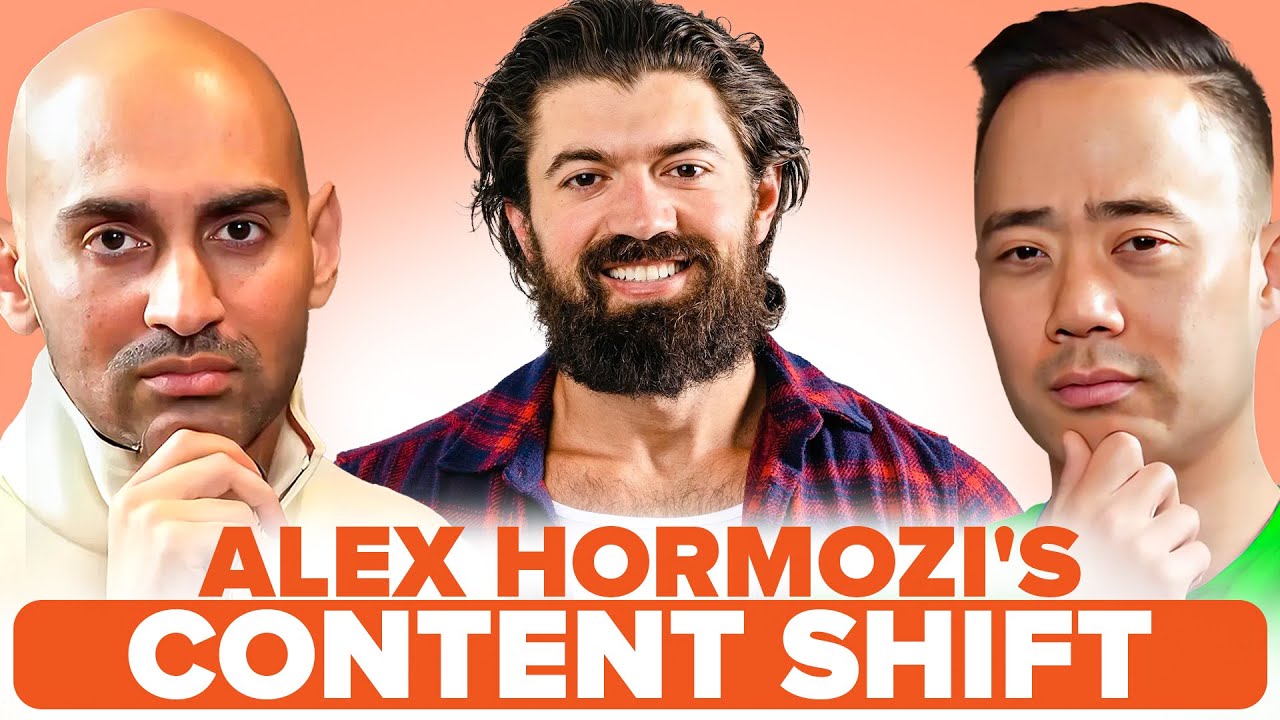
Eric Siu and Neil Patel discuss Alex Hormozi's shift from short-form to long-form B2B content, whether giving away value is overrated, and which marketers are underrated versus overrated. They cover hiring for taste versus analytical skills and agency growth challenges.
Chapters
Did you see that Alex Hormozi is adjusting his content format? Did we talk about that?
I think we talked a little about that last time and you mentioned he's going more long-form. Or he texted me he's going more long-form. It was one or the other.
I don't think we talked about it. So the fact that he texted you is interesting. So go ahead, you can lead off with it. Why did he text you about this? That's interesting.
Well, because we did a research piece and we sent out— we put a stat out on Twitter and he messaged me about it and how he sent it to his team and then they looked at data and they found that Yes, you can generate way more views from short-form videos, but the retention isn't there and the conversions to revenue and leads is not there.
That's funny. So your tweet actually got him to change his style.
I don't know if it got him to change it, but he messaged me on the tweet and he's just like, yeah, we're totally seeing it and then we're adjusting.
Yeah, so look, he made a video about this. I think we kind of briefly touched upon it, but he made a video talking about how he's no longer going to go for wide audience TAM, total addressable market type of content. Like he had one video where he was talking about This protein, you know, this like protein bomb, right? Where you have like cereal and stuff in it, right? And then he had another one about relationships and things like that. And what we talked about on this pod was that that stuff might get a lot of views, but that's not going to drive customers at the end of the day, right? Or in his case, drive applications for people that work with him for acquisition.com, right? It looks like you're pulling up the text right now.
Yeah. Yeah. He texted me April 19th, dude, you're crushing your X content. Really great stuff. Like I forward it to my team all the time and I put, not getting the views. He said, hahaha. But then I said, but it's working for B2B. The shit with the charts usually gets the least views but the best leads. And then he texted back, after seeing the post you made, I switched our strategies and serving our workshop attendees where we source deal, right? He put that in parentheses. I said, ah, cool. He says, 92% comes from deep content. It's like not even close. I rolled out our new B2B strategy. This week it starts. I said, nice. And then, we started talking about a Honda Odyssey and how he would drive a Dodge Caravan.
He has a very manly car. It's like a truck. It's like giant truck. I don't know if you've seen it. He drives it really fast. One time, I was on the way to the podcast last year and he like— I was in an Uber. It's maybe going like 40, 50 miles. He's like probably sped like 80, 90 miles, just ran right by us. And then, I just thought about the thing. But anyway, I digress. He's changing up his content model, right? He's going more narrow and he's focusing the content more, right? You know, our good friend Pep from CXL, ConversionXL, he's changing it up too. Talking about how he is no longer doing interviews, right? And that's something that's been sitting on my mind for a while. Like sure, I enjoy doing these interviews, I enjoy learning from people, but I'm probably going to cut down my interviews to maybe 20% to 30%. I'm not going to eliminate my interviews with people. But, you know, when I think about like Andrew Huberman, for example, he's always doing research, he's always experimenting. I'm doing a lot of that and why wouldn't I be sharing these like 20 to 30-minute long-form videos where it's just me doing it? In fact, Brad from recordeditpodcast.com, he's going to be helping me adjust my home setup. But that's a side note. So, point of saying all this is that when you— if you start to feel that your content is maybe not aligning with who you are exactly and it's not exactly helping what you're trying to do long-term, then it's fine to completely And I think a lot of people are warming up to this now.
I think so too. And then who'd you end up talking about? There was someone that talked about a trend in podcasting where interviews aren't working as well. Was it the My First Million or was it the— there was someone who did Art of Charm or something like that. Someone was talking about how that's— How to interview podcasts? Yeah, like it's the old way, like that content's worse.
Well, okay, so I remember. Okay, so I think Tim Ferriss said this on a My First Million podcast interview and he was just saying how it's very much a red ocean now. Because when you think, When you remember when I first started doing it, it was like 11 years ago.
Yeah.
This is like right before Tim Ferriss even started his, right? And that time it was innovative. But now you have a lot of podcasters, they're all getting the same guests, they're all asking the same questions. And in that case, it's not even interesting. And here's the other thing. I don't know if I told you, I think I told you this on the phone. But when I had someone reach out for like a partnership on something, he was like, we got on a call and then he's like, yeah, oh shit, you're actually a lot more legit than I thought you were. I'm like, what are you talking about? And he's like, oh yeah, like, well, your YouTube, you just interview people. And like, I don't know anything about you. And I was like, something's got to change here.
So I see interview podcasts work the best if you leverage it to get customers. So for example, in different countries, some of our leaders interview CMOs on a podcast. So if you interview a podcast, if you do a podcast, you interview CMOs like at really big corporations that your ideal customers, you build good relationships and you actually get business from them.
You know what? I, you know, that's what I used to do with Growth Everywhere. It was all CMOs and or it was like VCs. Right? And it worked really well for that. I just got bored of doing them, right? And so now, like, I just, I want to satisfy my own curiosity. So I'm just gonna focus on people I actually want talking to. Like someone, like a VC reached out to me this morning. He's like, oh, one of my portfolio companies, they're doing $15 million and they're growing really quickly. Like, you know, 60% year on year. I'm like, that's fantastic. Not interested.
So what did they want you for?
They want to say, oh, can we get them on the Leveling Up podcast? But it's just like, if I don't want to talk to them, then I don't want to talk to them. Like, it is what it— like, imagine how sucky that conversation is gonna be.
Dude, I'm still waiting for you to post the— was it Gary Vee?
Gary Vee? That's coming out in 12 days.
Oh, okay. So you record quite a bit in advance.
Yeah, yeah. And Bryan Johnson is gonna be happening, uh, later this month. Yeah, so I'll be asking about how we can not die.
Is Bryan Johnson the guy who—
Braintree.
Yeah, he gets blood from his kid, he then sends blood to his dad.
He sent blood to his dad first, then he got blood from his kid.
Got it.
Yeah. And then he says, he says he doesn't know if it worked or not, but it seems like his dad's doing well. So if you like my blood someday, I'm happy to transfuse you.
I don't know if it works that well. We have to have the same blood types.
Yellow and brown.
No, no, it has to be the same blood types.
Maybe because ultimate.
Huh? There's different blood types though.
What blood type are you?
I have no idea.
See?
Do you know what blood type you are?
A.
Oh, okay.
Yeah, I don't— it's a big deal in Japan, your blood type. All right everyone, quick message from the Agency Owners Association. So this is the peer group for agency owners that Neil and I both put together. This is for people that are doing 6 figures, 7 figures, 8 figures, even 9 figures as well. And we're all here to help you grow your agency faster. In this group, we share leads, we share learnings with each other. It's a community where people can ask questions, their most burning questions personally, professionally. We'll share templates, reports, things like that. We're constantly adding more value to the group. I will tell you that the price is continuing to increase. The good news is that there's no long-term commitment, so you can just learn more by going to marketingschool.io/agency. Once again, that's marketingschool.io/agency to learn more. And we hope to see you inside. The other thing too that I want to tie in with this is, um, remember Nick Shackelford?
Uh, the agency?
Yeah, he has the mushroom, uh, CBD like drink. I could be butchering that. It's called Brez. B-R-E-Z. But anyway, um, nice guy.
You know, he tried giving me the drink when we met up in person, or some CBD product. It was something like that.
You want to try some?
No, I, I, I told him I won't end up drinking it, so I gave it back. But it was nice of him.
Here's what he said, and this is something we can, we can debate on. He, he tweeted this and he's like, it's actually— here, I'm pulling it up right now. He said that giving value is overrated, right? And what he means by that is— and I'm pulling it up right now. This is from Nick Shackelford. So I stopped trying to, trying to, quote unquote, give value on here, here being X or Twitter, and speak interests and thought processes and what's top of mind. It's driven more friends, opportunities, and business than my Threads and Loom recordings on media buying or business talks. We get it. You're in marketing. You do something on this list: UGC, CRO, paid email, SMS, influencer. Every piece of content is hope someone clicks on your link in bio and books a call. I respect the hustle and understanding— understand the reasoning, but what drives the connections and partnerships isn't what you think it is anymore.
What's funny is, speaking of giving value, I used to do a lot of my presentations as 10 ways to boost your SEO rankings or X ways to do this in digital marketing to get more traffic. And I'd be like, step 1, this, step 2, this, and I would give it all step by step. And even in my steps, like let's say if I talk about Google Search Console and finding new keyword opportunities and updating your content and doing redirects and stuff, I would show step by step in the screenshots of like, click this, then click this, then do this, here's how you analyze the data. And that kind of content, no kidding, got very little to no customers for us ever.
You overgave.
And then when I started giving quote unquote strategy trend data, and I gave value, but a different kind of value, more so strategy and just concepts, but didn't teach them actually how to do the things, more so just educated them on it. And in my eyes, that's way less value. I generated way more leads and customers from that.
So I would argue, I think it's more value to the human mind because here's the, here's the thing, right? If you teach them how to think about something a little differently, it's the theory. Strategy is theory at the end of the day, right? If you teach them how to think— are you still sick? Oh my God. Still sick.
2 weeks in. 2 weeks.
So my point is, if you're giving someone a strategy and it's like, oh, I didn't think about it that way, they remember you for that. Like, it's— people come to this podcast like, oh, I didn't think about it that way. They're looking for those little nuggets, those little dopamine hits, right? If you give them a step-by-step, they start to get bored and like, are they really good? Guys, I'm tiring Neil right now. He's yawning right now. I'm sorry, but has nothing to do with you.
Has everything to do with sick. Yes, and calls in with India continually for so many days. I know I've been waking up around 3 a.m. every day.
That's what he's probably been sleeping at probably like 7 or 8 p.m.
Yesterday slept at almost midnight. That's all with India before I slept.
Calls with India, guys. That's how you get sicker.
That's how you get sicker.
But anyway, I think that that's the point, right? I think it's people. Well, what Nick is really getting at, kind of what you're getting at too is when you're sharing more of your— like a strategy, how you're thinking about things, it's more stream of consciousness on Nick's side. You're doing a little more prep, like you're sharing a lot of data and things like that, but you are teaching people how to think differently and that's why people will remember you for what you are. Yeah.
By the way, do you still have to get up early or no?
I get up around 5:30, 6:30. Yeah.
Oh, that's not bad.
You get up at 4:00, right?
Usually I get up at 4. Dude, that's the one problem of having a company where you're global. You work the randomest hours and it doesn't get better. It actually gets worse.
Yeah. And then every fire you have to get involved, like the big ones, the big fires, and the big fires are now global.
I usually don't hear about the fires until they're already put out.
Yeah, but okay, when I say the big fires, it's the big fires within your purview, right? I'm talking more strategic stuff. I'm talking more like M&A stuff, stuff like that. Yeah, not the people stuff. Not the people. Yeah.
Totally spot on. The people stuff I don't have to deal with. I deal with the M&A stuff. Like, we have a deal closing this month, so I gotta wire money for the deal, uh, and then we have another one closing in July. But I got to deal with the bank, get their approval on it, make sure they're cool with it, do the diligence. But yeah, and then you always have bullcrap that comes up or something silly, or, you know, people adjusting their numbers last minute and be like, yeah, we want more money.
Oh, this is for a deal that you're trying to buy though?
Yeah. And the deals we have right now, they're pretty good, but it is— it's an operational nightmare. And dude, you know this better than anyone else. You acquired 2 deals in 2022?
2021.
2021. And you did 2 in the same year. So much work.
2 months apart.
2 months apart.
Yeah.
Tons of integration work.
Yep.
Tons of meetings, cultures that you got to deal with. It's just a pain. And you did 2 in the same region, both in the United States. Were they both in Florida?
No, one was in San Francisco. The other one was like Illinois.
All right.
Quick note. This is about my company. It's called Single Grain, and Single Grain is an ad agency where we're focused on driving innovation. I want to talk about a couple of new strategies. And if you need help with marketing, great. If not, here are a couple of new strategies that you should try out. One is programmatic CRO. So we are doing programmatic conversion rate optimization on our site. So it's building products that will automatically optimize your site to increase conversion rates. We're also auto-optimizing, auto-updating from an SEO standpoint. And we're constantly thinking about what else we can do in terms of enriching the visitors that are hitting your website and also tailoring custom messages for them using AI. And so there's a handful of things that we're doing from a marketing standpoint, and our mission is just to drive more innovation. So if you want to learn more, just go to singlegrain.com, grain like rice. So singlegrain.com to learn more and we'll see you inside. Neil, do you know the difference between underrated and overrated marketers?
Underrated marketers are really good but not overhyped.
So this is what Brian Halligan from HubSpot said. So he was the CEO of HubSpot, one of the co-founders. And he said, overrated, marketers with good analytical skills. Underrated, marketers with good taste.
Okay.
It's a good place to start. What do you think about that?
I don't think good analytical skills is overrated because I see most marketers having terrible analytical skills. But I don't think having good analytical skills is enough. I think that's just a necessity in marketing. More so, I don't know if taste, in my opinion, is underrated. What I feel is underrated is creativity and thinking outside the box. See, everyone has budget constraints, everyone has marketing constraints. How can you achieve the goals that a business needs or wants within their constraints?
So my interpretation of this one is What you're saying with creativity, what you're saying with— you said thinking outside the box, right? In my opinion, taste here is that. It's creativity and thinking outside the box. And so, I do think that's heavily underrated. I do believe there's a dearth of people with good analytical skills. But if I had to pick one or the other, I'd probably pick the person that has more taste. It's really hard to find people with taste. And taste is one of those things that will always be in need, at least for the next decade or so. Who knows what's going to happen afterwards, but you're going to need people with taste that can come up with new ideas for all these models that are coming out because they need to train off of data.
I see taste as when someone says that they know what's good marketing and what's bad marketing and they have a taste. They can say, oh, that's good. This should work. That's bad. And I don't think it's hard to spot what's good or bad. I think it's hard to come up with what's good.
So, I think we're saying the same thing but in different ways. The vernacular might be a little different but at the end of the day, you need people that are creative. You need people that can think outside the box. In my opinion, that's taste. And so, the question is how do we go about finding people that have taste, right? It's hard to screen for that.
It's really hard for us to screen for that but the easiest way to find see if someone has that is to go back and look at their past work.
Yep. So you can ask for their portfolio, right? If they're like a designer, they're a dev, if they built— like, what have you built exactly? Can you show us a portfolio? The other thing is, so we've talked about this before, it's looking at their portfolio, but it's also asking them about, hey, asking them to brainstorm with you, giving them like a creative problem to solve, right? One of the problems that you have in mind and just seeing how they think about it, how they articulate themselves. One thing we like to do when we're interviewing people, Is we get them to write a written assessment on a couple of different problems so we can see how they write too, because they're going to be typing a lot. We want to see how they format. And believe it or not, some people are terrible with grammar. They're terrible with punctuation. They're terrible with articulating their thoughts. And that is exactly how it's going to be working with that person. So you actually avoid a lot of pain by doing things like that.
Yeah.
Yeah.
All right.
So that is it for today. Please don't forget to rate, review, subscribe. Go to marketingschool.io/agency if you want to grow your agency faster. And, uh, yeah, make sure you go there.
Next time you do a call, let me know. I'll join the call.
Oh, there you go. Join it. Um, once we get to around 50-ish paying members or so, we're gonna do the call with Neil. And, uh, yeah, it's gonna be a good time.
We're pretty close to that already, right?
We're at like 39, right?
Yeah. So join. Would love to do it. And I can break down all the stuff that we're doing to grow. And we're growing fast. To give you an idea, we'll go from start of this year, 750 employees. My guess We'll end the year with 1,200.
Yep. And we're gonna keep— guys, we're continuing to jack up the price too. So it was $149 a month, now it's $199 a month, and it's gonna keep going up depending on the value that we add to it. So join now and catch you later.
Bye.









