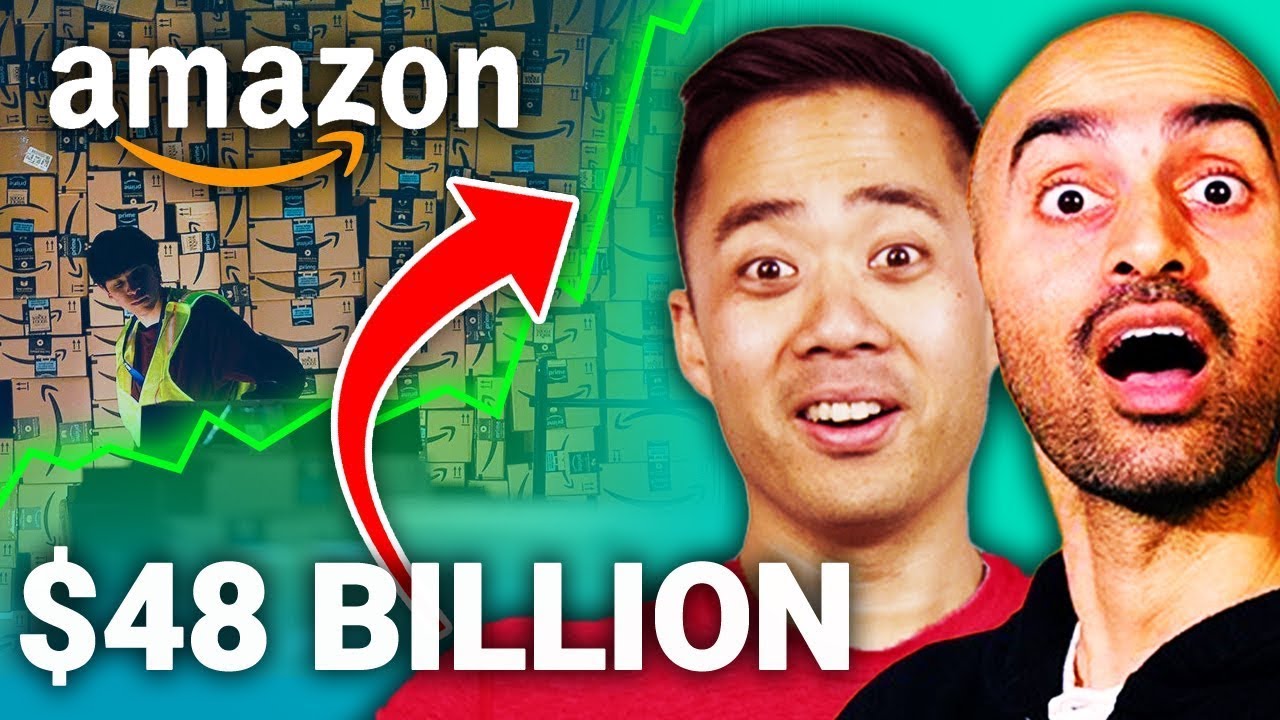
Eric Siu and Neil Patel break down Amazon's advertising business, which grew 25% quarter over quarter and now runs at roughly $48 billion annually. They explore how Amazon uses ads across its platform, the impact on seller margins, and why the company functions as much as an ad network as a retailer.
Chapters
All right, so we're going to talk about Amazon's fastest new growing business segment. So Neil, you can start off first because you watch CNBC.
Amazon's fastest new growing ad segment is advertising revenue.
You said Amazon's ads segment is the newest segment.
Amazon's fastest growing revenue sector is advertising.
Yep, well, let's talk about this. So here, let me share the numbers real quick on screen so you all can see this. Now this is broken out, right? So online stores, the growth rate is 6%, okay? And then third-party sellers, 18%, and then advertising services, 25%. I believe this is quarter-on-quarter change, Neil, if I'm reading this correct.
So according to CNBC, which is where I originally learned about this, advertising, $12.1 billion versus the Street expected $11.6 billion. That's for the quarter. So assuming if they're doing roughly $12 billion, this isn't during holiday season, just times it by 4, they're on track to generate roughly $48 billion a year in ad revenue.
Which is crazy. So we want to talk about like what's the so what behind this, right? I mean, it's crazy because we've done an episode in the past about how everything eventually becomes an ad platform if you have distribution. And it's just a nice, like Netflix does it now. DoorDash does this. Uber does it now.
Uber, you're in the app, they show ads for like, did you know you can eat at X, Y, and Z? Like, dude, everyone's pushing everything.
Yep. So look, this guy Sean Frank, he runs like a $100 million like Yeti competitor. It's called Ridge.com and super smart guy. But he says, look, Amazon isn't a retailer. Amazon isn't AWS. Amazon is an ad platform. It's a 3PL and an affiliate platform taking commission of every sale. These are the fastest growing segments, these are the biggest profit drivers, and it doesn't look like it's going to change. So—
I disagree with him. I say Amazon's a holding company. They do a little of everything.
I mean, that's fair. I mean, you can say that and then it can still be this.
Yeah, that's what I'm saying. Because AWS isn't really a, you know, it's AWS. I don't look at it as an ad platform or affiliate, but I agree, they're an ad platform, they're a 3PL, they're affiliate platform. They are AWS, they're a grocery store. They literally are a holding company that does everything.
Yeah. The thing with AWS though, I mean, we don't need to go too deep into this, but it is, I see how he calls it a commodity business because the costs are just continuing to come down a lot. And then this cost of data, I mean, it's been something that's been decelerating or deflating in the last like 37 years or something like that. But he ends it with this. Future of Amazon is more ads, more fees. Future for sellers is less margin. So the question is, what are you going to do about it?
So, okay, so check this out. This is where people get things wrong on Amazon and advertising. Most people look at Amazon advertising as you promote your product when someone does a search on Amazon. That does generate a ton of revenue. I've met up with Amazon over this. They've showcased their product. We've seen it. We've played around with it. Dude, did you know like when they're making their own movies, All right, let's say they have a movie with Will Smith. I'm making this up. And let's say this movie, Will Smith's sitting at a desk and there's a water bottle, right? No joke, you can pay them and they can switch out the water bottle for X amount of impressions to have Fiji on there, Aquafana, or whatever it may be. Or in a movie, if there's this massive billboard, it can be GEICO for 1 million impressions, it can be Allstate for another 2 million impressions, and then it can be Nike for 500,000 impressions.
They'll be able to swap out the cars too in the future.
Yes, they can literally swap out so many things and you won't notice it as a consumer, but it's ridiculous on what they can do with ads within the movies that they're creating. Now they can't do this, like let's say if they put Top Gun 2 on Amazon, they can't do that because they didn't end up creating Top Gun 2. But for the movies they're creating and the shows they're creating, they have this flexibility and they're generating a lot of revenue from this. It's not a big portion of their ad revenue yet, But I believe in the future it will be as Amazon Web Services becomes more and more popular. I mean, not web service, Amazon Prime becomes more and more popular, the TV version. And here's a kicker about Amazon Prime, the TV version that most people don't think about compared to like Netflix or Max or Disney. In Amazon, you can purchase, you know, HBO in there, Showtime, Paramount, et cetera. So then you can get—
Oh, wow.
Content from all these different providers within your Amazon Prime account, which just makes it more usable.
Look, I think this is fascinating. This just shows where the world is going. And there's a lot of AI stuff that goes with, like a lot of this stuff is deflationary, right? Like data costs are coming down. AI is going to make things a lot pretty deflationary as well. And so I think get ready, get ready for the future. And I think this is something that's really, really exciting. Any, any other takeaways from this?
Nope.
All right, that is it for today. Please don't forget to rate, rate, rate, subscribe, and we'll see you tomorrow.