Amazon's $8M risk, If you use AI content don't forget about DRIVE, ROI of 150M shorts views, & more
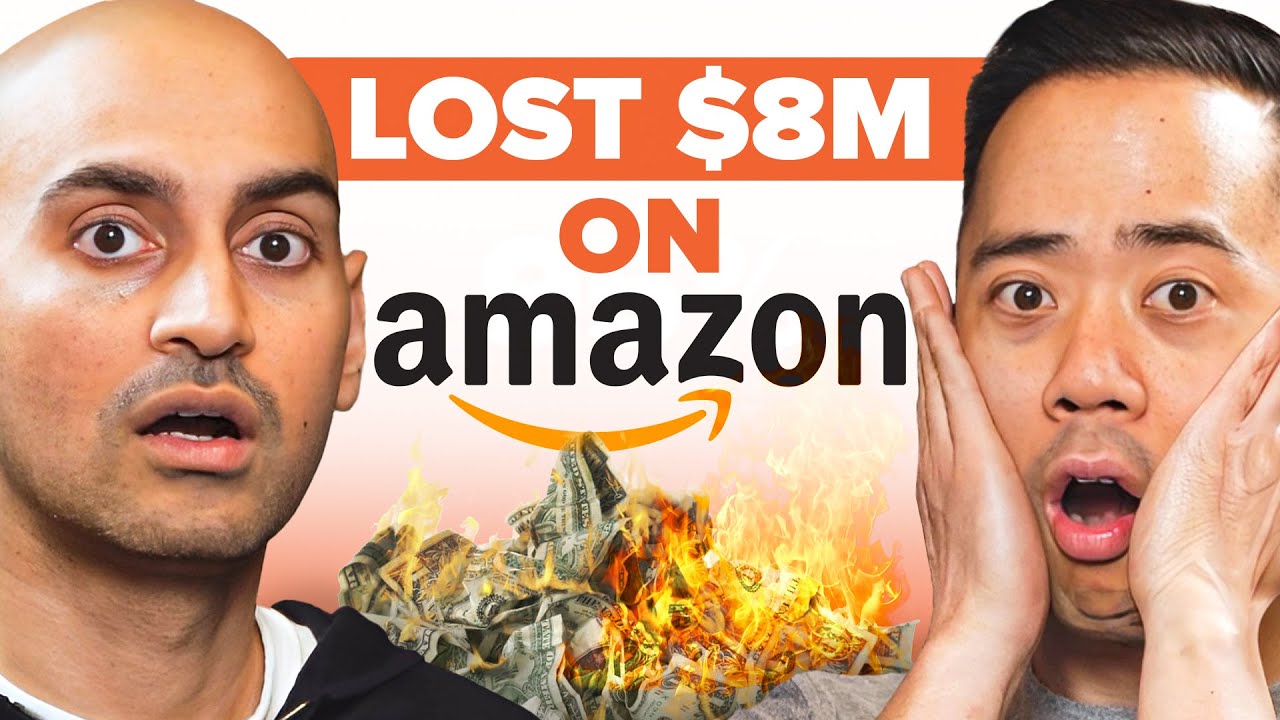
Eric Siu and Neil Patel discuss platform risk, AI content strategy, and short-form video ROI. They cover an Amazon seller who lost $8M overnight, the DRIVE framework for AI-written content, and how 150M shorts views converted to measurable business results.
Chapters
All right. So did you know, here, let's start with this one. So you're basically this one company, they were doing $8 million on Amazon and the whole thing went up in flames. And so I'm going to share my screen with you real quick. This is shared by my friend Matt Paulson, who by the way, will be at the Leveling Up Founders event. That's the mastermind I do for founders once a year, levelingup.com/founders, if you want to learn more about it, but he's got a $30 to $40 million newsletter business. And his tweet here says this: This is what I've been saying for more than a decade. Don't build a business that relies on one big company, big tech company's whims. So basically, this company went from eight million dollars per year to zero. It took this whole, this man's whole business away. Poof! Amazon is for sure the final boss of e-com. So it's a text message here, and it says in this text message, we did eight million dollars on Amazon last year. We are closing our business because of the new fees and because of Amazon's. Uh, 1P. So 3P, I know what's, what's first, is that first-party fulfillment? 1P?
I have no idea. I don't sell on Amazon. I know we help companies optimize their listings, but I've never myself really—
I think it has something to do with fulfillment. Um, so we have had exclusivity, exclusivity on 100 products of blanked-out corporation to sell on Amazon. Blanked-out corporation just terminated our contract because Amazon 1P told them they would pay them More for the products we sell and we'll sell them for less because they do not have to worry about the 3P fees. Right. So, I'm watching. Yeah. I'm watching my inventory run out and then we'll get hit with low inventory fees because I cannot replenish my inventory from blank company because Amazon negotiated us out of the picture. We have sold $40 million in the last 6 years. I've spent over $2 million in advertising on Amazon. I would love for someone at Amazon to acknowledge or care. that they put us out of business. Scott.
Wow. It's a dog-eat-dog world. It's business. It's sad, but it's true.
Yeah. I like, as I was reading this, I'm like, I feel bad for the guy, but I'm also, it's like props to Amazon for negotiating because like that's within their interest. I think the mistake that the business owner made in this situation was betting all their eggs, putting all their eggs in one basket. You know, once you max a channel out, it's in your best interest to diversify into other areas. So if one leg gets cut out, you can still sit on other 2. But if you only have one leg, then the whole thing crumbles, right? And so I think this is a lesson. This is just another lesson that there's always platform risk. And just like for example, even though Neil and I have an SEO background, Google's great, but we've diversified like this. We have our YouTube channel. Like by the way, I showed YouTube the stats or Neil the stats the other day, 167,000 views in the last 30 days. Pretty good. Still growing, right? How do we build, how do we diversify away from just Google? Because that's the world we're going into anyway. By the way, Neil and I have an agency owners group called the Agency Owners Association. All you have to do, just go to marketingschool.io/agency. Once again, it's marketingschool.io/agency to learn more. And now back to the show.
Funny enough, I had one topic that I wanted to talk about. You and I have seen this. So I did something on Twitter, it was just an experiment and it did really well and it ended up, you know, the hook, I won't read the whole thing, is if you're going to use AI to write content, you can't forget about DRIVE and I capitalized DRIVE, D-R-I-V-E, and I'll actually share my screen and then I'll get to the point and what people can end up learning from this. So if you can see here on the screen, I capitalized DRIVE. I pretty much say that DRIVE stands for data, review, insights, visuals, energy, Spelling out drive in essence. And I break down what each of those things are. That posted quite well, as you can see here in the analytics. It had 359 hearts or likes, whatever you want to call them, and 482 bookmarks, 36 comments, and 60 reposts. But what's entertaining is, you know, I ended up creating this not because I wanted to share drive, I already knew the concepts on what you really need in AI-written content for it to do well. But it was funny because, you know, I was watching some videos online because I look at what's popular and what's trending for other people. And I see that people are using different things like, you know, skyscraper technique or they have different acronyms for stuff and people are making up, you know, their own terminology like growth hacking. When you start doing some of those things, some of those terms take off, some of them don't. It's okay whether they take off or not. But one commonality that I saw is if you start coining terms or acronyms, that social content typically does better than your other posts, whether or not it catches on on fire and everyone uses it going forward. But it's a really good way to create hits because a lot of people focus on hits by like, oh, here are 10 hook formulas. Formulas that work. Well, instead of just copying formulas, try to create your own acronyms or try to create your own words or phrases that people could be using within industry. In other words, you're coining terminology. And we found that to do extremely well for social media content.
And by the way, like when you coin these terms, it's almost like posting reels too. You just don't know what's going to hit. Some of them will hit and some people remember, like, The skyscraper technique, it's still stuck to this day. I think it's got to be over 10 years now, right? Even Google coming up with double E-A-T, like people still like, people repeating that over and over. And so with this acronym like DRIVE, it might stick, it might not stick, right? But the fact of the matter is it's at least it's easy for you to remember. And if people catch onto it, then at the end of the day you can say, oh, I coined that term. Yes.
It's so funny because it's like if you end up doing it, one, it helps you with like speaking fees and things like that. Like if you look at Sean Ellis in growth hacking, Oh yeah.
Yeah, he cleaned up on that one. I want to take a second to tell you about my podcast co-host's agency. So NP Digital, so Neil Patel Digital. What they do is they do a whole host of marketing services and they are global. They're worldwide. They have SMB services as well. They have mid-market to enterprise services as well. They cover the entire gamut. So you can just go to npdigital.com to learn more about it. And now back to the episode. By the way, I got a report back on, remember I was talking about this one company that's paying like $45,000, $50,000 a month or so, and they're getting like 150 million views from this using different agencies. So basically I checked in, let me give you, I'm going to give you, here's the clippable moment. So here's the ROI of getting 150 million short-form views per month. So I checked back in with the company that's paying agencies to do so. And maybe 2, 3 months ago when I checked in with the CMO, I said, okay, you're paying this amount and it's a good amount of money and you're getting 5,000 pieces a month and they got you 60, 70 million views. Now it's like 100 million plus, right? And I said, okay. I said, what's the ROI of it? At the time she's like, I'm not sure. We just started. Check back with me a couple months later. It has now been a couple months later. And I said, okay, just checking in again. What's the ROI been? She's like, honestly, We can't measure it. We have no sense of what the ROI is, and this is almost impossible to track unless you have a unique funnel that drives this traffic into that funnel. But we think it's moving us in the right direction. And funny enough, as we're doing this podcast today, I actually got a text message from Alex Lieberman, who's one of the co-founders of Morning Brew. And then my other friend, Steve Gutina from pray.com, texted me too. He's like, dude, my friends are sending me, forwarding me your Your Instagram Reels, like you're blowing up right now or whatever, right? And so, you know, there's kind of like, it kind of reinforces that like there's no direct ROI to this stuff. Like we did well in the last 28 days, 10 million views or so, and it's going to continue to go up, but it's like, it's hard to measure.
Wait, you got 10 million views in the last 28 days?
Uh-huh.
Which channel or all combined?
All combined. So 2.8 million on Instagram and then 4.1 on YouTube. And then another 4 million or so on TikTok.
Is it still the rich BFF?
It's diversified now.
Oh, good for you.
Yeah. So it's like there is an ROI, but it's hard to track. This is very much a dark social thing. And if you want to put the time and resources into it, great. I think we can keep compounding ours. I think you could certainly compound yours too because At the end of the day, what I've learned from all this is forget about the overproduced videos. I'm just like, just tell decent stories and you'll get good views.
Yes, it really is good stories. The other thing that helps quite a bit too that I've seen is if you can just go out there and you can create content that is somewhat new. And what I mean somewhat new is I'm not talking about just leveraging news and trends like that. I'm talking about If you end up talking about stuff that others aren't talking about, you'll do well. If it's regurgitated information, I don't care what subject it is, it just doesn't do as well.
That's actually an important point, Neil. So for this podcast, the way we do it now is we used to try to get a month ahead. Now we're usually like 2 weeks ahead, which is riskier for us because Neil and I travel quite a bit. Well, you still travel a lot. I've reduced mine. That's besides the point. So what we do now is if a video or a topic we're talking about is trending, I'm going to highlight that topic in red. And so when my editing team jumps on it, they're going to move that topic up. That topic moves ahead of everything else. And so we're jumping on that topic because if we're talking about something that's trending today and the episode doesn't come out for 2 to 3 weeks, by that time it's already gone down. We're not going to get as many views. And so it's really important to trend jack when you can.
For sure. The trend tracking is huge. If you look at the All-In podcast, what makes them do well is they're just covering current events.
Yeah, and it's once a week, so it's actually risky for them too. It's like, I mean, by the way, the fact that it's 4 people and they all travel a lot, they're all busy, means that no matter what we do, we should be able to do once per week too. But I think we're a little risk-averse to it, so.
Yeah, but also on their end, what they also do is if someone can't make it, they bring in another guest.
That does happen. Which we can do too, which we do do sometimes too. I wanted to bring up this other topic over here. This is from our, or this is from my friend. Maybe, I think you met Ayman too. So Ayman Brand, he was the CEO of AppSumo for a while. And this is interesting because I've talked to a couple of my founder friends. It's like, oh dude, they're like, you know what works really well? Gift cards. So when you send gift card requests to people on LinkedIn, it's like, hey, I'll give you a $125 Amazon gift card or $100, a gift card for 30 minutes of your time. And so Ayman says this. So he's like, I'm about to use Shepherd, Support Shepherd, which is like a VA or it's like a, you can hire VAs there. So we're about to use Shepherd to hire a doppelganger to sit in on all of these pitches. I'll pay $4 an hour to get $100 back. Quick alpha. And so my point of this is saying, hey, we might be at peak gift card right now because everyone's starting to utilize this tactic. And when all marketers start to utilize the same tactic, That's when it starts to just not work anymore.
What's their— so, worshipers, dog pain, what is this? I'm a little bit confused on this gift card strategy.
So here's how it works. So imagine, Neil, let's say I want to sell you marketing services, right?
Okay.
So I'll say, hey Neil, I'll send you like a LinkedIn message saying, hey Neil, I'll give you $125 Amazon gift card Do you have like 30 minutes to talk about your marketing? You get what I mean? I'm basically just using that into like factoring into my meeting, how much I'm willing to pay to book a meeting.
Got it. And so instead of running ads, they're just pretty much giving away free gift cards.
Correct.
And they're finding the conversion and all that to be still as effective.
Yeah.
I'm assuming they're targeting very specific people, account-based marketing. They're only giving the gift cards to people they know that would be their ideal customer.
That's correct. And by the way, imagine if you did this and like you did this with your email list, for example, and you identified who's on your email list, they're probably even more likely to convert.
Yeah. That's pretty cool. Yeah.
But what I'm saying is if Eamon's showing 2 in a row over there, that means more and more marketers are doing it. So if you're going to try doing this, start doing it right now, because in a year or so, 2 years or so, like when When everyone's doing it, that's when your conversion rates tank.
Have you seen the Frank Kern method where he just gives you 10 grand cash? Here's 10 grand.
No.
For a call.
Explain, explain.
Like literally, guy shows up at your door, hey, quick phone call, 10 grand. He explains how— For what?
What's the offer?
Any offer that you're pitching. He's like, if you want to get really well networked with the right people, he's like, just have someone show up with $1,000, $5,000, $10,000, and he's like, here's the cash right now, quick call. People are like, what the heck?
Oh, someone— so someone's going to ring your doorbell and I'll give you cash?
Yes.
Oh, okay. That's even crazier because there's like human effort that's going into it and it's cold hard cash.
And you're hoping that someone doesn't run away with your cash being that person who's delivering it.
Yeah. What's the incentive there? Like, I just steal the 10 grand.
But I thought it was really cool because he's like, you want to get, you know, you want to do whale hunting and get calls with the right people? They have people show up at their door with the cash. I was like, no, I'd never thought about that. That is a pretty slick idea.
Yeah. Hey, let me know when you do it. You can do it first.
I'm okay. But what's, you know, I was on the phone with, I was on a podcast interview with, what's that agency? They're a D2C agency out of Canada. Dude, I don't know why I can't remember the agency. Either way, they're a decent size and scale. One thing that they've been doing to get customers instead of giving away stuff for free is they just do a podcast, which my teams talk to me about a lot.
They're like, Neil, you should do a podcast just interviewing CMOs.
And some of my team actually does this in different countries. We'll interview like the head marketing person at Procter Gamble in Brazil or wherever it may be. And it ends up generating quite a bit of revenue for them because now you have your ideal customer on a phone call with you.
By the way, the Growth Everywhere podcast now called Leveling Up, that's what I used to do. It worked well. I used to mostly just focus on SaaS people or marketers. I think 20 Minute VC or 20 VC by Harry Stebbings, that worked out really well. I think he started that podcast when he was 19 years old and he wasn't even a VC yet, right? And he just interviewed a lot of VCs and then now he interviews a lot of founders and it's gotten bigger and bigger and that's let the deal flow for him and it's worked out well. But yeah, I like the formats.
And he has a fund because of that podcast. He didn't have a fund beforehand, right? It would kick after.
Yeah. And so everything worked out, like getting the funding, like what, how are you going to get funding? Well, people have to know who you are, right? That's how he got the funding. How do you get deal flow? Well, people have to know who you are. And so it worked out for him. It's a good business model. So that is it for today. Please don't forget to rate, review, subscribe. And if you want to join the Agency Owners Association, It's kind of like YPO or EO, but for agencies. That's the group that Neil and I put together. You can go to marketingschool.io/agency to learn more. There's an online community and there's a live community as well. And we look forward to seeing you inside. So goodbye. Bye.









