Apple pays OpenAI…nothing?, and How to get 2.5B views from shorts/reels/TikToks
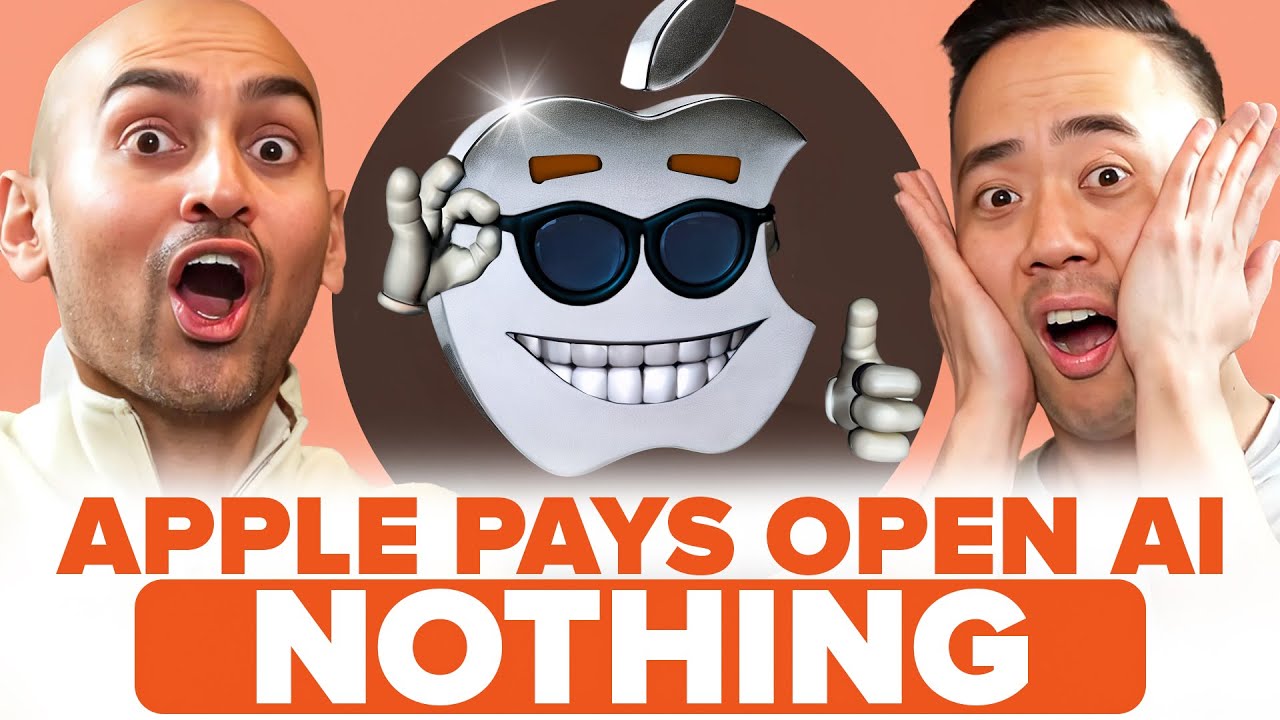
Eric Siu and Neil Patel discuss Apple's OpenAI deal and why the company paid nothing, plus how one creator hit 2.5 billion views using outsourced pods for short-form videos. They cover monetization challenges, entrepreneurship lessons, and a robots.txt SEO tip.
Chapters
So Apple is paying OpenAI nothing to add it into their phone. So here's what's being said. This is from Morning Brew. So they say Apple is treating OpenAI like they're an unpaid intern. So Apple believes pushing OpenAI's brand and technology to hundreds of millions of its devices is of equal or greater value than monetary payments, these people said, which shows that distribution kind of matters.
Wow, that's a great deal for both of them. I think, I really do think that's a win-win deal.
Yeah.
And you know what? At the end of the day, if their distribution ends up making OpenAI a lot of money, I bet you the deal's going to switch to a Google-type deal where if you look at Apple, you use Safari, their default search engine is Google. Apple did not pay Google for that deal. Apple actually gets billions of dollars from Google for that deal. And I think something similar is going to end up happening where if they can drive OpenAI a lot of users and it causes OpenAI to make a lot of money from that, Apple is going to want their cut.
Either that or from what I've heard, Apple's obviously building their own LLM. I think that the whole thing is, hey, in 2 to 3 years or so, we're probably going to kick you off our stuff. So that might happen as well. But, you know, everyone's operating within their own incentives.
They also built their own Maps. Google Maps in ways is still better than the Apple Maps.
Yeah, we'll see what happens. We'll see what happens. By the way, I met a guy, I met a guy for lunch this week. This is Tuesday or maybe Wednesday, but he got 2.5 billion views from Shorts, Reels, TikTok. So here's how you can get 2.5 billion views from Shorts and Reels. So basically he has a pod of people. So you have one person that's a project manager that will basically look at a clip, find the right moments, and then prepare it for a video editor. And then you have a video editor, right? And then you have a third person that handles the posting. And so this pod of people, they'll focus on a set number of accounts for like Instagram Reels or Facebook, Snap. And then so they'll handle that, those accounts, right? And then basically he pays these people $500 a month. These people are in the Philippines. And so each pod, you're basically paying $1,500 a month. And I was like, okay, that's great. How many views do you get per month? It's about 200 million. I was like, okay, what are your costs per month? He's like about $35 grand. So if you think about the cost, he has 23 pods that he's doing this for and they're pumping out a bunch of content and that's how he's— and basically a lot of these companies, they're not a company, but there's a company that does this as an agency. But what they do is they basically just have the talent appear in a lot of different podcasts and there's so many things to clip from and that's how they drive so many views. And I was like, okay, so what did that do for your business? Well, that drove— their business does about $8, $9 million a year or so. And basically at the end of each short-form video, there's a little call to action saying, hey, click on the link in bio to learn more about the community or whatever. And that's how they've grown it.
So did the views get them to $8, $9 million or they were already at $8 million?
That's all they did. No, no, no. It was all the short-form that grew this community.
That's cool. That's great results. Weren't you trying out something similar like this or were you going to hire them or?
Yeah. So the cool thing is we already have that set up right now, but I don't see a reason to scale it hardcore right now because other stuff is working so well. Like webinars is working, partner webinars, events and things like that are working so well. So the thing is like we could do, we could try to do, you could do anything. You just can't do everything, especially when it comes to marketing because there's so many things you can do. I think probably in 6 to 12 months or so, I think we'll just give it a shot and invest that. and see what happens. But we have a mutual friend that's doing it right now and the results aren't bad.
What kind of business do they have?
They have a SaaS company.
All right.
Yeah.
A B2B SaaS or consumer base?
B2B SaaS company.
That's great if it's working for B2B SaaS. That means it should easily work for consumer.
I think it's working from a view standpoint, not an ROI standpoint yet.
We'll see.
But remember I talked about how they did it for, that other agency did it for Marie Forleo and they're still getting like 60 to 80 million views a month.
So yeah, I just have a hard time monetizing some of this kind of stuff. Like, it's cool and all, but at the end of the day, you know, I'm very— you know me, I'm very ROI-centric. And if I can't create ROI, I usually—
Which is fine. And by the way, we talked about this yesterday in the community. There's Neil, like, there's like Neil and I, we're 2 different people. You're a different person than you, the listener right now. There's no right or wrong way to do things. I think younger versions of us were like, no, you should do it this way. But no, it's like now it's like, no, you shouldn't do anything. And just because we say you should sometimes doesn't mean you should listen to us, right? I think it's when we say you should, it's really us telling ourselves that we should.
So yeah, the way Eric and I look at things, and it took us a long time to learn this, is there's multiple ways to skin a cat. You don't have to— the way Eric does it doesn't have to be the way I do it, and the way I do it doesn't have to be the way Eric does it. Now, this doesn't mean that either Eric or I are right or wrong. There's multiple ways to do stuff. And you can do a different approach than Eric and I, and you may even do better than us, right? It's like what we ended up learning when we were just, as we got older, is not just the fact that, hey, we don't know everything. I think when we were younger, we of course wanted to continue to learn, but when we did something and it produced results, we're like, oh, you have to do this. This is what works. Well, yeah, it works, but it may not work for all companies. It may not fit all brands or teams or the way companies are structured. And there may be other better ways to do it. We just haven't found them yet.
Yep. And by the way, when we give advice, it just really comes from our experiences. And Neil has different life experiences. I have different life experiences. So we all think differently, right? And there's no— that's why we're saying there's no right or wrong. I think there's a couple more things. There's this really good tweet over here. So Jason Lemkin tweeted us, so SaaStr, right? So he says, talk to a founder with a 9-figure exit. But was hard. So then they raised the fund because it seemed easier, but that fund made some tough investments and now is starting a media company because that seemed easier. We'll see. And then I responded, I was like, everything is hard. And so the reason I'm even bringing this up right now is because in our Agency Owners Association group, there are people that want to go do a SaaS product over here. They want to go do this over here. Want to go to— like the grass is always greener on the other side. And the quote I like to use is the grass is greener where you water it. And we're just, even though we're telling you right now, you probably won't listen to us depending on where you're at in your career. If you're earlier in career, you probably won't listen to us. But what Neil and I are basically saying is like, everything's hard, but it becomes a lot easier when you just lock in on ideally one key thing. I got to take a minute to tell you about the Agency Owners Association. This is a peer group for agency owners. Think YPO or EO, but for agency owners. And I just wanted to read you a couple of testimonials. So this first one comes from Carrie, and we asked her, what do you like most about the group? She said, Having a group of people to discuss and bounce ideas. The leads are great too. Yes, we share leads in this group as well. This one from Ollie, he says, the ability to really post whatever I want and need and the group responds. Great experienced members. Getting a lot of insights from conversations with other members. Getting a lot of value from sessions from Eric. Getting advice from others as well. And so if you want to grow your agency faster and you want a peer group to do so, just go to marketingschool.io/agency. This is a group that both Neil and I created. And our hope here is to create a vibrant community of agency owners and do a lot more with it in the future. So again, marketingschool.io/agency, and we'll see you inside.
One of the early guys that I learned a lot from as an entrepreneur is this guy named Andy Liu. He sold his first company to Quantive, which eventually got bought out by Microsoft. His second company sold to Vizio, the TV company. And then he's just like, man, Neil, you know, all these gray hairs, all this stress, stress. Entrepreneurship is really tough. And he did well as an entrepreneur, right? He had exits. He was great at raising money as well. And he also was an angel investor. I don't know how many angel deals he's done, but I think it's somewhere around 100, maybe a little bit more now, maybe a little bit less. And then he's had amazing returns as an angel. And he's like, you know what? I'm just going to go and create a venture fund. So he partnered up with 2 other people, created a venture fund called, I think, unlocked venture partners. And he's like, yeah, it'll be more chill. Dude, he's grinding it out all over again. I was like, I thought it was going to be chill. And he's just like, dude, it's a lot of work.
Yeah.
And the gray hairs have definitely not gone away. He's doing a good job. He's picking really good companies and some of them have done exceptionally well. But it's funny, you're spot on. The grass is always greener. If you want to do something and you want it to be big and you want to be successful at it and it's in a big competitive market, it's not going to be easy. And if it's easy for a little bit, it's probably because of either A, luck, or it's not saturated yet. And eventually some of the luck will run out and the markets will get saturated and you're going to have to go back to grinding it out.
Mm-hmm.
And the reason a lot of people have done well and they have these exits or they make all this money, sure, some of it is luck, But a lot of it is them making their own luck by being persistent at it, doing it for so many years, never giving up, learning from their failures, putting in so many hours when they don't want to, selling personal assets so they can put it into the money or moving in with their parents when they're married and they have kids and sacrificing a lot. It's never really as easy as people think.
That's why there's a certain level of respect with entrepreneurs to entrepreneurs, the ones that have made it, because we know how hard it is to make it. The thing I'll say is if you actually listen to what Neil just said right now, I guarantee those of you that are maybe starting out earlier in your career, you should have an outcome that's no less than $10 million. And maybe I'm talking out of my butt. Hopefully you come back to me in the next couple of years and we can prove this out, right? But I truly believe if you focus for, you know, 10, 20, 30 years or so, that should be the minimum. And hopefully it's a lot bigger than that, right? I want to take a second to tell you about my podcast co-host's agency. So NP Digital, so Neil Patel Digital. What they do is they do a whole host of marketing services and they are global. They're worldwide. They have SMB services as well. They have mid-market to enterprise services as well. They cover the entire gamut. So you could just go to npdigital.com to learn more about it. Now back to the episode. There's another thing I wanted to bring up and this can be the last thing over here that will be helpful. So this is, I'm going to go back to SEO real quick. So the analyst at Google, Gary, and I'll carry this because Neil's falling asleep. So Rusty Brick tweeted this. So basically Gary, how do you pronounce the last name? Illyes?
Something like that. I don't know. Yeah.
So he's kind of like the new Matt Cutts basically, right? So Matt Cutts used to be the head of Google Search Spam. I don't think they ever replaced Matt Cutts. They're just kind of like, it's kind of like an ambiguous thing now, but—
I think it's Danny. Danny's Google search liaison.
Oh, is he? Well, I don't know, but you should really stop letting Googlebot crawl your action URLs. So for example, buy, add to cart, subscribe, et cetera. So here's what the LinkedIn post that Gary says. You should really disallow crawling of your action URLs. Crawlers will not buy that organic non-GMO scented candle, nor do they care for a wishlist, right? So a common complaint we get about crawling is that we, that we were, or that we're crawling too much, which uses too much of the server's resources, though doesn't cause problems otherwise. Looking at what we're crawling from the sites and the complaints, way too often it's action URLs such as add to cart and add to wishlist. These are useless for crawlers and you likely don't want them to be crawled. So if you have URLs like, you know, ?addtocart or ?addtowishlist, you should probably add a disallow rule for them in your robots.txt file. Converting them to HTTP POST method also works, though many crawlers can and will make POST requests. So keep that in mind. I just think at the end of the day, this will be the final thing, that there is like a certain crawl budget that's dedicated to your site. So if you make it hard, then you're going to get less pages crawled, which means less traffic for you at the end of the day. This stuff still matters in 2024. So that is the final thing.
Make sure you go to marketingschool.io/ Agency?
That's right, that's right. See, see, even with Neil's jet lag, he remembers it. All right, that's it for everyone. Please don't forget to rate, review, subscribe as well, and we'll catch you later.









