Bonus episode #2: A sneak peek of what our AOA hangouts look like
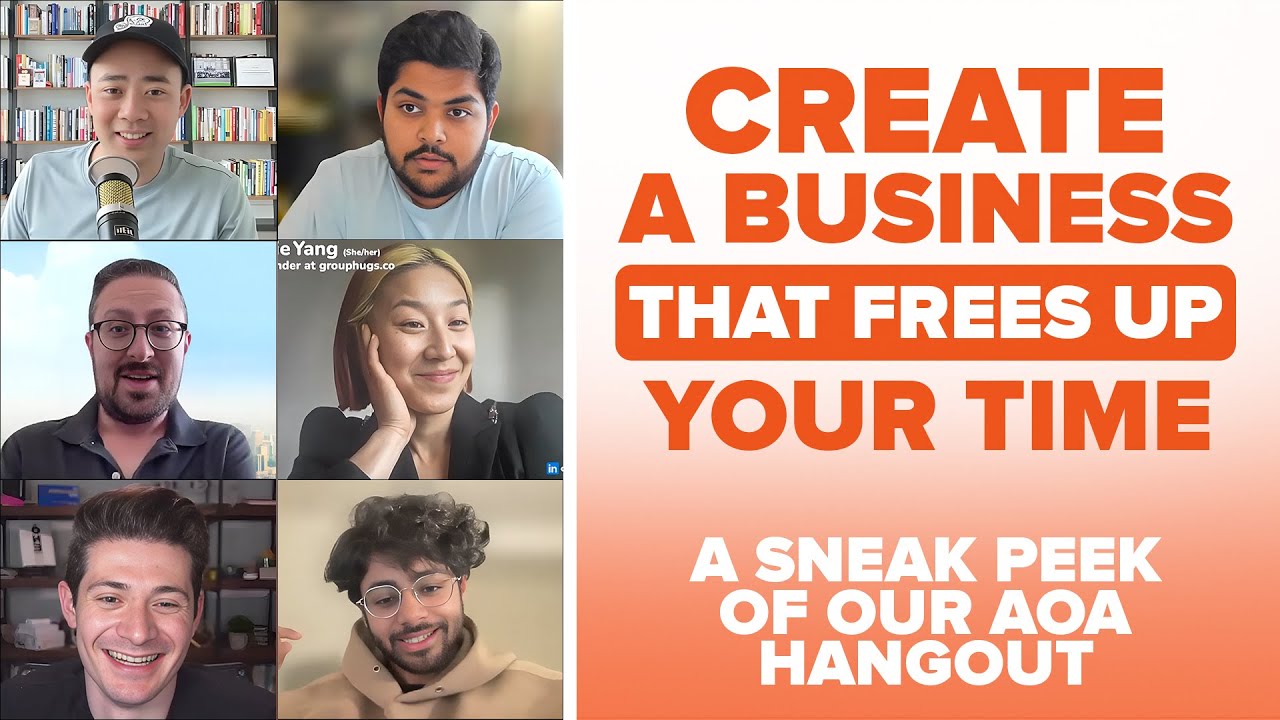
This content was created by Eric Siu. This content was uploaded by Eric Siu. This is a YouTube bonus episode titled "Bonus episode #2: A sneak peek of what our AOA hangouts look like" (posted May 11, 2024). It is a ~10–15 minute preview of an Agency Owners Association (AOA) coaching hangout led by Eric Siu (with Neil mentioned) featuring agency founders and members (e.g., Abhinav, Carrie, Brian, and others). The discussion covers running the AOA group, the importance of founders writing memos to clarify strategy and push initiatives, advice on building a remote high-performance culture, content/branding advice, and practical scaling tactics (cold outreach, no-risk offers). The hosts also promote related resources/events (marketingschool.io/agency and levelingup.com/founders).
Chapters
All right, so we have a little treat for you. So this is a coaching call from the Agency Owners Association. This is a group that Neil and I have for agency owners to help you grow faster. So if you're in the agency space, you are a services business, this is applicable to you. It's a little preview of a call. It's probably 10, 15 minutes or so, and you'll get a sense for what it looks like to be in the group. If you want to learn more about the group, you can go to marketingschool.io/agency. Again, it's marketingschool.io/agency. Hope you enjoy the episode.
One thing I wanted to kick off with this week, and then you guys can start to go through your questions, is— and sorry, I'm traveling right now, but one thing sticks out to me is the lack of founders that are unwilling to write. And I did a podcast interview with the CEO of Eight Sleep. So it's a company I invested in. And his rule is that if you want to do a one-on-one with him, You basically have to write a memo, right? And I mentioned the book in my message yesterday or the other day. The book called Working Backwards from Amazon is a fantastic book, and it talks about how Amazon grew really off the back of writing these memos, right? Because the problem with a lot of these organizations is a lot of people come with half-baked ideas. They're not well thought through, and it ends up wasting a bunch of time, right, at the end of the day. And especially the executives, they end up wasting a lot of time too. The memos, building a culture of writing forces people to think. It stops people in their tracks, and you end up getting more clarity of thought, and you end up taking better actions from it at the end of the day. And so, Matteo, that's his name, he does that. Amazon does that. And then another company I invested in called Levels, they do the same thing too. In fact, if you look for, if you go to YouTube, You type in, uh, you'll be finding all their videos, how they run their company. And I think it'll give you all a lot of ideas too, because a lot of you are— I think everyone here is working remote first. And if you want to build a high-performance culture, you're going to have to be willing to write these memos, right? Like even today on my flight, I'm going to be writing a couple memos. And these are memos where I'm thinking about strategic issues, right? So issues with recruiting, issues with issues with maybe how maybe we're not moving quickly enough, issues with sales, with marketing, just anything that's bugging you, because you as the founder, you're going to be able to push things a lot faster than other people. And I think I've said this a couple times, my biggest mistake is expecting that I could hire a GM or a CEO and expect them to push the pace as quickly as I will. And that's just not the reality, right? Because another example is I hung out with my buddy Syed, and he has a holding company of WordPress businesses. And we're kind of just lamenting over the weekend that we used to think that we could just hire these people and leave them alone. But the reality is that's not the case, right? The best thoughts are going to come from you, and the best thoughts often come from writing. So we'll start it off with that. That's my little spiel for the week. And that being said, anybody feel free to chime in with questions that you might have, and we'll rip through these.
More a clarifying question. I've never been to one of these Hangouts. Is the format more just Problems, advice, things we're going through, and people chime in on what they recommend solution, or is there a particular format you guys follow for this?
Yeah, it's more of a Q&A, and, and I'm happy for anybody else to chime in when someone has a question, but it's typically been me answering so far. Um, it's more scalable for me when I, when I do these calls like this, and then we end up sharing the recording with the group afterwards. Does that make sense, Abhinav? Um, and Abhinav, I don't think you've— you and Carrie, can you introduce yourself real quick, who you are, what you do, and one thing you need, and then pass to Carrie?
Yeah, sure. Hey guys, my name is Abhinav, based in Austin, Texas. Been here for over a decade, run a software services agency. I've been trying to position myself as more of a zero-to-one for early-stage startups and mid-stage startups to take an idea to market and figure out what that path looks like for you. And so trying to— been building around that, started a podcast 6 months ago to talk about the journey of building as well. And the biggest problem right now is more Finding the right offering for my customers because I'm working in a space where they're not the most cash-heavy businesses or startups. I'm trying to find the right offering and the right customer segment within the zero-to-one space, and I can go deeper into that, but that's a spiel.
All right, over to you, Carrie.
Hi, I'm Carrie. I'm based here in New York City. I've had my agency Group Hugs for the last 5 years. It's a YouTube marketing-focused agency, long-form only, organic. And we work with brands, businesses, and we started working with a couple of creators, which are totally different ballgame. And like we do end-to-end. So from strategy to scripting to production, editing, remote production, editing, and then uploads and optimization, A/B testing. And what I am focusing on is I guess just scaling this business in general, because there's a lot of different steps in doing all the different parts of YouTube and really finding the right clients that are ready to dedicate the time and effort to growing on YouTube, because as you know, it is a lot.
Yeah. And Carrie, are you Korean or Chinese?
I'm Chinese.
Okay, that's what I thought. Yeah, but never know. But Carrie, if you can send me, maybe like send me a message in school or something. with your one-sheeter, because we're getting more and more asks for YouTube stuff. And so my whole thing is, just so you know too as well, Abhinav, we get an overflow of leads and we try to send them out to the group. And I think the rule with Ezra is basically you have to participate, right, in order to qualify each week. So that's what it is. So anyway, who else has got some questions we could answer here? And by the way, anybody feel free to chime in. Doesn't have to be just me answering.
Does it have to be about writing?
But also, I do have a question. No, it can be anything.
Okay. I mean, I do have a question about writing.
Yeah, do it.
Like, do you write like on your laptop? Like, you don't— you're not like talking about like physically writing?
Literally, what is— Yeah, I do. So a lot of it's Apple Notes. I'm writing on my phone, or I'm writing on my iPad or my, um, my laptop. But I will say that whenever I get a chance Write on a physical notebook, I feel like it sounds maybe rah-rah, but I feel more connected to it. And I feel like I've actually— like a lot of people have said this, right? Like when you write in a physical notebook, you're more connected to it. It seems like it actually sits in your mind more than like, you know, when you're writing on a device.
Yeah, that's what they say.
I think there's a science behind that because when you're using your muscles, there's a different part of the brain that's kind of doing the thing. So I mean, That's, that's the reason that it, it kind of sits more. Yeah, you kind of get the connection with that writing.
I think that's a good point. I think my question for you all would be, maybe if you could drop into chat, just type in like, what's your number one problem right now? And maybe that's one thing you all should write a memo about, right? And I'm happy to share a template, like a memo template that I've done recently, just so you guys get a sense for how this looks. And then you guys can experiment with it because I think you guys, most of you are going to find that it's very clarifying.
All right, real quick, I need to tell you about the group that Neil and I created called the Agency Owners Association. And this is a group that's similar to entrepreneurial organizations such as YPO or EO. By the way, Neil and I are both in YPO, but we thought it'd be really cool if we're able to create a group that's dedicated to agency owners to helping them scale. So you can be at 6 figures, 7 figures, 8 figures, we have different groups for different levels. All you have to do is go to marketingschool.io/agency. Again, that's marketingschool.io/agency. And you can go there to apply. And I will tell you right now what we're doing is there's an online community. We do calls every now and then. There's stuff that we share in there that we don't share publicly. And you can, at least with the online community, you can cancel at any time. So you can go there to learn more about it. And that being said, back to the video.
Can I ask you something about, uh, that's connected, that's, uh, that's connected to writing. And, uh, actually, uh, this past week I listened to some of the podcasts like Sam Parr, uh, maybe I think it's even you as well. some other guys as well, which were saying the same thing that you have to get good at. I think, yeah, Greg shared this as well, that you have to get good at copywriting, which means writing. You have to get good at getting the writing. So I'm trying to write, but for me, I'm trying to write to see what I'm thinking, to organize my thoughts and all that. And recently, I am trying to figure out what's my unfair advantage, where I really think that I can lead or where I can differentiate myself apart from other agency owners especially. So I think I'm still struggling to find the focus and all that. So how do you use writing to really dig into those areas as well, to really understand what's my unfair advantage or to use that for your own strategic vision for your own company.
Yeah, so you're talking about writing in 2 contexts. So one is you're talking about writing in terms of building an audience. The other writing is just writing for your organization to really get things done. Um, what the phrase I put in there is like, writing is like casting a spell on your organization, right? Because you're basically writing a document and then things actually happen from it. And it's pretty amazing because all of you as founders have this invisible hammer where you can push things through, right? And you're probably not aware that you have that much power. Your word goes a long way, right? And so I think that that's one piece, Ali. And I think you have to think through what are the core problems right now, maybe 1, 2, and 3, and then start to write about, hey, like, this is the problem right now. This is the potential solution. Here are the resources required, and here's what we're trying to accomplish with this. And then by when as well. And then, you know, you can read it, you can read it in a meeting with the right stakeholders. And then you can push a product through after you, or like a solution through after you debate it and discuss it with the team, right? So that's one piece. The second piece is, Elian, when you talk about creating content for the public, I guess my question for you would be, what are you actually world class at?
Yeah, so because I'm still trying to kind of figuring out what's the thing that I'm really good at. I think I just write. I started to write where my thoughts go and when the audience kind of resonates with that one thing. I think it's more about the blend of— I'm starting to kind of figuring out that when— because I'm from Japan, when I start— when I do the blend of like Japanese technology with the global marketing, I think that's the part that where I think I'm kind of, uh, kind of ahead from, uh, than other people. So yeah, that's, that's the thing that I'm— but yeah, I don't know how to, how to put that, those in, into words.
My advice to you would be, how about you? Can you guys hear me okay? Yes? No? Okay, sorry. Um, so, Aryan, why don't you try for the next 30 days committing to writing 30 minutes a day and see what happens after that?
Yeah, I've been doing that for past 5 days and yeah, I'll, I'll, I'll, I'll continue.
So just stay consistent for 25 days. Sometimes you might miss, like I did the, I did the accountability buddy thing, right? Like I mentioned you guys last time, and I think some of you have accountability buddies here, right? That I think without the accountability buddy, I wouldn't have been consistent, but even then I still missed a couple of times. So just keep in mind, it's okay to miss a couple.
All right, so I wanted to take a second to tell you about Leveling Up Founders. This is an event/mastermind for people doing 7, 8, 9 figures. These are founders that are doing that amount, and we've been doing this event for a couple years now. We've had amazing speakers, but more than anything, it's about the people. What I mean by that is like-minded people want to hang out with like-minded people, and this is the best spot to connect with people of a certain caliber, and we vet every single person that comes through. So if people are— even though they make a lot of money, but their character, we don't really align with that, we're not necessarily going to let them in. We did this event in Beverly Hills, and it's happening in the beginning of August. All you have to do to learn more about it is just go to levelingup.com/founders. Again, it's levelingup.com/founders if you want to hang out with amazing people. Neil, my podcast co-host, is going to be there. I'm going to be there. People like Syed Balkhi, he will be there as well. And again, it's It's going to be a great time. levelingup.com/founders to learn more.
Let's continue to see you inside. To move along here. Who else has got some stuff? Otherwise, I'm going to read through some questions. Okay, Brian's got a question here. What's the number one thing you focus on to scale quickly? So I think Brian, maybe you could give us some more context around where you are right now and where you're trying to go. Because then, uh, this question depends.
Yeah, I mean, it's just scratching 6 figures, the agency. It's relatively new, so I'm just trying to figure out what I can do to scale. I think one pain point is that it's easier to get some of these lower-cost clients, and a lot of the clients I'm dealing with are small businesses that don't have a big budget. I'm trying to branch off a little bit more into some larger ones that can afford a little bit more that are a little bit less price sensitive. So I was thinking about, you know, what that could look like over the next 6 to 12 months.
Yeah. You know, Brian, um, I'll say one thing that's been working for us and then we, we've never really done cold outbound. We're just trying it now, um, as an experiment. Did I, did I mention this test to you already or not really?
I'm not sure.
Okay. So you tell me if I've said this already, but basically we use this thing called, I think it's smartlead.ai, not saleslead.ai. So smartlead.ai, that's a tool that will allow you to use a bunch of different inboxes to send maybe 500 or 1,000 emails a day. Okay? And the key thing with the email is we've tried floating it because we create a lot of content. We've tried floating content to people. That doesn't really generate responses. But now we've changed our first email to a really good offer. So the first offer is, hey, we'll design, using AI, we'll design 10 landing pages for you, and we guarantee that it'll be at least a 10% lift over your current landing pages. You'll pay us $2,000 for these 10 pages, and if we don't perform, we'll give you your money back, and we'll even send you a legally binding document, right? So that email gets about a 3 to 4% response rate right now, and we're still tweaking it. But it comes down to, Brian, the offer that you have at the end of the day, right? How can you give people a no-brainer offer and really de-risk it for people? And it's working for us.
I'm not sure if you mentioned it, but it does make sense. I have someone doing cold outreach for me, so I can maybe ask him to, you know, try giving them an offer.
Yeah. Well, that's the Brian. So you have to be, if you have someone you've outsourced it to like a contractor, right?
Yeah.
Yeah. So you gotta be all over them, right? You can't, that's one of those things where it's like, it's nice to, it's, you know, to hope that someone can do it for you. Um, but like you, you basically have to micromanage them because it's a, it's a high-risk thing. Like the offer, you're gonna have to keep tweaking it. You're gonna keep tweaking the copy, keep tweaking the headline. So that's what I would say.
Yeah, no, I'm on top of it. It's a young guy and he's, he's doing like mass emails and texts and he's getting me appointments and I've gotten some clients out of it. So it is working. But we have like weekly touchpoints and all that. So I'll, I'll talk to him. But that's a good idea, I think.
Yep. Okay, cool.









