Buying followers, Video editing affecting views, 3rd-party cookie deprecation & more
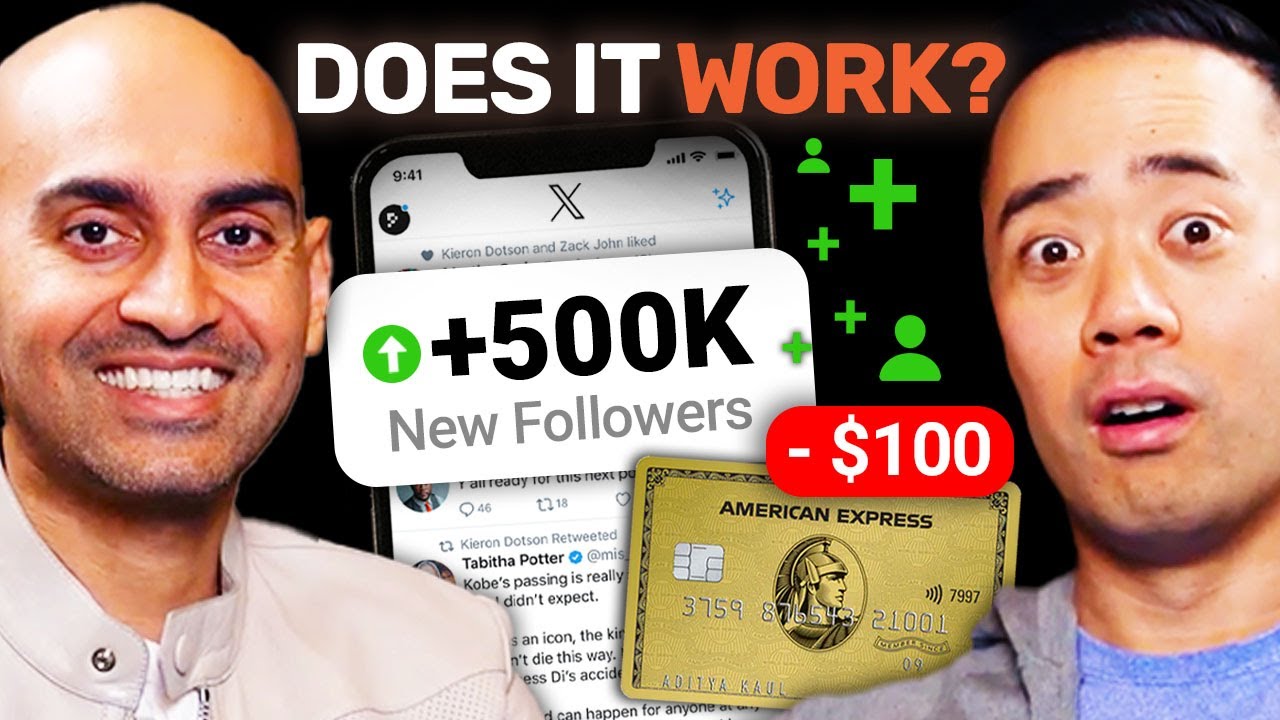
Eric Siu and Neil Patel discuss buying followers, which tanks engagement and reach, and share data from 102,394 Instagram Reels showing captions and hooks matter far more than video editing. They also cover third-party cookie deprecation and device listening for ads.
Chapters
All right, so more people are buying followers, and we want to talk about if it actually works or not in this year and beyond.
So Eric and I know a lot of people in the marketing space. We don't want to call out names, but we know people who are on Twitter who have like 20,000+ followers, and then when they put tweets, and they're decent tweets, they're not bad.
I would actually say they're good. I think they suck.
Overall compared to the average tweets out there, I don't think they're that bad. And we were going through and looking at how many hearts they're getting or likes, whatever you want to end up calling it, per tweet. A lot of them are at 0, some of them are at 1. And it's just like, this is just terrible.
Yeah. So, okay. I mean, I mean, but it's terrible because it does relate because this person, when you look at their Twitter and then you also look at their Instagram too, it's very clear as day that they bought followers.
Yes. And they're still buying the likes and the views. But yeah.
So in addition to followers, they're buying likes. And are they buying— you think they're buying comments too?
I think so. Yeah, I think they're going for the whole, the whole shebang.
Yeah.
But here's the funny thing, like you can just tell, it's like you had tons of likes. And if you look at your view ratios for how many likes you got, it's really off compared to any other channel that's in your space that has similar topics. And what most people don't realize is, we're not saying you shouldn't buy, actually we are saying you shouldn't buy, but we're not judging you if you buy followers or likes or views or any of that. What I think most people forget is the way these platforms work is they look at your total follower count, they look at how many people have seen your content, and then they start showing that if a higher ratio of your followers is engaging with your content, they start showing it to more people who follow you as well as other people who don't follow you depending on the social network. So if you just have a ton of people who don't want to follow you, but you bought these followers to skew your numbers, now it's going to be people don't care to see your content, but they're being shown your content. They're not engaging. So it's just going to crush your reach because it's going to show algorithms like Instagram and Twitter that, hey, these followers don't care for this content.
Yep. It's your engagement rate that matters at the end of the day. And it's very easy for an algorithm to just call it out, right? And so the problem is most people go, Most people that are buying followers are going for a vanity metric. And it's just to like, it's the, it's not trying to be real. It's like you're trying to look good instead of just trying to do the right thing and trying to be useful. Like that's actually what gets the views at the end of the day. And here's the other thing. We were talking about how like I've, I know some people and like I saw that all of a sudden it's like, whoa, their following really grew quickly on like, you know, call it Twitter or Instagram, for example. Right. I'm like, hey, like, so what do you guys do to grow? And it's like, oh, yeah, you know, just posting really good content. That's what got me there, man. And I'm just like, God, you're so full of shit. So I'm just like—
Dude, we were going through 2 of those people yesterday and they're just like, posting good content. Your content's not that amazing. No, it didn't naturally get a million views for you giving business advice that something wasn't dead simple and it wasn't rocket science. Something's off and people are doing it for vanity and it's the wrong thing. It doesn't do any justice. You may think it makes you look cool, but in the long run it's going to hurt you. You're taking a shortcut that's going to really crush your reach in the long run.
Yeah. I'm just trying to think, like when I look at my profiles, right? It's like none of them, I've never bought followers on any of my profiles and nor have you, right?
I have on Facebook. I did tons of Facebook advertising.
Facebook likes you buy.
Yeah. And I, no joke, I don't know how much I spent on Facebook, but I think I paid through Facebook ads $200,000, $300,000 to get more fans on my fan page.
But I would argue that's different because that's buying it on Facebook. I'm just saying like a lot of Twitter people, they're buying it from like a third party, you know?
Yeah. And when they're buying from a third party, they're buying those packages online that says, We'll give you 100,000 followers for $5,000 or $10,000.
And then we'll also give you the engagement package on top of that, right? Because you need to have likes with it too.
So yeah, anyway, that's what we think. Yeah, and speaking of social media, I did an interesting experiment that I wanted to debunk because dude, I don't know about you, I get so many DMs and emails of people saying, hey, we can do better video editing for you. Do you get those messages?
All the time. Actually, Brad, this is how we met.
Oh, he sent that video? I didn't know that.
Brad's our editor, by the way. by the way, for those that can't see.
So I get so many of them on a weekly basis. I was telling my team, I can't be the only one that gets this. So we wanted to do something that was really interesting. We looked at 102,394 reels on Instagram. Technically, the original number was larger than that, but we couldn't determine every video. So then we started disqualifying some, but we looked at 102,394 reels on Instagram to figure out if video Quality and editing really affects social media views. Now, when I'm talking about video editing, I'm talking about how people are creating those reels and putting animation in, not just sound, but like, you know, crumbling paper or whatever it may be.
Can I guess before you go, before you do it?
Yeah.
Doesn't matter.
What do you think people say?
I just think it just doesn't matter.
Okay, there's 2 aspects. What do you think the data says? And what do you think most people think?
Okay, I'm just referring to the data. I don't know. data says it doesn't matter. I think people think it matters.
All right, so we surveyed 1,681 people and let's start with the people stuff. 1,228, which is the majority, said yes, it does matter and they care if a video that they're watching has animation and is beautifully edited. 453 said they didn't care. So then we asked, would you continue to watch a video with good content but poor visual design? 760 said yes. And 921, which is the majority, said no. In other words, they're saying again, quality really does matter. Now, when we looked at the data, we looked at what videos are generating majority of the views. So with the 102,394 reels, we looked at if people consume more reels that added visual design elements, we just pretty much based it off of views, right? And what we ended up getting with is, Videos with visual design elements generated 24.4% of the views. Videos with minimal to no visual design elements, 75.6% of the views. And then from the Reels that we analyzed, we looked at the ones that performed the best and didn't include visual elements, like, you know, which I was talking about. So we looked at pretty much the top 10%. And we try to look at multiple factors. We looked at over 20 factors, but there was roughly 6, 7, 8, 4, 5, 6, 7, 8. There was roughly 8 that had a lot of commonalities. So the number one thing that affected views that these videos had in common was 41.5% of them had captions. This makes sense because not everyone turns on the music, right? The 37.9% was a hook. Videos that have a strong hook keeps attention. Humans have a shorter attention span than a goldfish. Makes sense. 26.1% was entertainment, you know, making you laugh or doing something funny or silly or whatever. 24.8%, which is kind of similar, had emotional component, making you cry, storytelling, things like that. And some of these things overlap. Storytelling was at 13.6%. Background music was at 9.7%. Covering a trending topic was 8.6%. Newsworthy was 6.5%. It makes a lot of sense.
I mean, by the way, like, I think when you look at— I don't think, I know— when you look at Reels, a lot of it— Reels, Shorts, TikToks— a lot of it's just podcasts. And so it just— you go with the hook, you have the captions, and you're good. You got to have a good mic. That's what matters a lot, right?
Wait, are you saying a lot of the Reels out there are just people recording podcasts?
Not just— I said there's a lot that are like podcasts, right?
And like, that's why I see a lot of them in my Instagram feed, but it could just be what I watch.
That's my Instagram now. It's just podcasts. Like my Instagram feed is just podcasts.
So yeah, literally what I post. It's just a lot of short clips from the podcast.
Yep.
Like I watched a lot of yours of My Rich— I won't say the last part. I think it's cussing, right?
No, no. My Rich BFF. That's not cussing. BFF is what? Best—
what's best friend forever?
Best friend forever.
There you go. I don't know if I messed something up.
Shows our age. So anyway, that's our— like, do you have any key takeaways before we—
Yeah, I would just say you don't have to spend a lot of money to create the perfect type of content. Focus on your content quality, not necessarily your video quality, and focus on the messaging that you're trying to convey in the shortest amount of time. Make it punchy, hook them. Assume a lot of people don't have audio turned on, so have captions. That's the kind of stuff that just Does well.
The Rich BFF one to that, to that point was just captions. And that one got 4.7 million views on YouTube.
What was that? Sorry, YouTube.
TikTok. TikTok.
What was the clip on?
I think it's probably on the one where it's like, you should never stay at a job for more than 2 years. That hook is so good. And then you have people fighting each other. Dude, I was one of them. Yeah. Yeah. You're like, this is idiotic.
Right.
And then someone like a lot of them, it's half-half actually.
Yeah.
And when it's half-half, when it's polarizing like that, people just fight each other in the comments.
Dude, if I look at a lot of the people who have done well that I know who have been in corporate America, they've stuck around for so many years and they climbed their way up the corporate ladder to CEO. If you're switching jobs every 2 years, people probably don't see your value and you're not that good. So you're switching jobs every 2 years.
Yeah, because you're scared of getting caught, right? Like she said, she shared some statistics and this is a good thing about— I think there's a lesson to learn from Vivian as a creator, right? She says things that are very hooky, right? And then also she's very confident about what she says, right? And so that makes for a good combination of like this.
And she's smart. She's very smart. Goldman Sachs?
She's ex-Goldman. She went to University of Chicago, which is a great school. And yeah, she does well for herself. And, you know, she just released a book as a New York Times bestseller. So yeah.
Good for her. And then another one that she did that did really well from your podcast interview was, I think people only need $20 million or what was that?
Well, no, no. I asked her what her FU number was. She said $25 million. Yeah. But we actually, I mean, here's another one, like just to show, like Neil and I, we don't really do any crazy hooks here. Sometimes maybe we do try to, but she had one that was like, yeah, billionaires shouldn't exist. I was like, what about meritocracy?
Right.
She pushed back on me there. Um, but like, we're trying to find that, that, that one to post.
So why did she say billionaires shouldn't exist?
She just thinks, So I don't, I don't remember the reason, but I just remember me pushing back and saying, hey, like, what then? What's the incentive to work?
Right. It's like, it's just communism.
You can do whatever you want with the money and the money can expand. It's not like a limited pie. Right. So like, and then like I saw people in the comments pushing back.
So to me, yeah. I'm big on that. I believe if you earned it, you know, you have the right to have whatever you earned.
Yeah. I mean, anyway, we can talk about that later, but I mean, here's another thing that I had in my mind. A lot of people have been asking us around third-party Cookie deprecation, or deprecation, I should say. So maybe we should talk about that and address that.
Which is coming up soon, by the way. I don't know exactly when.
You can actually extend it now with Google for until December 2024. Oh, cool.
I didn't know that.
For select companies. But let's talk about the implications behind—
Select companies, the ones that are spending a lot of money on ads?
Probably. Yeah, probably. Probably. Look, I think the main thing here is like, if you're using the DSP, like, let's say you're using like Trade Desk or Maybe you have like Sixth Sense, for example, which is, I believe it's a demand ABM platform, account-based marketing platform. You can actually access pools of cookies.
Yeah.
You can't do that anymore, right? And so that's third-party cookies being deprecated, right? So the solution here is you need first-party tracking. You need to make sure you're pretty clean there. And that's what it is at the end of the day. The typical Google and Meta stuff, like you're still going to be fine with your retargeting. You just can't do like offsite retargeting.
Dude, you know what's funny with them changing cookies? I actually think it makes agencies more valuable.
Go on, go on.
The reason being is it goes back to the old days where tracking becomes harder. So they need third party and hire data and analytics people and teams to create more insights. More creative, more creative. And figure out what's working and help them double down. But I actually think this makes agencies more valuable. And the third-party deprecation with cookies, it's not that popular when you talk to SMBs or if you go to a conference. But if you're talking to Fortune 1000 companies, it's a really hot subject for them, especially because a lot of them are spending an arm and a leg on ads.
Oh yeah, because they love throwing money at that stuff.
Yeah.
And like most of that stuff sucks, if I'm being honest.
Yeah.
Yeah. But it goes back to what we said, like where's the future of paid ads going? And I ask, like when we interview people, it's like, yeah, where do you think marketing's going? Like if they're not saying creative and data, like we pretty much, the interview's done.
Dude, and speaking of the future of ads, you heard the Cox Media Group thing, right?
No.
So, you know, pretty much I ended up releasing a tweet on this and I said, you're right, they are listening to you to serve better ads, but is that bad? Cox Media Group has revealed that yes, your devices are listening to you to identify relevant conversations via smartphones, smart TVs, and other devices using AI to let local businesses target ads to those people. Now, I don't know about you, but 7 out of the last 10 products I bought were from ads and typically Discover ads, like the ones that you see on TikTok or Instagram. Like for your kids? No, for myself.
Oh.
Like I found this wand that blows out fire like Harry Potter, although they never mailed it to me and I emailed them and— You got scammed. Yeah, I got scammed and I spent like $100 or whatever it was. Like you put a little piece of paper in it and it just shoots out fire. And I was like, oh, this is cool. And I was gonna give it to my son.
What? His son's only 2 years old.
I know. And then my wife said, you can't give him this. I was like, all right. I was gonna do it while holding him. Like, he can't actually get burned from it. It's not like a big fire. It's just, it shoots out and no one can get really hurt. Or so what I think based on the video I saw. Yeah, I don't know about that.
Sounds sketch to me, man.
But you know, the real question is, would you rather be in a world where they show you relevant stuff or random stuff? And for me, And I know not everyone's like this. I don't mind if they really listen to me. I'd rather see relevant stuff than irrelevant stuff. And when I say I don't mind them listening to me, not for everything in my life, but certain times like when I'm browsing and surfing the web, at least they can figure out what I'm interested in so they can show me stuff that is right for me.
Yeah.
And I do like when they listen. And I'll give you a great example for this. I recently moved into a new home or a condo. And when I moved into a condo, I was searching for mattresses. I bought Purple Mattresses. I didn't buy them because they were expensive. And then I continually saw ads and one of the ads gave me a discount and then I bought them. So I'm happy they listened because I saved quite a bit of money.
Wow, dude, I could have told you the right one to buy. Did you get an Eight Sleep on top of it?
A what sleep?
You need to get an Eight Sleep, dude. What's an Eight Sleep? Oh my God.
The number 8?
Use the code ERIC15 or ERIC10. I invested in them. They're like, um, A lot of athletes use it, but it's basically, it cools your bed. This is good for people listening too, because like you need to be a high-performing marketer.
Is this like an Xbox device that connects to my mattress?
Yeah. So what it does is it can cool your bed on one side. It can also heat it on the other side so you can split it, right? And there's also sleep analytics on it. So you know how well you're sleeping too.
You put water in this thing?
Distilled water. But it lasts for a very long time. So anyway, they are sponsoring like Formula 1. They're sponsoring all these people. There's like all these athletes that use it. And so yeah, it's good. Put it on top of your bed, get the Pod. Pod Pro Cover.
But what does it cost?
Well, if you use the code ERIC10, you get 10% off. I don't get paid for that, by the way. I'm just giving you a discount.
Dude, it's $2,245.
Oh damn, for the Pod or the—
Pod 3 Cover with Pro. Do I need 3 covers?
Oh, they upped the price from like $1,800 to $2,200.
The Pod 2 Cover, I don't know the difference between 2 and 3.
Yeah.
Uh, 2 Cover is $1,845.
Yeah, just get that one. Just get that one.
Will it work for my size bed? Oh yeah. What's the difference between a 3 and a 2? I don't know. I don't get this.
I don't know. Eric 10. That's what it is. That's what— hey, real time, he's buying it right now during this podcast, guys.
No, no, no, I'm not buying it. It's too expensive.
Anyway, what were we talking about?
We were talking about ads and how they're listening to you. But that wraps up this episode. Make sure you review or subscribe to the podcast if you haven't, and make sure you give us a 5-star rating and Leave a review on wherever you listen to this podcast.
And we'll give you $100 if you do it. Um, we will randomly pick. Yeah, that's it. Only for these 2 episodes. We're gonna see how it goes, and if it goes well, we're gonna continue to do it more. So that is it for today, and we'll see you tomorrow.









