Critical Acquisition Mistakes We Made That You Can Avoid
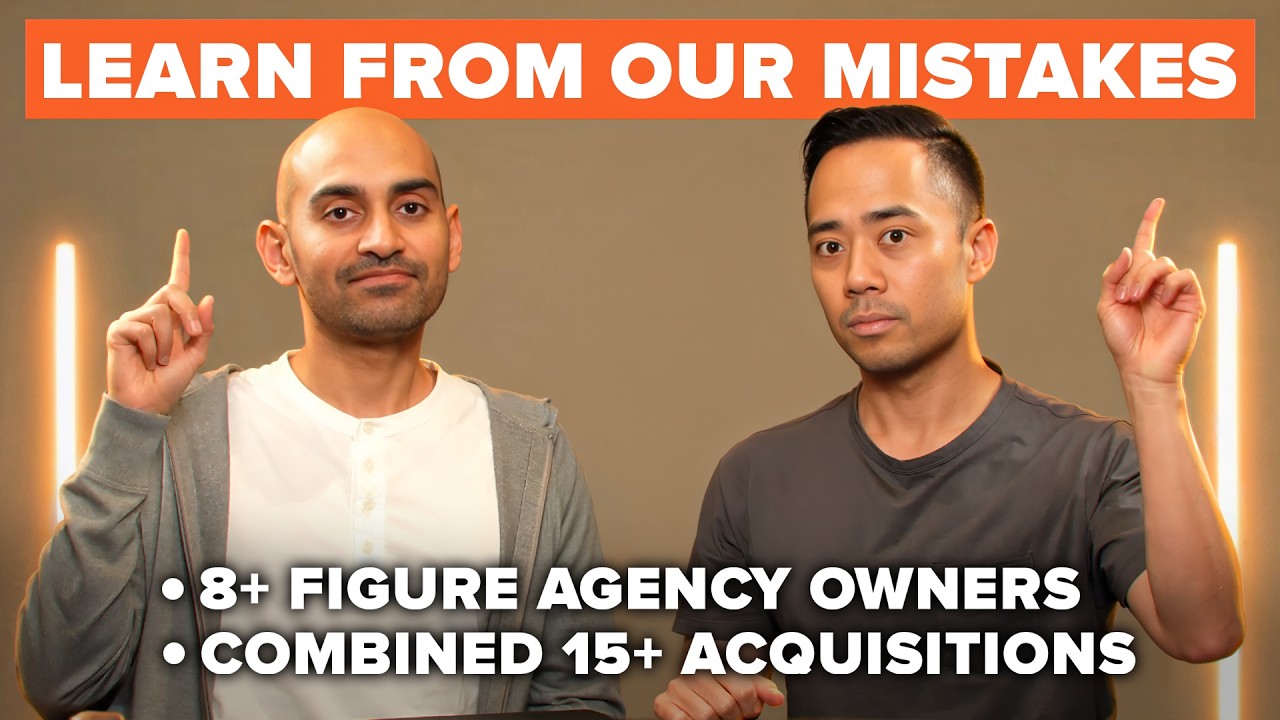
Eric Siu and Neil Patel share mistakes from acquiring marketing agencies. Don't rush deals, stay involved in integration instead of delegating to a GM, and watch how corporate overhead can kill a smaller agency's margins. Check Glassdoor and employee sentiment before you buy.
Chapters
The downside of acquisitions, what we have both learned from buying companies. Well, we'll tell you the upsides and downsides. I'll tell you more. I like to learn from mistakes. So the first thing I would say is, we wish that— I would say you want to do more due diligence. Okay, so when you're doing it, you can't, you know, unfortunately, we're working with someone that was trying to get us to close these deals, like in like 30, less than 30 days or so. That didn't really that wasn't favorable to the buyer or the seller. It was favorable to the broker at the end of the day. I should have known that. I didn't. The second thing I would say is you have to vet. We didn't vet enough of the leadership team that they had. We didn't vet, you know, some of the logos that they had as well. So we, because we didn't do enough due diligence, I guess that wraps over like the people, the clients and all that. We couldn't find like a lot of opportunities for synergies, right? Because when you're looking to buy a company, you're looking for, complimentary services or a very strong leadership team, or, you know, logos you can upsell and cross-sell into, right? We didn't have a lot of those synergies because we didn't do enough due diligence. So it all comes back to due diligence. The second thing is, when we bought these companies, we hired a GM and we let the GM handle everything. And then I floated away from the business, right? That was probably the biggest mistake. And that's why I like, I'm so big on like, you have to be involved now in some way, shape, or form.
Yeah.
And actually, one thing I wanted to talk about as it relates to this, and I'll pass it to you, Is, um, I heard, uh, Tobi from Shopify, the, the CEO of Shopify, talking about this. In a company, you have exothermic people and endothermic people. You remember your science?
No.
Okay, so endothermic is like people that are— it's usually like, you know, they take in energy, or people that— or like things that are kind of like, you know, um, they're not gonna increase the temperature, so to speak. Now, if you're exothermic people, you're increasing the temperature, right? Like someone like you, someone like me, the founders are usually the ones that are not satisfied with the status quo. And by nature, they're going to try to increase the temperature of the company, which increases temperature for everyone, right? And so my point of saying all this is that you have to stay involved. I don't care if you're the CEO, I don't care if you're the CMO, I don't care if you're the chairman, but you have to be pushing the pace. Because, you know, I think, I think things would have gone a lot better had we done that. So I'll just start off with those 2 things and pass it over to you.
Yeah, the biggest downside that I ended up seeing is, and I think, you know, we've done a good amount of deals at this point. The biggest hard part that it took me to understand was people's profit isn't necessarily your profit. So a great example of this is if a business is running at, you know, let's say they're a startup or an SMB business, let's call it $5, $10 million in revenue, $1 or $2 million in profit. Typically their cost structure of running a business is way lower than ours and they're able to produce better margins than we are. I know they say like with scale comes better margins, but we just have costs in a business that costs more than most smaller businesses have. For example, our accounting system is more expensive than most small businesses. Our sales system is more expensive. Our HR platform is more expensive. So when you put a lot of businesses on these platforms, no matter what size they are, With the larger ones, it's fine, right? Because they're usually already using these softwares or they have expensive solutions. You know, you buy a business that's doing $1 million in profit or $2 million in profit, you can drastically decrease their numbers by implementing all your systems and processes that they may not be using. Doesn't seem like a lot, but there goes an extra few hundred grand a month— a year, right? Not a month. So then your numbers start going down. That's one thing I learned. But of course, there's opportunity in cross-selling and stuff like that. So when you're paying for a deal, we really look at not what we're just paying for the deal that someone's charging us. Also, we look at what's our real cost of a deal. And the reason I say that is we typically get financials audited of corporations, which costs us quite a bit of money. Like to do a deal from a legal aspect and accounting aspect, it probably costs us around $500,000 to $600,000 to do a deal. Mm-hmm.
Yep.
Of time spent, external contractors. So, you know, there's been some opportunities that have been presented to us where if we were a smaller business, I would be like, oh wow, this company does $5 million in revenue, $200 grand in profit. I can fix this and get this to a million really fast in profit. I can make so much money off the buy, but because of my cost structure, Those deals are just too hard for us to look at. And there's shockingly a lot of those in the marketing industry. I'm just unable to do a lot of those because of my cost structure.
The number one challenge for businesses is hiring. And more specifically, the number one thing I get asked for all the time is, Eric, where can I go find an amazing marketer? And the reality is right now, when you think about the world, we have inflation. That also means wage inflation right now. And it means that when it comes to hiring talent, you can't spend as much as you would have in the last couple of years because it's just become too cost prohibitive. And so we've partnered with one of the best offshore recruiting firms when it comes to marketing. They've been a great asset for us, and I believe that they will be a great asset for you. All you have to do is go to marketingschool.io/hire. Again, it's marketingschool.io/hire to learn more. You can fill out the form there and we're going to place you with the best marketing hires that we can help you find. One of the other downsides I think is for us, when you buy a company, especially when you buy an agency, so we're buying agencies, right? Both Neil and I. The thing is that the people are the product at the end of the day. And you have to spend a lot of time with the people. And because I wasn't involved, right? Like if you don't get involved with the people and try to continually sell them on what your vision is and what your values are and just how you do things in general, they're not going to align. And so there's one company we bought where people would actually, during the client call, they would not show up to the client call and they would go take a yoga class instead, right? That's not something like— I didn't learn that till way later, but that's not a cultural fit, right?
Yeah.
But that's something if you get ahead of it quickly and talk to people, communicate to the entire company and talk, just you're constantly trying to meet with people. You have to basically— one of the downsides I would say also is you have to keep in touch with the people, but you're also going to be spending a lot more time doing these integrations too, right? You're not continually working an 8-hour day, you're probably going to be working maybe 12 hours a day, for a while to get these integrations to work.
So the 2 things I wish we would've done earlier in processes, and we've been lucky, we've never bought businesses with these problems, but we've been down pretty far in diligence process and we've wasted a lot of hours, which is money. But the 2 things I wish we would've done earlier in our processes, and we do them now, is A, look at the Glassdoor reviews because it can tell you a lot about culture. 2, I don't know what version of LinkedIn this is, but we're able, our HR team is able to go to a company page or something like that. I've never used this kind of LinkedIn profile, but we're able to see how many people at the organizations are open for a job.
Oh yeah, yeah, yeah.
Because if you, and we looked at one company where I think it was like 60, 70% of their labor or employees were looking for or open to a hire. And it doesn't matter that the business is growing and they've been there for a long time. If that high of a percentage of your employees are open to a new job, There's something wrong with the business.
That's fascinating. So what's a good percentage when you're looking at a company? I don't know. 70 to 80% is really bad, right? But I would say maybe 25% might be healthy. I'm just totally throwing numbers out there right now. Like, what do you think it would be?
I don't know. I know we do have that part of our process. So early on when we're showing companies, we look at that right away as well as Glassdoor. I don't know what is an acceptable percentage. But internally, we have a rubric. I actually should ask them to find out. What they look for.
Yeah, that's— I mean, that's— those are both great things. I think Glassdoor, sometimes I see agencies game it, right? Some agency— there's an agency we both know that had like 1.5 stars before, and all of a sudden it's like 4 stars. I'm like, oh, how did that happen? Right? Because they hire a lot of people. There's review sites, review companies that will help you do that.
So yeah. You and I know a mutual friend who's based in California. They have an agency, they sold their agency. Uh, we know him well, and before people would quit, they would make them leave a really positive Glassdoor.
You mean before they quit or right when they joined? Because that's a honeymoon period. They're happier when they join, but when they—
No, it was before they quit.
Before they— what if they're unhappy?
They forced them to.
What if they're unhappy?
They still force them to write a positive Glassdoor.
It's, it's hard when you— oh, but, but he would make you do it in front of him? Yeah, yeah, yeah, yeah, yeah, yeah.
Which I don't get why you would do that. I'm like, if someone's gonna quit— I like it.
I mean, that guy's intense. So it's, uh—
Or firing, same thing, but then severance. Like, people want the money, they force them.
I don't know if that's legal or not, but yeah, typically, I mean, maybe if he forces them to write it when they're being fired, um, I guess maybe that stops them from writing a negative review after. So yeah. Yeah.
We, we're not recommending anyone use those tactics, by the way.
And that is it for today. Please don't forget to rate, review, and subscribe, and we will see you tomorrow.









