CrowdStrike offers a $10 apology gift card for outage, Olympic ad spending at record levels, & more
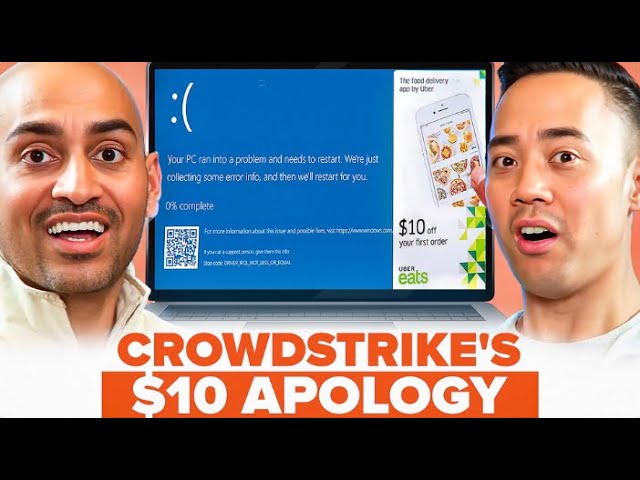
Neil Patel and Eric Siu discuss CrowdStrike's $10 apology gift card for their major outage, which crashed Delta flights and the Sphere's displays. They also cover Olympic ad spending hitting record levels and Elon Musk's brand risk as a public figure.
Chapters
CrowdStrike is offering $10 apology gift cards to say sorry for the outage to companies that have had issues due to CrowdStrike.
Did you see what happened to the Sphere when the issue happened? It was a blue screen of death on the Sphere in Vegas. You know that big, that big circle? And it was like, you know, the Windows error. It's like the sad face, the blue screen. Um, and you know how like Delta had to cancel 6,000 flights or whatever? Um, and that's the best thing they can do, you know? And like, what, what, what, tell you what, what do you guys use for security now? Do you guys use CrowdStrike before? And if so, are you still gonna use it?
I don't know what company we use for security. I know it's expensive as crap. Um, we don't use CrowdStrike before. I definitely would not use CrowdStrike from now on after this one. You know, all the airports were shut down and they first released a statement. This is only effective for Microsoft users. Well, you know how many corporations are using Microsoft? And 2, the way they handled the situation, especially with the $10 apology gift card, is just pathetic, right? Look how many airports shut down and people were stranded and how much money it cost all these other companies. And they're like, no, no, this isn't an attack or anything like that. We messed up and we released an update that just screwed all you guys up. Like, okay, it's better than not being hacked, but this is still not acceptable. Both are terrible.
Yep. Yeah. And this is like, this is anti-marketing actually. So when you do this, it makes everyone even more pissed off and all the press you're getting is actually negative press. And I remember that CEO was being interviewed on some news channel and then he started crying, like sobbing halfway through. Did you see that?
I did not see that.
Yeah. They're like, so what are you going to do about this? We're going to do something about it. So he was just panicking like that. But Yeah, I think it's— a response is warranted, but to do something like that is a slap in everyone's faces. Because again, let's go to Delta Airlines. 6,000 flights were canceled. I remember seeing some TikToks of people. This one gal was like screaming at the airport and running around. She kind of just like collapsed to the ground, right? Because everyone has a lot of things to do. So when you take away someone's life from them like that in one day, you owe a lot more than a $10 gift card. Yep.
And this isn't $10 gift cards to like, oh, you're a traveler. Like, no, it's $10 gift card like, oh, you're a corporation being affected. Here's $10. You may spend millions of dollars with us, but here's $10.
Yeah, the worst. That's— I don't know who— whoever came up with that idea from the communications department should be fired.
Should be fired. Yeah. Yeah.
All right.
And then they were like, it's not— if you're on Apple or Linux, you have no problems. You know, this isn't affecting everyone. Well, majority of the world for corporations is on Microsoft. They're not on Apple or Linux. And PC.
Yeah, they're on PC and Windows, which is what we used to be on all the time too. So—
Dude, funny enough, still from our corporation, we still are on PCs. I use a Mac, but people in my company, like, we use the whole Microsoft suite— Outlook, Word, PowerPoint, Excel. It's hard to run a business without it. I know Google has Google Docs. It's not the same.
Yeah. Microsoft just kind of has it all built in together. It's easier for enterprises to manage and they're one of the, you know, multi-trillion dollar companies. So it makes a lot more sense for you guys, especially to be using Microsoft Office Teams Enterprise, all the things.
And it's cheaper. That's the thing that no one really talks about.
Yeah, yeah, yeah. That cost you. Hey, hey, hey. So how did this outage affect you?
This outage did not affect us at all.
Wow. Okay.
Again, because we're not on CrowdStrike.
Yeah. Okay. That's right. That's right. I forgot that you mentioned that. Right.
If you're using Microsoft, but you weren't on CrowdStrike, there's no issue. It was just the people who are on CrowdStrike.
Interesting.
Olympic ad spend at record levels as streaming boom helps fuel demand. And when you look at the Olympic spending, it's been on a tear. ComcastUniversal seeing record-breaking revenue for the games in April, which is way before the Olympics started, months. The network said it was on track to set a new record after notching $1.2 billion advertising commitments with $350 million of total coming from ad buyers who have never bought during the Olympics before. But yes, like this kind of stuff, it's polarizing and, and a great example of this that everyone can relate to. And it has nothing to do with like LGBTQ. If you also look at Elon Musk, a lot of the stuff he's doing is polarizing. Good or bad, it's just polarizing and it does affect revenue. And a great example of this is I know people who love Tesla cars and had them and always drove Tesla cars, but stopped because they don't like Elon Musk anymore, right? His brand is so associated with his corporations that some people choose not to buy them because of the stuff he puts out.
You know, he got into it on Twitter with, or more so his His, I guess her name is Jenna now. So name was formerly Xavier, which was Elon's son, and then transitioned to Jenna. And Jenna was going after Elon on Threads, and then that thread blew up and then people moved it over to Twitter. So I think our point of saying all this stuff is it's probably better off, not probably, it's definitely better off to just leave your politics outside, leave it away. Don't talk about this stuff. And because when you rile people up like that, you could, You can kind of screw yourself.
So you can definitely screw yourself and it can cause an impact in revenue.
I got to take a minute to tell you about the Agency Owners Association. This is a peer group for agency owners. Think YPO or EO, but for agency owners. And I just wanted to read you a couple of testimonials. So this first one comes from Carrie, and we asked her, what do you like most about the group? She said, having a group of people to discuss and bounce ideas. The leads are great too. Yes, we share leads in this group as well. This one from Aliyan, he says, the ability to really post whatever I want and need and the group responds. Great experienced members, getting a lot of insights from conversations with other members, getting a lot of value from sessions from Eric, getting advice from others as well. And so if you want to grow your agency faster and you want a peer group to do so, just go to marketingschool.io/agency. This is a group that both Neil and I created, and our hope here is to create a vibrant community of agency owners and do do a lot more with it in the future. So again, marketingschool.io/agency, and we'll see you inside. What it means to be a real executive. So Neil, you know, um, you know J. Paul Getty?
That name sounds very familiar, but I don't know him.
Okay, so, um, he was one of the richest men in the world back in the day. He was an oil tycoon. He came like way after the Rockefellers. Yeah, so he has the Getty Museum.
Or his kid or grandkid or one of them got kidnapped. Yeah. Yeah.
Yeah. And then he's like, I'm not going to pay it type of thing. But he has these in this book. So I'm reading this book right now. It's actually sitting over there. The book's called How to Be Rich. And it might sound like a tacky title, but it's basically the billionaire's playbook. Like he wrote this book, this book came out and then he died like a month after, I believe. And so he was just saying like, you know, to be an effective executive, there's 5 things. And I'm going to try to remember as much as I can right now. But, and we can kind of debate on this and we can talk about what it means to be an effective executive because You know, Neil, you have executives at your company. You know, I have executives, and it's always important to have a strong executive team. So maybe, Neil, why don't you start first? What do you think are the most important traits for a strong executive? And I'm actually going to pull up the book right here.
Sure. So I have— I've never read the book. One, someone who is good at managing. 2, I think systems and processes are really important. 3, I think learning is super important and being able to admit when you're wrong, learning from it, right? You don't want an executive who just always thinks that they're right. They not only need to learn from their mistakes and other people's mistakes, but they also need to listen to the people that they manage. What are some of the other— what are the main ones that are in the book, Eric?
Yeah, so I'm gonna read over here. So number 1, example is the best means to instruct or inspire others. The man who shows them as well as tells them is the one who gets the most done from his subordinates. Number 2, a good executive accepts full responsibility for the actions of the people under him. If called before his superiors before something has gone wrong in his department or office, he accepts full personal blame for the fault. It's his for having exercised poor supervision, which is exactly what you said. Okay. Number 3, the best leader never asks anyone under him to do anything he is unable or unwilling to do himself. Case in point, I'm on vacation recording. You're up in the morning early at 5:00 AM recording right now. 4, the man in charge must be fair but firm with his subordinates, showing concern for their needs and doing all he can to meet their reasonable requests. He treats his juniors with patience, understanding, and respect, and backs them to the hilt. On the other hand, he does not pamper them and always bears in mind that familiarity breeds contempt. Number 5, last but not least, there is one seemingly small but actually very important point that all executives should remember. Praise should be given in public. Criticism should always be delivered in private. Employees who have done a good job should always be told in front of their fellows. This raises morale all around. Employees who have done something wrong should be told in private. Otherwise, they will be humiliated and morale will drop. There's more in here, but I think these, we can react to these to begin with.
Yeah, no, I think they're all good. What I found when it comes to screening executives, The easiest way to figure out if they're good, like all these points, and there's probably another 20, 30, 40, whatever the number is of key traits that you want them to have. The easiest thing to do is look to see who worked for your competition, continually got promoted, because it means that the company found that they were valuable. If they stayed there for a while, that's great. And if they did this at 2 places that were competitors, right? 2 different companies, and they continually got promoted at both of them, that means 2 companies in your space found them valuable because they probably performed well. will probably perform well for you too, if they already have done that same exact thing that you're looking for them to accomplish in the previous organization.
I want to take a second to tell you about my podcast co-host's agency. So NP Digital, so Neil Patel Digital. What they do is they do a whole host of marketing services and they are global. They're worldwide. They have SMB services as well. They have mid-market to enterprise services as well. They cover the entire gamut. So you can just go to mpdigital.com to learn more about it. And now back to the episode. What we're really saying here is success leaves clues. And especially to Neil's point, if they've worked at 2 companies and they've been promoted, that, that, by the way, I've seen a lot of people that have worked at agencies and I've made the mistake of hiring people from agencies that have worked there for 10 years but haven't been promoted, right? So just because somebody worked at Dentsu for 10 years, but they haven't been promoted, that's actually a huge red flag. It's like they're good enough to keep, but you know, They're probably more or less a B player. And it turned out, unfortunately, people like that are usually B players.
And if they're at a big organization and they haven't been promoted, big organizations can't cut as easily as startups, right? There's a lot more bureaucracy, red tape, especially if they're publicly traded and depending on the country that they're in, the rules and stuff that they follow. But if they've been somewhere for 10 years and they can't get a promotion, something's wrong with them.
J. Paul Getty said something really interesting too. So by the way, when you're wildcatting or whatever, you're prospecting for oil, you have to learn how to drill. You have to learn explosives and all these things, right? You have to be out there in the field. This guy was out there in the field even though his dad was already rich and he was kind of taking over his dad's business. He was out there and that really got everyone's morale really high. Another thing he said that sticks out to me, and I don't know if it's necessarily in this chapter, but Neil, he said this, he's like, So back in the day, this was probably in the '30s, '20s, '30s, '40s, right? '50s or so. He's like, look, if you're about to sign a big deal or if you're about to go into a big meeting, go get your shoes shined. Go do something to take your mind off of it so you can, you can not take your mind off it, but it's more so to mentally prepare yourself. He's basically saying just take a little pause before you jump into things headfirst. And usually even that 5, 10, 15 minutes before, that goes a long way. And he, he, he I don't think that's something we've ever mentioned, but I'm pretty sure you and I both do it. And it's something that doesn't get talked about enough.
No, you're totally right.
It doesn't.
People want to talk about all the sexy stuff, the glamorous stuff. They don't want to talk about the stuff that's like doing it, grinding it out, the boring ugly stuff, which is usually what creates success. I think that's it. I think Eric got cut off. We'll see you guys tomorrow. Appreciate you guys tuning in for Marketing School. Have a great day and check out marketingschool.io/agency. I believe it's the URL.









