DeepSeek's $6M Training Headline Was Fake Marketing
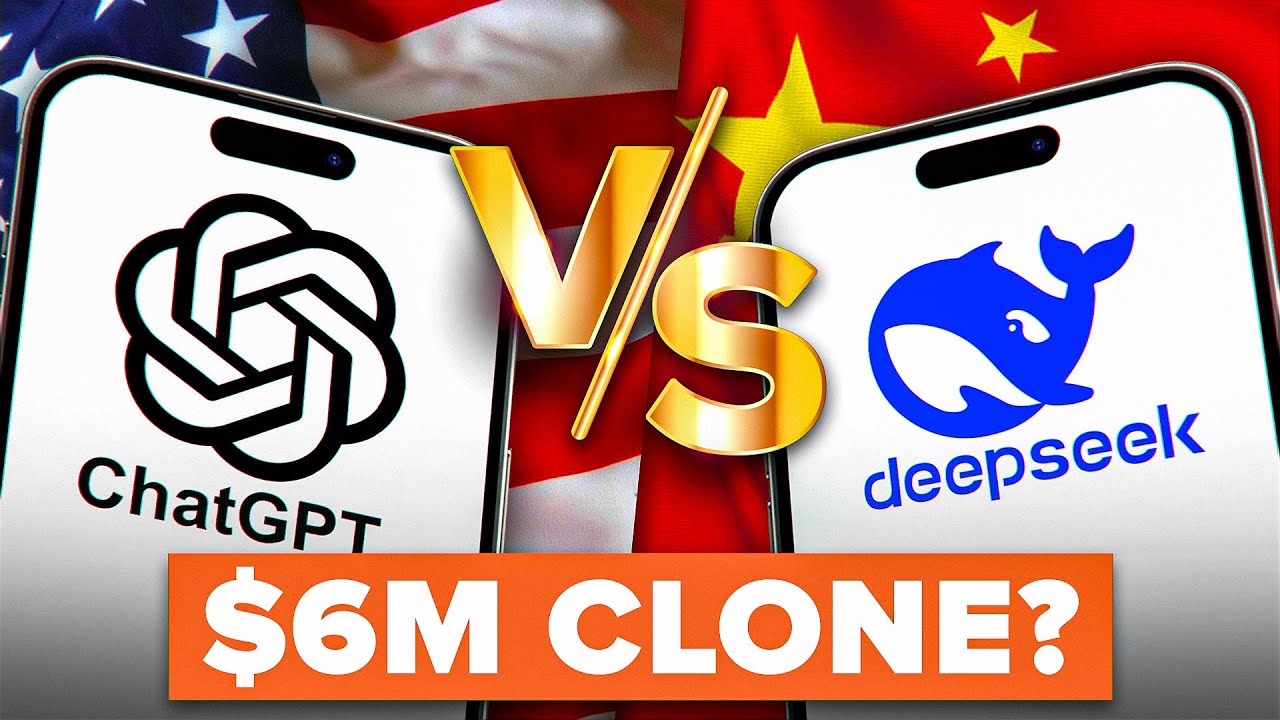
Eric Siu and Neil Patel break down DeepSeek's disputed $6M training cost claim, which appears to be marketing spin. They cover the technical innovations that made it cheaper, why it matters for Nvidia, and what marketers should know about using Chinese AI models versus running them locally.
Chapters
So DeepSeek's $6 million training headline was fake marketing. Did you know that?
I saw rumors and on X there was people breaking down charts of where Nvidia's revenue is coming from. And they're showing one of the largest buckets being Singapore. And they're like, why would Singapore need all of these chips? And I don't know if this is true or not, but on X people are claiming the Singapore revenue was in theory people from China buying the chips, but they're skirting around regulations. Yeah.
Oh, wow. Neil didn't bring his iPad today. So the thing with DeepSeek is, just so everyone that doesn't know yet, DeepSeek is this model that came out actually Q4 2024. So it's this hedge fund that launched this in competition with OpenAI, for example, or Gemini. It's an LLM.
Chinese hedge fund.
Chinese hedge fund. So it's a China-based company. And the headline was, oh, wow, this company spent $6 million and it's basically at par with OpenAI's O1 model, which is their best one right now. Actually, O3 just came out today. The mini launch just came out today, but O1 is their top-tier one. You're paying $200 a month for it. It's expensive, right? The cool thing is this one's way cheaper. It's either— it's free for people to use, it's open source, which is very big, and you're getting like a 93% discount when you're using it.
It's roughly 1/45th the cost. Yes.
And the beauty of this— so even this week I was talking to my CTO, I was like, oh, I think what we're going to do is we're just going to buy a lot of these NVIDIA computers that are coming out and we're just going to stack them up and run DeepSeek locally. It's going to be way cheaper. Which we're still going to do, by the way. But the reality is Brad Gerstner from Alterminor Capital and David Sachs actually said this. There's a guy Dylan Patel, which is Neil Patel's cousin—not really—but there's a new report by leading semiconductor analysts. Like if you guys really want to nerd out on this stuff, Dylan Patel is the guy to go to. Okay, so DeepSeek actually spent over one billion dollars on its compute cluster. The widely reported six million dollar number is highly misleading, as it includes CapEx and R&D, which might be a part of that Singapore piece. Right? At best, this describes the cost of the final train. training run only. And we're not going to go into too much detail here.
And you're saying they spent $1 billion just on the training, not to create it all from scratch? Yeah, just $1 billion training the model.
And you know what happened, right? You know what they trained off of, right? ChatGPT. Yeah, they trained off of OpenAI's model. And so like, there are some innovations that they came up with here. And there's a guy that, uh, founded Groq, and I listened to this podcast. Um, he's the CEO of Groq, G-R-O-Q, not G-R-O-K. Oh, not the Elon Musk. But it's still an AI company. So he worked on TensorFlow and he worked on like at Google, He's like, look, man, at the end of the day, open source always wins. You look at Linux and things like that, open source will win. And so what it means now is that it's not really the frontier models you should be looking at, the LLMs. People were making fun of, oh, like rappers, right? You know, GPT rappers or whatever. What this implies for marketers now is that it does come back to what kind of apps are you going to build? What kind of agents are you going to build that are actually fully autonomous, right? It's not based on, you know, the latest LLM anymore, right? And so they— he thinks he's been in the space for a long time. He's like, look, man, I think the competition, like the frontier LLMs, those things, like they're going to get commoditized. It's what apps are you going to build? So I think that affects us as business people and marketers.
I would say around 6 months ago, I was on a panel and—
You do panels?
Uh-huh.
I hate doing panels.
Yeah, it was virtual panel though.
Okay, that's fine.
So it was easy. One of the people on the panels was a venture capitalist. I forgot which fund, but it was a massive fund. And they were talking about AI and how it's disrupting everything. And her tone or her pitch or what she kept saying throughout the whole panel was, China's kicking our butt in AI. You haven't even seen it yet. And she kept saying that. And I had no clue what she was talking about.
Did you believe it?
I believed that China was doing some crazy stuff in a good way, right? In which they're really building some cool tech. But I never saw anything from China. I don't speak Mandarin. I've never been to China. So I was just like, all right, I believe that's such a big company that's investing so much in tech, why wouldn't they be doing something? But they're just like, you haven't even seen what they're doing. She's just like, a lot of what they're doing is better than what we have in the US.
Yep.
I have no way to agree with her or disagree with her 'cause I'm blind, right? I haven't seen anything that she's talking about. I'm assuming this is part of the stuff or some of the things that she's talking about, she's just seen quite a bit more. And yeah, I think you're going to start seeing more competition, not just from China, but a lot of other countries are going to continually develop more and more when it comes to AI. But I agree with you. And if you look at Nvidia stock, it tanked. A lot of people believed they created DeepSeek for $6 million— the whole company for $6 million, just to clarify, not just the training of this model. And people are saying the training costs much more.
Yep.
People are assuming they spent $6 million including the hardware, structuring the company, Everything, hiring the employees, only $6 million, which most people know that you can't do a lot of this, these kind of things for $6 million, right? Um, and I think a lot of that caused Nvidia to also crash because I would get a call from my dad. He's like, oh, did you see someone copied OpenAI for $6 million?
Yeah, that headline cost $600 billion in market cap.
His net worth went down $20 billion that day.
Jensen. Yes. Yeah. But he doesn't care. Like, here's the thing.
I'm pretty sure everyone cares when you lose $20 billion in a day. I don't have $20 billion.
I think he knows he'll be fine. Because the thing is, like, what, what I've learned from all this, just reading a lot this week, is that you've heard of Jevons paradox, right?
No.
Okay. So Jevons paradox is where once the cost of something comes down, it actually gets used a lot more. So electricity back in the day, right? Or like LED lights, for example, back in the day, everyone's using candles and stuff, then became light bulbs, but those were inefficient, and then LED lights. So the thing is, we're like, oh my God, Um, Nvidia is screwed, right? It's not true. Actually, we're gonna still need more chips because the cost is coming down so much. And people like you and me, let's say we're starting from scratch, we're going to be able to build a lot more.
So it's not Nvidia screwed. Have you looked at their financials? I don't think their quarterly earnings—
Well, what do you mean it's not about them being screwed? Because other people, the headlines are people think they're screwed, right?
Or let me rephrase, it's not them being screwed from the concept that there's not going to be more usage. Look at their profit margins on Nvidia. for their revenue to profit, it's unheard of.
Yeah.
It's one of the highest. It's, let me actually just pull up their stock symbol. Okay, check this out. So when you look at the last quarter, they did $35 billion in revenue and $22 billion in EBITDA, right? Like just to put that in perspective, at that scale, they're doing 62% profit to the bottom line, you know, assuming they didn't have debt payments. But even if you just look at like net income, They're still at $19 billion on $35 billion in revenue. You know, I don't think most people are concerned that, oh, AI usage isn't going to go up. I think most people who are logical see that AI usage is going to go up because it's going to be integrated in a lot of parts of the world. But for Nvidia specifically, I don't see that organization having 60-plus percent margins on their company in the long run. You're going to have competition, costs are going to go down, and People may not need as many chips to actually complete the task as things get more efficient. Yes, they'll still need chips. But as time goes on, there's gonna be more competition and pricing is going to go down just like everything else.
I think it's nuanced. I think we saw the drop because people panicked because it's like, oh my God, it's over, right? It's— and so I will agree that the long term, like competition is going to happen when people see profit margins like that. There's going to be more—
Too high.
Yeah, it will come down. The question is, I think they can hold for a little longer. Yeah, because they're, they're pretty— they're still pretty far ahead right now. But I think, again, people look at that, it breeds competition. People want to make more money too, right?
Yeah.
So, it will happen. Here's the final thing I'll say around this. And I'll just add on to the Chinese piece because I've talked to a handful of Chinese people. My barber, he has like a bunch of people that live in China, right? And he's like, it's not even close right now. We're talking about competition. Actually, my mom said this, right? She said this. She's like, you know, sometimes freedom is really good. Like, she loves being in America, right? But she's like, sometimes freedom isn't. Sometimes it's better to just have someone dictate to you. And so, I asked my barber about this. I was like, so, what do you think about that? Do you think that's a good thing? He's like, you know, largely families in China, they're okay with that because their lives are better, right? Because the way their kids are educated right now, 5 or 6 years old, they know STEM stuff, they know how to code, and they're working really, really hard, right? And so, it's forced into the culture. And if you look at China, it's— you haven't been to Japan before, right? Have you been to Japan?
I have.
Okay. So, Japan's super clean, right?
Yes.
It's pretty close.
And affordable.
It's pretty close to— yeah, and very affordable. It's pretty close to clean, as clean as Japan and pretty affordable. Don't get me wrong, I still prefer to live in the US, but I think from the way they're doing a lot of these things, look at it this way. The final thing I'll say is this. Semi Analysis also mentions that costs could fall by another 5x by the end of the year. Okay? Basically, the key innovation they came up with is called multi-head latent attention, so MLA, which significantly reduces inference costs by cutting KV— I don't know what that is— KV cache usage by 93.3%. The report suggests that any improvements DeepSeek makes will likely be adopted by Western AI labs almost immediately. So they did come up with something pretty good. And I love this competition because it makes things cheaper for us. If you're an agency owner looking to break high 7 figures, 8 figures, or even 9 figures, the Agency Owners Association is for you. It's ran by my partner, Neil Patel, and myself. And we've been there, done that from an agency standpoint. And if you want to learn more about it, if you want to grow faster, get more clients, take yourself out of the day-to-day, just go to marketingschool.io/agency to learn more. Yes, and then I like how it's one forty-fifth the cost.
Yeah, but going back to China, do you do did you watch the TikTok U.S. president or CEO, whatever his title is, testify to Congress and they're questioning him about TikTok in the U.S. for children versus TikTok in China? No. And he's just like, you know, let's say it was a senator asking him. He's like, Senator, no, it's not the same. You know, in China, we show them educational material that can help them learn all this kind of stuff. In the U.S., it's Pure junk and entertainment. Well, because I'm paraphrasing, he did not say it's pure junk and entertainment, but he pretty much implied it's junk and entertainment.
Like, and people might think, oh my God, they're doing that on purpose. I don't think they're doing it on purpose. I think what happens is in China they force it that way, right?
Yeah, it's not his choice.
It's the government. But in America, when you have the freedom, oh, this is, this is what you get when you have full freedom, right? This is— you, you tend to want to consume a ton of junk, right? Um, and I'm not— I'm just saying this is human nature. I'm not— well, it's algorithms.
If the algorithms show that kids love all the educational material, the algorithms would only show educational material. Because it would cause more usage and hence make them more money.
Yeah.
That's not the case though.
No.
Little kids don't want educational material shown on TikTok.
And so like you as a parent, like sometimes you have to figure out the content you want your kids to see, right? And so they're just moderating it out on like a governmental level.
Yeah. The solution I have is you just don't show kids TikTok or Instagram.
Do they use TikTok?
Do my what?
Do your kids use your TikTok?
No, no, neither. But every once in a while at nighttime, they will ask me, hey, can you show me some Instagram videos? Their version of an Instagram video is either a dog singing Apathe. I think it's called Apathe.
Is that some Indian thing?
No, the Bruno Mars song with that rose girl.
I don't know.
Or A-P-T or something like that.
I'm not hip enough.
Yeah, me neither. It's just a popular song that everyone was singing probably 3, 4 months ago. Or they'll ask me to see things like, let's say if it's during Christmas, they want to see how Christmas lights look like for houses that just go all out because you can see that kind of stuff on Instagram, right? Um, but going back to DeepSeek, everyone's talking about DeepSeek versus ChatGPT, and I don't really care who is the winner or loser because at the end of the day, all this—
We're promiscuous. We're LLM promiscuous.
At the end of the day, all this is gonna do is cause all of 'em to get better and compete, which benefits us, the end consumer. Hence governments like the US government doesn't like monopolies, right? 'Cause it just benefits the consumer to have all these corporations competing against each other. I'm not saying, or I'm not agreeing or disagreeing that saying, hey, if a US person uses DeepSeek, that's really bad for them because it's Chinese controlled. You know, I'm not trying to get into politics or anything like that. Just more so the overall technology. If they develop crazy cool technology, people here are going to try to copy, learn from, et cetera. But I think the bigger thing that people aren't really paying attention to that you and I see as marketers is AI and a lot of these platforms are changing consumer behavior. Like when you go to search, Years ago it used to be, and when I say years ago, I'm only talking about around 2 years ago, people would just type something in and you would have to sift through links. Now we're getting used to conversations and typing in conversations and having these full-on conversations with the machine and asking a question, giving us an output and us telling the machine how we want it modified. And a lot of people, if you actually look, because we've done studies, where we track what people are doing with their authorization, of course. And you're seeing people talk to these LLMs with manners like, hey, can you please do this?
I still do please because I don't— when they take over, I don't want to be enslaved.
And what I think is going to happen is all this stuff that's happening right now, whether it's Deepsea, ChatGPT, etc., it's training us to talk to machines and robots like they're humans and interact with them on a deeper and eventually more emotional level, even though we're not doing that right now. But it's taking us down that path, and I don't think most people are seeing it.
Yeah, eventually it'll be like the sci-fi movies where you're talking to a robot full-on and it responds. You could— I mean, even the Google Dev Studio thing, when you're talking to it, it responds real time. There's very little latency. And we've talked about Hume.ai before. I think it's going to get pretty nuts. The one thing that I think is practical for everyone, then we can move to the next topic. is how you can actually use DeepSeek without worrying about the CCP. What I mean by that is, I don't know if you know this, Neil, but when you want something to be deleted and it's on a Chinese server, it doesn't actually get deleted. It just says delete next to it. If the government wants to pull that, if the CCP wants to pull that, they can pull it. The way around this is if you use Perplexity and you use R1 in their DeepSeek, because their R1 is their reasoning model, that will get around it.
Okay.
Or you can run it locally, which is what we're talking about right now. I'm just like, how many, how many of these computers can we buy and just run this all locally? So that's how you can do it without having to worry about, you know, your data being stolen or anything like that.
So I don't personally worry about that too much. But when I use DeepSeek, I don't push in sensitive information or anything I would want leaked. But I assume that when you ask it anything, it's pretty much there and it's stored forever. Yeah.
Yeah, yeah, it's stored forever. I mean, it just says delete next to it. It's just the text delete, but it's not deleted. Yeah. All right, that's it for today, guys. Please don't forget to rate, review, subscribe. Go to marketingschool.io/agency to learn more about the Agency Owners Association to grow faster, and we'll see you tomorrow.









