Do You Want Your Lawyers Using ChatGPT? A Debate
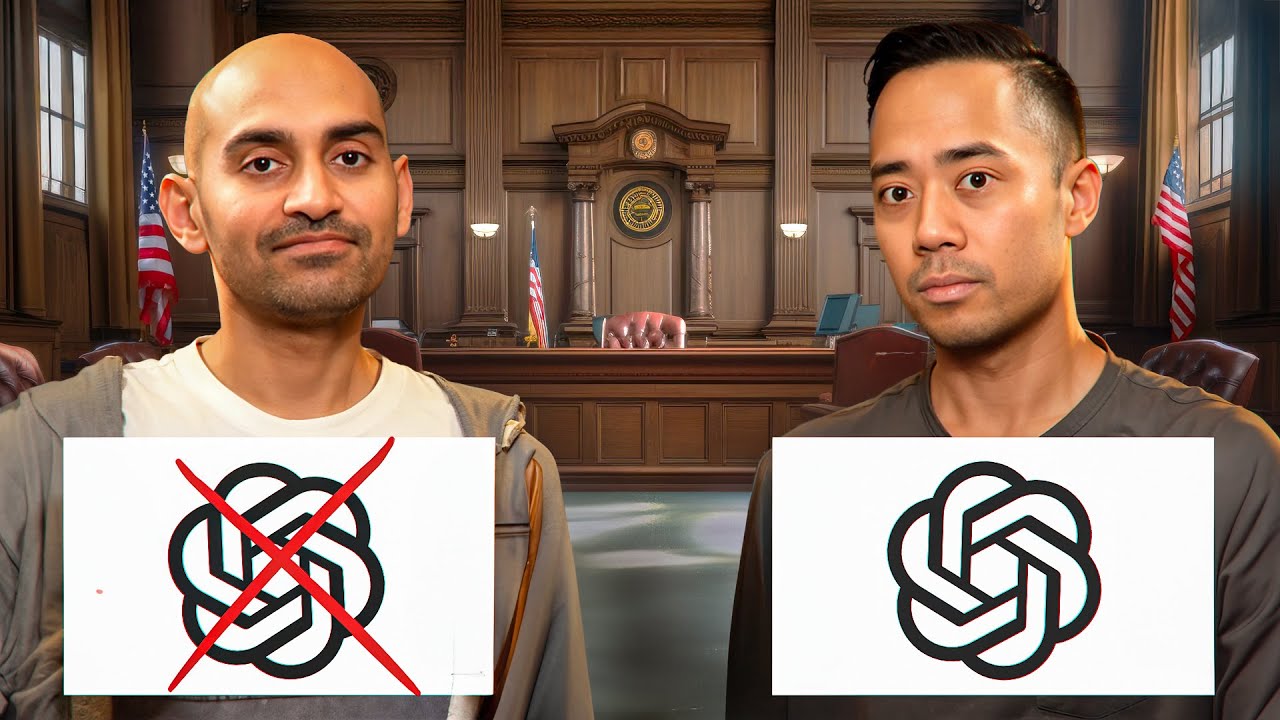
Eric Siu and Neil Patel debate whether lawyers should use ChatGPT and other AI models for legal work. They discuss efficiency gains against risks like hallucinations that could expose firms to liability, and explore whether a Chief Automation Officer role makes sense for law firms.
Chapters
Did you see that ChatGPT can write these $1,000-an-hour briefs for $3? We've heard examples of senior lawyers at law firms who said, you know, I just had O1 write a legal brief for me. That would've taken a $1,000-an-hour associate 6 hours. OpenAI CPO, Chief Product Officer, Kevin Weil, I think Weil, Weil, says their O1 model can now write legal briefs that previously were the domain of $1,000-an-hour associates. What does it mean when you can suddenly do $8,000 of work in 5 minutes for $3 of API credits? I don't think this is anything— we've heard about this type of stuff before, but I think the costs are just continuing to come down more and more, and the models are getting better and better, the O1 stuff. Between the stuff we talked about earlier with Anthropic computer use, that's a real agent, and then you have Bolt.new where you and I can prototype anything. We're developers now. We're pseudo-developers now. And then we're bringing down the cost of just, you know, costs overall with like legal costs, right? I think that's pretty, that's pretty crazy, right? So I, this all kind of goes in with this, this concept of the Chief Automation Officer. So this is from Steph Smith, and she works at a16z. And she said, I actually originally shared the concept of CAO, Chief Automation Officer, in 2021. So basically, It's a scrappy semi-technical generalist. They've been 10x with LLMs, Cursor, Zapier, AI, et cetera. And so basically, I'm not going to read the whole thing here, but you can see this if you can rewind the video. But the concept of a CAO is emerging as a crucial role in modern companies to maximize efficiency and productivity through technology. Here's an overview of this potential job of the future. I'll just read off a couple things. Key responsibilities: identify repetitive low-value tasks across the company that can be automated. Implement AI and automation tools to streamline processes. Train employees on how to use new technologies effectively. Stay updated on emerging automation technologies and their potential applications. Work closely with other C-suite executives to align automation efforts with company goals. So I think we're going to see more and more of this. It's just starting right now. All right. So I wanted to take a second to tell you about the Agency Owners Association. So this is an agency peer group ran by my podcast co-host Neil Patel and myself, Eric Siu. And these We're 9 and 8-figure agency owners respectively. And what I will say is, at the end of the day, you want to learn from people that have been there, done that. If you want to grow your agency to 7 figures, 8 figures, and beyond, this is the group for you. And we bring in other agency owners to speak as well. And it's a great peer group where you can help each other out. And you're going to learn how to acquire more clients. You're going to learn how to take yourself out of the day-to-day and to build the business of your dreams. And the cool thing, till November 30th, we are holding a special price. And you can apply at marketingschool.io/agency. And the great thing about it as well, if you try to get into group, there's a 7-day free trial, right? So once November 30th hits, we're going to increase the price by $200 per month. So right now you're getting it at the lowest price possible. So go to marketingschool.io/agency to learn more and we'll see you inside.
How many times have you been sued? Um, or had to deal with legal matters where you have to fight it out?
I think less than, I don't know, 2 or 3 times.
All right, enough.
Yeah.
Would you use a law firm that's using AI for their briefs and stuff?
I would use a law firm that's reputable, and as long as they have a human in the loop, I'm okay with it.
Yeah, that's a good answer. Yeah, I'm similar. I want a human in the loop. I do not care if they're using AI or not to save money. All I care about is the end result.
Yep.
And, you know, for our in-house counsel, I would of course give them all these tools so they can be more efficient. But when we pay external firms to help us with our legal matters, because there's only so much your in-house team can do, because the in-house team is usually more generalist and then your external team is typically more specialist. Like, I'm going and hiring that person who's going to get things done and is going to win. And I look at the return, I don't care what they're costing per hour, I care for the end result and them achieving it.
Yep. You care for the outcome.
Exactly. And my fear with AI in some of these scenarios like legal, I've seen and heard horror stories. Like remember that attorney in New York that got in trouble for using ChatGPT?
Oh yeah, it hallucinates.
Yeah.
Yeah.
And you and I have both used it in marketing and we know it's nowhere near perfect.
Yep.
And it's off a lot.
Yep.
This person is, it's in their benefit to talk about how ChatGPT or whatever, it can do legal briefs. But you and I know there's no way it's 100% accurate and there's probably a lot of issues with it.
Yep. 100%. I think, um, again, this stuff's gonna take time, but I think we're, we're getting there a lot faster, it seems.
Yeah.
And, you know, Toby actually said this, um, from, from Shopify. He's like, dude, even if we just use ChatGPT now, over the next 10-year period, we'll probably add $10 trillion in value. But the crazy thing is it's continuing to get better, right? So that's what I'm excited about. I mean, we'll continue to talk about this stuff, um, as it goes. Try all the things we're talking about, right? Um, Anthropic Computer Use, um, Bolt.new, um, you know, the, the 01 model from ChatGPT, it's great 'cause it, it spends time to think. I don't know if you've used that one, But it's pretty damn good.
There's a lot of great solutions out there. But yeah, you and I are on the same page. I think it's improving. Within 2 to 5 years, it's going to look very different than what it is today. I still think there'll be tons of errors because the inputs that it's scraping from the web have tons of errors and inputs because everyone has difference of opinions, which means the outputs will be skewed and not 100% accurate. But paying good people combined with AI, I do believe, is a solution going forward.
Yep. And I've kind of changed my stance a little bit. I was like, kind of like, oh, a lot of people are going to lose their jobs. I think some people will lose their But as long as you learn to use this stuff, I think humans will just be doing other higher-level jobs at the end of the day. It's always been like that in history. You know, back then, 100+ years ago, we were mostly farmers. And then now things— then we moved to the industrial age. And now like most of us are just working on our computers, right?
So, things change. Yeah, and not only do things change, but we've adapted as humans. When farming, a lot of it has been automated, it's not like the rest of the world has lost their jobs. They figured out new ways to earn a living. You know, it's yet to be seen what happens in the next 10 years, but I still do believe there'll be opportunity for people and people will have to spend more time leveling themselves up and becoming better at specific, highly specialized skills.
And that is it for today. Please don't forget to rate, review, and subscribe, and we will see you tomorrow.









