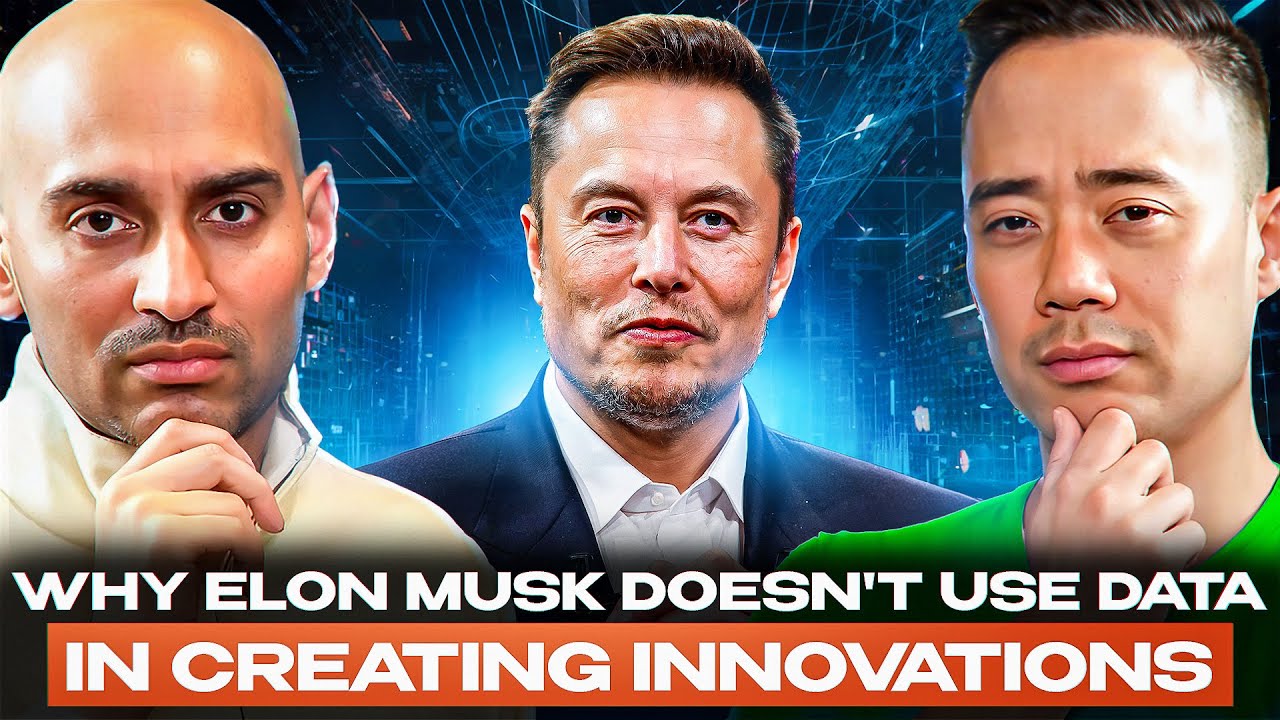
Elon Musk ignores data for innovations, Roaring Kitty purchased $245M of Chewy, & SEO beyond Google
This content was created by Eric Siu. This content was uploaded by Eric Siu. This is a YouTube episode titled "Elon Musk ignores data for innovations, Roaring Kitty purchased $245M of Chewy, & SEO beyond Google" (published/edited 2024-07-17). The excerpt is a conversational interview/discussion between Eric Siu and Neil Patel covering topics including whether Elon Musk uses data when innovating, Starlink Mini, the Roaring Kitty/Chewy story, modern SEO across platforms (TikTok/YouTube/Instagram vs. Google), agency growth (client/employee referrals, hiring), recruiting practices at top firms (e.g., Andreessen Horowitz) and paid homework-style candidate evaluations, and promotions for their Agency Owners Association and marketingschool.io resources. The tone is informal, podcast-like with back-and-forth dialogue and a closing sign-off asking listeners to rate, review, and subscribe.
Chapters
Okay, here's a here's a question for you. Do you think Elon uses data when he innovates? Yes or no?
When he innovates, I would say yes and no.
Okay, so I was watching an interview he did. He did it on the Can Lions. So he has he's a Can Lions.
Yeah, I saw the Can Lions interview.
So he did say this in the interview. He's like he's he said. you can't really use data when you're innovating. Because like, for example, if you ask people, you're making the televisions, like, would you buy television? Everyone's gonna say no, right? Same thing, like, would you buy a car? Would you buy like a light bulb? So you say it's kind of hard to do that, right? Like, but I do kind of— it is fair to say yes and no, because I'm sure he does look at—
He uses— I think he uses data to decide if this thing, if he thinks like there's a trend, but more so I actually think he's using data to improve the innovation. What I mean by this is, you know, Look at Tesla and all the data that they're using for self-driving, right? I don't think without the data he could innovate. But the concept of, hey, I want cars to drive on their own, there's no data to show that.
So when he's creating new innovations, he— there's just no way you have data. But when you have to iterate on it, absolutely, he's using a ton of data.
Yes. Or to create the innovation itself, sometimes you have to use data. But I think the ideas and to create the concept, sometimes you just have to do it with scratch and very little. And then you can add in the data whenever you have it to make it better.
I mean, come on, the guy has rockets coming back to space. Did you— do you have a Starlink Mini, by the way?
What's a Starlink Mini?
Oh my God, you're okay. You're for sure gonna buy this. You can thank me later. Elon, you owe me commission. So Starlink Mini, you pay $399 or $599 for the modem. It's internet you can use anywhere in the world. And it goes up to about 100 megabits or so. And I think it'll get faster over time too.
Does it work on a plane?
I think so.
No.
Because Starlink works on JSX. You've flown JSX, right?
Do they have the mini? The plane internet?
No, they have the main one.
Yeah.
But the mini, I've seen it work in like rural areas or like random areas. Like sometimes you have crappy Wi-Fi, right? Don't quote me on the air thing, but if it works in the air, like I would for sure just buy it right now.
Well, I have the proper Starlink.
Okay, so you should be able to use it in the air, right?
No, no, I have the proper one where you install like a little satellite on your roof.
But can't you bring that with you as well in the backpack?
It's massive. You're installing it on a roof.
So you need the Mini then? Yeah.
Well, I have that for our ranch because the ranch is in the middle of nowhere.
That's right.
But other than that, why do I need the Mini? I'm usually in the city.
Well, if you can use the Mini in the air, then you're good to go. Because, you know, when you're flying like cross over the Atlantic or Pacific, you know, spotty Wi-Fi.
That's okay. I don't always need Wi-Fi.
All right, well, you're still gonna buy it anyway.
When I go over the air, like I came back from Dubai, I had it because it was free. If I had to pay for it, I wouldn't have paid for it.
Emirates had it for free, huh?
Yeah.
Nice.
For Platinum members, it's free.
Platinum members, it's free?
Platinum, maybe Gold too.
You mean the Emirates?
Their tier status.
Oh, got it, got it.
But like, if I had to pay for it, I don't know if I would have paid for it. Did you see what Roaring Kitty did with Chewy?
Um, all I know is he got sued. He got sued? Yeah.
I did not see that. SEC. SEC sued him?
I think so, yeah. No, really? Yeah.
Let's actually Google it.
I'll bet you an Air One.
SEC sued—
By the way, I bought an Air One hat. See, that's how good Air One is too.
You should have worn the hat.
I'm going to Air One after this too. Shout out to Air One.
Over GameStop is withdrawn now.
Oh, it's withdrawn?
Roaring Kitty fraud lawsuit over GameStop dropped after 3 days.
Because there's nothing there. Like, what are you suing him for?
Yeah, it doesn't look like the SEC is suing him.
There was something like a couple days ago. If it's 3 days ago, then that aligns with the timeline. But anyway, go back to what you were saying. So Rory Kitty purchased $245 mil of Chewy.
Yeah, he purchased $245 mil of Chewy. And instead of the stock going up, it started going down.
How much did it go down by?
Not by much, but no one gave a crap because they're just like, all right, this dude's just pumping up stocks. We're over this marketing. And it just shows that marketing can backfire. Like, it's just like clickbait. You know, if people know that you're going to continually do clickbait, they're going to be over it. And they're just like, I'm tired. I'm not going to click on your articles anymore because I know what to expect.
This is a good example of like a one and done. There's not a lot of value that he's necessarily adding. And so at least, okay, you look at the amount of time you spent blogging. How many years has it been? 15, 20 years?
15 plus, yeah.
Okay, 15. Like, you just, but you've just been consistent with the value, right? This podcast, I think this is 8 years now. We're coming up on 8 years. It's just nonstop consistent, right? Doesn't— I remember the other— I remember we recorded in Brazil and like this little tiny room. I re— we recorded in the heat before.
We recorded in Brazil?
We recorded in Brazil. We both spoke at this conference, remember?
Oh yeah. Our association.
We went to this club before too, you know?
Yeah.
Yeah, yeah, yeah. Yeah.
So, uh, yeah, we partied it up. I didn't remember recording.
We didn't party.
Did we? We partied.
Okay, fine. We went to that club. That's about it. And then we went home. That's what we did.
That's true. We partied for 10, 30 minutes, 20 minutes. Maybe you and I don't like going out.
Yeah, I like staying home. Like, what are you doing for July 4th? Nothing.
Me neither.
Nothing. Nothing. Oh, I'm going to this white— this party over here, like this, this all-white party in Malibu, my backup parties in Bel Air. I'm like, yeah, none of that interests me. So—
My favorite is when I used to go out to clubs and stuff like that, people like, oh yeah, let's drink. And I would like sip one drink and I'll drink very, very little. Of the alcohol bottle or of the drink, beer or vodka or whatever it was. And I wouldn't finish it. And they're like, why? I'm like, I'd rather be home watching TV and working.
I just filled a vodka shot with water and then act like I'm drinking. That's what I would do. I got to take a minute to tell you about the Agency Owners Association. This is a peer group for agency owners. Think YPO or EO, but for agency owners. And I just wanted to read you a couple of testimonials. So this first one comes from Carrie, and we asked her, what do you like most about the group? She said, Having a group of people to discuss and bounce ideas. The leads are great too. Yes, we share leads in this group as well. This one from Alian. He says, the ability to really post whatever I want and need, and the group responds. Great experienced members. Getting a lot of insights from conversations with other members. Getting a lot of value from sessions from Eric. Getting advice from others as well. And so if you want to grow your agency faster and you want a peer group to do so, just go to marketingschool.io/agency. This is a group that both Neil and I created, and our hope here is to create a vibrant community of agency owners and do a lot more with it in the future. So again, marketingschool.io/agency, and we'll see you inside.
I think the new version of SEO is not actually search engine optimization. There was a great article on Search Engine Land on search everywhere optimization. Like, just think about it.
It's still SEO.
Yeah, SEO, but—
Search Eric optimization.
There you go, search Eric. But you have Google, you have the AI platforms, You have TikTok, you have Instagram, YouTube. But dude, here's what's funny. You and I talk about this, we do a lot of this. You talk to so many potential customers, I talk to so many potential customers, they all say they're on these platforms. How many of the customers you talk to are actually optimizing for the search aspect of these platforms?
Less than 5%.
Dude, I would actually say the people I talk to is like less than like 1%, probably less than 1%.
Yeah.
Yeah, it's ridiculously low. Everyone's like, yeah, I create content for TikTok. But do you actually optimize for when people search up TikTok?
You mean like optimizing for search natively, right?
Yes, not on Google. Like SEO on Google is great, but I'm talking about if you're publishing content to TikTok, you should be optimizing so when someone types in content marketing or social media and they're looking for tips, your content on social media or content marketing pops up. Or if you create content on Dog food, when someone types in dog food, your content should come up, right?
Yeah. I mean, people like to say they do everything, they'd like to hit all these channels, but not enough people put enough time into these things. So, and I think, I mean, we're on a lot of different channels. I wouldn't say we're the best at every one, right?
Like we try, we try to be at least decent on all of them. Yes. But, but I would say that when we are on channels, and we see certain ones driving results, We're at least decent on them. Like, we don't focus on all the channels. It is a lot of work, but we double down on the ones that actually drive ROI for us.
And then for you, it's mostly SEO that drives ROI, right? Email drives ROI, webinars drive ROI. Webinars is not a channel, but what about the other social channels? YouTube drives ROI for you?
The biggest ROI for us is Client referrals. Another big— they're not going to be in order, but I know my top 3. Client referrals.
The best.
Employee referrals, right? Because we just have a ton of people at this point. So, you know, people just like working with good people over and over again. And the third one would be from reports like Forrester, like Wave reports. We're not in a Wave. They haven't done a Wave in a long time.
That's interesting.
But like industry trend reports, things like that that a lot of CMOs look up to, we generate quite a bit of business from that.
It's interesting because your top 3 is basically just do good work.
The first, no. The main one of client referrals, yes. The employee referrals are hire good people. That goes to HR and recruiting. Because if you're a company like you're Uber and you're like, man, I had a great experience working with this SEO agency. My account manager was amazing. They left. of crap. Let me go find out where that account manager is. That's not do good work. It's hire amazing people that are good at what they do.
This is, this is my argument for it is still do good work. Because if you're going to hire great people, they want to know that they're going to go to a company that's amazing, that's doing good work, right? So everything comes down to how well are you serving your customer at the end of the day? So to me, it's still very much do good work. And by the way, if they want to follow that employee, it's because they've done, they've done good work too, right? So it is recruiting, but it is also do good work.
Yes, but a lot of people hire great people, or a lot of companies hire great people when they do crap work to try to fix it.
Yeah. Right?
Because you're trying to fix your agency. Not all agencies do great work, or in your words, they try to level up, right? So assuming you already do good work, hiring more good people helps. But if you do good work and you hire crap people, your work quality, going back to your point, is going to diminish. You're going to get less referrals. and they're not going to bring over any leads, but they go hand in hand.
Definitely.
Right? You need to recruit really amazing people. And the Forrester one and industry reports, that it's not really about doing good work. It kind of is, it kind of isn't. The bigger thing that it's about is actually size and scale. Because if you're not at scale as an agency, even if you do amazing work, you're not going to get included in those reports.
The number one challenge for businesses is hiring. And more specifically, the number one thing I get asked for all the time is, Eric, where can I go find an amazing marketer? And the reality is right now, when you think about the world, we have inflation. That also means wage inflation right now. And it means that when it comes to hiring talent, you can't spend as much as you would have in the last couple of years because it's just become too cost prohibitive. And so we've partnered with one of the best offshore recruiting firms when it comes to marketing. They've been a great asset for us, and I believe that they will be a great asset for you. All you have to do is go to marketingschool.io/hire. Again, it's marketingschool.io/hire to learn more. You can fill out the form there and we're going to place you with the best marketing hires that we can help you find. It's interesting because this is just like how our brains work. So the way I see it is like, you know, good work kind of like spreads into those 3, right? But your mind is very much more what should I say, linear with that type of thinking, right? Which is not necessarily right or wrong. It's just like, it just is. But you can see from this, how we're talking about this, we think about it a little differently.
We think about it very differently because I think our experiences are different. I'm not saying mine's better than yours or yours is better than mine, but I'll give you a great example of this. So forget good work. When my agency was brand new and we were growing, even a year or 2 years old, people couldn't say, oh, we know NP Digital, Great work. We were just too new. But what was driving a lot of business was hiring amazing leaders from previous companies. But a lot of these leaders were well connected, but they weren't the ones actually doing the work. And they're not the ones that get into the weeds, but they brought over a lot of business over time. And they knew the people to hire that had relationships, that were good at sales, that were good at building certain departments. Some of them were good at doing work. Some of them had nothing to do with work. But what I found was really the key to building my business, and it's going to vary for each person because there's no one way to skin a cat. If I had to pick one thing, it was hiring people who have grown agencies in the specific areas I'm looking to do. So for example, someone who's good at building marketplace division, someone who's really good at building a paid media division, someone who's good at building SEO, someone who's really good at building a region like Spain and who's managed Spain for a bigger agency, or someone who's run a whole territory like APAC, right? When we hired people like that, or someone who is the president at a competitor that has 7,000+ employees, when we hired people like that, it just brought revenue and growth.
Yeah.
Even without the good work.
I would argue those people still did good work, not necessarily for clients, but to be promoted multiple levels, right? You're doing good work at the company that you're in. So to me, people is all about you're hiring good people, but those people, they have to be good. Well, what does good mean? They've done good work.
There's a big— there's quite a bit of a nuance there. I agree with what you're saying, but at scale, like when you're hiring people from like companies that has 7,000 employees, a lot of the people that keep getting promoted haven't done work in like 15 years.
I don't mean client work. I mean like they've been— they're very competent people. They get the job done.
Yes.
That's what I mean.
I thought you meant like they're doing amazing client work.
No, yeah, I think I should, because I realized towards the end of it, I'm like, oh, I think you think I Constantly referring to client work. I just mean as a whole.
Yes, they're good at their job. Yeah, right. Whether it's operations, reporting, communications, they help keep you know the wheel greased and that making sure that everyone's happy.
Trains are running on time.
Exactly. So yes, that in total causes good output for clients and good client work. But you're spot on. You're hiring great people that are just good at what they do.
Yep.
And I think that was a. key to our success more than anything else.
I honestly think as we get older, the one thing that matters the most, more than marketing or sales, is just hiring good people.
It really is. Okay, so dude, check this out. I'm not going to name the friend because I'm not supposed to have this data, okay? Or I'm not supposed to have what he was given. So if you look at one of the most famous venture funds out there, it's Andreessen Horowitz, right? There's a lot of good ones like Thiel, Sequoia, et cetera. But Andreessen has created a big name. Ben Horowitz, Marc Andreessen, they're really well known. And when you look at their fund, they manage tons of money. Even in this bad economy, they're still raising massive funds. So I had a friend who's in the space of crypto, and Andreessen has a massive team, hundreds and hundreds of employees. I think it's like 200 or 300 employees, which is quite a few people for a venture fund.
Because they have all these services.
They have all these services. They're value-add. Well, one of them is recruiting. All right. So they hit up my buddy who works at other crypto companies and he's done really well. So they hit him up for a specific role. I'm not going to mention the role. And they drag him through tons of interviews and they're like, we have tons of portfolio companies that are recruiting for crypto right now. We want to know more about you. But before they even pass him to the portfolio companies, they're just grinding him, doing tons of interviews, making sure that he's good. And then when it comes time to seeing if he's a right fit for the role, not only is it more interviews to see if you can execute, dude, the homework assignments that they give their potential candidates, they're so gnarly, like 5, 10-hour homework assignments.
Wow.
And they tell you how many hours it should be. No, here's the kicker. They pay you for it. They'll tell you like if it's like $1,000 or $500 or whatever it is. They'll tell you the time limit or how much time you should spend. And they'll have you do specific tasks that are related to that business and solving their problems. They're pretty much testing you out to figure out if you're going to be a fit. But before you even get to that point, they're asking you about previous work experience. Like let's say they're trying to solve— let's talk about marketing because you and I know marketing really well. They're like, all right, this is a crypto project that's mainly related towards B2B. They're not trying to recruit other consumers. They're trying to recruit other platforms. Please provide examples of other B2B crypto marketing-related projects that you have performed and show me the examples and the results and the specific strategy that you use and the systems and processes you use to implement that strategy and what were the results from it. Like they're getting so much into the weeds that they know that if you can't really answer it thoroughly, you're probably not the person who helps solve it and you're just bullshitting your way. And assuming you can get past all of that, then they actually give you homework assignments to really see if you have what it takes to solve the problems and they'll pay you for it. But I started passing this over to Mike on my end, my co-founder, because he deals with a lot of recruiting.
Mm-hmm.
I'm like, dude, check out what they're doing. We should just implement this for a lot of the roles that we're hiring for. I'm not talking about a role that you would hire someone for like $50 grand or $60 grand, but I'm talking about like good important roles. And yes, every role is important, but if you hire really bad leaders or people like mid-management, it can really screw a lot of things up. But for those mid-level, high-end jobs, make them go through the wringer because you'll just hire a lot less crap and you hire really amazing talent. That'll just level up the whole company and you'll have a lot less failures.
So that is it for today. Please don't forget to rate, review, and subscribe, and we'll catch you later. Thank you.









