Famed Investor Asserts That AI Is Underhyped
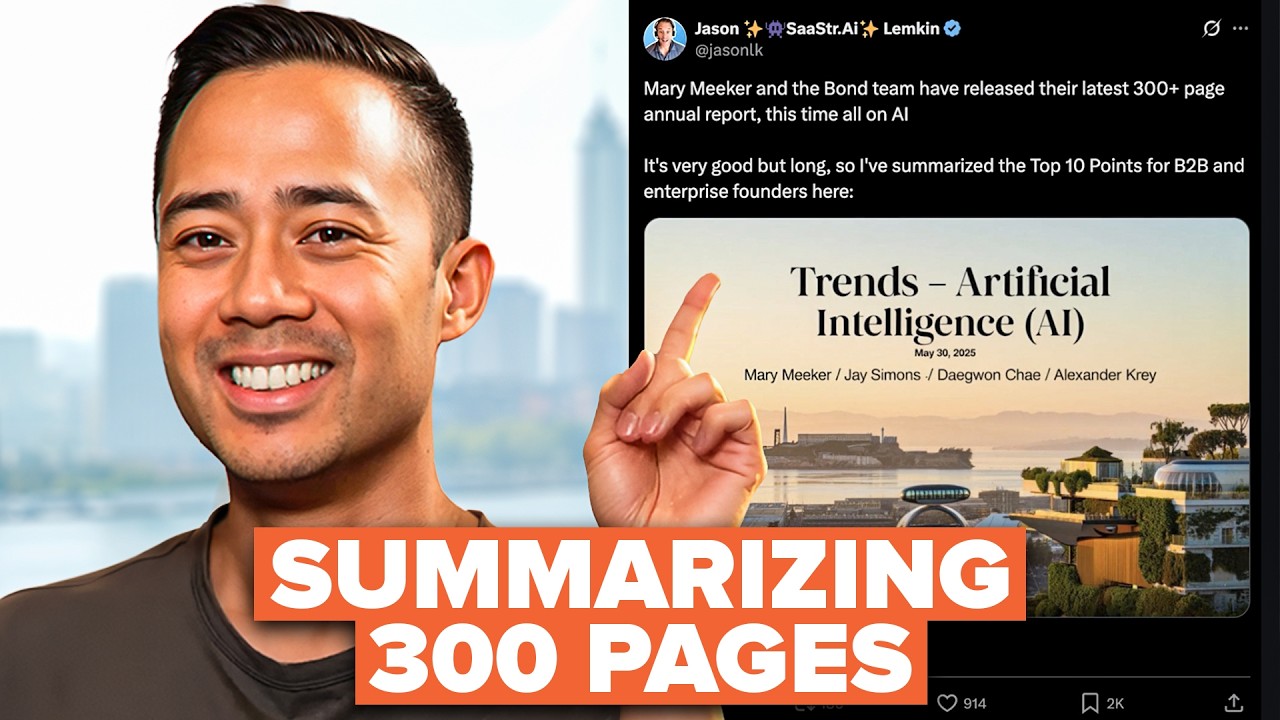
Eric Siu argues AI is underhyped long-term despite short-term hype. Token inference costs dropped 99.7% in two years, and AI reached 100 million users in 0.2 years, faster than Netflix. He sees massive automation ahead for lower-level roles while executives gain decision-making power.
Chapters
Famed investor asserts that AI is underhyped.
Yeah. So did you read the Bond Capital report from Mary Meeker?
No.
Okay, so I'm going to, I'm going to cite a couple of highlights here from Jason Lemkin. So Jason Lemkin from Saastr, he cited some, some charts here, right? So first is, oh my God, I reached my time limit on X. Here, let me show you this. Okay, so AI user adoption is literally unprecedented. So you look at the years to reach 100 million users from 2000 to 2023, at the very high point, ChatGPT took 0.2 years to get there. Netflix took like 10.3 years. So we know that part already, right? To get to 100 million users, it's at 0 to 800 million weekly users in 17 months.
Okay. But the internet adoption has also skyrocketed since people like Netflix first came about.
Now, infrastructure math is unprecedented. So we know that the big 6 tech company CapEx, they're spending a lot on infrastructure right now, right? So $212 billion annually, which is 63% year-on-year growth. Right?
Wow.
And you like numbers. I'm going to keep going. This will be interesting.
Infrastructure, including like power plants and stuff like that.
Yeah. Amazon AWS CapEx as percentage of revenue, 49% versus 4% during initial cloud buildout. So it's way higher now, right? Microsoft AI business, $13 billion run rate, 175% year-on-year growth. Nvidia data center revenue, $39 billion quarterly, 78% year-on-year growth. Okay. I'm going to keep— I'm going to read off a couple more numbers here. So Token costs have collapsed 99.7% in 2 years, right? So inference cost—that means the cost to do something using like a ChatGPT—fell 99.7% from November 2022 to December 2024. Nvidia's GPUs are 105,000 times less energy per token, right? So what costs dollars now costs pennies. So the cost of intelligence is coming down a lot, right? And this is—I still think we're in the very nascent stages right now. And so you can see this graph over here: the AI efficiency gains over time. It's basically dropping to. to near nothing. We're talking pennies, right?
Yep.
Now, just a couple more things and I'll turn it over to you. So you look at— there's a couple of enterprises. So Cursor, obviously, you know, went from $1 million to $300 million ARR in 25 months, and it's used by millions of programmers, edits over 1 billion characters per day. Harvey, the legal AI.
But didn't Cursor go public recently?
No.
Or was that something else?
Windsurf sold to OpenAI for $3 billion. Are you talking about that one?
No, I thought— who went public in the AI space recently? It wasn't Cursor. Okay, that's fine. Someone went public recently and their stock just boomed.
I forgot.
CodeWeaver or something? Code— what was it?
I don't know. You're talking about the one that has the data center stuff, right?
AI stock IPO booms.
Okay, well, I'm going to keep going here. So CoreWeave. CoreWeave, yeah. So they help with data center stuff. Cool. Yeah. Harvey Legal AI, $10 million to $70 million AR in 15 months. That's legal AI. Abridge, which is healthcare AI, $50 million to $170 million CARR in 5 months. I don't even know what that means. And then physical world AI scaling even faster than software. So Tesla, Full Self-Driving, 4 billion fully self-driven miles. Waymo is now 27% market share of SF rideshare bookings. And then Anduril, you know, the defense company, 2x revenue growth for AI-enabled defense systems. And the final thing I'll say here is AI job postings are up 448% while traditional IT jobs fell.
Wow.
So the great reshuffling. So I think you and I can both agree, maybe we're in the first inning of AI right now. I think it's very early. I don't think we're going to see the full gains of this for a while. Like, it's just like the internet, the dot-com era. We didn't see a lot of these gains for a very long time.
No.
And so that's— you have Shopify CEO, reflexive AI usage is now a baseline expectation at Shopify. Duolingo CEO, AI use will be part of what we look for in hiring. AI use will be part of what we evaluate in performance reviews. Headcount will only be given if a team cannot automate more of their work.
So I believe a little bit different than Mary Meeker. I believe that's her name from Bond. I believe AI in the short run or right now is overhyped. I think it's underestimated and underhyped for long-term potential. And the reason I say that, and I'm specifically talking about marketing, when you look at marketing and AI and you talk to organizations, they believe AI agents, AI tools, as it stands right now, In today's world can just do everything for you and run marketing campaigns. And we're seeing startups fire all marketing teams and be like, we're just going to run it through AI. That's not the reality we live in today. In the long run though, I genuinely do believe people underestimate what AI can do for you in marketing and just in general when it comes to advertising from a global aspect, like knowing your fingerprints on a fridge and you're the one opening it up and figuring out what items you take and weighing milk and being like, this is how much of this food you eat. Neil aid or Eric aid or whatever it may be. And this is how they need to optimize their health. And then insurance companies can adjust premium or figure out if they want to target you because you're a better potential patient or candidate, or life insurance companies could figure out how much they're going to end up charging you and they can adjust how they do their marketing based on a lot of those devices. Now, data comes into play here and what they can or can't take and laws and all that kind of stuff. But I think AI is really going to change the way we do marketing in the long run. And I believe the pyramid is going to be flipped upside down in which right now you have a few executives, a lot of people underneath. I think it's going to be flipped around in which executives portion-wise, percentage-wise, right, not total number of headcount, but percentage-wise will make up a bigger number of your pool. And then you're going to have a lot less people on the bottom end of a pyramid because it can— a lot of that kind of stuff can be automated by AI.
Let me read some of these valuations here, then I'll give you my thoughts on underhyped long-term and short-term. So Private market valuations: OpenAI is $300 billion valuation on $9.2 billion in revenue, so a 33x multiple. Anthropic is $61.5 billion valuation on $2 billion in revenue, the 31x multiple, but it's already— it grew to $3 billion ARR already. And they did. Yeah. And then xAI, $80 billion valuation on less than $1 billion in revenue, so greater than 80x multiple. So combined, $95 billion raised against $11 billion in annualized revenue. So I think the valuations are You— some people might say it's rich, but I actually believe that AI is underhyped in the long term. And I think it's underhyped in the short term too, just because the vast majority of people right now, I do agree, they can't do a lot of things that we want to do, right? But the vast majority of people also, when I'm, when I'm playing around with it, like I was playing around with the connector yesterday with HubSpot and ChatGPT, I'm like, I have all these superpowers that I didn't have 2 years ago.
Yeah.
I feel freaking unstoppable. And so I think we're just scraping the surface right now. But I think long term, the stuff you mentioned versus I'm gonna be able to see what's going on with my body every night, what's wrong with my biomarkers. Oh, something like, I don't wanna make it disgusting or whatever, but like you're gonna have toilets that can scan everything that's wrong with you.
Yeah.
Like we are going there. And I told everyone, earlier we talked about my mom passing. I told everyone, I don't know why I've been doing this. I think it's the growth-oriented side. But when I talk to my relatives, like, how are you doing, whatever? And I just, I go into like, you know, guys, as long as we just live another 10 years, like we don't have to worry about this stuff anymore, right? And I truly believe that cancer, disease, and all this stuff, if we can just live 5, 10 more years, AI, healthcare, all these things, we're just gonna be in a good spot. By the way, speaking of AI, do you know who might sponsor this podcast? Sam Altman.
Really?
Yeah.
They hit us up?
Yeah.
OpenAI did?
Not OpenAI, another company.
ChatGPT?
No. Yo, you don't know about— you know about this? They have like this eyeball scanning thing, the world thing.
Yeah, yeah, yeah. There was a crypto company that he had that's doing this, no?
Yeah, yeah. So it might happen. Who knows? We're—
That'll be cool.
Figured out. But yeah. If you're in B2B, here's the deal. LinkedIn account-based marketing sucks, but it doesn't have to. With Karrot, it allows you to create personalized ads towards your customers and also personalized landing pages that align with the ads. So you're going to have higher conversions and influence pipeline reporting to prove that your ABM works. So if you want to learn more, just go to karrot.ai and you can join the waitlist. Again, it's karrot.ai, K-A-R-R-O-T, and we'll see you on the other side. Dude, can I just talk about that OpenAI connector? You like this.
Yeah, go for it.
You're going to do this over the weekend, I guarantee it. Because it won't make you money. This will make you money, guys. Okay.
It will or will not make you money?
Will make you money.
All right, let's talk about that.
All right, so the OpenAI version that we pay for right now is the Pro version, which is $200 a month. As of 2, 3 days ago, ChatGPT just added connectors, MCP connectors to HubSpot, to your Google Calendar, to your Gmail. So what I did 2 days ago, I was like, hey, so I just connected my HubSpot. I was like, tell me about the last 6 months worth of deals versus the previous 6 months. Tell me about all the key metrics and everything. It started summarizing conversion rates. It started to summarize the weak points. Oh, here's your sales velocity over here. Here's what it looks like. And the numbers were accurate, right? And it spent 2 hours researching. And I'm like, dude, this would've taken an analyst days, maybe even weeks to do. And it just did it. And now I can make decisions faster. I instantly compiled that. I sent it to the team. I was like, guys, here's our new sales plan for— and I want you guys to talk about it next week when I'm not going to be in that meeting because I want to see how they do without me. And so then I started asking about, oh, on the carrot side, right? Because that's more of a startup right now. Oh, who should we be following up with there? And it listed the reasons on who should be followed up with next and then when the last contact was and what we said to them in that contact. And I'm like, oh, okay, my calendar, help me, tell me how I've been spending my time in the last 6 months and how it's been trending upwards or downwards for each of these different categories. It did that for me, right? That used to have to be done by hand using an EA. So my point of saying all this is that Someone like you or me who likes to look at numbers, you can get these things quickly and some of it's like, why are you even spending time on this? But some of it's like, okay, yeah, this will make you more money.
Yes. The interesting thing with the connectors is a great idea. I bet you I will not be able to use it this weekend or it'll take a while. My legal team will have to look into who owns the data, are they training off our data and all that kind of stuff.
They're not training on it.
Yeah, but we still have to check contractually because We are based on their terms of service and privacy policies. The reason I say that is we have clients with strict contracts. The bigger organizations, usually the stricter contracts you have. The last thing we can have is other people's data being passed into OpenAI, them using it for other purposes. Like it'll just cause me to get in a lot of trouble.
Can you use it for your Salesforce or your HubSpot?
No. You can't?
Potentially, but I had— Do you have your client information in there?
We have client information in there.
Okay.
So I had to find out. And also personal information too. We let people know and our privacy and terms of service, uh, I don't know which one it is that we're collecting data. We list out tools and things like that. And I don't know exactly how it works, but we have in-house counsel plus outside counsel. I just know for a fact we can't just use tools that may access the data. We have to see exactly how it's being accessed. Is it ours? Is it— they don't, they don't store it. Like I had to get checks on all this kind of stuff. That's the hardest part about growing right now in our organization.
So send them that message. I mean, it's so you can play around with this in a couple of weeks then.
No, no, but hopefully the, the reason I say this is the hardest part, like this is what's frustrating for me as an entrepreneur, and, and it totally makes sense and I'm not trying to break any laws, is my growth potential is also being stumped because of rules, laws, and regulation. And I'm not saying that's wrong or right.
Yep.
Usually when you're a startup, what allows you to move fast is you don't have red tape. You just do whatever you want.
Yep.
There's not really any consequences. You're not making money. When your organization is scaled up and you have revenue, you need to protect. You need to protect.
Yeah. Which makes sense. So I trust that you might be using this in the next couple of weeks because I think you would love this.
I hope so. I'll have to find out what I can.
You guys are on Teams and Microsoft too, right? They have a lot of Microsoft Connect. Oh, because they're partnered with Microsoft, obviously.
Yeah, they're the big partner.
You can do, you can do a Teams integration too and all these things, but you can just ask whatever questions without having— I think that's the big, the thing that bothers me the most. It's like, why do I have to wait so long to get these seemingly basic things? Basic things, because I just want to make decisions fast.
And everyone talks about how OpenAI AI is crushing it and they're making all this money and they're growing so fast. Very few people talk about how much Microsoft will make from this because they were the earliest funder and they put in the most money at the earliest time. Now they've raised tons of money from other players at crazy high valuations, maybe more in total than what Microsoft funded. But percentage ownership-wise, I don't think it's public or I don't have the data. Maybe it is. I'm pretty sure Microsoft owns a majority of— or not the majority, they're the largest individual.
Entity.
shareholder of OpenAI.
Yeah. And you can tell OpenAI is trying to break out of it a little bit.
Yeah, I think they're having issues. But dude, people talk about like, oh, it's too high valuations, this on Perplexity or OpenAI. These investors, what people aren't seeing is they're giving the crazy valuations to the ones that are already somewhat proven and the most likely to win. And they have bottom side protection where some of these deals, they're getting liquidation preferences and things to make sure they're making at least double their money or triple their money. Yeah. So yeah, they're giving high valuations, but a lot of these deals usually have downside protections for these investors.
I do think before we move on from this and we can talk about Meta for a second, then we can move over to the Elon versus Trump thing. I do think that these MCP connectors, me using it the other day with OpenAI, I was like, oh wow, I feel like a lot of apps that go through it this way when you make like a custom MCP connector, that's going to be the new app store. It's not the OpenAI app store. It's actually connecting it through AnswerThePublic or Scout or whatever else that you have. And Helping people use your product from ChatGPT. Yeah, I think that's the new App Store.
I think that will be the new App Store. Time will tell though. I have no idea. The real problem with the App Store is what are they going to restrict? Because Apple and all these players really do try to restrict.
Yeah. And they try to, they take a big tax too.
Yeah. But if it affects their revenue, they will restrict on what you can do. And maybe they open it up, you know, with connectors and all this kind of stuff, but they probably want to make sure they're still making money.
Yeah. I just I just love the fact that I can get this data at my fingertips now and I feel like I'm unblocked. It's like I'm getting more and more unblocked every day. That's what it is.
Well, but wait, you can get the data right now. Wait till some of these platforms start blocking you. Like, I was in France the other day. Did you know there's no AI overviews in France?
No.
Yeah, there's regulations. Every country is different. It's not as simple.
Really?
Yeah, yeah, yeah.
I didn't know that.
Just wait. I'm telling you, it'll get harder and harder because then you're going to have to deal with laws for individual countries and be like, oh, You can't do this with AI or you can't. Like, just think about that for a minute. You're talking about data and connectors. I'm talking about Google has already scraped content. They can't just quickly and easily roll out AI overviews in certain countries because of regulation.
I was listening to BG Squared this morning and I think there's like some enterprises saying, oh, that you can't, that you can't train off like your own data or something like that. Or like even though you paid for like a— oh, Salesforce said this in their terms. Now they've updated their terms. Apparently someone can correct me here, but If you imagine you're paying 7 to 8 figures a year for a Salesforce contract and they say, oh, you can't train off that data. You can ask whatever you want, but you can't use like an LLM to train off of it. That's in the terms now.
I believe it.
Yeah. Which is, which is, which sets a precedent that maybe if you're enterprise software, even mid-market software, that you might just put that in your terms now where it's like you can query whatever you want, but you know, you can't, you can't, it's not your data even though you're paying big money for it.
But they want you to use Salesforce's LLM.
Their agent.
Their agent to do everything and collect more revenue. Which is fair. Like you would too.
Yeah, yeah, yeah, yeah.
I don't blame him for it.
That is it for today. Please don't forget to rate, review, subscribe, and we'll see you tomorrow.









