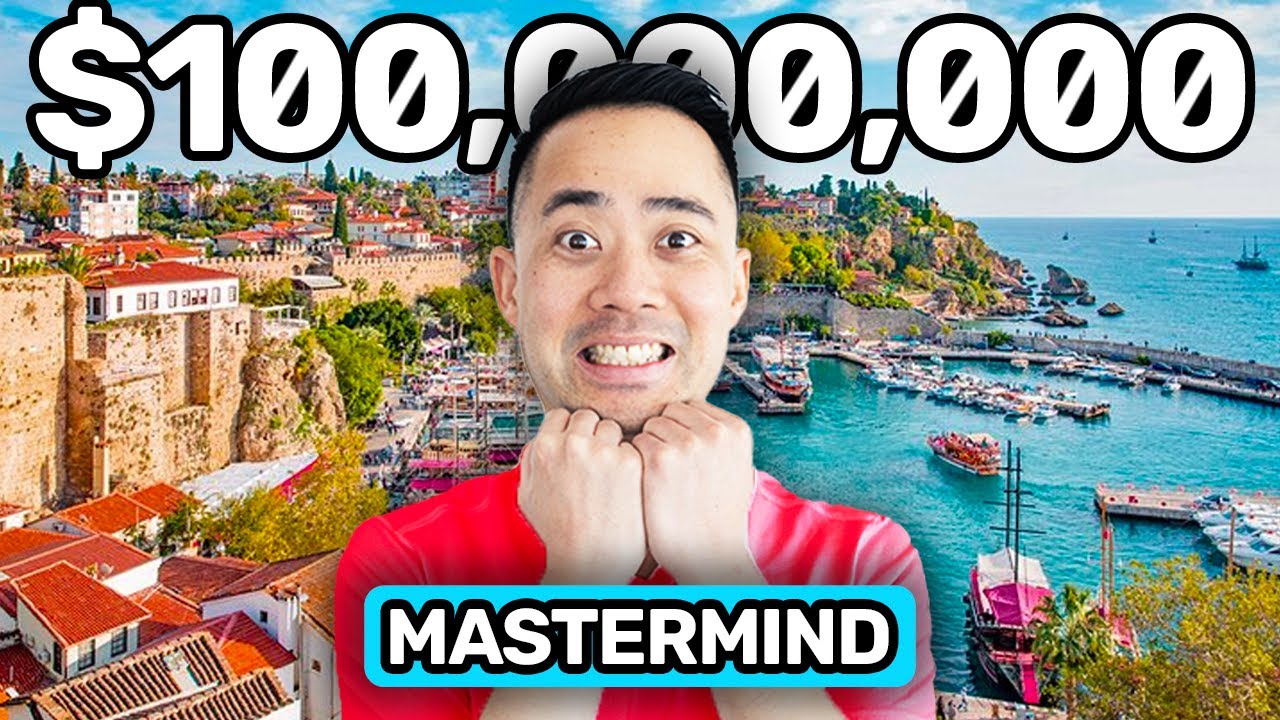
In this video, Eric Siu shares insights from a curated mastermind retreat he organized in Bodrum, Turkey, featuring a rotating group of marketing‑savvy founders such as Sayed Balki, Patrick Campbell, Eric Rivera, and David Hensel. He outlines five key takeaways: (1) despite company performance, founders are hoarding cash and adopting defensive postures to weather economic uncertainty; (2) many are returning to “basics” by re‑establishing in‑office culture to regain alignment and focus on mission; (3) AI adoption is accelerating, with practical internal uses (e.g., sentiment scoring via Gong) and a proposed new role of “AI operator” to experiment, implement, and educate the organization; (4) the mastermind’s format follows a Gestalt protocol—participants present a challenge, receive clarifying questions, then share relevant experiences rather than direct advice, fostering ownership and learning; (5) the retreat blends learning with fun (basketball, tennis, meals) to cement long‑term relationships, emphasizing that high‑quality, self‑selected peer groups are far more valuable than generic networking events. Siu also promotes his own paid mastermind, Leveling Up Founders, aimed at 7‑figure entrepreneurs, and reflects on the volunteer‑driven, cost‑sharing nature of the event, noting that no profit is taken from participants. The video concludes with a call to action for viewers to suggest future content.
Chapters
I'm gonna share some takeaways from a mastermind that we did in Turkey. And I believe that most, if not all the people from this group are going to become centimillionaires, if not billionaires. Just some context around this group. In 2018, I decided to put a group together and the first trip we went on was to Cabo. And we have a core group of people that go on this trip and then we will rotate people in and out. These are all entrepreneurs. These are all marketing-minded founders. And if you've seen my content before, you've seen me talk about YPO or EO. These are more peer groups for entrepreneurs, more for business people. And I just wanted an angle where I could hang out with founders that really understood the internet well, and they really understood marketing well. And we would just go on these trips and we'd share a lot of knowledge with each other that we typically wouldn't share publicly because marketers tend to pollute a lot of tactics and strategies. And so we use these groups to get ahead and also we became really close with each other. So this trip, we did it in Turkey. And this is in Bodrum, Turkey. You can see this picture over here. The whole idea here is that we not only want to get together maybe once or twice a year, but we also want to go to places that we normally wouldn't go to, and this helps facilitate that. And so I'm going to jump into this a little more. Sayed Balki is in the group. We call him the King of WordPress. And so he has a WordPress holding company. He focuses on investing into WordPress businesses. He also has real estate property that he owns as well, and Patrick Campbell over here, he sold his company for $250 million to Paddle. He sold ProfitWell for $250 million, so he's done well for himself. Eric Rivera over here, he has a pet holding company, and there's a couple other people that I haven't listed. But the whole idea here is that with this group, it's a group of people that are humble, a group of people that are hungry, a group of people that are also smart. These are the people that you want to hang out with, and obviously myself with my ad agency. And so the first thing I wanted to share takeaways-wise was it doesn't matter how well the company is doing, but people are holding on to their cash. And what that means is people are taking a defensive posture. Right now, and they are making sure that they have enough cash to weather the upcoming storm, whatever that storm looks like. Or if there is no storm, still they can take advantage of the opportunities because the macroeconomic environment is getting weaker and weaker. As entrepreneurs, these are things that we pay attention to. We're looking at all these factors and thinking about how this might apply to our businesses, and then adapting accordingly because that's what entrepreneurship is. Second one is it doesn't matter how well a company is doing or how poorly a company is doing right now. Everyone is going back to basics. What that means is this: if we look. At 2020, when the shutdowns happened and people couldn't work in the office, well, a lot of companies they were forced into a really unnatural environment. Let's say you built your business over a ten-year time span, and what you were used to doing was building an in-office culture, and that's where you really crushed it. You had maximum alignment, and that's what worked for you. And you had to go into a situation where you were forced to go into remote, but you could never quite make that work for you. Now you're hearing a lot of pressure from people around the media or people that you might have on your team saying, "Oh, we're not going to go." back to the office. That's over. That's over and done with. If you were used to working in an in-office environment 5 days a week and now you're doing something that feels unnatural to you, well, maybe it's time to go back to basics. It's time to go back to what worked for you. It's time to get back to basics and focus everyone and align everyone and say, hey, this is what our vision is. It's wartime right now. We need you to do this. If you're not aboard, then that's okay. You can find a job somewhere else and maybe we can work out a deal. But that's what it is. There's no more walking on eggshells. It's really getting to the point and it's about moving forward and it's about protecting the company first and not about all the outside distractions that are out there. So social issues, that's one thing, but business is business. Focusing in on what the mission is, focusing in on what your values are, that's what matters within the context of business. By the way, before we continue, click on the link below if you're interested in masterminds, because I do a mastermind called Leveling Up Founders. It's for 7+ figure founders, and we do one in Miami each year and one in Beverly Hills. And it's just really super high caliber of people in the group, and it's just a great thing. So levelingup.com/founders if you want to check it out. It should be in the link below as well. But let's continue on with the takeaways here. So the third takeaway here is on the topic of AI. So AI, we're seeing a lot more practical business adoption that's happening faster than blockchain. I still very much believe in blockchain, but the fact that we are all talking about it and talking about the implications and the use cases here are important. And so I'll share an example here. One of the things that we do with AI internally at the ad agency is that we use our conversational intelligence tool Gong and we pull client sentiments. So we scored their sentiment on a scale of 1 to 10, 10 being they're very happy. We summarized all the calls, we put in all the action items, and then these are all stored into a spreadsheet. And so there is no sandbagging, there is full accountability, and everyone's calls are front and center. And so our job is to make sure that we're doing a good job, not only just making our clients happy, but making them happy because we're doing a good job. And that's what it ultimately comes down to at the end of the day, because the mission for Single Grain, the ad agency, is that we want to do innovative marketing that drives conversions, that drives traffic. And that word innovative is a very strong word. And it's hard to stay on top of that world. And the other thing that we also talked about too is that there's a need to potentially hire AI operators within a company where you hire one specific role that's just dedicated to focusing on experimenting with AI, implementing AI, and also just continuing to teach and educate and disseminate information throughout the entire company. Now I want to move to the 4th takeaway here, which is the format that we used. And so we had 7 people come through and everyone had a challenge that they wanted to share. We'd go for about 30 minutes to 1 hour or so. And the format was that we would provide context. Let's say I had a challenge around recruiting an amazing executive team as an example. Okay, that might— so I'll share the context around, okay, why do I want to build this executive team? Where we are as a business right now? What has happened in the last 12 to 24 months or so? And so we provide context around it, and then people get a couple minutes to ask clarifying questions. So they'll say, why do you want to hire this executive team? Have you done this before? And what specific executives do you want to hire? As they're asking these questions, they're trying to figure out how to help you with either experiences that they can share, or if you permit it, advice that They wanna give, or they might even be able to make introductions for you based on what you need. So clarifying questions. Then the next step is each person shares for the next 3 to 5 minutes. So I might share a challenge and then the other 6 people, after they ask the clarifying questions, they will then share their experiences. And the reason most people share experiences here, this is known as the Gestalt Protocol. They share experiences because if they give direct advice and the advice doesn't serve me and I take it, I'm gonna have some resentment there. And then after that, I get a chance to reflect at the very end talking about what I learned and thanking each individual person based on the gift that they gave me. And then we would move on to the next person. And so we would do this in increments where basically we would do 2 a day or something like that because we were there for a couple of days. But also when we would have dinners, we would also share tactics, tools, and hacks. So we'd have great food. We do these meetings over here and it was just a great situation. And so we also had fun as well. You can see this is us playing basketball. So this is Syed picking up the ball over here. This is David Hensel guarding him. So David has a portfolio of service businesses. We'll just call it that. And then here I'm challenging Syed to Drive it in and shoot with one hand. He tosses it up and that's Patrick Campbell with the ball and that's Eric Rivera with his pet holding company. And so we have fun. There's tennis, there was basketball. So I guess this is takeaway 5. You're not only trying to learn, but you're trying to have a good time and you're also trying to build long-term relationships with people because it's really hard to find people that are like-minded. And then here's a picture of the dinner convos that we had as well. So it was great food. So you can see over here, this is the group and this is us eating. And you know what's interesting too? This is like a side note, but yes, absolutely, it's all men, but it's not like I intended it to be. If someone really loves going to masterminds and they are at a certain level, at their similar level, I've actually gotten asked, and we're not opposed to having females in the group, right? But sometimes you get notifications like that, but that's not what we focus on, okay? We focus on learning. So dinner combos over here, so great food. And then here, I remember we're talking about tactics and sharing tools and things like that. And there's a lot of things that I just didn't hear about, certain funnels to analyze, certain tools to check out. And there's one tool where someone in the group, he had to cut a good chunk of his sales staff because the tool was just so good and he didn't know where to reassign the other people, right? But that kind of just shows the power of technology and how deflationary technology can be. And so it wasn't like we're just messing around the whole time. It's these situations where the networking is actually more so relationship building. I'm not that interested in going to networking events because it's kind of a crapshoot, but when you're able to put your own group together and curate the quality of the group, that is extremely powerful. By the way, before we continue, if you're getting value from this, let me know what other content you'd like to see me create or other questions you might have around this event, because that might lead to more videos as well. Let's see what else we got here. This group we started in 2018 or so, and the core people in the group have continued to grow personally and professionally. And I think to be able to design your own group, your own mastermind, is a force multiplier because you create the quality, you get to pick the topics, you get to pick the places to go to, and eventually everyone else chips in. And so I would say this too, maybe for the very first one I took on a lot of the work. I worked with my assistant at the time on it. And it was a lot, but it was really rewarding because everyone volunteers to put in. And so this event was actually planned mostly by David Hensel, the person that was guarding Syed in the basketball clip. And so that's what it is. Everyone volunteers, everyone chips in. Nobody's profiting off this thing. So I never made a dime off this. It's more so everyone pays costs so we can hang out with really high-quality people. That's what it's all about. It's about high-quality people that you hang out with, whether it's high-quality people in your organization, high-quality friends. And then by doing that, you're able to bring higher-quality work to the world, you're going to be able to better serve your customers. So yeah, those are the takeaways around this event. I hope you enjoyed it. And if you want to learn top takeaways, I've interviewed over 400 CEOs and founders. You should just check out this video over here. It's a great one. There's a lot of takeaways there. And I hope you enjoyed this. Catch you later.