Gamestop's Roaring Kitty play backfires, Marketing leaders at AI Summit: ‘This is 2001 Again’ & more
Neil Patel and Eric Siu discuss GameStop's Roaring Kitty trading saga and the legal questions around influencer-driven stock moves, plus marketing leaders at an AI Summit comparing the current moment to 2001. They also cover AI in advertising, Eight Sleep's SEO strategy, and how creators like MrBeast build audiences.
Chapters
Another topic that, you know, you and I both talked about last week on our episode of Marketing School that we should probably talk about this week is all the GameStop action.
Yeah. I mean, we can follow up on that. It's, I mean, it's gone up and down, up and down. And you want to go first? You want to set the tone on this real quick?
Yeah. So what's his handle? Roaring Kitty or something like that?
Roaring Kitty. I think it's like Kirk. Collins or something.
So Roaring Kitty ended up posting how he's gonna go live and do a webinar on Friday.
It's past that day. Keith Gill. Keith Gill.
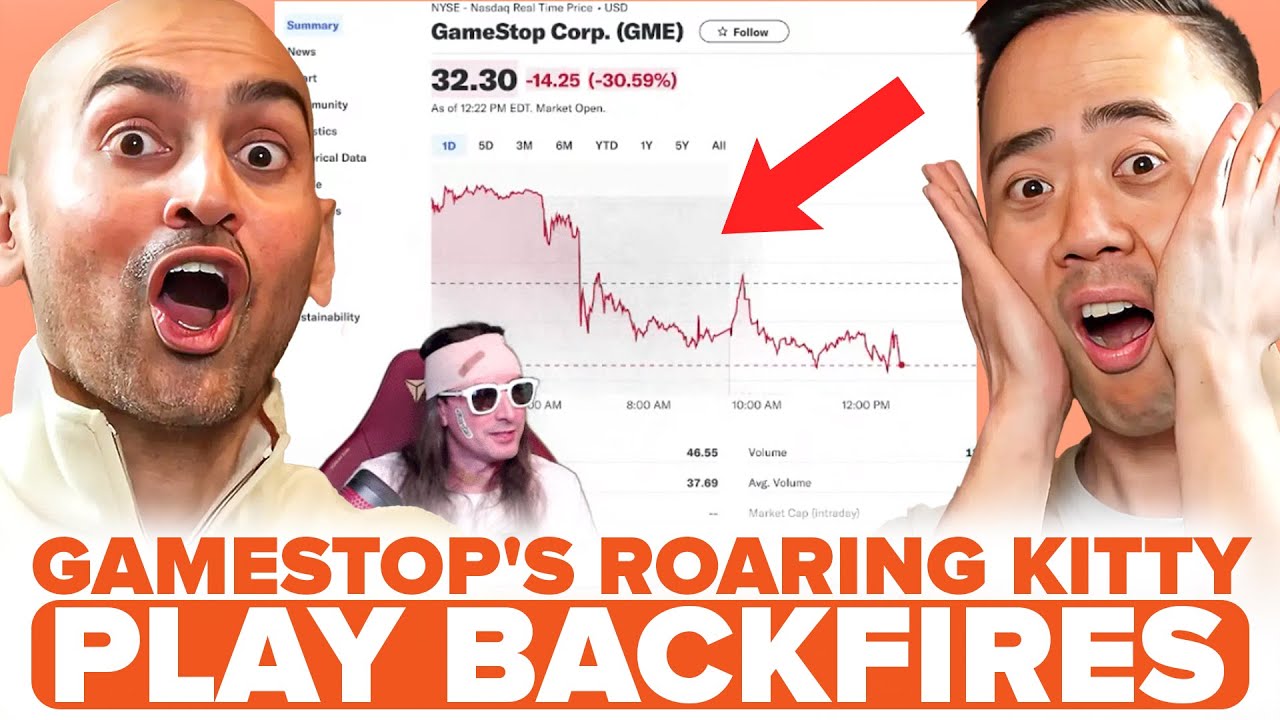
Keith Gill. So he posted how he's gonna do a live webinar, and after hours, I think the stock spiked to like $60. All right. And then GameStop announced— this is the curveball— they announced they're gonna release more shares and, uh, get some cash, because why wouldn't they? And they also put a disclaimer out there talking about the value of the shares and not necessarily being, you know, valued correctly based on the company financials. And, you know, they were— I think they were just protecting themselves from any legal issues. But yeah, all of a sudden it caused GameStop to erase the $60 and go back to what it was pre-open. And then I think it went down all the way, what, 20, 30%, or was it 40%?
Let's look at it here. Oh, you're not as fast because you're on your iPad, huh? Um, so 5 days, so it shot up to $61. And just for context, on June 5th it was at $26, so then it shot up to $61. Um, and then now Friday it's down to $27. Yeah, so the same thing.
Yeah, so it's gone up a little bit, you know, from $20 to $27. That's not bad. But it's no $60. And this Roaring Kitty guy is still going to make a killing. He's just not going to make as much compared to if it was $60.
He didn't do it. I mean, I think that the lesson with this one is he built an audience off the Reddit mania and then everyone started to follow him and he kind of held onto it. And then, you know, the moment he just posted a meme of him like, you know, hey, it's— this is— that meme actually means we're about to fight the final boss. It's that when the gamer locks in like that, the gamer becomes really focused, right? And you see when little kids focus more, that's what was happening, right? It's like, this is the final boss. And so I think we're going to see more of this in the next couple of years because I don't know that the SEC knows what to do with this yet.
Yeah, I don't know if it's illegal or not. I'm not a lawyer. I saw Morgan Stanley, which owns E-Trade, was debating whether or not to stop Roaring Kitty from trading on their platform anymore. And it was just legal and ethical reasons and they haven't figured out what they wanted to end up doing. But yeah, it's a big gray area because what's the difference from Roaring Kitty talking about a stock and saying, by the way, I own it and I'm not giving investment advice, and Jim Cramer on CNBC saying like, oh, check out this stock, it's amazing, buy, buy, buy, buy, buy, right?
Well, he— so the difference is, the difference is it was so subtle because he built the audience. And like, you remember your friend Tim Sykes, right? Like, he built his portfolio and then everyone started following. He's like, oh my God, this guy's going to help us make money, right? And then he's just like, hey, I'm going to go all in on GameStop. It worked and he disappeared. And then he came back, but he had built up so much of like trust with his audience already. The moment he posted a meme, it's just like, oh crap, here we go again, right? So I think that's a really like unique thing that he could do where he didn't say necessarily buy more GameStop.
Yeah, he didn't explicitly say you should buy GameStop. What's funny is Tim Sykes says, hey, buy this stock, sell this stock, or this is what I'm doing. And he hasn't gotten in any trouble. And I know they have amazing lawyers because we share one of the law firms that we both work with. And I know that legally during certain times, he can't just go in and out. He has to give like a specific time window before he can do a transaction so that way he's in the clear. I don't know exactly what the rules were, but there's a way to do it where you don't get in trouble. And I know You know, Tim hasn't had any issues from my understanding and he is really careful because we were both in Newport Beach years and years ago. I think like 12, 13 years ago.
Javier's?
No, we were, he rented like a house and we were just chilling there for the weekend. And he was just like, he's like, oh, check out this stock. And he was telling me and, you know, he was like, oh, I can't actually do anything. I need to give it time because of some alert that I just pushed out for legal reasons. And then he showed me he didn't make as much as he could, Because he was following whatever time rules that he needed to, but he still made money from it.
All right, everyone, quick message from the Agency Owners Association. So this is the peer group for agency owners that Neil and I both put together. This is for people that are doing 6 figures, 7 figures, 8 figures, even 9 figures as well. And we're all here to help you grow your agency faster. In this group, we share leads, we share learnings with each other. It's a community where people can ask questions, their most burning questions personally, professionally. We'll share templates, reports, things like that. We're constantly adding more value to the group. I will tell you that the price is continuing to increase. The good news is that there's no long-term commitment. So you can just learn more by going to marketingschool.io/agency. Once again, that's marketingschool.io/agency to learn more, and we hope to see you inside.
So there was quite a few marketing leaders that met in New York and they had a whole conversation around whether or not AI should be used as a primary creative tool in the ad industry. You know, of course they're not going to be able to decide for people whether AI should be used or not, but nonetheless, what we were seeing is People are already worried about it and they have a lot of different points from whether, you know, hey, are you plagiarizing someone else's work? Is it truly creative? Is the quality going to be high? I think some of it is fear from the ad industry. And I also think that companies should do whatever they want. And if it produces a better ROI, use more of it. If it doesn't, then don't.
You know, It's like the marketing leaders met at New York. It's like, who gives a crap? It's like, are they the world's richest people? Do they have a lot of influence where they can just actually make decisions top down that affect everyone? Not really, right? And so I think more than anything, what you're saying, Neil, is there is fear because most people, I'd say the majority of people are generally resistant to change. And you look at how long the internet took to take effect, right? The internet's been around for 35-ish years or so. Like the commercial internet. And when you look at new technologies, it's like, oh, it's going to be a fad. It's going to be a fad, right? And granted, a lot of things do tend to be fads, but even crypto, that's going to take another probably 10, 20, 30 years to really play out. And so this stuff with AI, I don't think that trying to fight against it, which is what we've been saying on this podcast, is going to be helpful. You're better off just embracing it.
Dude, so I totally agree. I don't think there's a point in fighting it. I think you should embrace it and you should use it to become more efficient. Dude, you and I have been using it for, I don't know how long, but year plus. And we found instances where it helps us and instances where it hurts us. Like I haven't figured out how to produce AI fully written content and it'd just be amazing 100% of the time or even 80 or 90% of the time. I'm assuming you're in a similar boat.
Yeah. You know, I watched a clip with MrBeast and then someone asked him how he uses AI with his stuff right now. So he plugged his own software, but which is not really AI, but he says that the way he uses it right now is uses the AI to find certain moments to clip, right? So if I, for example, in this podcast we're recording for 90 minutes or so, or 75, whatever it is, but I might say Neil a couple times, it'll find all the instances where I said Neil and then you can easily clip those moments. And then it seems like he does use ChatGPT quite a bit to come up with different ideas. I think you and I could probably use it better for packaging because I think both you and I are not the greatest when it comes to packaging our YouTube thumbnails and our headlines, right? Because you should have a bunch of different ones. But in general too, too, because Neil and I both have an SEO background, we tend to, I think we go to what we understand, which is blogging quite a bit. It hasn't quite beaten the human when it comes to blogging.
But even with social, we both post a lot on social. I haven't seen AI create amazing social content yet that just gets tons of views.
I look at it as the same. I look at blogging Writing and social is the same. It's like writing good shit, you know?
Yeah, writing or creating visuals, it's just not there. The visuals may be appealing, they're just not getting engagement. And at the end of the day, if you create content for social and you can't get engagement, then it kind of doesn't matter.
All right, so I wanted to take a second to tell you about Leveling Up Founders. This is an event/mastermind for people doing 7, 8, 9 figures. These are founders that are doing that amount. And we've been doing this event for a couple years now. We've had amazing speakers, but more than anything, it's about the people. What I mean by that is like-minded people want to hang out with like-minded people, and this is the best spot to connect with people of a certain caliber. And we vet every single person that comes through. So if people are— even though they make a lot of money, but their character, we don't really align with that, we're not necessarily going to let them in. We did this event in Beverly Hills, and it's happening in the beginning of August. All you have to do to learn more about it is just go to levelingup.com/founders. Again, it's levelingup.com/founders. If you want to hang out with amazing people, Neil, my podcast co-host, is going to be there. I'm going to be there. People like Syed Balkhi, he will be there as well. And again, it's going to be a great time. levelingup.com/founders to learn more, and we'll see you inside. Speaking of engagement, you know what's interesting to me? So the— remember I talked about Eight Sleep a couple of weeks ago. Guess how many brand searches they get in the United States per month?
Eight Sleep. Let me guess, 100,000?
22 million. So—
Per month.
Here, check this out. Per month, per month. Here. So check this out. So I did a little— the cool thing is we're recording remotely so Neil and I can both do screen shares here. So I did a little post here and here's the right way to measure SEO, right? And Ahrefs has some really cool competitor graphs. I don't know if you know this, Neil, but you can look, Eight Sleep I'm doing in the blue over here and then Amerisleep is in orange and then Sleep Foundation and then Casper and Sleep Doctor. So these are all sleep websites that get a lot of traffic. You can see, and those of you that are trying to prove out the value of SEO, by the way, when you're looking at your clients, you can just look at Eight Sleep's traffic value. It's $5.5 million per month. The traffic value means that they would be paying Google for that organic traffic, $5.5 million a month. So that's the value of the organic traffic, right? Now, in second place, you see Casper at $870K per month, and Casper was public. I don't know if they took it private again. Sleep Foundation is $687,000 per month, right? And you can see over time, the blue line just keeps shooting up. And then one other thing I want to show you over here is, look, just in the United States, Eight Sleep is driving 15 million visitors per month and Sleep Foundation is 2 million. And I was like, what is driving all their traffic? Because they're not, I don't think they're the strongest at SEO. Look at this, their share of voice when it comes to their share of traffic value, right? 75%. versus everybody else. And so my point of showing you this is that the way, one, the way to prove SEO is to show, okay, can you tie to dollar values, right? But going back to Eight Sleep, the reason that they're doing so well is because they're going hardcore with branding. Look, you look at all the sponsorships that they do, the Formula 1, they do all the big podcasts out there. Huberman, you hear them on Tim Ferriss podcast, you hear them on every single podcast out there. And that's why their brand is just everywhere. It's ubiquitous. Like everywhere I say it, it's like you hear it's like, oh, do you have an Eight Sleep? Do you have an Eight Sleep? Do you have an Eight Sleep? It's just their brand has gotten so strong.
Yeah. And by the way, are you an investor in Eight Sleep? No?
Yeah.
Good for you. The big thing that I've seen years and years ago, and they're pretty much leveraging this trend, call it like 8 or 9 years ago, maybe a little bit longer than that, I noticed a trend where if you get a ton of brand queries, your rankings for everything shoot up. And it still is true today. Google loves brands. They know brands are less likely to put in fake news, bad information, whatever you want to end up calling it, right? And what we ended up seeing is if you can end up building a brand and the brand doesn't have to be your exact domain name, it can be like neilpatel.com/ubersuggest. Everyone typing in Ubersuggest and then mainly clicking through on the Neil Patel result. That also helps with brand queries, even if it's not the exact name of your domain name. They're able to just look at how many people are typing in a keyword and what's the click-through rate on it. And if it's extremely high, It helps a lot of your other terms just rank higher from everything we've tested.
You know, I've always had a sneaking suspicion because the name of the company, my ad agency is Single Grain, and a lot of people search for single grain malt whiskey. And so I don't know if there's a correlation there, but it always is, there's always a good amount of brand searches for the keyword single grain. The other thing that's worth calling out, which we've said a couple times already, is the, when you think about MrBeast, when he tells you to go watch a video, he never links to it directly on Twitter. He never links to it directly on YouTube because he wants you to search for it. at YouTube and he wants to, I don't know if he intended to do this, but it helps with his brand at the end of the day. And you and I both know people that have tested this. They've run different types of campaigns where it's like, oh, you know, like Rad Fish Kid SparkToro case study or whatever, right? When he did the reveal on the Google leaks and that really helped SparkToro and they got, it seems like they got a bump in traffic at least for that week.
Yeah, and it helps with the rankings for all the other terms that SparkToro is ranking for, right? So you'll find the same thing. And Rand did a study a long, long time ago when he was at Moz where he had everyone type in like best steaks or a keyword like that. And he told everyone click on like the second result or the third result and it ended up spiking up really quickly. He also did an experiment where they would click on like the first result, quickly click the back button and then click a few down.
But— By the way, he also did it with like fake keywords too, like gibberish.
I didn't know that he did it with fake keywords. But yeah, it just shows that Google has been using these signals from click-through rates to brand queries and things like that. like that for a very long time. They have a huge impact on SEO.
All right, everyone. So that's it for today. Speaking of which, the Agency Accelerator, or sorry, Agency Owners Association, I should say, Neil and I will both be doing a session this week. And so we do these, we do these group coaching calls every now and then. So that's happening. You can learn more about this group, marketingschool.io/agency. Please don't forget to rate, review, and subscribe. It helps this podcast grow and we will catch you later.









