Google’s AI Overviews Slammed by News Publishers
This content was created by Eric Siu. This content was uploaded by Eric Siu. This is a YouTube episode titled "Google’s AI Overviews Slammed by News Publishers" (posted 2024-09-24) featuring a conversational discussion between Neil Patel and Eric Siu. They talk about recent backlash to Google AI Overviews, whether overviews are stealing publisher traffic (data suggesting slight traffic gains for some), Google's Helpful Content updates and Danny Sullivan's comments, the importance of brand authority versus domain/link authority, and related SEO/data studies. The hosts also include promotional segments about their Agency Owners Association and Eric's agency Single Grain, plus a discussion of brand-building ideas (e.g., the 95/5 rule and mental/physical availability).
Chapters
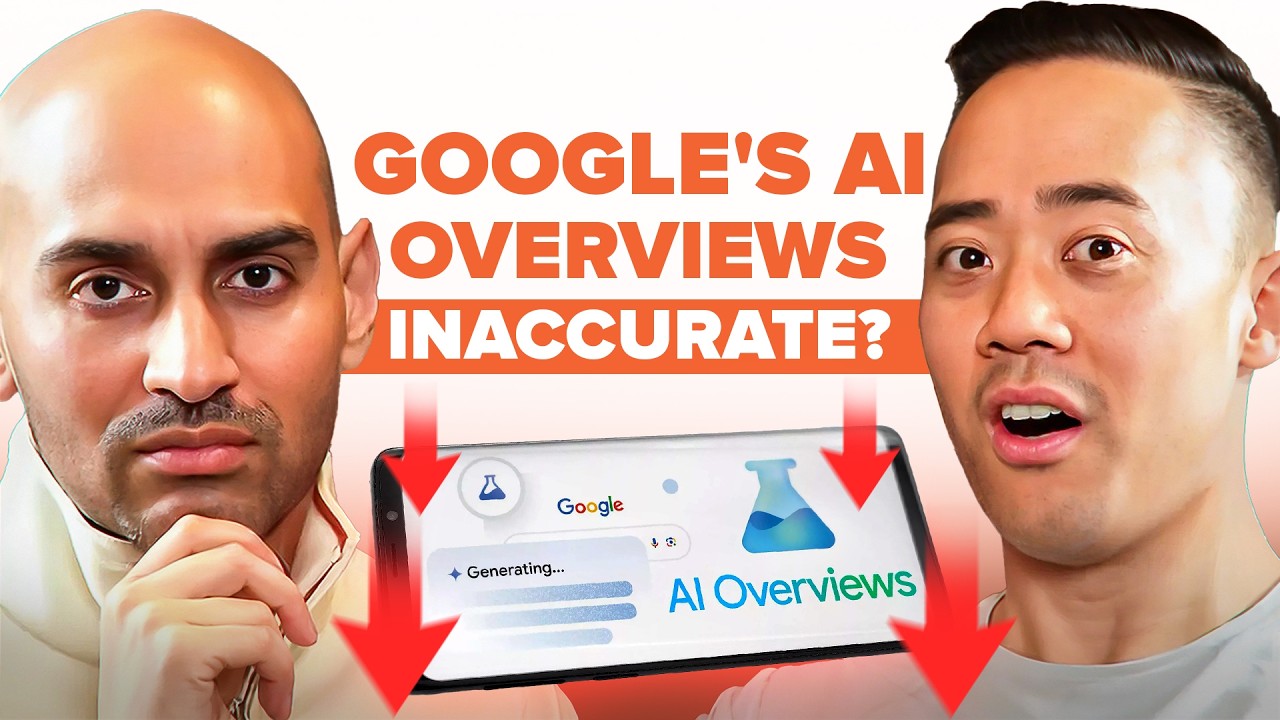
All right, so we have talked about Google AI Overviews, but have you seen how they've been recently slammed by tons of news publishers?
No.
A lot of news publishers are saying, A, the information is inaccurate. You know, this is on Search Engine Journal. A lot of people are complaining how a lot of the AI Overview content is inaccurate. But you want to, if you had to take a guess, what do you think the number one thing news publishers are griping about because of AI Overviews?
That they're taking the traffic?
They're taking the traffic. And I don't know where they're getting this from, but we're seeing an increase in traffic and we have a lot of data points on this.
I just think, you know, like as you say that, I'm like, I look at it, I'm like, no, like who can— I'm not— when I look at the AI overviews, it makes me want to click to the result to read more. Yes.
We're seeing the same thing.
Yeah.
And forget what we believe. We're seeing data that is causing more clicks. Not by a lot. It's a little bit more than 1% that we've seen an average increase for people who are doing SEO. Not a big increase, but the notion of people like, man, they're jacking all my traffic. No, they're not jacking all your traffic.
I think it's just human nature to like to blame.
Yes.
And that's what this is.
Or it's just like, why don't people just adapt? I don't get why people just keep complaining.
It's because people don't want to take responsibility, Neil.
That's right.
Yeah. Anyway, we'll just leave that as what it is. I got to take a minute to tell you about the Agency Owners Association. This is a peer group for agency owners. Think YPO or EO, but for agency owners. And I just wanted to read you a couple of testimonials. So this first one comes from Carrie, and we asked her, what do you like most about the group? She said, having a group of people to discuss discuss and bounce ideas. The leads are great too. Yes, we share leads in this group as well. This one from Ollie, and he says, the ability to really post whatever I want and need and the group responds. Great experienced members. Getting a lot of insights from conversations with other members. Getting a lot of value from sessions from Eric. Getting advice from others as well. And so if you want to grow your agency faster and you want a peer group to do so, just go to marketingschool.io/agency. This is a group that both Neil and I created, and our hope here is to create a vibrant community of agency owners and do a lot more with it in the future. So again, marketing Click on the link below, go to neilpatel.com/school.io/agency, and we'll see you inside. Okay, since we're talking about Google right now, okay, there is a report by Cyrus Shepard over here that shows sites that are susceptible to Google's helpful content system, right? So Cyrus Shepard says, excellent data via TH Capper showing sites hit by Google's helpful content system tend to have lower ratios of quote unquote brand authority to quote unquote domain authority. Oversimplified layman's terms, when your brand is weaker than your overall link profile, you may be at risk to Google's helpful content update. And remember, we talked about this since the beginning of this podcast when Eric Schmidt would say brands are kind of the things that stand out versus the cesspool of the internet.
Brands are the solution.
Yeah, brands are the solution. And so you might have a super strong link profile, but if you have no brand authority, you're going to lose. And so here's what it says over here. Cyrus says, I would posit that this is only one factor of many when considering Google's HCU, but having a highly visible brand with lots of brand and search volume seems to be a great defense against negative Google actions, right? And so it shows average domain authority and brand authority of analyzed sites. When your brand— when your domain authority is super strong, but brand authority sucks, that's when you're likely to get hit. And I think that's a little interesting to me.
I never thought about the ratio, but I can definitely see that because you can build a ton of links, although that's hard. And you may not have a strong brand.
Yeah. Yeah, I mean—
And I bet you they're comparing branding for other people ranking for similar keywords versus just domain authority and overall brand queries.
You know, I mean, let's just use these software review sites as an example, right? You've seen a couple, you've been involved in some as well, but there's one I remember called Finances Online. They're never quite as strong as like a G2, for example. Or like a Clutch, it's kind of its own brand, right? And they rank for all the agency keywords. So those are 2 really good examples. Wirecutter would be another one that ranks versus just like, you know, buy stuff online or whatever.
Well, Wirecutter also has a ton of domain authority.
From New York Times. Yeah. But even before.
Yeah. No, they had a brand. And having it on the same domain helps because New York Times has really strong branding as well as domain authority.
Yep. So by the way, in this study, I'm just continuing on here. This is from Chris Long from Go Fish Digital, I think. So in the study, Tom Kapper, that's his name, he analyzed 1.8 million URLs to identify the winners and losers from 2 different helpful content updates. So September 2023 and March 2024. He defined the winners and losers as anyone that had a 50% change in terms of their top 10 ranking queries. After analyzing his data, he found something super interesting. When calculating a domain authority to brand authority ratio, this was one of the factors most correlated with sites that saw losses. So anyway, you like these graphs, they're pretty cute. You should do more graphs like that. But anyway—
I released one today.
Did you? I didn't see it.
Look, social networks, LTV.
Dude, come on, but it doesn't look like one of those data science graphs. This is just bar graphs. You got to go, you got to level up your bar, your graphs. Okay, how many people understand those Not many. Exactly. That's why we don't do it. Touché, touché, touché.
No, dude. So when we do analysis and our team analyzes tons of sites, it looks something closer to that versus this. We turn to pretty data because when you're presenting in front of a lot of people, people are like, dude, I have no clue what you're talking about.
Okay, that's fair. That's fair. I stand corrected.
And that's a good point for everyone. Eric and I both do this. When we present to an audience, I can't because I'm not that educated, but I do not talk like I'm from Harvard or MIT, nor does Eric. We don't use big vocabulary. We just talk like we're one of the people in the audience and we just relate.
Yeah.
If you can't do that and you want to talk over people's head and seem smart, they're like, cool, you're really smart. We're not going to do business with you, but you're really smart.
And people are just not liking you because you're not as relatable.
Yes.
Yeah. Yeah. All right. Quick note. This is about my company. It's called Single Grain, and Single Grain is an ad agency where we're focused on driving innovation. I want to talk about a couple of new strategies, and if you need help with marketing, great. If not, here are a couple of new strategies that you should try out. One is programmatic CRO. So we are doing programmatic conversion rate optimization on our site. So it's building products that will automatically optimize your site to increase conversion rates. We're also auto-optimizing, auto-updating from an SEO standpoint, and we're constantly thinking about what else we can do in terms of enriching the visitors that are hitting your website and also tailoring custom messages for them using AI. And so there's a handful of things that we're doing from a marketing standpoint And our mission is just to drive more innovation. So if you want to learn more, just go to singlegrain.com, grain like rice. So singlegrain.com to learn more, and we'll see you inside. By the way, did you see the interview that was done with Danny Sullivan?
I did. I didn't read it all, but I saw it. There was a lot of Twitter notes on it.
Okay. Do you want to give some of the notes? Because I didn't see the notes. I just— I'm reading the bullet points from ChatGPT.
Yeah. So the big thing is with Google Helpful Search, there's a few things talked about such as, hey, if you have a drop in traffic, you over time can get back traffic, but it doesn't mean you'll necessarily be back to where you are.
And by the way, let's just reset the tone here. This is Danny Sullivan who used to work at Search Engine Land, who was the chief, the editor-in-chief.
He was the co-founder of Search Engine Land.
Oh, co-founder. And then he got hired by Google and he's a Google search liaison now.
Yes. So there's a few things Danny's been talking about. And to give even more context, People have been having issues saying, hey, Google's algorithm isn't great. We're seeing a lot of crap sites rank. So that's context. And what's happening is, is people have been talking about it all over the web and showing examples of crap websites, crap results, whether it's from AI overviews or whether it's from just irrelevant sites ranking or people taking content and their site ranking over the original source. And Danny has talked about things like, hey, if you saw a decrease in traffic, It doesn't mean that when you optimize your site, you're going to go back to having the same traffic. It may be a little bit less, could be a little bit more. He also talked about things like, if you optimize your site and you just started ranking and you're ranking, let's say position 6, you may not want to touch that page too much and tweak it because it could also cause you to lose traffic just like it could cause you to gain traffic. Another thing he started talking about is Google has been making a lot of changes to the algorithm and they're continuing trying to tweak it and make it better and more helpful to people. You don't want to just go and continually just keep changing and changing and changing. Just let things settle in and you should focus on what's doing best for the user. If you're doing what's best for the user, even if you've seen a decrease, keep focusing on that. And in the long run, hopefully things work out for you.
Yeah, there's a lot in this one. I would just recommend you guys go to Search Engine Roundtable. But some of the bullet points I got here was, so it says, Sullivan acknowledges some sites struggle with recovery from previous updates. That's always been the case with SEO. And Google emphasizes consistent content quality rather than specific tweaks or rankings. The update aims to better service content from smaller publishers, which we've seen quite a bit. Google's core updates focus on improving search quality, high-quality content. Here's the thing with these, right? He has to— Google has a certain way of talking in these interviews and there's not a lot that he could give away. And this is a really long interview, right?
Yeah.
So we ain't going to read all that.
No.
But I think, Largely most people know what to do here. By the way, did you gain traffic from the last update?
Did I gain traffic?
Uh-huh.
Yes. I thought you said gate traffic.
I'm like, oh, sorry, gain. G-A-I-N.
Yeah, we did gain traffic.
Here, I'm just going to read one section.
Did you gain traffic?
Yeah. It's like everything's ripping in a good way.
So when our traffic goes up, our lead count doesn't go crazy up. When our traffic goes down, our lead count doesn't go crazy down.
Ours has gone up a good chunk, I would say. But okay, let's see what he says here. He says, AI content and scaled content policy. So Rusty Brook says, I then moved on to the topic of AI content and asked if the same advice is there. In short, Sullivan said the same thing. It is not about if it's written by AI or not, but rather it is about the scaled content policy. He said, people focus on the wrong message. They focus on that AI-written content is okay in some cases. But he said the focus should have been more on if the content is being produced at scale, AI or human-generated, with the intent to be written for search and not users, I would look very closely at what we said about scale, scaled content abuse. And then finally, the last part I'll say is Sullivan said that the community seemed to take the first half of our statement and ignore the second half. The first half of our statement was we're not really focused on how the content is created, whether or not the content is helpful. And that got turned into a bunch of people as Google doesn't— as if Google doesn't care if content is AI. That was the wrong message. So at the end of the day, just provide value. with this stuff. All right, I got one here. So this is how you can change your brand from BS to holy yes. All right. So from bullshit to holy shit. So this is from Chubby's— Chubby founder, they IPO'd. And he said, look, I spent most of my time on the road to Chubby's IPO thinking brand marketing was BS. However, these 5 ideas changed that. This is a really good post. He should post more. It helped me gain confidence that number one, 1, brand building is something modern consumer brands need to do. 2, there is a way to connect brand building to financial results. And 3, doing so generates more profits than direct response alone. So I'm going to give you like 2 ideas he has. One is called idea number 1, the 95/5 rule.
Okay.
It says, the points are only 5% of buyers are in market to buy right now. Number 2, effective marketing increases the probability the brand comes to mind when the buyer goes in market. Right? So his action here, he says for the first idea is focus on the 95% and make creative that gets remembered. Okay. So number 2 is actually, let's do, yeah, idea number 2, physical and mental availability. So the points here are brand growth comes from growing the following 2 things. A, mental availability, buyers think of the brand when in market to buy. B, physical availability, buyers can buy the brand when and where they're ready, right? So when you build mental availability, you increase the likelihood people buy from you without being prompted by a conversion ad. And then the action here is building mental availability. Availability is priority numero uno, right? So he says all these things, goes towards the end, and he's like, there you have it, how to turn brand marketing from bullshit to holy shit. And a couple of weeks ago, we talked about how like, you know, Adidas was like they spent too much on performance. Nike was like they spent too much on performance. Again, I think it's like a 60/40 thing. And you, depending on who you are, maybe you go towards more, more towards brand, but it's It's a mix at the end of the day. So that is it for today. Please don't forget to rate, review, subscribe. Go to marketingschool.io/agency. You can no longer just sign up for it. It's application only now. And if it does look like it's a good fit, we'll have someone from our team reach out and see if it's a good fit for the group. So that is it for today, and we will see you tomorrow. Bye.









