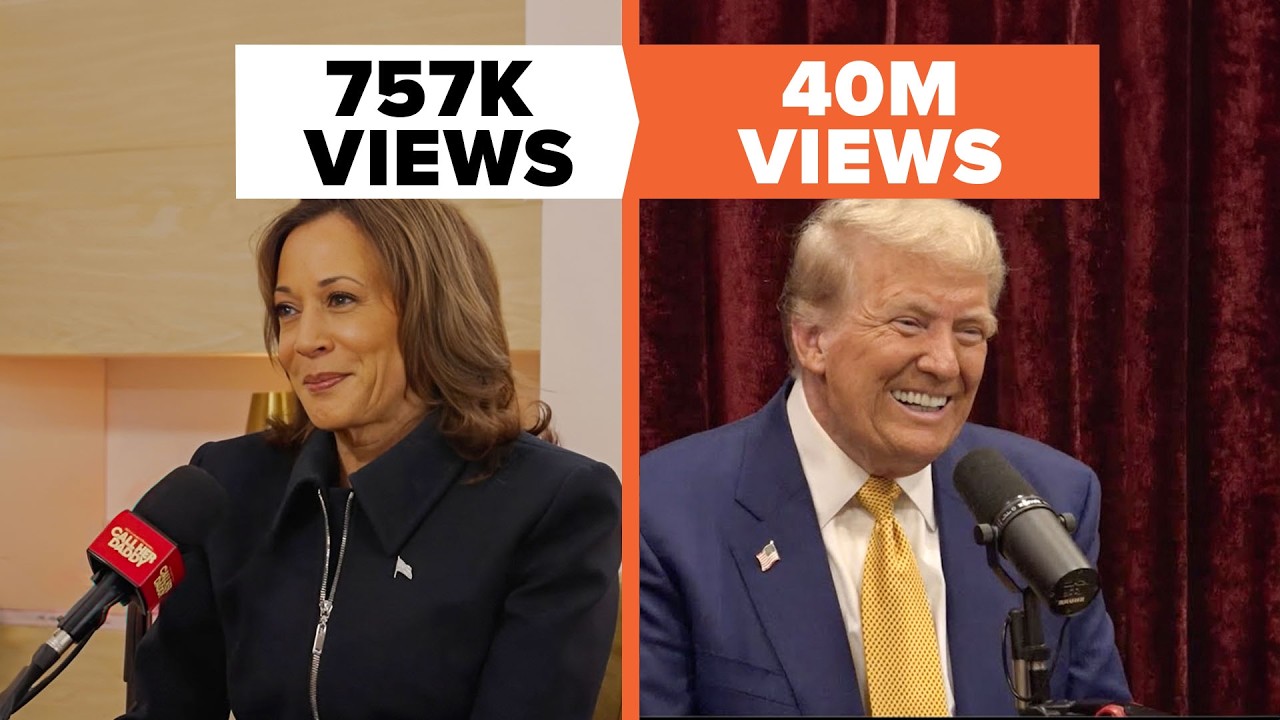
This content was created by Eric Siu. This content was uploaded by Eric Siu. This is a YouTube conversation titled "Harris vs. Trump: Podcast Views, Censorship, and Media Influence" (created 2024-11-01) featuring Eric Siu and Neil Patel. The two discuss comparative podcast view counts (Kamala Harris on Call Her Daddy vs. Trump on Joe Rogan), allegations of censorship/search visibility on platforms, political polarization and its effects on brands, Jeff Bezos' stance on the Washington Post and media trust, and business advice about avoiding mixing politics with marketing/employees. The excerpt also includes a promotional mention of Eric Siu's agency Single Grain and a plug for the Agency Owners Association/marketingschool.io/agency.
Chapters
Did you see Kamala Harris' podcast views versus Trump's podcast views?
No.
Okay, so Kamala Harris did an interview with, um, what's it called? Call Her Daddy, right? And a very popular podcast. They got funded like, I don't know, $100 million. Number 2 to Joe Rogan, basically. So Spotify did a deal.
Is it a sex podcast?
Huh?
Is Call Her Daddy a sex podcast?
No, no, no. It used to be, I guess, but it's just a popular podcast now. So Okay, so she got 771,000 views and then Trump did Rogan, right? And Rogan, I think, is now over 40 million views.
For the Trump podcast.
Yeah, so it's like, and then plus they talked about censorship with that video too, right? 'Cause like people were just showing that, oh, you can't search for it. Everyone was trying to search for the Trump Joe Rogan podcast and it wasn't coming up and people were showing the video. It wasn't coming up on YouTube. And then YouTube claims that it was because too many people reported it and so they just made it invisible and that's what tends to happen, right?
Wow.
I don't know if I buy that, but, Even though it got censored, he still has over 40 million views versus 771,000.
But here's the thing. If tons of people reported it because they didn't like Trump, you bet you, because roughly half the population is a Democrat, half of it is a Republican, at least in the United States, roughly. I'm a little off on my percentage, but it's close enough. The other half is going to report the Harris podcast. Why wouldn't they, right? So why would that show up?
I don't know about that because, okay, Usually if you're Republican, you're kind of doing your own thing. You're focused on yourself. That this is what I— this is what I believe to be the Republican Party. They're typically not the type to, I don't know.
No, there's extreme Republicans and extreme Democrats on both sides.
Yes, there's extreme right-wing and there's extreme left-wing, right?
Enough where YouTube would remove both. But actually do a search on it. Let's actually do a search. What is it called? Call Her Daddy?
Call Her Daddy, uh, Kamala Harris.
Let's see. Vice President Kamala Harris, call her daddy. 600,000, 746,000 views, like what you said.
Yep. And then search— now I think you could find the Trump one. Type, type Trump Joe Rogan.
Okay, so Trump Joe Rogan, uh, is it Powerful JRE?
Yeah.
40 million views.
Yep, 40 million views. Right now you can find it, right? Um, but our point of saying all this is, oh no, oh, we support Kamala Harris or Trump. No, it's more so Trump's brand is just really strong. And I think he's got, he's got like this rabid fan base behind him. Right. And so when you kind of built like this cult following, um, I mean, the numbers reflected at the end of the day.
His brand is polarizing.
Yes. And polarizing gets views.
Yes. Harris's brand isn't as polarizing, but a lot of people on the other side are voting for Harris or want to vote for Harris because they don't like the Trump brand. If I had to take a guess, that's what's making her more popular.
I told you about this, right? So I just randomly did an experiment earlier this year. Like a couple of Ubers that I sat in this year, um, I just asked them, who are you gonna vote for? Right? And then they would always say Harris, right? I was like, okay, interesting. So what do you like about Harris's policies? And they're like, oh, it's just not Trump. And then I asked my, my, um, one of my close family members, we'll leave it at that. Um, and, um, he's— I was like, okay, so, um, who are you gonna vote for? He's like, Harris. I was like, okay, what, what's, uh, what do you like about Harris's policies? Right? It's like, he's like, oh, you know, um, I just— the other person's so evil, I can't, you know? I was like, but like, tell me what, Any policies? Like, no. So to your point, a lot— it seems like a lot of people are voting just because not Trump.
Yeah.
Yeah.
Which is powerful for marketing.
Yeah.
And if you're ever facing a competitor who is really polarizing, play the opposite. You'll get a lot of customers from it.
All right. Quick note. This is about my company. It's called Single Grain, and Single Grain is an ad agency where we're focused on driving innovation. I want to talk about a couple of new strategies, and if you need help with marketing, great. If not, here are a couple of new strategies that you should try out. One is programmatic CRO. So we are doing programmatic conversion rate optimization on our site. So it's building products that will automatically optimize your site to increase conversion rates. We're also auto-optimizing, auto-updating from an SEO standpoint. And we're constantly thinking about what else we can do in terms of enriching the visitors that are hitting your website and also tailoring custom messages for them using AI. And so there's a handful of things that we're doing from a marketing standpoint And our mission is just to drive more innovation. So if you want to learn more, just go to singlegrain.com, grain like rice. So singlegrain.com to learn more and we'll see you inside. We should also talk about, um, you actually sent me this, the Washington Post, what happened with, um, that situation. We should talk about Jeff Bezos' response to that.
Yeah. So Jeff Bezos went out there and said, people don't trust the media anymore. And he's specifically talking about the United States, but this could be applicable to many other countries. Uh, and what he did is he stopped the Washington Post from endorsing a candidate, which they, they've always endorsed a candidate for what, the last 30 years or something like that?
Something like that.
And he's like, nope, you know, we're not endorsing anyone. We're here to just be neutral and state our opinions. I'm paraphrasing. He didn't say neutral, but he, you know, he wants to instill trust in the media and he doesn't want to seem like he's leaning left or right. Um, but that is actually true journalism. You report things for what they are, not based on what you want everyone to believe. And I think this was really smart, even though he lost, what, they said 200,000 subscribers.
200,000, and they only gained 4,000 this year.
That's huge. And I think they lost a CEO too for this.
Maybe.
I think the CEO resigned.
There's quite a few people that resigned. There's a couple of major editors and then some other people, but I don't know if the CEO resigned. I didn't see that.
But this is why I like this move from, Jeff Bezos. All right. Jeff Bezos bought the Washington Post. For him, that's like me spending a dollar, anyone spending a dollar. It is literally, it's actually like me spending probably a fraction of a penny. That's probably how cheap it was for him. So for him, you got a trillion-plus dollar company. Would you want to screw up your trillion-plus dollar company by saying that politically you believe in one candidate or other? Because what's changed now, I think, compared to before, you're starting to see people having issues, entrepreneurs having issues because of what they vocally say politically. Like before, back in the day, uh, Buffett was out there with Clinton, right?
Mm-hmm.
And you're now seeing a lot of entrepreneurs get away from endorsing any candidate. And if you look to see what's happening, look with Elon. California did not want to give him approval for more rocket launches, and they cited because of his political views and his endorsement of Trump. And then you also had his pay package removed of what, $50 billion or $40 billion or something like that? If I was an entrepreneur or I'm in business, people may not like this, but don't mix politics in with your marketing and your business. Keep them separate. You should just avoid talking about anything related to politics.
And the reason you don't want to talk about politics is you can polarize your employee base, you can polarize your customer base. And I think the main thing that matters to me at least is when you polarize your employees, base, you can't get good work done and it actually affects your— it's a downstream effect for your business. The bottom line, everything, right? And so, that's why I was sitting at a dinner and I was speaking at an investor conference earlier this year and one of the YouTubers there is like, dude, Eric, you should just really speak your mind on what you think. And I was like, no, that doesn't make sense. And he's like, well, no, you'd get so much more views. I'm like, I also polarize my employee base too because when you start to say polarizing things, you're going to have people that disagree with you. And so, then he was just kind of like stared at me and I was like, Yep. So anyway, take that. That's food for thought. Some people like it to get views, but what matters more? Is it views or actually doing the mission of your company and growing your company?
Yes, and you will lose not just employees, you will lose revenue because there's always going to be 50% who disagree with you. And if you say you want to be in the middle, then you're going to have people on both sides disagreeing with you.
It's better to just say we're focused on our mission and that's that. You can have your beliefs, whatever they are, but as long as you're aligned with the mission, we're good to go. All right. So that is it for today, guys. Go to marketingschool.io/agency to learn more about the Agency Owners Association, where we help agency owners grow. And that being said, we'll see you tomorrow. See you tomorrow.