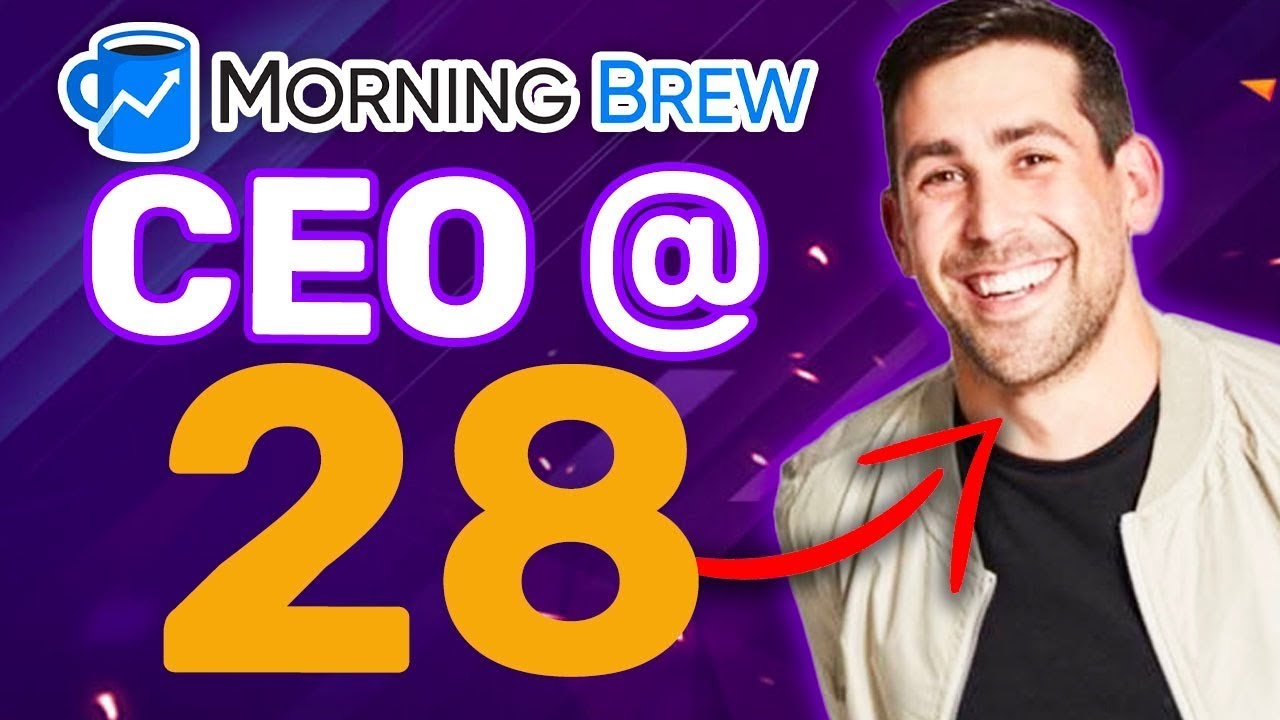
The Morning Brew co-founder stepped down as CEO at 28 when the company hit $100M+ annual revenue, moving to executive chairman because his strengths in selling and storytelling no longer matched what the business needed. His co-founder Austin took over as CEO to handle operations and scaling. Now he spends 30-35 hours weekly on content, recruiting creators, and strategy.
Okay, you're 28 right now, and then you're like, you know, you've done— you did Morning Brew for a little bit. It's like, okay, it's time for me to become executive chairman. So walk us through that thought process and walk us through kind of what you're working on now, because not many people think like that. They're like, I need to be CEO.
Yeah, well, to be totally honest with you, I definitely wasn't in my head like, oh, you know, I have to be executive chairman. What basically happened was we got to the point in the business where I would say the role of the CEO really changed, right? Like, I think you've seen these, these Y Combinator articles about the stages of business and the different forms of CEO. And I would say the early stage CEO, they have one job, which is to find product market fit. Then you have kind of the second stage CEO, which is, let's call it like the operational CEO, which is really about process planning and scaling. And then you have the third stage, which in some ways I think actually reverts back to re-steepening the growth curve, thinking a lot about culture as you've built up a ton of scale. And so, you know, what I found, at least at this point in my life, is I loved the first stage. I loved it. And it's what leaned into the things that I was best at. You know, you learn this very early in entrepreneurship, but like, you really have to quickly figure out what are the one or two things that you're really good at that the world needs that you enjoy doing. And for me, it was selling and storytelling, willing new shit into existence and proving that I had a great solution to a problem. And that was kind of it. And it worked really well in, let's call it the first 3 or 4 years of the business because we were selling everything. We were selling employees on why they should take a risk to join a newsletter business, selling investors on why you should bet on 2 college kids that are building a media business that generally media businesses aren't. Always the best investments, selling advertisers on why you should spend money with Morning Brew when you could go to the Wall Street Journal or CNBC. It was all a sale. And the second piece was actually building, like building the newsletter, building our podcasts, like building our audience. And we got to this second phase where we had the foundation and it was about accelerating. And in order to accelerate, we had to be great at being proactive and looking forward. And to be honest, that was the combination of things that did not leverage my best skills and the things I didn't love most. So my co-founder Austin moved into the CEO role because like that is his shit. That is what he is exceptional at. He's a great operator. And so I moved into the executive chairman role and I would say basically I spend my time on 3 things now. One is creating content for 2 reasons. One is because it allows me to storytell. And 2, as someone who's really passionate about media, I just find it's the best way to see where the industry is going is by being a creator myself. Second is Morning Brew. Like as we scale from, as you refer to it and most people refer to it as a news newsletter to a media brand. One of the big bets we're making is that people identify with people. And so we are bringing creators onto our platform, and that is a new type of sale. And so I'm spending a lot of time on that sale, convincing creators why they should join Morning Brew. And the third is honestly just like tackling the biggest problems with Austin related to the business. And so that's how I spend my time now as, as executive chairman.
How often do you talk to Austin per week?
Every day.
Wow.
Okay.
This is like, I'm assuming, like a couple hours or what does it look like?
We don't have set catch-ups. Maybe we should. We used to, but now it's literally just in between meetings. We'll talk about important things going on. It'll be like if I talk to a really interesting creator who I'm like, we should look more into this person about bringing them on the Brew platform, I'll send them their information on Slack. I'll be like, you should check them out. Or if I'm talking about a challenge within the business with him, whether it's a personnel challenge or whether It's a way to level up our partnership with Axel Springer Business Insider. We'll shoot each other a call. Or honestly, now what we do most is like huddle on Slack. Like huddles have been like the best, the best feature added to Slack.
Yeah, they're fast. So what percentage of your time do you think goes to Morning Brew right now? Do you think it's still the majority, but just in indirect ways?
I would say that 30 or 35 hours a week are spent on Morning Brew.