How Eric got 2.1M views, Our content creation framework & more
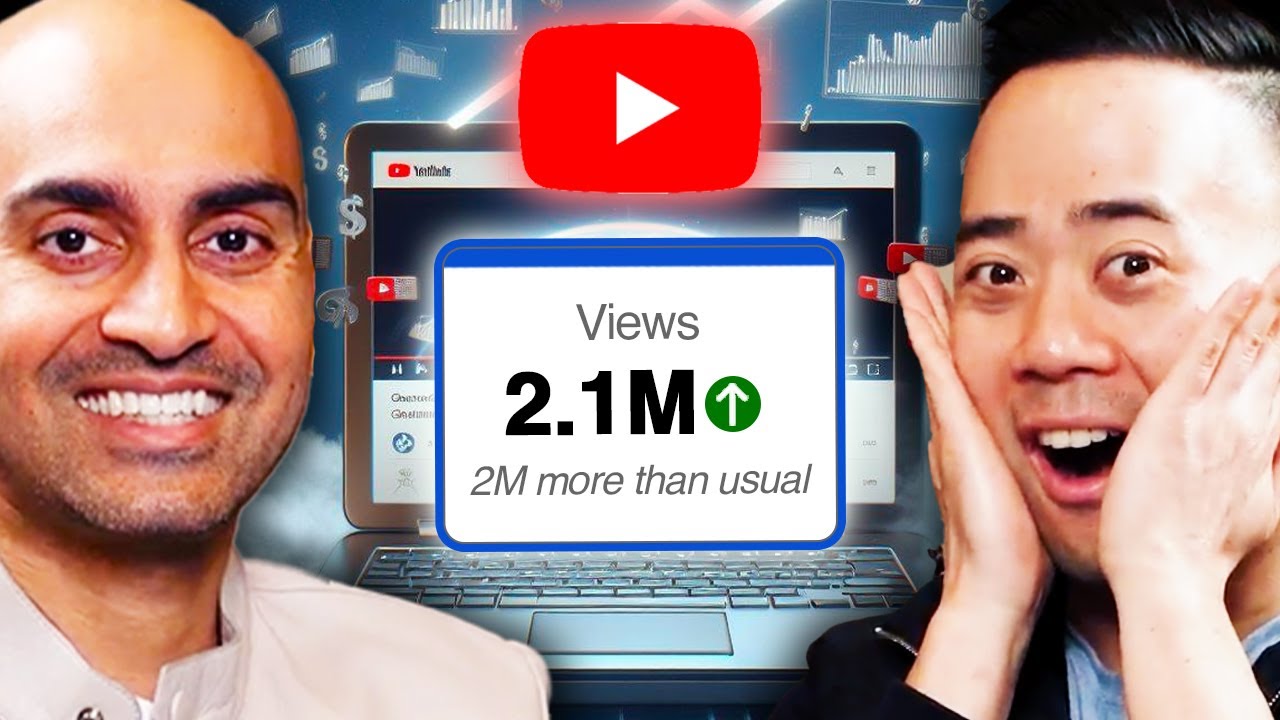
This content was created by Eric Siu. This content was uploaded by Eric Siu. This is a YouTube episode titled "How Eric got 2.1M views, Our content creation framework & more" (Leveling Up with Eric Siu) published Feb 6, 2024. It is an in-person interview/conversation between Eric Siu and Neil Patel where they analyze Eric's recent jump in YouTube views (shorts vs. long-form), discuss hooks, retention, content repurposing frameworks, examples (Vivian, Alex & Leila Hormozi, Chris Do), and broader content/AI research ideas (including a BCG AI study). The discussion focuses on tactics for creating and promoting social video, ideation workflows, and balancing audience reach with business/customer goals.
Chapters
So we are gonna talk about how I got 2.1 million YouTube views from 66,000 views. So in January, so far, January's not even over yet. They'll probably go a lot higher because each day in the last 48 hours is a million views.
Wait, so in January you got 2.1 million views?
So far.
And that is to— what's the YouTube channel?
YouTube is Leveling Up with Eric Siu. Everyone go subscribe and I'll love you forever.
Is the channel name Leveling Up?
Yeah, Leveling Up with Eric Siu.
No, the URL.
Oh, it's just Leveling Up Official.
Leveling Up Official. Man, why do you got to type in the official? Why don't you just have Leveling Up?
Because someone took it.
Okay. So, all right, I'm looking at your channel right now. So when I look at your channel— oh wow, that's crazy. Dude, what was your December traffic? The bar just went all the way up. All right, so— 66,000 or something. So you went from 66,000 to 2.2. Where was most of your views? Actually, I'm just going to sort by most popular. So top careers to choose in marketing. No. Oh, your rich BFF's $25 million secret wealth plan.
Here, Vivian is carrying this channel right here. I'll give you some because it shows me top content. I'll tell you what performed. So last 28 days, never stayed at— so she says some things that are headlines, right? So—
Oh dude, this is Shorts. Never stay at a job for more than 2 years.
Yep. But then here, look at the 4th one. The 4th one is actually a long-form one. That's 225,000 views. That's a really good one.
Yeah, that's the one I mentioned. Your next one is, how rich can you get on content creation? The 3rd one is, if you want to stay at home wife— if you want to stay at home wife, what was the rest? I don't know what the rest of that title is.
If you want to stay at home wife, I think it's dot dot dot.
Yeah, it is just dot dot dot. I'm curious on what that is.
Yeah, main thing is she's got a hot take and then the idea, Tam, is very big.
On a random note, before we dive into how you got 2.1 million visits, what was the short on how rich can you get on content creation? What was the answer?
She said how much she made. So Vivian, she was transparent with the numbers. She makes like 3— she just started a business, I think. She went from working somewhere, she now does $3 million a year, $300K is profit, she's reinvesting most of it.
Wait, base was $80K when she worked on Wall Street, then $10K signing bonus, and then—
Then she went to go work at BuzzFeed. She made like $600 grand, I think, in her top year.
Oh, wow. Yeah.
So now she's like, she makes less, but like she's reinvesting a lot of it. So yeah.
Yeah, she went into tech media and sales, and that's when she started to really make the big bucks. I'm listening, I'm reading the captions as you are talking. Yeah, $600 grand is quite a bit more money. But, you know, she says her goal in the podcast episode—
Is $25 million.
Is $25 million. And then you mentioned to her that you think she can end up making—
Oh, instantly I was like, I'm pretty sure you're going to make more than that in like 10 years.
Yeah, I think she'll make more over time. But what was the secret? Because I'm looking at this, a lot of the views came from Vivian, right? If you look at your long-form video, it was Vivian.
Yep.
I thought her content was amazing or interesting. I commented on one of them. She was like, you should switch a job every single year. Oh yeah, and then Neil's like, this is stupid. Yeah. I don't think I said that in the comment, but—
I think he said something like, this is not true. He didn't say this is stupid.
Yes. And then, so her long-form video is your most popular. And then if you look at the Shorts, it was also the top 3 are her.
Yeah.
By far, because 855, 401K, 369, and then the 4th one was 70,000 views. But if you look at the type of content that you're getting views from, It's— generic's the wrong word, but it appeals to the masses.
The idea TAM is huge.
The idea TAM is huge. It appeals to almost anyone who has grown up, but I bet you that content isn't going to get you one customer.
It won't. And so, that's why in the last episode, if you ever listen to the last episode, while that's cool that I'm getting all these views, and we'll talk about how I got the views and then we'll switch to— we'll move on from that. I was just saying in the last episode, If I want to get more SaaS customers, for example, I should layer in like Jason Fried from Basecamp. Like he's down to do an interview, right?
Yeah.
So he's kind of known in that space. So I'll switch back and forth between high-powered CEOs and then people with high idea or big idea TAMs. And that's what I would say about Vivian, right? Or people like Vivian. Like I think it's great, but I want to switch it up to only people that I'm interested in talking to at the end of the day. So that's that. Now, in terms of how I got to the 2.1, right? Like Shorts is a big thing, obviously. But what I would say is like we've been very consistent starting from August. And so, I guess it's been 6 months or so starting with the Hormozis, right? Alex Hormozi, Leila Hormozi. Like those 2 did really well, 75,000 views, 44,000 views. And then like after that, it's just like a lull, right? Like some videos are 9,000 views, some are like 1,200 views or so. But we talked about this concept of— like at least I still believe there's a concept of YouTube jail, right? Yeah. And I believe because I wasn't consistent that I was in YouTube jail for a while. But now, even with Neil bringing up the shorts, all my shorts were getting like maybe like 1,000, 2,000 views or so. But there's a breakout now because Vivian broke out. When I look at some of the other shorts, 60,000 views, 30,000 views, 50,000 views or whatever, I think I'm out of jail there. And when I'm looking at some of my— the most recent video with Chris Do, that's starting to grow a lot faster versus how it was like 2, 3 months ago or so. So my whole thing is like, Consistency. I'm putting a lot more time and effort into it. So this is not a sexy thing to say. There is no secret here, right? The secret is like good work, hard work. So yeah.
Dude, look, it is good hard work, but you have to make sure your content quality does really well. And I think where most people get it wrong is the hook. If your hook sucks, the rest of your content, no matter how good it is, just won't perform that well. So what I love doing is on Twitter, I will go in And I'll brainstorm hooks and then create the rest of the content based on that. And if something doesn't do well in the first like 10 minutes that it's live on Twitter, I'll go in and edit it because you can edit it for up to 60 minutes. I don't know if that's only for paid accounts. I think it's only for paid accounts. And then what I do is I change up the hook and then if it starts doing better, now I got my hook for when I record my long-form and even short-form content from that tweet.
You know, it's interesting that you say that, Neil. So like, when I rewatched this interview with her, it was like a 1-hour, maybe 67-minute interview. But the first 5 to 10 minutes was interesting to me. So it was hooked. Like, if you can get them in the first 5 minutes, you'll probably have them for the rest of the video. But here's the thing, when I'm looking at the retention chart, only 43% of viewers stayed at the 30-second mark, right? You actually want that to be like maybe 60% or higher. So we didn't do the best job with the hook in the beginning, right?
Yeah.
So that is a lesson. If you want to keep people longer, Like when you look at Colin and Samir, they're averaging 40-minute average view duration on their channel.
Who?
Colin and Samir. They have like a YouTube channel where they interview creators. 40-minute average view duration. That helps them a lot. For us, we're like maybe like 10 to 15 minutes average view duration.
Colin and Samir? Oh, I found it.
Yep.
Their view count's not bad. It's actually really good.
Yeah. And look at who they get. Tim Ferriss, Emma Chamberlain, right? Ali Abdaal, right, our mutual friend. So yeah.
They don't actually crank out tons of content. They more so focus on quality.
Yeah, and it's like, you know, when they do one, it's like a 2, 3-hour interview with MrBeast or something.
Yes.
Yeah.
And I think that's the mistake that most people make with content. They just assume that if you put out a ton of stuff, it'll do well. I think that was the case before and they would just push content hard. But now because there's so many people creating content, if you don't have something special, you're not going to stand out. You need to really fine-tune your hook. And what you need to do There was a guy named John Morrow and he had this amazing idea. So he lived in a community where people would drink. So he would go down after he writes an article and he would look at the hook, the title, whatever you want to end up calling it, and he would start reading them off to people who were drinking and some of them were drunk. If he was able to capture their attention, he knew he was onto a winner. And that was his strategy and it worked really, really well.
Yep.
You know, I'm not saying you need to go to a bar to figure out a hook. You could actually just go on Facebook Run a few different variations of a hook and spend $5. You'll see which one's a winner. Use that for your content.
Yeah. So I actually spend a lot of time thinking about the hook on these interviews and I have to do a lot of research too, right? The final thing I'll say around this is you have to— Neil actually made a really good point. So my unique intersection of my interest is business, marketing, health, and personal growth. Like those things, right? So I'm dynamic in those areas. Now, Neil might be interested in gardening, cooking, sewing, and like, I don't know, walking his dog, right? He doesn't really have a dog. But point is, he might have a completely different set of questions to ask Vivian versus myself. And that's how you make your content unique. Because I know when I listen to these other interviews, when I'm doing research, I'm like, oh, I can go deeper here. I can do better here. And I know where I can't do better too.
Yeah, but you know what's funny? The big thing that I disagree with her interview, and I'm not saying I'm right, Or wrong, is I believe she could have made $25 million staying on Wall Street, if not more.
Probably.
She seems smart. She seems ambitious, hard worker, creative. I think she could have made a killing on Wall Street.
Probably. I don't think she would have been fulfilled. I think she would have achieved, but I don't think she would have been fulfilled.
Yeah. And if you're not happy, it doesn't matter how much money you can make. It's not worth doing it, right? Life is short.
Yeah.
So the next thing that we really want to end up talking about is because we're talking about content and getting traffic, is the frameworks that we use for generating traffic on the social web. I'll break down mine and I would be curious to hear yours as well, Eric. So my content framework is I use an app called Tweet Hunter and then I browse X, so Twitter, X, whatever you want to call it, and it shows me the most popular articles. I then browse all the people within my industry to see the most popular stuff that they're putting out. I then use that data to figure out what could be potentially popular for me. The key is not to copy it. The key is to use it for ideas because typically if something does well, other things that are like it will also do well. Then what I do is I put out at least 2, if not 3 or 4 tweets per day on X or posts, whatever you want to call them now. Some days I'm less because I just don't have enough time. And then what I do, and X, by the way, the reason I do this on X is X doesn't penalize you for posting often while some other platforms do, especially when some of them are duds. Because no matter how good you are at marketing, you can't have all hits. And then once I have the hits, ideally I'm hoping at least one a day hits, I take the winners, the ones that have the most views and engagements on X, I read them word for word and I create short-form videos. And then I post those short-form videos on Instagram, Facebook, LinkedIn, YouTube, and TikTok. For the places that allow description like LinkedIn or YouTube, I will take the exact copy from X and literally copy and paste it. I'm not changing anything. And then the next thing I do is I take my most popular short-form videos and I take the most popular of the week, I turn it into a blog post, and then I look at what's the most popular in the month, typically 1 or 2, and I turn them into webinars.
Hmm.
And that's the model. And I promote the blog post through an email blast, but that's all I've been doing and it's been changing our numbers in a really positive way. It works. It actually takes a lot less time. On creating the content. It takes more time brainstorming ideation, but it's worth it. And overall, I would say we spend more time on content marketing than we used to, but our view count in total is probably up like, if you're counting blogs, podcasts, everything, maybe 2.5 to 3x what it was before.
What was the before baseline number?
I don't know. I just know my team told me it was up more than double, almost triple. So that's what I'm getting.
Baseline number is probably like 7 figures in views, just so everyone knows. So, it's a significant amount?
Yeah, it has to be somewhere in the 7 figures. I crank out enough content on all the social platforms.
It makes sense. And this also sounds a lot easier. Like, it's very optimized, right? And it's not like— I think it's easier for you to just have a framework to follow and you don't need to think too much. Like, the thinking is really front-loaded with your ideation in the beginning, right? So, I think that's good. Mine isn't as streamlined. It used to be more streamlined like yours, but now because of the podcast, So, it's like we have to find a venue. We have to secure the guests as well. And then, I— so, let's say I'm interviewing you, right, Neil?
Okay.
I would spend probably 3 to 4 hours listening to podcasts that you've been on and finding other information out there and then figuring out what I can ask that other people can't ask, right? Which is what I said earlier. And thinking about the hook as well. How can I make it really interesting?
Yup.
And also knowing that a lot of these aren't— like some of them are just going to take off. Like Vivian's, I had no idea it was going to take off like that, right? So, I think it's just continuing like that and figuring out like, can I make a really good So, that's for leveling up, right? For this podcast, it's a little different. So, Neil and I, the way Neil learns is a little different than me. So, Neil is really good at calling people and just getting information. And, he'll watch CNBC and things like that, right? For me, I read a lot, right? And, Neil reads too, but I read a lot of articles. I'll read Twitter. Neil reads Twitter too. I'll read a lot of stuff and I'll just save whatever I find interesting.
You also read a lot more books than I do. Yeah.
So, I read a lot of books, right? So, every night I'm reading. So, we have Different ways of learning. And but I'll just find the most interesting things and I'll put them in here. And then Neil will take what he's refined on Twitter and he'll put them in here. That's how we come up with ideas. But the cool thing is we make idea babies on this podcast because we just talk, right? It just becomes a conversation. And it makes it a lot more clippable now because we're in person. That's one. 2, there's gonna be moments where we say more interesting things because we're— when we're online doing it and it's just like one topic at a time, not combined like this. It didn't really give us a lot of room to say interesting things. Now we have a lot more serendipity.
Yes. And the other thing too is we also get ideas from us just talking. Yeah, we get ideas from our daily life. Like yesterday, I was speaking at a corporate event. And we were talking about AI. And I'm like, you know what I should do? And I hit up my team. I'm like, we should do a study to see how much time AI saves or loses companies for specific marketing tasks. Because everyone's like, AI is so amazing and it does this and that.
Yeah.
I'm actually for AI. I'm not trying to be negative against AI, but in some areas of marketing, we're actually seeing people lose time using AI. And we're like, you know, if you just did it manually, it would've been done quicker and faster versus if you just use AI. So I was like, huh, I should— I told my team, I'm like, we should go track a lot of people, you know, like with their permission and do a study with them on if they did tasks using AI and what happens when they do it manually without AI. And then you're seeing which ones are actually saving Which ones aren't? So you know where you should use AI more and where you should use AI less.
Have you seen the BCG AI study?
No.
Okay, so the Boston Consulting Group, they did this study on AI and basically it was— they have— Boston Consulting Group I think has 11,000 consultants. They ran this on 1,000 consultants and it showed the efficacy of AI. Basically, it showed that people that are enhanced with AI perform 47% better and then people that are top performers, maybe their performance lifted 13% or so, but the bottom line was AI lifted performance. If you can do a similar study like that, that's for sure going to get a lot of play because I like that. That was shared quite a bit and the people that were sharing it were all like really smart and also really rich people.
Yeah, no, we're going to end up doing it. I just have to wait for the data to come around and I think it's going to take the team at least 30 days to figure this out.
Yeah. So, I think that's it for today. I think we went a little over too. Hope you enjoyed this episode. Please don't forget to rate, review, and subscribe. We're sorry about the ad load, but please, 5 stars and hit us on YouTube too. Goodbye. Goodbye.









