How I Use GPT-6 Astra to Run My Business (7 Real Examples)
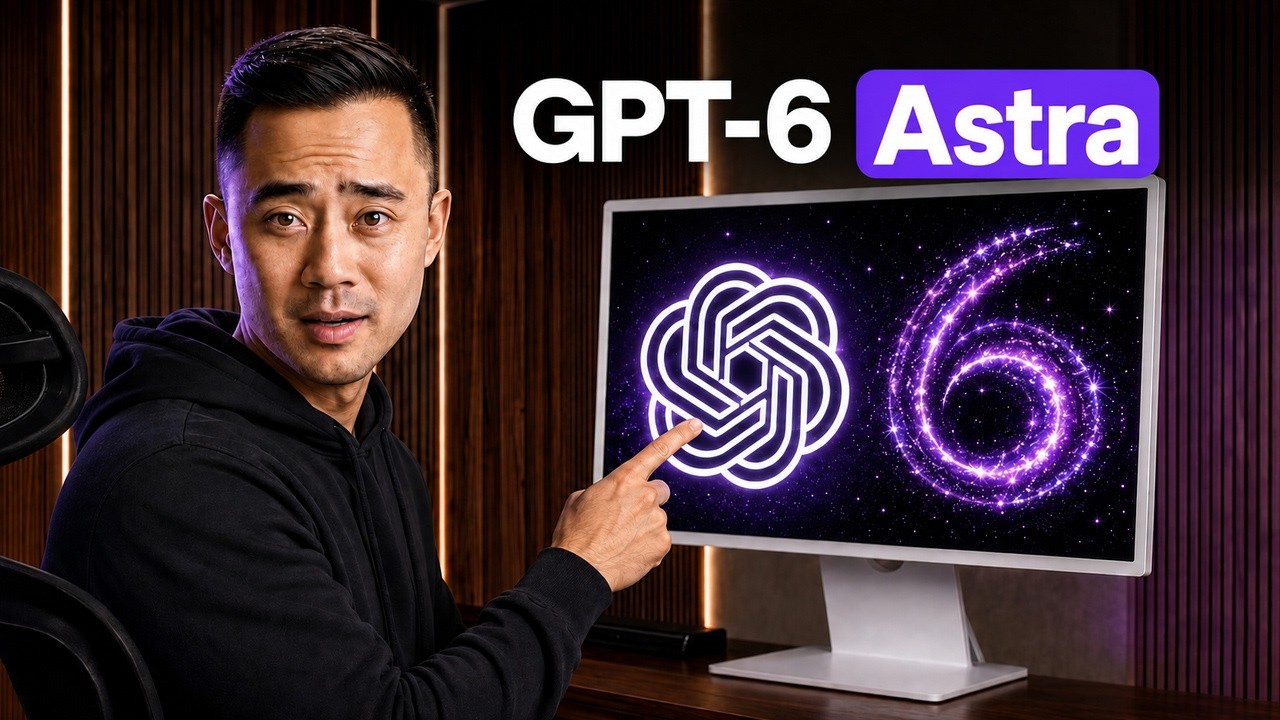
In this solo walkthrough, Eric Siu demonstrates seven practical ways he leverages GPT‑6 Astra (referred to as Astra) to automate and scale core marketing and operations tasks for his agency. He starts with high‑volume short‑form video editing, showing how Astra can clip, add B‑roll, overlay captions, and retain viewers without human editors. He then builds an autonomous engine‑optimization (AEO/SEO) pipeline that pulls content from podcasts, docs, and conversations, compares raw Codex output with ClickFlow‑enhanced drafts, and iterates toward higher‑quality blog posts. Next, he uses Astra to generate polished design assets—charts, slide decks, and interactive website mockups—tailoring visual style and reducing manual design effort. He also applies Astra to CRO, having it audit form fields and page layouts to pinpoint lead‑leakage and suggest streamlined versions. The tool is further employed to improve YouTube thumbnail CTR by simplifying visual hooks. Throughout, Siu emphasizes a strategic shift: humans will manage AI agents while machines handle the bulk (≈99%) of cognitive work. He ties each example back to revenue impact—more content, higher engagement, and faster conversions—while promoting his services (Single Brain, ClickFlow) and encouraging viewers to adopt Astra for real‑world business growth.
Chapters
All right, so ChatGPT-6 Astra is out and everyone's going crazy about it. You know, everyone's talking about all these games that they're making, Call of Duty this, you know, Mario this, and like, you know, all these like world games and all that. And don't get me wrong, that's cool, but at the end of the day, I care about generating more revenue for my business. So I'm going to talk about ChatGPT-6 Astra for my business, how I'm using it to run it for my business. So this can have practical real-world takeaway and actually help you make more money, grow more users. Don't get me wrong again, games are great, but at the end of the day, like, who cares about the games, man? Let's talk about real-world practicality. So let's get into it. So the first obvious use case is using it for editing, whether it's long-form editing or short-form editing. And I will tell you that we've gone through so many editors and it just wasn't the right fit for us ultimately. But using this one, and I'm just talking about human editors, but This, we've worked with V5 back and forth here. I just, my problem was very simple. I just said, hey, I want you to edit vertical short-form clips, okay? So look, I said, hey, I want you to clip the best clip for vertical short-form here and in B-roll and add in B-roll and have an overlay in the beginning first 4 seconds, include captions and do your best to keep the user retained throughout the video. The first 3-second retention matters a lot. So I put in a raw Riverside file here and this Riverside file, that I'm using is about 7 minutes of me just making short-form videos, right? I'm just yapping to it and it's raw and it's unclipped, okay? So I'm going to show you this version over here and let's get your thoughts, okay? So let's clip this one over here. If your company isn't working like this already, you are behind. My name is Eric Siu and my company has helped companies like Amazon, Uber, and Microsoft grow faster. If you have a single brain that lives inside of your Slack or Microsoft Teams right now, it has context, it has memory, it has connectors to all the different tools that you have. Ultimately, it makes AI multiplayer. I asked a question, I was like, hey, what's our documentation around how we handle one-on-ones here? It's connected to Google Drive, and so it knows how we handle one-on-ones here. It knows that we use the red light, yellow light, green light, and the overall company moves a lot faster. By the way, if you want access to our best AI marketing skills, our best sales skills, just comment skills and we'll send it over to you. Okay, so there's a few things that I want to call out with this. This to me is really exciting because when you look at You can see the— when I mentioned Amazon, Uber, Microsoft, it pops up the logos over here like a human would edit this, right? Now, am I saying a human is— this is completely better than a human right now? No. But you can see that this is going to get way better. And this is already good enough for me to post to my Instagram. And so for me right now, the constraint is not necessarily packaging anymore or the lack of ideas. I just need to have something to be able to edit at a very high volume. And so I can get more content out there. Yeah. And now this is exciting to me because now I can unlock more content being outputted, which leads to more views, which hopefully leads to more leads, which leads to more dollars for my business. And you can do the same thing for yourself, right? So as I continue here, look, it's showing the Microsoft logo, the Teams logo, the Slack logo. And the cool thing is I was screen sharing as I was doing this video and it pulled just a segment from that little screen share. So I didn't ask it to clip this part out over here. And you can see there's little diagrams in here, ask, find, answer. And you can see over here as I continue on, what I think is cool, okay, it'll continue to pull that out. But look, look, I didn't ask it to do red, yellow, green here, these little dots. So these little markers, these little artifacts that are being inserted into the video, usually you would expect a skilled human editor to do this, okay? So I think this is great to me. And then now you're just going to watch me dictate and say, hey, I want you to Actually go through the entire video and give me the best clips you can find, all of them. Let's just do that. By the way, you see me using Astra Max over here. I'm going to bring it down to high and let's just see what happens and let's go from there. I like this one and I think you should save the editing style here for V5, but I now want all the best clips from this original link that I shared with you. And then I want you to share all the output with me. Oh, and then by the way, I think it gave me a little caption too. So One AI, Your Whole Team is the title. Your team's AI should know how your company works. I asked our shared AI how we had no one-on-ones. And then, so I mean, this could be better and I can probably give it some skills on how we go about writing captions. Now the next one is exciting to me because this to me is building an autonomous engine optimization system. So that is AEO SEO. This is the new way of doing AEO SEO in my opinion. And the way you want to think about this is that you have a lot of content that you produce, whether it's from your podcast, your YouTube channel, and internal documents that you might have or internal conversations you have or customer conversations or prospect conversations. These are all areas where you can pull content spikes to create AEO SEO content. That's how I look at the future of this stuff, right? And so what I've done with this is I literally just took a— MD file that we have already in terms of how we run this, because I run this in Grokbot and I run this in Hermes as well. So I said, hey, can you reimagine how we've built this and build this in an autonomous engine optimization system that continues to produce content to update, consolidate, create net new content or TOFU, MOFU, BOFU content? So top of funnel, middle of funnel, bottom of funnel, and continue to optimize our AEO, SEO, traffic, and conversions. That is the goal ultimately, right? And so I'm going back and forth with it. Basically what it's done is it shows me Codex versions, so just purely ChatGPT-generated content, and then content generated with the assistance of ClickFlow, which is the API MCP that we use to create more content on the AEO SEO side. Our customers that use it talk about how the content is high quality. We think it's a great harness for creating content. I asked it— actually, I'm just looking at it for the first time. It created these pages initially, so I'm going to show you some samples over here. It's like, okay, How to stop an AI SEO agent from creating more work than it finishes. Okay, this is whatever to me. It's very short. It doesn't stick out to me, right? 1,000 words, it's unpublished. And then I said, hey, I want you to map this to the design guidelines that we have. I'm just looking at the site for singlegrain.com, right? So this looks more like our site. I mean, it's a little off with the logo over here, but this definitely looks like it. So how do you use AI SEO agents without filling your team's review queue? And then here's a table of contents. This is actually how our blog content is designed. And then there's editor notes and checks, which I like. That's pretty cool as well. And it said that this was prepared for Codex. No Eric Siu byline or personal experiences claimed. Okay, that's actually really cool as well. I actually didn't see that till right now. So yesterday I was like, hey man, I just want you to I want you to show a comparison, Codex content versus ClickFlow content. And we're actually going to get the comparison over here. Okay. So is ClickFlow a viable harness for Codex? Okay. So basically it's showing the actual drafts over here. Look, it actually creates a blog post. Okay. TL;DR, ClickFlow can hold and run checks on Codex written content. Its default quality rules and one verified citation alarm prevent us from endorsing it as an autonomous engine, complete autonomous engine today. By the way, if you're enjoying this video right now, you gotta check out Single Brain at singlebrain.com. This is where we help people with AI implementation as it relates to marketing. We build these marketing agents, these marketing teammates that live inside your Slack, your teams, and we manage it for you. And we continue to build workflows on top and we customize them. So if that's something you're interested, go to singlebrain.com and we'll see you on the other side. Okay. So I'm just gonna take a look at this, right? So if we look at, let's look at this Codex baseline one. Okay. So how to use AI agents over here. So this is updated. I like this diagram over here. That's really cool. So this is, I think this one's purely Codex. And then let's try ClickFlow. So how to use AI SEO agents without filling your team's review queue. Most teams adopt AI SEO agents expecting faster output. I think this was longer form as well. And you can see the graphics aren't as new. I would say the diagrams look a little dated, I would say. Observe before you iterate. There's frequently asked questions at the bottom of it and then it does have internal links in here as well. Let's take a look at the Codex baseline again. This one is— it has a table of contents over here, give the agent a finish line. It does have internal links in here as well. I would say honestly, just skimming this, not actually reading through it right now, I would say that Codex seems to have the edge, but if we combine them, let's see what happens here. Codex for using ClickFlow output and the shared brief saved separately, no publication. Okay, great. So anyway, all that to say is that it does a pretty good job. I would say actually looking at this, look, when it's combined, it makes more diagrams here. And I would say we probably need to tweak this a little more, right? So let's just mess with this 'cause this is my first time seeing this with you. Okay, so hey, so if the scores were 7.05, 5.95, and 3.90, all below bar, Then I want you to use a UX review and build an expert panel to review these until these are like a 9 out of 10 for each of these. And then I want you to do a real apples-to-apples comparison because right now I think Codex slightly has the edge, but I need to better understand the difference between Codex versus ClickFlow. And then if you combine the two, Does the output actually end up better? So you're probably doing 3 comparisons here. So go ahead and do that and then run it again and then show me. And by the way, like the way that you see me working right now is I think this is the future of business, right? I think, you know, there's something interesting that I just read the— actually yesterday where it's talking about, you know, 99% of physical work used to be done by animals. And today 99% of work that is now done by machines. And When you think about the future, well, 99% of cognitive work right now today is done by humans. Well, in the future, 99% of most cognitive work is going to be done by machines, right? Which leaves us to having a very small percentage, 1%, maybe a little more than that. 1% to 5% of work is going to be done, cognitive work that is going to be done by humans. That's going to be the work that only humans can do, right? So if you think about it now, you have to learn how to become a manager of agents. And this is why I think GPT 6 Astra is so important to learn right now. And I do think this is the next step change for getting things done. GPT-6 Astra is amazing for content creation, not only for editing short form, but also when you look at this, these are some charts that I'm looking at creating. And these have really— this is a really cool design over here. And by the way, the way I first started this was my podcast co-host Neil for Marketing School. He was just talking about how charts perform well for him yesterday. I was like, oh, I should probably be making more charts too for my Instagram, right? And he was showing me the performance and charts actually do a good job of driving leads. They're pretty shareable over to X. They're pretty shareable over to LinkedIn as well. So they're pretty nice for cross-platform. So this is my first time seeing this because I asked for it to add in some more color to the initial formats because the initial concepts were like this one, right? 3 directions for Eric Siu. Source back charts over here. We're using the last 30-day skill. So these look pretty stiff. And honestly, I don't think this is like GPT-6 Astra-like. And then even these over here, I'm like, dude, man, like this isn't even that special. What are we doing here? And don't get me wrong, like these dot chart shares, the slope change, that's good. The dot chart comparison, process diagram, those are all good, but we need to take it to the next level. So what I basically did was I think I just said, hey, I want you to take this to the next level. I guess we can look at it this way. Okay. So maybe it's a little too busy now, right? So maybe we need to tone it down a little bit, but this one kind of just went ham, right? So growth signal, the build or buy line has moved. Okay, share of survey respondents, so 32% skipped at least one software purchase because AI can build internally. Okay, that's interesting. Build it, then own it. Build, maintain, measure. Can you ship it? Use existing models. Okay, great. I just think it's a little too busy now, right? Growth signal, software has a new competitor. Okay, this is kind of cool, right? The demo is not the cost. Build, iterate, maintain, review. I don't know if these are together. Like, I kind of need to ask that question. All right. So I like these. I think they might be a little bit too busy. And then also my question would be, are these issue 1 and issue 2, are they a carousel? Do they go together? Because I'm, you know, if we're looking at, you know, growth signal for slide 1, that one makes sense on its own. But for slide 2, it kind of doesn't make sense on its own. And it's a little confusing for the human, right? So I'm just wondering if they're part of a carousel, but I'm looking at the second one now and the demo is not the cost. That kind of sounds like AI slop to me and build, integrate, maintain, review. Okay, ship the first version. What does that mean exactly? What are we talking about? And then the third one, the third one actually looks really cool. The field manual one, I actually really like that one. I think that might be the one to go with. If I'm being honest. And then that's what I would say, that the Field Manual is the one that sticks out to me. It's less busy, so maybe we can iterate off of that one and then build 2 more iterations off of it. But I think we also need to clarify what exactly slide 2 is and how these fit together. So go ahead and give it another shot and let's try 2 more concepts on top of the Field Manual one. And you know, go from there. Maybe one can be more more anime-like. So I had asked it. I said, I said, hey, you know, let's let's go ahead and use you know purple, orange, and and white, and and black as the colors. And it's done a good job of integrating that. And Astra Six is amazing for websites. So if you see over here, I'm just going to show you the one that it made that it just made recently. This was a preview over here. So you can see that this is a It is an interactive website that's moving along over here, right? It's talking, like, by the way, look at this discovery to demand to customers over here. So I just took an X post that I liked and I just said, hey, let's just see what you can come up with over here. And it actually put it together. So this is actually pretty damn good, right? And so I would probably add a little more to this, but not bad, right? Let's go over here. This is my field of my reference point over here. So this is Single Grain Fire next field of growth. And then here's the thing. We had a couple different concepts over here, so I'm gonna show you this one. Okay, this one's not bad, right? So we're looking at doing the single grain website design right now. Redesign. Be the answer. Win the customer. And you can see it's a little interactive over here, right? This is a little grain. Book a strategy call. Let's see what happens here. You know, where where should growth go next? What's your choose your biggest challenge? We'll show you the first conversation to cover. Get found in AI search. Build a conversation. Useful first conversation. Map out buyers. Okay, this is cool, right? And these are like some of the recent customers we have case studies with. It's up there. Good work, better business. This is not bad. This is pretty good for what it is. And I didn't really give it much direction. I just said, I just asked for 3 concepts. So when it comes to design, I actually really like how this looks. And if we go to this one over here, you know, good things grow together. Anyway, so this is kind of cool. I mean, but I'm not like a, We're not like an environmental agency or something like that. So this would be cool for that, but that's not what we are. And then this one over here, Growth with Teeth. I think this is more like a— I think we had some large agency backgrounds over here or examples that we had used here. So all that to say, I can keep playing around with this, but I think we were using— oh, we used Max for this. Just keep in mind, we're using Astro Max for this. I tend to find that using the medium model, which is what I was using that for SOL 5.6, it's probably not enough on its own. So if you want nice designs, you probably want a little more effort going into it and you might as well just do that, right? So I think from a design standpoint, man, this is like there, like from an editing standpoint, design standpoint, and this is ultimately going to drive more conversions for me and leads. And that's what I ultimately care about. By the way, if you want to grow your AEO and your SEO traffic faster today, you got to check out ClickFlow. So if you go to clickflow.com, we have an API and MCP that you can use, your agents can use as well. Or we can even manage it for you because in addition to creating the content, we actually will handle digital PR. We will handle other things around technical SEO, technical AEO as well. Just go to clickflow.com first to learn more and we'll see you on the other side. Ostr6 is also great for finding website leak issues. And so all I said over here was, hey, find where the leads are leaking on the singlegrain.com and singlebrain.com website, okay? So it actually shows over here, look at this. I have one for Single Grain. This is potentially a new concept over here. Let's find your next growth move. And it has less forms. What it was initially saying, by the way, is we have too many required fields on the Single Brain intake. And then for Single Grain, we have 7 required fields. And then Single Brain Mobile, the form begins 1,277 pixels down after introduction and agenda. Put it directly below the short heading. And then now I'm at the point where what's the MVP for this? How do we test this? So going back to this again, ChatGPT-6 is great at finding website leakage. And you can see what's happening over here. It's basically shortening the forms. And then same thing for Single Brain, right? It's shortening the forms over here. The sites look similar. If you look at the homepage, less chasing work, more getting work done. This is Single Brain. And if you go to Single Grain, you can see this is what the homepage looks like as well. So they've kind of redesigned it. You can see the intake over here, what confirmation looks like, and what error looks like. So this is a full-on CRO strategist. And you can see I've worked on Medium over here. Right? So what's the MVP? And okay, the safest MVP is one shorter single brain form in staging with proof that tracking and HubSpot delivery still work. Production stays read-only. Okay, great. So that's something I might decide to test, and then I can add in certain connectors if I want to do it. And then someone or something should be managing this and then checking how it affects conversion numbers. So the idea here is that if humans are going to be focused on the 1 to 5% of cognitive work, Then you should let the robots handle the rest, right? So once you put this together, you let it just continue to compound. And I'm telling you right now, like, you know, AI came out what, 3 years ago or so? Maybe 4 years ago or so. And now it's just starting to get strong. You know, there's a lot of upside to be had here if you start to use Astra 6, not just for making games, but for actually using it to grow your business. But I just want to show you that we have this YouTube CTR skill here on increasing click-through rates for YouTube videos. And these were the original thumbnails that 5.6 made and they're actually pretty good, right? And I said, so then I switched to Astra and said, hey, how would you improve this now? And it said, actually, it would simplify each thumbnail around one clear viewer problem. That's good. I didn't even call that out. Make the 3 options, test different reasons to click, rebuild the creative eval around your actual preferences, right? They can't find you is not the best hook, but the spotlight is a weak visual or is the best hook, right? Open for agents is the weakest option. Get picked first. So it has, you know, it has its own opinion. And so these are the new thumbnails, right? So you're not listed, you know, competitor, competitor, your site. Okay. This drives a little bit of FOMO. It's like, oh damn, like how do I get listed there? Right? Good. It understands a little more about human psychology. Can AI read this? You know, you, AI, and become the answer. So AI answer your site. That's actually really good. Like I want to be the answer, right? So I would say these are really good. If you're going to spend all this time making content, you better make sure that you're doing the best to get the content out there. So increasing the click-through rate through rate is one thing that you can do. And then you can hand these skills off to other people to take over. Again, you want robots to do robot things and you want humans to focus on doing human things. I'm telling you again, ChatGPT Astra 6 is amazing when it comes to design because this was the— this is our original website over here for the Single Brain Gateway. And you can see it's a little bland, right? It's a little lacking right now. But what I did was I just simply put this website Into ChatGPT, and I just said, "Hey, give me some concepts. Give me more concepts here." So this is one of the new concepts, right? So single brain gateway, one key, your accounts, nothing else. And it drew out this gateway over here. It shows Google Ads, HubSpot, Gong, and it says connect today, connect once. So it look this looks good, and it's pretty interactive as well. You can kind of you know play around with it. And I'm like, this is pretty professional, right? And then I moved on over here. I'm like, okay, here's an alternative, right? Here's what your agent can reach over here. And this one's a little different, but it kind of makes you feel like you're using the app itself. And in this one, I guess this is a comparison. So I think if you look at this one, yeah, this is another concept over here, your accounts, your rules. So we have this single brain gateway that allows you to connect a lot of your different tools without— so your agent can find them and use them without having to have all these API keys just lying out there or your team getting confused or your team getting frustrated. You can use this one as well, or you can use the black version of the first one that I showed you, the first concept. And I mean, this looks really great, right? From a strategic standpoint, I was like, okay, well, what else do we need to do with the Single Brain Gateway over here? So, with the Single Brain Gateway, what I was asking about, some people that have these gateway products, right? So, we have Monit, we have Factory, we have Solo.io, we have Kong, right? So, it gives us overview over here. And I'm like, okay, here's what to improve, right? I'm like, what else should we do from a strategic standpoint with Single Brain? The gateway, right? I was like, so how do you see this fitting into the broader go-to-market for Single Grain since we're trying to become the top marketing services software company? That's what we're trying to do, right? And then give me this combined with your last overview into an HTML file using the Aperture-like design that you made. So I said, hey, take this and move it into the concept that you had before. And remember I told you this was my favorite over here, this design over here, right? And here, boom, here we go. Sell the work, own the system, earn the trust. Okay? So— What it's calling out over here is, okay, the company is a service. The advantage is the system. A CMO buys dependable marketing capacity, right? Give every layer a job, right? The gateway over here, 4 gateways to strengthen the business. This is, I think it's still a strategic document. It's a strategy memo, right? But it kind of reads like a homepage as well. So land with one job, expand through trust. Like this is good 'cause now I can share this with my team and we can meet around this and we can define the strategic direction and we can look at what other people are doing with their gateways. And we wanna figure out uniquely how we're gonna build ours. But when you explain things like this, when you communicate like this in a way that makes sense to other people, ultimately people get more done at the end of the day, right? And so I think this is good at a high level to be able to explain. And then if we wanna go deeper into it, we need to be talking about what else are we gonna be doing specifically as a marketing LLM that we're building, right? And again, we can look at the competitors and I think that that's certainly helpful. But when you can build an artifact like this, And then you can use ChatGPT to just make a website and you can make it a shareable link that makes it very accessible for other people. And then the cool thing is you can also map this into different versions, one for investors, one for the public to see, one for the team to see, and maybe you have more private information in there. But ultimately for me, work is about solving problems and I think making games is cool, but what I'm talking about here, just think about how you can apply it to your business and I guarantee you're going to get way more done. So that being said, hope you enjoyed this video and we'll catch you in the next one.









