How McKinsey Helped Nike Lose $223 Billion
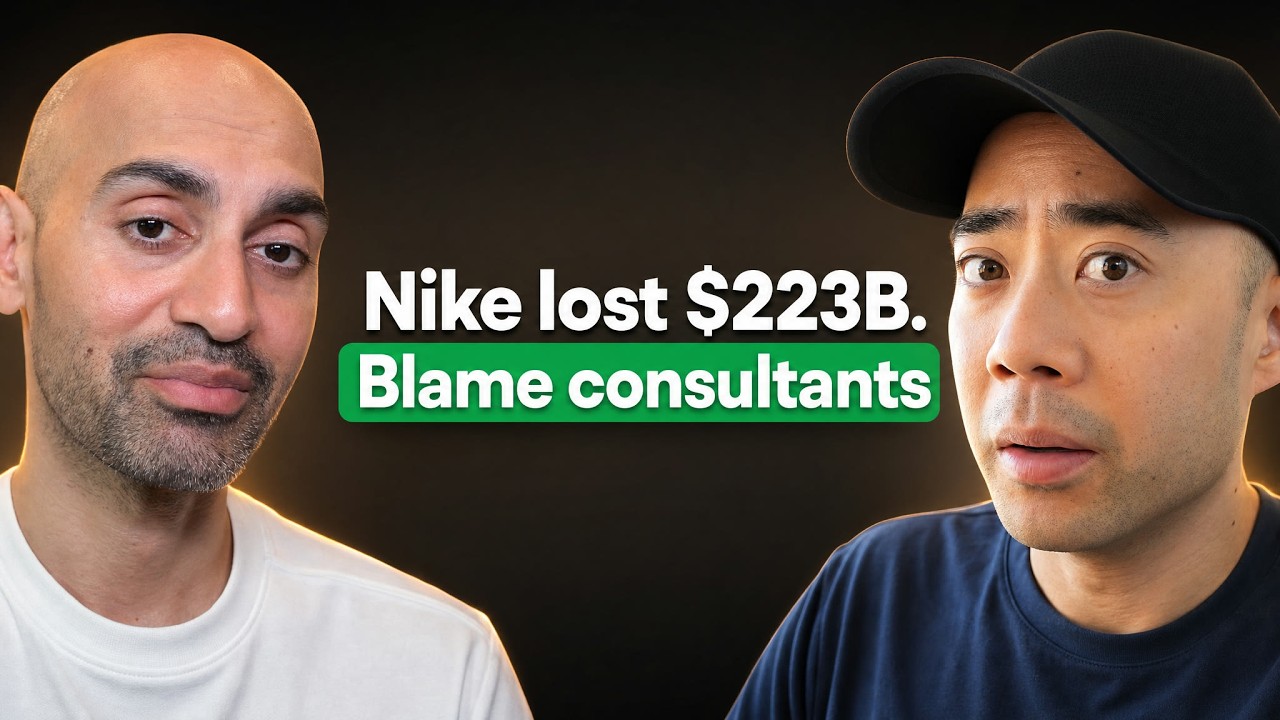
In this conversational YouTube episode, Eric Siu and Neil Patel dissect Nike’s dramatic $223 billion market‑cap decline from its 2021 peak. They trace the chain of strategic missteps attributed to McKinsey’s consulting advice, which urged Nike to eliminate traditional product categories (running, basketball, soccer) and re‑organize under broad gender/age groups, push an aggressive direct‑to‑consumer (D2C) model, and reallocate marketing spend toward programmatic digital ads and away from brand‑building “halo” campaigns. The hosts argue that these moves stripped Nike of deep category expertise, eroded its iconic brand narrative, and caused inventory and wholesale channel fallout when the company abruptly cut hundreds of retail partnerships. Throughout, they critique the reliance on spreadsheet‑driven consulting recommendations, citing broader concerns about consultants lacking operating experience. The discussion then pivots to related brand‑erosion examples, notably LeBron James’s partnership with the gambling‑oriented Polymarket, which they deem a risky brand move. Finally, they explore the rise of e‑commerce influencers like Sam Sulek, compare YouTube view counts versus lead generation, and sprinkle in personal anecdotes (Tesla purchase, ad read for SingleGrain). The episode blends data points, personal opinions, and industry anecdotes to illustrate how strategic over‑engineering can damage a legacy brand.
Chapters
So Nike's market cap hit a peak of $280 billion in November 2021. It's now down $57 billion to $257 billion. So a $223 billion drop. What's the market cap today, Neil? I feel like you're looking at it.
$54.91. Stock's at $37. Close.
It went lower. Okay. It will be delisted from the S&P 500. Okay. So former Nike branding exec Massimo Yunko wrote a viral post in 2024 laying it all out. I don't know if you remember seeing this on X. I think I kind of remember it. He was basically blaming all the effort they were putting into direct-to-consumer. Remember he was talking about how everything's too trackable? And I think we did a Marketing School episode on this. So he blamed the CEO at the time, John Donahoe, 2020 to 2024, for going all in on direct-to-consumer with a cameo from McKinsey. So I think he worked at McKinsey before, the consulting company.
Oh, great.
So handful of things over here, right? Like McKinsey advised Nike to get rid of categories, running, basketball, soccer, and reclassify everything into women, men, and kids. And so I think we can react to each bullet point, but let me finish off this point. Okay, so the logic was that Nike was duplicating resources and a pivot to D2C would provide enough customer data to inform product decisions instead of relying on category experts, category experts, a basketball vet, that spent 20+ years at Nike. A lot of these experts were fired and then Nike lost their insights. This was a clear L because Nike quietly brought back categories at the end of 2023. So what do we think about this part, Neil?
So they eliminated categories, they brought them back, and yeah, I think that's a smart move. My recommendation to them is just revert all the stuff that didn't work and just go back to the ways that were working. Nike got a little too creative with some of their campaigns as well. in just my personal opinion. They got away from a lot of the motivation and the just do it and pushing on the stuff that was doing really well for them for years. And a lot of these experts were helping them innovate the product line. It went from Nike was continually doing new stuff, pushing out new stuff to, oh, Nike's not really making any changes other than a new shoe design. Their apparel was very similar and they weren't adapting to the times. And it's like, all right, sounds good. Not going to buy Nike anymore.
Yeah. And by the way, like I haven't bought Nike for a long time and I was a big Nike fan growing up. I think you were as well. And so I think they didn't do enough. Like if you're going to make a big change like this, sometimes you might want to think about one, talking to people, but second thing, maybe you roll it out in phases. Maybe you didn't roll it out all at once. So I don't know if they did this all at once. It sounds like maybe they did because keep in mind like 2023. So this is towards the end of this, you know, John Donahoe's Tenure?
Well, here's a big issue here. In general, in business, if a consultant is trying to tell you how to run something and what you should do, especially McKinsey or Bain and Company or Boston Consulting Group, I usually would recommend doing something else because a lot of these people have never operated a business and they'll tell you how you should run your business. And then if you look at their track record, when they put a lot of these execs from McKinsey to be a CEO in a lot of these organizations, they tend not to do well. And then they got to go back to operators who are on the ground, who know how to run things and who are actually talking to the consumers versus a McKinsey person who's just looking at spreadsheets and be like, yeah, if you do this and move this around here, you know, you can go from there.
And I'm—
I've dealt with it. We've done M&A a lot. And I've seen people do spreadsheets like, you should just buy this company. Look at this. If we combine it, look at the numbers and how great that'd be. I'm like, cool. You, how about you do this with your money and you go try doing that? Because it usually doesn't work out the way it is in your spreadsheet or anywhere like that.
And it's like, hey, have you done any integrations? Oh, you haven't? Okay. Would you like to try it? Go try it with your own money.
Yes. Oh no, but we've seen it work. Look at these case studies from Harvard Business Review and it works. Just follow that. Like, it doesn't work like that in real life.
And that's a lesson, like going back to what we were saying earlier, when you're in the trenches and you're locked in there, you're going to do just fine if you keep going, right? I think a lot of situations, people kind of tap out or they get unfocused or they kind of go to do something else. That's when things start to fall apart. And by the way, again, like going back to what we were saying earlier, like adapt or die. That's kind of what it is. So hopefully Nike can bring it back because Nike was a great story kind of growing up. I'm going to move to the third point and come back to the second point over here. Okay. So the third point here was they prioritize digital marketing. So Nike changed its marketing budget to focus on driving users to Nike digital properties and membership platforms. For decades, Nike spent 10% of sales on brand advertising to create an aspirational halo, which is what Neil was just talking about, right? The prioritization of programmatic ad spend meant Nike went from create demand, new customers, to serve and retain demand, retargeting existing ones. The result was a slowdown in sales. Because of that, writes Massimo, who spent 21 years at the company, right? Long time. Nike invested a material amount, billions, into something that was less effective, less effective, but easier to be measured versus something that was more effective but less easy to be measured. In conclusion, an impressive waste of money. The quality advertising was not so great. So without going into details, like I can show you the creatives because some of my friends, my other friends this week were showing me the creatives. We're not going to talk about that. One thing I'll say here is going back to what Neil said, once you start to get away from what you were before and what you were known for, and you start going into whatever's trending at the time, people start to lose trust in your brand. And a brand is what people say about you when you're not in the room. And so for me, Nike before growing up, like Neil and I would share these commercials with each other. It's like you see Lendall Tomlinson, the running back, right? At the time running into Troy Polamalu, right? That's inspirational, right?
Yeah.
or you see like a World Cup thing or something like that, right? Doesn't matter if it's like women's sports, men's sports, whatever. I always looked at, I'm like, man, I want to be like that, right? But when you see stuff that doesn't make sense anymore, it's like, well, I don't want to be like that and I don't want to be associated with that brand. Therefore, I cannot buy that brand's product. And therefore, whatever I'm saying behind the closed doors now is a negative thing. And that word of mouth travels very quickly, which is kind of what's related to this brand piece over here. Again, like I think Neil and I, we're big fans of digital marketing, it's what we do for people. But I think sometimes, you know, again, you want to make sure that you're like, if something's working for you, like why would you eliminate it? Yep.
No, and this is what I was saying. It's like Nike created a lot of people who love their products from their commercials. I remember my nephew Jaden would tell my sister when he was younger, I need Nike shoes. And she's like, why do you need Nike shoes? You have these Skechers. And he's like, I want Nike shoes. They make you run faster. Right? I'm not saying the shoe actually makes you run faster. And my sister did teach her son that some shoes may make you run faster, but a lot of running faster has to do with dedication, training harder, and other aspects, eating right, getting enough protein, getting the right amount of sleep than just purely the shoe. Of course, a really heavy shoe that weighs 10 pounds is going to make you run slower than A shoe that is a pound. I'm making up the weight because I don't know actually how much shoes weigh, but you guys get the point. Running with a 10-pound weight in both your feet, you're not going to run as fast. She did buy him the Nike shoes. He did end up learning the lesson, but that's a cool part about the campaign. And when I dug into why he wanted Nike shoes, it wasn't just because he believed they help you run faster. It was the TV commercials and how they push people. People were successful and athletic and doing well wearing Nike products, and he wanted to be like one of those people. To me, that's good brand advertising.
By the way, when Neil buys a Tesla, it's because he just wants to be like Elon Musk.
It's no different.
Just kidding, just kidding, guys. That's me being facetious.
It took Eric so long to convince me to get a Tesla, and then eventually—
Dude, I didn't convince you anything, man. You just kept talking about it, and like, Noah was in the room too.
No, no, no, no. But years before when you had a Tesla, you told me—
Oh yeah.
You should get one. And I'm like, no, it's a crap car. And I would give all these reasons. And then I was telling Eric, I don't know when this was, call it like 6 months ago to a year ago, maybe a year ago. I kept talking on and off about buying a Tesla and they didn't say I should do it or not. They didn't really care. I eventually ended up doing it. And the reason I bought the Tesla was for one reason only. The self-driving technology. I do have to say, compared to a Mercedes, the car's not that comfortable. And you miss a lot of the perks that you would get in a luxury car over a Tesla Model Y, even a Tesla Model X or S or whatever they're called. I still believe like the Mercedes build better cars, but that technology of self-driving for me, It makes up the lack of the other comforts.
Yep. Well, it's like in life, there's no solutions, only trade-offs. So the last point over here. So they ended wholesale leadership. Okay, so Nike ended hundreds of relationships with wholesale partners and prioritized Nike's website over retail. The change looked genius during COVID but as customers returned to brick and mortar, Nike's products were nowhere to be found. It had burnt bridges with partners who were happy to give shelf space to upstarts. This wasn't covered, but I think On and HOKA, these are yoga brands or athletic brands, athleisure, took advantage of this for running, okay? So there was a lack of feedback from retailers, which led to inventory issues. The quote unquote data-driven insights from online sales proved not to be a panacea. And so this is a situation, again, it seems like they kind of just ripped everything and tried to make these drastic changes. And when you do these changes with a big company, these drastic changes, it's hard to kind of unwind these changes.
Yep. On a side note, you have a topic in here. I think a lot of people have seen it. It's related to this because it's related to sports and marketing. Why LeBron James's Polymark partnership is a brand eroding move.
Real quick, if you want to acquire customers faster and more efficiently this year with the latest strategies and tactics, then check out singlegrain.com. That is my ad agency. Again, www.singlegrain.com. Check it out. And if it seems like a fit, we'll get in touch and help you with a free marketing plan. Yep. So here, let me pull this up. So this is a guy I know named Bryson. So shout out to Bryson over here. So check this out. So by the way, I'm a big fan of LeBron, right? I'm based in LA and I'm a Laker fan. Oh, guess what? They deleted it. Oh, look at this. Okay. So unless they paid Bron $100 million and gave him equity, I see no world where it even makes sense to partner with the prediction market. So what was the original post that LeBron put up was him doing a commercial with Polymarket and him walking into Polymarket, right? Just so everyone knows, Polymarket is— they call it prediction markets. Guys, it's just gambling, right? You're just gambling on what the score is going to be. You're gambling on— by the way, I've tried it, right? I bet on the Spurs to beat the Knicks when they're down 3-1, and I was like, I was so confident, right? Lost the money. Clearly gambling, right? So anyway, I think he probably got a lot of blowback here. And so he was, he was doing DraftKings commercials before, and then the Polymarket one, I think a lot of people started talking about it, but let's see what happened. The post is gone, Neil.
I believe I also am not a LeBron fan, so if he's eroding his brand, I don't really care.
Yeah, but let's talk about why we think it's a brand eroding move. So you go first.
So I haven't seen too much of it other than he partnered with Polymark or created a hint. I didn't actually see the commercial or anything like that. I saw a message go out or people talking about it. Polymart is just gambling straight up. Oh, here, here it is, Neil. You see the commercial there? Yeah. Oh yeah, yeah, I did see that part where he is getting off the elevator.
Yeah.
But I look at Polymart as just straight up gambling. There's nothing wrong with gambling businesses, but if I was LeBron James, I would not partner with a gambling business when there's other opportunities.
The way I see it, I'm like, man, you're already a billionaire, right? What more money do you need? And you're at this stage in your career now. where you don't need to be doing this, right? Maybe you play with the Sixers for 1, 2 years, maybe you win a championship and you kind of ride off into the sunset and you go do more business deals. The money that you get from this is not worth it because as Warren Buffett says, it takes you decades to build a brand. You can erode it within 5 minutes. You can lose it within 5 minutes, right? And so, you know, gambling is not, by the way, like me, I played a lot of poker growing up. I love gambling, don't get me wrong. But I don't think it's something like I would want to be known for, right? Because I've seen it going to the casinos. I see the people that bet their entire paychecks. I've seen people that lose their relationships over it, they lose their family over it. This is not the type of stuff that you want to be promoting. You want to be promoting healthy stuff, right? That's just my opinion. I'm not LeBron James. You can do whatever you want, but I do think it's a brand eroding move. Yeah.
I didn't know you were a LeBron James fan. I never liked him.
Why didn't you like him?
I know too many personal stories.
Well, I do too because you told me. So that's fine. But I will say he brought a championship to LA, right? You know, he's, uh, he's, you know, I'm okay with that, right? He's done his job. So, um, that's what I'll say. By the way, this is, this is kind of related. So do you remember Sam Sulek, the really buff guy on YouTube that makes videos?
Yeah, we used to talk about him like a year ago and you would share your screen.
Okay, check this out. So I found, Neil, I found the Sam Sulek of e-commerce. Have you seen this guy? Here, check this out. Let me share my screen with you.
So here, check this out.
Let me share my screen.
That Sam Sulek guy must have been taking steroids or something. Maybe I'm wrong though.
I would bet that he probably is. I'm trying to pull this up for you real quick.
So yeah, that's my assumption. I have no proof, by the way, if anyone's listening.
Sam Sulek YouTube. Let's just go to Sam Sulek's YouTube first. Okay. First, let's look at this guy because YouTube's taking forever to load. Do you see my screen?
Yeah, he has 4.5 million followers. Tons of videos, tons of views on his videos, but yeah. Yep.
And look, like 21 hours ago, he's uploading every day, right? The Bulk Rebirth. Look at, look how huge this guy is, right? And like, he's just making long videos of him like working out. Basically, that's how it is. And I think he's just talking about life. So this is how it is, right? So bulking, the last pump, all these things. Okay. So that's the context. This guy's buff.
Okay.
So Mark Builds Brands YouTube. I found the Sam Sulek of e-commerce.
Okay.
So it won't necessarily load right now, but if you can see this, this guy is basically, he's recording like screencast videos of him talking about dropshipping or funnels and things like that. And his shirt is off. So he's like a buff guy with his shirt off and he's just saying, here's how I made money, this and that. So, so here, check this out. All right, Neil, do you see this?
Cookies or something that's messed up. Uh, let's see. Okay. Yeah, he even has a picture. You can tell he's buff.
Yeah. So how to make FU money with branded dropshipping. So that got 430K views. So let's just look at this guy, right? Because Neil, I would say, to be fair, you and I, like, if we're getting, you know, I'll just speak for myself.
I'm getting— He doesn't post that often, but he still gets a ton of views.
If I'm getting 15,000, 20,000 views per video for the type of content I'm making now, I'm actually happy with that, Neil. I don't know how you feel. Like, what are you happy with on YouTube?
Uh, I don't care about the view count. I look at how many customers or leads we generated per the video. So if we do a video and we get like 3 to 4 leads from ideal customers, I'm very happy with that.
I think it's harder for me. The reason I'm saying, let me give you some context here. So the reason I'm talking about 15,000 to 20,000 views is because I know the content I make today and the content Neil makes today is much more focused on our target audience. So like if I make an AI thing, it's like for business or for work, right? The content Neil makes is like maybe he has some enterprise topics that he's covering. And so I know by default we're going to get more of those people coming in. I also know it's harder to track because The funny thing is someone came in the other day and it was like a startup that raised like, I don't know, like $100 million recently. So like decent funding. And they had like left a comment on a YouTube video. I watch your stuff. How do we work with you?
Right?
And then I'm like, okay. But like you can have things like, you can have things find these people or also keep in mind, sometimes when they find you on YouTube, they'll go through like another channel and then come through your website or something like that. So you never quite know, at least for me. So anyway, going to this guy, he's getting 59,000 views, 36,000 views, and he has this one over here, copy my landing page template and maybe $1.4 million in 30 days. So here's a template, here's the result over a time-bounded period. And so his shirt's off, right? His shirt's off over here. And so my whole thing with the shirt-off thing, Neil, is it's a pattern interrupt. It's just marketing. And you look at this enough, I'm like, This guy seems like he knows what he's talking about. And 2, he's buff. Maybe I should listen to this guy, right?
So, yep.
Isn't this interesting though?
It works. It's interesting. I'm curious to see how he makes money from it.
He's kind of like, uh, I wouldn't say he's like Alex Becker, but Alex Becker is pretty funny, right? Like when he makes his videos. Um, but it's, it's kind of like a similar style where they're just like screen sharing and, and going through stuff. Which is actually what I really enjoy. Um, all the other stuff bugs the hell outta me.
So, yeah. Yeah.
So that is it for today and we will see you tomorrow.









