How Shivani Siroya Built Finance App Tala + More! | Ep. #193
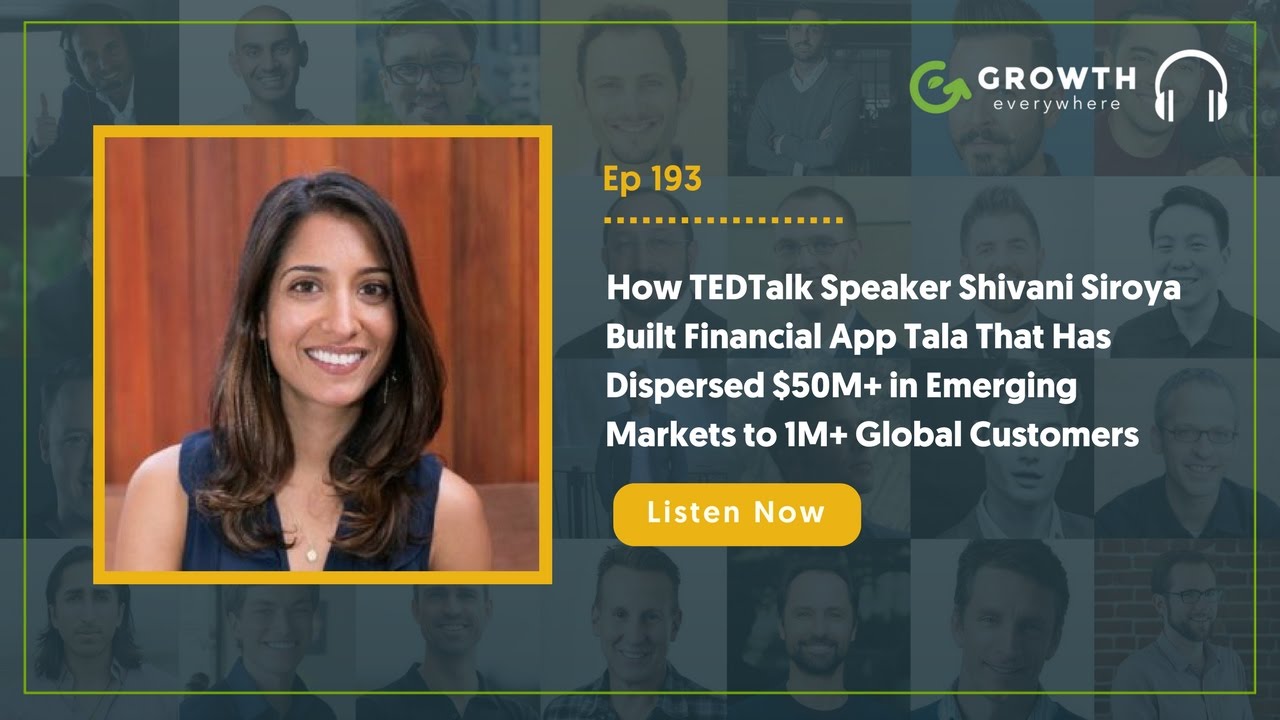
Shivani Siroya built Tala, a mobile lending app that scores borrowers and disburses loans in under two minutes using phone data. The company has served over 1 million users and raised $14.4 million by launching first in East Africa and Southeast Asia, where regulation was lighter, before expanding elsewhere.
Chapters
And this entire process for about 85% of customers takes under 2 minutes. So literally from downloading the app, registering, getting scored, and actually getting money into their account, it takes under 2 minutes.
Do you want to impact the world and still turn a profit? Then you're in the right place. Welcome to Growth Everywhere. This is the show where you'll find real conversations with real entrepreneurs. They'll share everything from their biggest struggle to the exact strategies they use on a daily basis. So if you're ready for a value-packed interview, Listen on. Here's your host, Eric Siu.
Before we jump into today's interview, if you guys could leave a review and a rating and also subscribe as well, that would be a huge help to the podcast. So if you actually enjoy the content and you'd like to hear more of it, please support us by leaving us a review and subscribe to the podcast as well. Thanks so much. All right, everybody, have a special guest today. Her name is Shivani Saroya. She's the CEO and founder of Tala, which is revolutionizing financial services in emerging markets. She's also a TED speaker as well and has spoken on smart loans for people with no credit history. Shivani, how's it going?
It's going really well. Thank you for having me.
Yeah, thanks for being here. So why don't you tell us about a little more about who you are, what you do, and go into, you know, just generally your story?
Okay, sure. So what Tala is, is that we're a data science and mobile technology company that is, as you mentioned, changing the way that people access financial services, but more importantly, that we are giving them choice and control over their financial lives. We've developed an Android application that allows anyone around the world to actually get scored and get access to capital using just the data on their mobile devices.
Awesome. So how does the score work exactly? Can you go into a little more detail?
Sure. So it's really simple. A customer will find out about the product either through word of mouth, a referral, you know, see an ad. They'll actually go to the Google Play Store, they will download the app, and we will actually ask them for permission to key pieces of data that are on their phones that allow us to really understand, you know, the identity of this individual, to understand their capacity and whether they can actually afford to repay, and then lastly, to understand their behavior, to understand the likelihood of whether or not they will actually repay the loan. We do that in about 5 to 10 seconds. At the same time, a customer is actually filling out about 8 to 10 questions on their mobile device. And that's more about, you know, again, demographics, where to send the money, etc. And then, you know, once they're done with that, we send them a loan decision. And this entire process for about 85% of customers takes under 2 minutes. So literally from downloading the app, registering, getting scored, and actually getting money into their account, it takes under 2 minutes.
Wow, awesome. And so what are these key pieces of data that you mentioned? What are like one or two?
Sure. So I mean, it's again, we want to understand, do you have loans outstanding? What is the amount of money that you get paid on a daily basis, weekly basis, monthly basis? Are you someone who's really consistent with making your bill payments? So a lot of that information is actually sitting on the device. And so around the world, as opposed to email, so when we make you know, a transaction on Amazon, we get an email. In these markets outside of the US, it's actually more likely that you'll get that receipt in the form of a text message. And so what we've done is within our application, we have a software that allows us to parse for all of that kind of transaction or receipt-level data. So that really tells us the income or the debt-to-income ratio of a customer. Other things in terms of behavioral stuff, which is more around your character, and that likelihood piece, that's really where it gets more interesting. It's like the kind of apps that you use, how do you actually use your phone? So how many calls are you making throughout the day? How many messages are you sending? And so what we've done is for each one of these features, we've actually set up thresholds to say, hey, when someone has more than 80 contacts that they're in connection with on a weekly basis, or there's a lot of consistency there, we find that those kinds of individuals are more likely— to be good borrowers. And so, you know, we bring in about 10,000 different data points per individual, and it's about 90 days worth of historical data when a person actually downloads the device. And so we have a really good sense of the daily life of this customer. And so it's not just these random data points, but it's really about the context of their daily life.
Wow. And all in 2 minutes, huh?
Yep.
Great. So what are some of the big emerging markets that you're— that Tala is part of right now?
So, we are currently in East Africa. So, we're working in Kenya as our main market there. And then we are also in Southeast Asia, and we have an office in Manila.
Interesting. Okay. So, I guess we'll talk about customer acquisition in a second, especially in those markets. I guess in terms of numbers, what kind of important numbers can you reveal around the business today?
So, important numbers around the business, the way we think about it is, again, because of the fact that we're not just focused on the credit aspect, so the access to credit aspect, but again, It's this entire financial lifecycle. We look at the number of people that have actually accessed our product. And so in East Africa alone, we've already had over 1 million individuals actually access and download the product and get registered. I think other things that are important is around access to finance. And so today, in terms of cumulative origination, we've now disbursed over $50 million in capital to customers in these markets. And that's just been since the early part of 2015.
You guys have raised about $14.4 million in financing. What's the bulk of that going towards? I'm just trying to get people some context. When you raise a good amount of money, how do people think about using that money? So what are you guys using that money for mainly?
Sure. So we always do our own R&D. And so we do use our own balance sheet capital to test new markets, test new products, new loan offers. And so it's very important for us, I think, to really own that risk. And so we're not putting other people's capital at risk before we actually know that, you know, our algorithms are actually functioning in the right way. So that's a large part about it. I think another piece is really around the team itself. We do have, you know, most of our technical team here in the US. So the data science team, the engineering team, and so we have really our own internal operations in that way. And then— We do have now local teams that are in Nairobi as well as Manila. Then I think the last thing is that outside of credit, we have actually done a lot of R&D on new products that really enhance that choice and control aspect for our customers.
Great. In terms of customer acquisition, how did you guys go about acquiring your first, let's just say, 1,000 customers?
I think I always go back to I think something that's really helped us has been, you know, we want to design something that is very, I think, low touch for the customer. So it's really about meeting them where they already are and products that they already use. I think the other thing is making sure that we're developing something that is truly scalable and can work in multiple markets, right? And so in that same way, it's like we could not depend on having local loan officers actually meeting customers in person, getting customers to fill out paper forms, etc. If we're truly trying to change the system and make it more flexible and make it more fair, then we really need to think about it as, what are they already using? What we started realizing is the way that we could do that is actually using digital channels. When we launch in a new market, we actually really focus First, on digital as a main source of acquisition. So, in Kenya, we literally started with just a few Facebook ads, Twitter ads, Google AdWords, and then from there, as we started really getting traction, the word of mouth and the referral aspect really started to take off for us.
Got it. Great. And I'm assuming, so it sounds like the bread and butter right now for customer acquisition is mainly around digital ads, so whether it's Facebook, Twitter, and then it just kind of blows up because people keep talking about it. Is that what's going on right now?
Well, yeah, exactly right. So it's— I think it's, again, you know, can you really do good or on, on the value proposition that you're offering your customers? Right. And so when we really said, hey, this is completely unsecured, it's instant, you know, customers like will tell us in their testimonials that they felt like it was magic. Right. And so now if a customer has that experience, they're immediately going to tell their friends about it. Right.
Awesome. And so this sounds, this sounds really great on paper. And obviously, you know, I mean, in America, this would be awesome too. So how, you know, what steps do you need to go through to make this actually become a reality in America? Because there's so many— I assume there's so much red tape.
Yeah, I mean, I think that when, when we think about the problem, it is a global problem. And there's about 70 million US residents that actually are also underserved from financial institutions even here. So we definitely want to think about ways that we can work here in the US. I think for us, it's, it's more that the speed at which we can work in, you know, outside of the US has been there because there's just less regulations, less red tape. And so, you know, innovation and kind of new forms of financial services can kind of take off faster. But that being said, we want to make sure we can do something here in the US. And so we are talking to a few partners that can enable us to, you know, kind of get through some of those regulations and licensing here too.
Great. That's so smart because you guys went with the more kind of less red tape areas like emerging markets, proved out the model first, and then now people are starting to take notice. And then, you know, now it seems like it's much more possibility to become a reality in America, right? Was that intentional?
Yep, exactly.
Cool. Great. And so just, you might have covered this one already, but just so everyone can know again, how many customers worldwide do you have right now?
Around the world? So as I mentioned, we've had over 1 million individuals actually, you know, access and download the product.
Got it. Okay, great. And so let's talk about, I mean, because you have, you know, people all over the world, you have an international team. How do you go about building an international team? We talk about hiring a lot on the podcast, but most people are in the US. So how do you build an international team?
So I think it starts with, you know, one, I think it always goes back down to the values and the culture aspect. But it also makes— what you need to do is make sure that the person that is actually going to be running that local team is really ingrained with your kind of head team here. Our country manager in Kenya, her name is Rose, and she's phenomenal. Not only did she run a very large banking institution in Kenya, but then also has worked on the credit reference bureau side. So she understands the problem from a very, like, you know, direct customer point of view, but then also understands it from a system and macro point of view to know at, you know, at a very, like, global scale or regional scale, what's the problem that we're trying to solve? solve for the system as well as for the customer. I think it's also making sure that, you know, the person that is running those local teams has actually worked in remote environments before, and so that they also know what some of the best practices are and that they can be an independent leader. I think the, the very last thing that I'll mention is that there is no kind of like workaround for in-person kind of camaraderie. And so what we try to do is make it so that someone from our leadership team, our product team, our customer service team from the Santa Monica office is actually in one of our countries working with our teams, probably like at least once every other month, if not every month. And then the same thing is that, you know, the teams that are there, you know, whether it's engineers, whether it's customer service, whether it's the, you know, country manager, they're actually here in the US with us and You know, we're doing Wind Down Wednesdays, we're doing happy hours, we're doing all hands. And so those routines, you know, when they're done across all offices, actually make it so that we all feel like we're one family.
Yeah, I remember Chamath Palihapitiya, who led growth at Facebook, said, you know, most MBAs would say you should just hire like an MBA and go to like these international companies and run the kind of the operations there. But it's exactly what you said. It's basically you should hire somebody that's actually from that area.
Yeah.
And it works out better, right? So how do you go about finding stars like Rose?
Well, I think it's definitely word of mouth. It's so like before I actually started Tala, I, in order just to get advice on the problem and how to start, you know, solving this issue, I ended up connecting or trying to connect with about 1,500 individuals on LinkedIn, right? And so the The aspect of research, and I guess you can say like LinkedIn stalking, is something that I'm familiar with. And so I think it's like, if you can really define the characteristics and the skill sets that you want and the background that you want for these people, then, you know, I really do think that it's a matter of actually the hard work of like, you just got to go find it. So you can use recruiters, but, you know, it's really just having conversation after conversation, getting more clear about who those people are going to be. And then, you know, I think going after it. So with Rose, we actually connected with her about a year before, and it just ended up being that the timing wasn't right then. And it was actually just both her and us kind of keeping in close touch. And so she was able to watch us actually progress and actually work with us on different projects in the previous role she was in. And then when the position actually became available again, It's kind of like, okay, the timing is right now, right? So you almost need to play a long game for the people that you want.
There you go, everyone. So hand-to-hand combat through LinkedIn. 1,500, you got to go even harder than that. So what's one big struggle you faced while growing Tala?
I think a big struggle, or, you know, let's say if I thought about, you know, things that we may want to change, had we had the perspective that we have now, it would have been really around this customer relationship side. So when we first started the company, we were really focused only on the credit scoring side or the financial identity side. And then we would pass on these scores to financial institutions. You know, what we didn't realize at that point was that we were the ones actually acquiring the customer, you know, getting the data and then actually passing that on to the institution and giving up that relationship. And when we actually decided to go ahead and lend our own capital against these scores, we started to realize that That customer relationship is the most important thing. Not only are you keeping that margin for yourself, but it's actually this kind of long-term data channel and this long-term relationship that you can actually make the entire value chain of financial services better, right? And so now instead of a customer thinking of a bank or a credit provider as just a utility, right, that they keep on their phone, We are now really the number 5 app in the entire country in terms of Android applications. The mindset of the customer has changed from thinking of us as a credit provider to a partner, to a friend. That's something that actually sustains for the long term, as opposed to just thinking about price and the size of capital that you provide.
Awesome. Okay. A question that just randomly popped up. You guys are mainly Android, obviously, because emerging markets, they mostly don't have iOS devices, right?
Yes, exactly.
Got it. Okay, cool. And so, I mean, it's another— out of curiosity, I mean, your background's really impressive. It seems like you're, you know, you're really on top of things. So how do you go about learning in general? Like, what do you read all the time? What's your entire process? Sometimes, you know, when I talk to someone that's really, really smart, really cerebral, I want to find out what the learning process is.
I don't know. I mean, I think of it as like, okay, well, I obviously read all the stuff that's you know about fintech and what are the trends and what's happening in our markets in terms of the new apps. But we really like to think outside of outside of just finance, right? And so if it is this relationship piece, then a lot of that is centered around I would say like you know things around like psychology, around relationship behavior change, and it's thinking about. Who are the, the apps in that, in that space, whether it's meditation apps and how they're bringing you back in and actually getting people to commit to these kinds of routines, whether it's things that we can look at that just make life easier, right? So when we're thinking about repayment schedules, we should be thinking about smart repayment schedules that are actually designed around when you actually get paid, right? Because if we just ping you all the time, And you don't have money in your account, you're going to hate us, right? And you're going to stop thinking about that as a trigger. It's no longer going to matter to you. And so I think that's more where I get my information is really thinking about things that are analogs for us as opposed to just looking at the people that are in our industry.
Interesting. Okay. So, I mean, again, this actually ties into learning as well. So, you know, your TED Talk experience, can you talk to us a little bit about that?
So I am really fortunate and excited to be a TED Fellow. And so So, that process was, you know, you do need to show up.
What does that mean, really quick? What does a TED Fellow mean?
Sure. So, TED Fellows are fellows that are either working in technology, entertainment, design, they're artists, they're musicians, they're working on enterprises that really have an impact around the world or here in the US. And it can be people working in medicine, it can be people working in biology, physics. Anything, really. It's more just folks that maybe are a little under the radar right now that TED really feels like, hey, this is an area that we would like to bring attention to, and the work that this person is actually doing. And so, TED Fellows get the opportunity to do a TED Talk at the main TED. And so, yeah, that's how that whole experience came about, was that it was really an opportunity that came through the fellowship.
Got it. Okay. And how did you go about— I mean, how did you even find out about the fellowship and become a part of it? Because I'm sure there's a lot of people in the audience that want to do a TED Talk. Not saying everyone's qualified, but I'm sure everyone's curious.
Sure. So I did have a few really good friends that had been TED Fellows in the past. And so, you know, I never thought about it for myself, to be honest. And I was on a trip with a friend of mine, and she actually said, you know, you have to do this, you know, give it a shot. What do you have to lose? You know, just fill out the application. And she was totally right. And I think what's really great is that when you look through the form, They're not just focused on the work that you're doing, but they're really focused on who you are as a person and what is the vision that you have for your work and what you want to accomplish. It really gets at what is the root of your own personal mission.
Great. Your talk was incredible, so I highly recommend that everyone checks it out. I think TED Talks are what, 15 to 18 minutes max? Is that correct?
Yep, exactly.
What has that talk done for you?
It definitely made it so that we're constantly getting emails and requests for new partnerships, which is great. Again, because of the fact that our work is global, getting help from other folks to get into new countries for testing, thinking about ways that we can actually just enhance the product from an automation perspective or new data sources, reducing the risk just allows us to move much faster. and deploy more capital. It's also helped us, you know, hopefully on the recruiting side. So we've been getting a lot of really great folks to join the team. And then I think lastly, it's— I would say it's legitimacy, right? You know, this kind of work in some ways, sometimes it can— credit scores, while they, in my opinion, are one of the most important things, still there's not that much awareness of it, right? Even here in the US and really how that affects your daily life. And so Personally, for my own personal mission of getting people to be really aware of their financial access and how they make those choices, I think the TED Talk really has helped to bring awareness to the issue of the fact that there are over 2 billion people around the world that currently don't have a credit score and that are underserved. So that in itself, if it helps more people get into the space, I'd be really excited.
Awesome! Awesome! So what's one big change you made in the last year that's that's either impacted you or your business in a big way?
I think that a very big change is, you know, I think it's interesting. I guess the 2 things I would mention, one is just the remembering your commitment to the problem that you're solving, right? If you can always remember that that's what, what is most important, then your path to actually solving it, or the solutions that your company or that you are designing, you can be very unemotional about that piece, right? Because you're always going to have twists and turns in the path. And I think that's fine because as long as you stay very grounded and focused on what you want to get to, that's the most important thing. And so I think I've actually been telling our team that and saying, you know, it's about learning, it's about testing, and it's about seeing what continues to work and iterating on that. But being unemotional about that journey and actually just being very focused on the end goal. And that's, I think, allows you to move very quickly. So that's a big thing.
And tactically, I mean, what are some things you've done to kind of, you know, kind of reduce emotions or be more unemotional about, you know, smaller things?
A big one is really setting the precedent for the fact that leaders are really setting that sort of vision and strategic path of saying, hey, here are 3 large priorities for us. But we are not going to come up with the what and the how. We are actually just going to set that as thematic pieces for us. And then really allowing creativity and the more tactical prioritization to happen from teams. Because I think it's actually really bad sometimes when, you know, people are going in and getting into the weeds too much, because then you've got a lot of cooks in the kitchen. And instead, what you want to do is actually set it at the high level. And then from there say, okay, all priorities, all tactics, all projects, should actually revolve around these 3 main things, but that's it. And it just makes it much more simple for people to really then understand the why of each one of those things, as opposed to having, you know, 70 different priorities.
Right. And so how are you guys tracking that? Are you guys using like OKRs and then just letting people kind of define their own?
Yeah. So it's not, it's not necessarily that people define their own, but we do have KPIs that then tell us whether we're on track for those 3 major areas.
Got it. Okay, great. And then as a CEO, I mean, you're flying around, you're doing all these different things at once. I mean, you know, culture starts at the top, but I'm just curious, you know, who— you talked about you guys doing a lot of, you know, happy hours, things like that, all these events. Who typically plans those events for you? Because it seems like you're super busy.
Yeah, we do have a people ops team at the company. But I mean, I would say that we're actually all involved in some ways, right? So While we're large, we're about 82 people, we're not that big yet. These routines are things that people really take pride in and they get excited about. Whether it's doing a lunch and learn, somebody from the team or an expert will actually present every single Tuesday at 12:30 PM. We record it and the other teams in Nairobi and in Manila are also doing their own exact same time. It's like someone can be planning it, but the person presenting is actually doing a lot of the work, right? And so I don't think it's just one group of people. I think, you know, everyone's got to have a hand in it to make it really successful.
Awesome. I'm totally stealing that.
Great.
What's one new tool that you've added in the last year that's added a lot of value, like an Evernote, or it could be like a Fitbit or something?
Yeah, I think a really good tool for me has been— it's not necessarily a tool, but I guess maybe it's an activity. Actually, I have tried to start having a little bit more of both a morning and evening routine. And so, I've noticed that having those things set in stone for yourself just makes getting ready in the morning more efficient, going to bed more relaxing. And they only are like at the most maybe 10 to 15-minute routines. And I think that's been really, really helpful.
Awesome. Have you seen the Tim Ferriss videos on how he does his morning and his evening routines?
I haven't yet. I'm definitely gonna go check that out.
Oh yeah, you totally got to check it out. So just for context for everyone, Tim Ferriss basically like when he goes to bed, like he'll go into a spa and he'll drink like this crazy tea. And then like there's all this, this like, I don't know, it's like a checklist that you can basically like follow and duplicate. And then he has this morning routine too. But it just totally reminded me of that. So that's, that's cool. What's one must-read book you'd recommend to everyone? Could be business, could be fiction, whatever.
A really good book. That I just finished was The Undoing Project by Michael Lewis.
Interesting. And what's that one about, really quick?
It's basically, it's again, this idea around like framework for decisions and new ideas. And so I think that was a really good one.
Got it. Cool. We'll drop that in the show notes. And then final question from my end, what's one publication or blog or podcast that you tune into every day?
I just started listening to something called The Good Life Project.
Oh yeah, that's a good one.
Yeah, it's a good one. I really enjoy it. I don't know much about it yet because I've only gotten into 2, but I thought that was a good one.
Shivani, this has been awesome. What's the best way for people to find you online?
Well, you can definitely look up our website, which is just tala.co. So, it's T-L-A dot co. Or otherwise, you can look me up on Twitter, and it's just instead of Shivani, it's Shivs, S-H-I-V-S, and then my last name, S-I-R-O-Y-A. And I respond to everything.
Perfect. Shivani, thanks so much for doing this.
Sure. Thank you for having me.
Thank you so much for listening to this episode of Growth Everywhere. If you loved what you heard, be sure to head back to growtheverywhere.com for today's show notes and a ton of additional resources. But before you go, hit the subscribe button to avoid missing out on next week's value-packed interview. Enjoy the rest of your week and remember to take action and continue growing.
Thank you.









