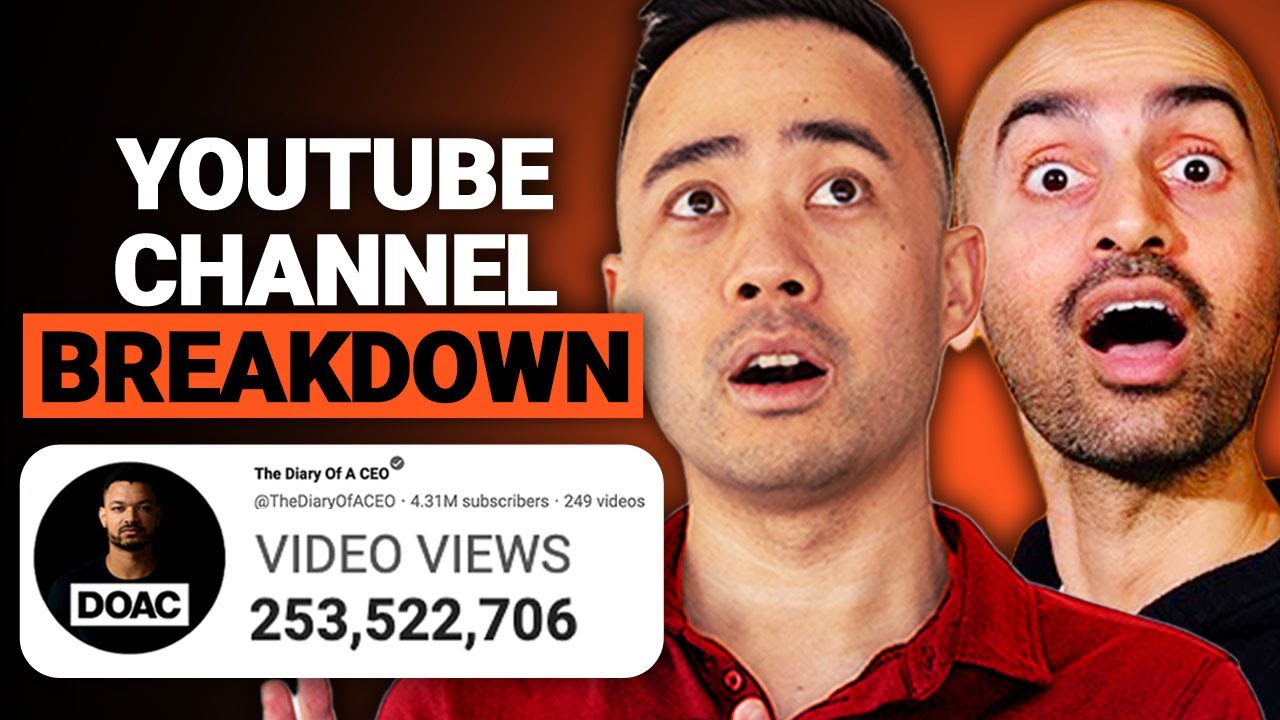
Steven Bartlett hits 1M views per video by testing over 100 thumbnail variations, spending $2M upfront from sponsors to seed views, and mobilizing his community in the first 24 hours. His broad, controversial topics like "Don't buy a house" drive mass appeal, though niche creators like Alex Hormozi convert better despite lower view counts.
Chapters
All right, so we are going to talk about Stephen Bartlett's insane YouTube process where he gets millions of views per video. So Neil, do you know who this is?
I do not.
Okay, so have you heard of Diary of a CEO before?
No.
Okay, so Neil, it's okay. I like to watch these things. Neil doesn't really like to watch these things. He's got better things to do. But here, so take a look.
I got kids and a family. I don't have the time.
Yeah, exactly. Like I said, better things to do. So this is Diary of a CEO over here. This is Stephen Bartlett. He has about 4 million subs on YouTube. And you can see he did this Jordan Peterson interview 2 days ago. It's already got 400,000 views. And he did another one 5 days ago, 695K views, right? Now, Neil, this guy is also, he's a dragon on Dragon's Den, which is the UK's version of Shark Tank. And if, well, I shouldn't have you guess, but just look at this over here. Like, look, Morgan Housel, 2 weeks ago, 1.6 million views. So he's getting a ton of views, right? So I actually watched the podcast.
Well, but look at this. He's doing really generic content, right? What I mean generic content and controversial, but generic is it appeals to everyone. So the savings expert, do not buy a house, do this instead.
Well, read this one, read this one.
Yeah.
Read the bottom one.
I've proven this food keeps you young.
No, no, no, no, no. Read the thumbnail.
I have the erection of an 18-year-old. Right?
Anyway.
So it's just like he's creating content that just has mass appeal. No wonder that video has 662,000 views. Here's the thing to keep in mind, dude. You know, the other day I was talking to Alex Hormozi. Hormozi. And we were talking about social media content. He has the same problem that a lot of other people have. Great size following, the type of leads and the type of businesses that are hitting him up from his audience audience isn't ideally what he's looking for. And a lot of that happens because when you create content that's mass appeal, it's hard to drive revenue from it. Now, it doesn't mean Alex is doing a bad job. He's actually doing a great job because everyone knows him. So now if he does outreach to companies, they're going to know him and it's going to convert extremely well. Plus he can monetize his audience. So it's not like he's losing money or anything like that. But when you create generic content, it's harder to monetize. When you create content around a specific vertical, EX, I create very specific content to marketing, not marketing for startups, marketing for larger corporations. And what I found is I don't get the amount of views, but the monetization from a visitor or someone viewing the content to a conversion into a customer is much better than if I created generic content that just appealed to the masses and got tons of views.
All right, so still, we're going to give you part of the process that Stephen Bartlett has. And one thing is, I don't know if you know this, well, you probably don't because you haven't seen this thing, but he tests over 100 thumbnails and headlines per video. It's a lot of testing, right? And so that's one piece. And I'm not saying everyone should do this. We're just saying, hey, this is part of his process. The other thing which I learned was that In the very beginning, he was spending a lot of money to drive views. And so the way he would do this is he would get like 4, let's say 4 title sponsors. So it's like this podcast is sponsored by Pepsi, for example. They might pay him $500,000, right? So you get 4 of them for $500,000, that's $2 million. He would take that $2 million and dump it all into ads to get the views going in the early days, right? And then Supposedly, one thing that he does is that, and this is his team doing it, they will then find a community of people that are engaging and viewing the videos. They'll always try to blast those people hard when a video comes out. And so the video gets a lot of play in the beginning, right? And usually when YouTube sees as a signal where there's a lot of views coming in initial first 24 hours or even faster than that, and they're also pushing views from perhaps a paid standpoint, that video is usually going to do better, right? And now he doesn't need to do it anymore because he has the reach, but that's how he got it jump-started because this guy seemingly came out of nowhere. He was part of, he had like one of UK's largest social media agencies and then he decided to do this podcasting and he really has been rising quite a bit in the last couple of years.
Yeah. And he's done a really good job. I think it's great branding. Dude, if you can create mass content that appeals, if you can create content on a regular frequency that appeals to the masses and is controversial, like don't buy a home, do this instead, you're going to end up getting a lot of views.
Yep. And then by the way, we were talking about Sam Sulak a couple episodes ago. So this guy, Diary of a CEO, 25 million views in the last 30 days. So Sam Sulak got more than him. And, but only 7 videos published, right? Because here's a long-form podcast and then 330,000 subscribers. new subscribers.
So anyway— Wait, Sam Sulek got more than him in the last—
Yeah, Sam Sulek got more views.
I thought Sam Sulek's at half a million views a month, no?
No, no, no, no, no, no, no. So Sam Sulek got about 26 million views in the last 30 days. And then Diver CEO is about 25 million or so. So it's slightly higher.
Oh, okay.
Yeah. The interesting thing is Sam Sulek's videos are all about Sam Sulek. The Diver CEO one, it's like the interviews. So it's a little different. If you want to build brand affinity, You might go to Sam Zulek model. And one of you that's listening right now, if you got something really interesting, you're a bodybuilder, go and do it and tell us how this goes in the next 2 years or so. Just copy that formula and say you learned it from marketing school. So that is it for today. Hope you enjoyed this episode. Please don't forget to rate, review, and subscribe. Check out this video over here and we'll see you tomorrow.