Eric Siu and Neil Patel discuss how podcasts generate massive revenue, using Scott Galloway's show as a case study. They cover distribution deals, SaaS growth metrics comparing remote versus in-office teams, and Amazon's return-to-office push.
Chapters
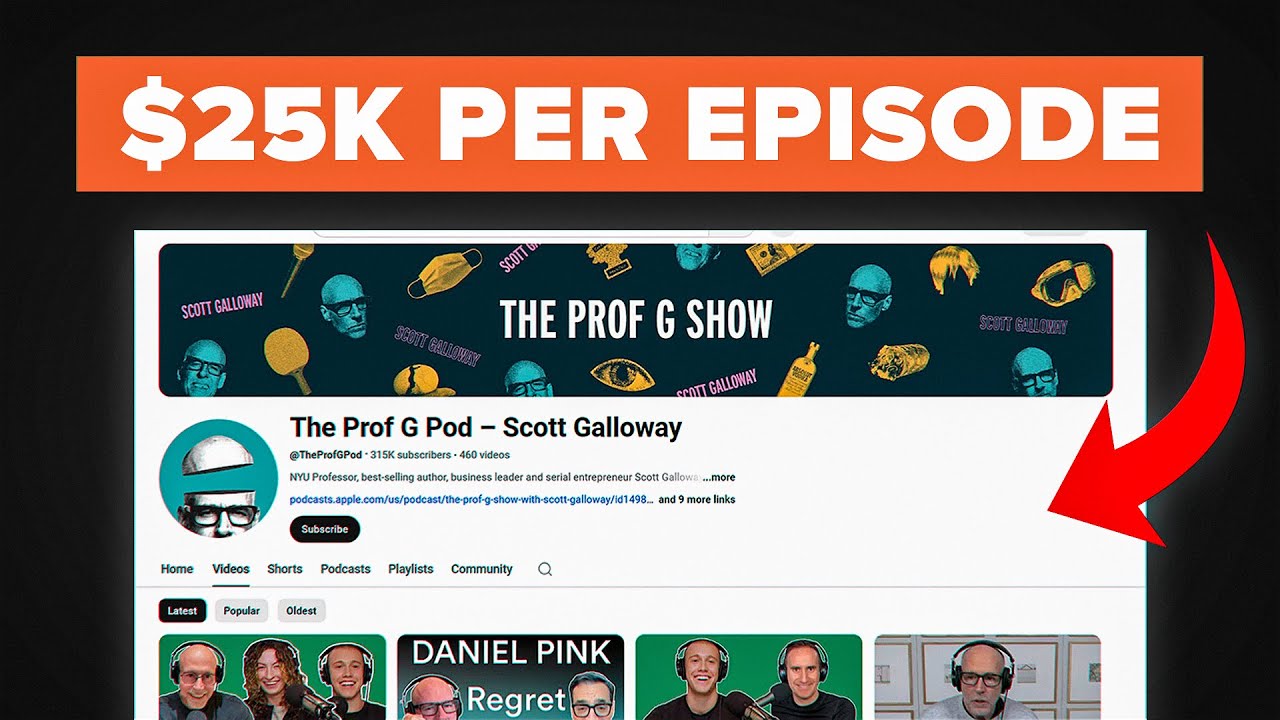
Do you want to know about the podcast that makes $18 million a year? Scott Galloway's podcasts make $18 million in revenue a year. So basically he has the Prof G podcast, which makes $6 million, basically $25,000 per episode. And he has Pivot, which he does with Kara Swisher, who used to be a reporter for—
All Things Digital.
Yeah, All Things Digital. You're right. With Kara Swisher. So that makes $10 million a year. That's $100K per episode. And then he has another one called Raging Moderates with Jessica Tarlov. That one does $2 million a year. That's $20K per episode. So He shared the podcast revenue data on Prof G. And I think he said he'd love to do like, you see these big deals happening, right? You saw the Rogan deal was a couple hundred million dollars. Call Her Daddy was $80 million or $125 million, something like that. So their deal with Vox is coming up this year. And then CNN's like a potential suitor because Swisher's already an on-air TV contributor. This is interesting because I think podcasts are becoming more and more valuable and we're seeing a lot more of these deals happen. And that's exciting. So, I actually like the Prof G podcast because he talks about business. And so, it just goes to show that like there is an angle there. It's wide TAM stuff where he talks about the economy and everything and he gives his opinions. And so, I think there's a bright future for podcasts. I think we're still very much getting started right now.
I think podcasting is going to boom. I think people are consuming it as a new format instead of television. Yeah.
Who knows? Maybe in the next cycle, we'll have the presidential candidates on this podcast.
Who knows? I doubt that. I'll make you a bet on that one.
Well, not if I bring them to Leveling Up and then publish it here, then it counts.
I still don't think they're going to end up coming on this podcast.
You never know if it becomes really big. By the way, oh, oh, this one's fantastic. Okay. So.
We have too much of a niche audience.
We do. If I were to ask you which teams grow faster, in-office teams grow faster or remote teams grow faster?
Grow faster in headcount or grow faster in driving results and revenue?
Median year-over-year growth rate. For what income on, on basically, it's called revenue for the company?
Yes. And in-house.
So how much more do you think it grows?
60%?
A little less than that. So 50% median year over year growth rate for in-office, and then 39% for remote. And so this was, I was just talking with my CTO yesterday, we're talking about this, like, he showed me this slide. I was like, oh, this is interesting. These are 2024 SaaS benchmark reports. So this is just for SaaS companies. And it says default in-office teams grow faster than remote. And so there's been— I've been trolling LinkedIn with all these like remote posts, and then it just gets people so pissed off, right? And I'm like, oh, maybe I found my niche. Maybe on LinkedIn, I'm just the remote work guy, right?
No, no, you are— you're the guy who trolls the remote work.
Well, I mean, we're remote first, right? So like, people think I'm like really against it. We just in LA, we have like a pocket of people that were just in office. But this is another data point here, because Amazon's mandating its full-time RTO, right? Even though they have— they hit some snags, and maybe they're gonna delay it May. I saw a survey this morning, 91%— the, the, that mandate out of, uh, 5 stars, it has like a 1.2. Like, people are really pissed off, right? Um, 91% of people are really unhappy about it. Um, but when you see this, like, okay, this is— you just see more and more data points. Okay, 70% of, of, of leaders are— Forbes reported this, Morning Brew reported it, saying that most people are going to be coming back. Okay.
Yeah.
And then you have this one here saying that You know, in-office grows faster. Like it becomes harder and harder to say that, you know, people are not coming back. I just think most people are going to be coming back unless you're a high performer.
So what is Amazon doing when people have moved to a lot of different states and countries?
I think you're just coming back to a hub. I haven't read fully on it, but I think you're just gonna— you're either gonna come back to a hub.
Yeah.
Or you just lose your job. Or you're gonna lose your job, which I don't think they care about either. Unless you're a high performer, then they'll probably make some concessions and say, hey, you can work remotely. But if you're not a high performer, they're probably okay losing you.
Yeah, I believe that.
Yeah. So I don't think it's like, by the way, both of our companies are remote first. We're not saying we don't support remote. In fact, I love remote. But I just think most people are going to have to come back because unfortunately, most people aren't high performers.
It's not even about the high performance. I do agree with you on that statement. But it's about when you look at any big organization, you only have so many experienced employees that are at the top. Majority of your workforce is going to be less experienced and they're not going to be as great as your A players or your executives at the top. If you want all your B and C and D players, and being a D player doesn't mean you're bad, a lot of times it could just be you're green and you're new and you have a lot to learn. They're not going to start improving the grade that they're at unless they're around other amazing employees. And that's just not going to happen in a remote-first environment while everyone is in person. People learn so much faster and they grow faster as well.
Yeah, I've noticed that people in their mid-20s or so, they want to be in the office, at least with us. The people that are older, let's say we're older, right? You've paid your dues. You're okay working from home. So, I think it just depends. And, you know, that's an interesting way that you think about the D players as someone that's still learning. I think about an A player, like a D player is just a low performer to me. An A player, even if you're really green, is someone that is doing really well in their current state right now, right? We kind of look at it a little differently.
Yes.
Yeah.
I look at it as a player, as for me at least, someone who can bring a lot of revenue, someone who can manage, someone who can execute and get their hands dirty. You don't have to worry about them. They go solve problems and they figure out just ways to improve the business and just generate more revenue.
I want to take a second to tell you about my podcast co-host's agency. So NP Digital, so Neil Patel Digital. What they do is they do a whole host of marketing services and they are global. They're worldwide. They have SMB services as well. They have mid-market to enterprise services as well. They cover the entire gamut. So you can just go to mpdigital.com to learn more about it. And now back to the episode. Remember what— did I tell you what Brian Chesky said about A players versus B and C players?
No.
So basically Airbnb CEO Brian Chesky said this. An A player is someone that is working 6 months ahead and they're just telling you what they're doing. Okay? Remember that?
Yeah.
And then a B player is someone that is doing something in the now and they need some direction, okay? A C player is someone that is like, they're doing something that they should have done 6 months ago. And it's like, what are you doing, right? You should have done that earlier. And so, I think that's a really good way of describing it. And here's the thing, next 5, 10 years again, we're talking about these McKinsey says 70% of work's going to be done by AI agents. Like, I think Amazon, now that Jeff Bezos is back, he's like working. He said he's working harder than he's ever worked. I don't know if you watched that interview. You watched it, right? Yeah. He's in. What do you think he's saying? He's like, well, he all he's focused on is what right now in Amazon AI.
Yes. And by the way, with people who don't want to come back to the workplace, he's a no problem.
They'll replace them with AI and save money and not have to pay severance. Yeah. And so you know you can call him like a greedy. Greedy, whatever. But like, at the end of the day, he's just doing what's efficient for his business.
So yeah, he's just doing what's best for his pocketbook and his shareholders' pocketbook.
Anyway, that's it for today, and we'll catch you tomorrow.









