How to Be a Billionaire: Naveen Jain On Taking Moon Shots and Having Audacious Goals
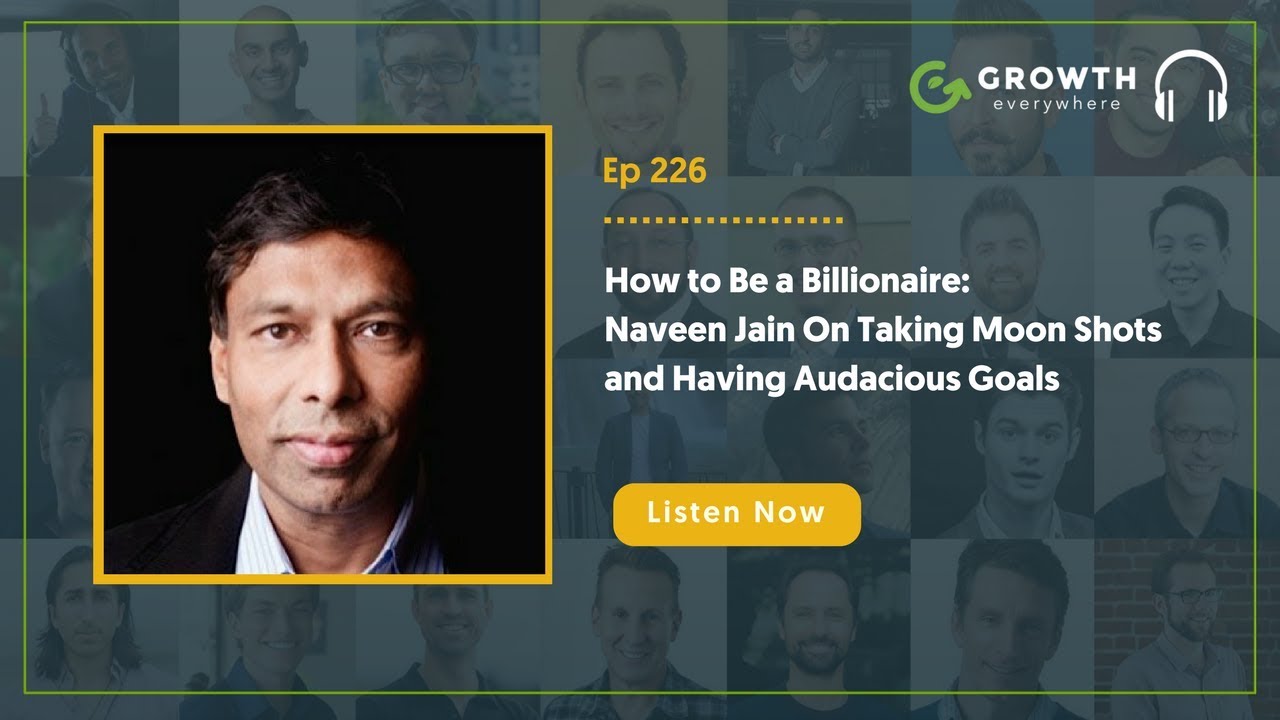
Naveen Jain, founder of Moon Express and Viome, explains how he targets massive problems as "moonshots." Moon Express aims for a $10-million lunar landing. Viome decodes the gut microbiome to make sickness optional through personalized nutrition and AI.
Chapters
Your self-worth is not from what you own, but it comes from what you create. So you may own a lot, but you're still useless and worthless to the society because you haven't created anything.
Do you want to impact the world and still turn a profit? Then you're in the right place. Welcome to Growth Everywhere. This is the show where you'll find real conversations with real entrepreneurs. They'll share everything from their biggest struggle to the exact strategies they use on a daily basis. So if you're ready for a value-packed interview, listen on. Here's your host, Eric Siu.
Before we jump into today's interview, if you guys could leave a review and a rating and also subscribe as well, that would be a huge help to the podcast. So if you actually enjoy the content and you'd like to hear more of it, please support us by leaving us a review and subscribe to the podcast as well. Thanks so much. Okay, everybody. Today we have Naveen Jain, who is an entrepreneur, a philanthropist, and also the founder of several successful companies including Moon Express, Viome, Intellius, Blue Dot. I'm just gonna let him go down the list later. And he's also a board member of Peter Diamandis's Singularity University and also part of XPRIZE as well. Naveen, how's it going?
I'm doing wonderfully well, Eric. It's good to be here.
Yeah, so yeah, I mean, look, you're doing so many different things, right? So why don't you tell us a little bit about kind of who you are and what your story is?
Well, you know, I think, as you see, I'm an entrepreneur and my focus really is what are the biggest problems facing humanity. Because the bigger the problem, the bigger the opportunities. And that is really the way every entrepreneur should look at that. Every time you get frustrated with something that it's not working right, you start thinking about and saying, if it is such a big problem, let me go out and solve it, right? And start thinking about when I solve the problem, is it really a problem that people feel is a problem, or is it something— it's a perceived problem? So are you really selling aspirin where somebody has a headache and you're giving them an aspirin? That's an easy sell versus you're selling them a vitamin that they don't really perceive the pain and you're trying to sell them something they may not even know they need it. That's a much harder sell. To me, the best way to become a successful entrepreneur is to really start to think about solving the big problem because solving a big problem is actually easier than solving a smaller problem because when you set out with an audacious goal of doing something, it attracts the best talent around the world. world because they believe in that purpose. So whether it is a company called Moon Express that I started 7 years ago, and imagine at that time a simple boy who came from India with no food to eat dreamt of landing on the moon. And because to me, the landing on the moon was symbolic of what an entrepreneur can do. So when you start a company, we always say, Eric, hey, let's go to the moon. We're going to go to the moon. We're going to the moon. So I said, let's just go to the moon and done with it, right? But it's very interesting is that, you know, going to the moon is really to some extent is a 4-minute-a-mile problem. Nobody believes it could be done, and that's why it was never done until we decided that is something we could do. And if we started down the path, we realize that exponential technology is growing so fast, and many of the components that go into landing on the moon are actually— when we started, you know, we realized that 70 years later, when we'll be ready to land on the moon, it will be very, very much, very much competitive. So the first time when the United States landed on the moon, it cost us $25 billion. And in today's dollars, that would be close to $100 billion. Right. So, you know, we realized that maybe we can actually use the sensors. Prices are coming down and the rocket prices are coming down. Maybe we could bring the cost down to $100 million. And that was our goal, that could we do this for $100 million and it would be an amazing result. It turns out that I was so wrong that I couldn't even believe it. Now, as we are ready to go launch and land on the moon later this year, it turns out our cost is going to be under $10 million on a marginal basis. And that to me is a phenomenal power of technology, that something that nobody thought was possible not only becomes possible, it becomes possible at a price point that we ourselves didn't realize was possible.
Wow. And is this a function of Moore's Law that the price keeps dropping like that?
Well, it's Moore's Law on multiple technologies. So each technology is on Moore's Law. And when you start to see the convergence of these technologies, this is where— why I believe the next 10 years are going to be the most disruptive 10 years in human history. There has never been a time in human history where so many technologies are coming together, each one of them on exponential curve. And for the first time, the entrepreneurs have powers. That means you and I, an individual and a small group of people, are now capable of doing things that could only be done by the large companies or even the superpowers. So think about it. When we land on the moon, Not only we become the first company ever to do so, we actually become the 4th superpower. Only 3 superpowers have landed on the moon. So imagine a small group of people becoming the 4th superpower. And as you may already know, Eric, that we are the only company in the universe that has permission to leave Earth orbit and land on the moon. And President Obama signed into the law that actually allows us the right to bring back the material from the moon and own it as a private company. And those are the kind of things we couldn't have possibly imagined we could do 7 years ago.
Okay, so 2 questions. A, why even go to the moon? That's the first one.
Well, number one, I mean, obviously, if you think about the biggest goal that our biggest problem facing humanity is a possible extinction, right? So going to the moon has 2 purposes. One is obviously commercial. The moon has $16 quadrillion worth of minerals on the moon, whether you're looking at Rare earth elements, you're looking at the platinum-grade materials, or you're looking at helium-3. And helium-3, as you know, is probably the most advanced and the best clean energy source for fusion energy. So that means a small quantity of helium-3 could power the planet Earth for generations to come. And the second goal is much more noble cause that we all live in a single spacecraft called planet Earth. And it's only a matter of time when we get hit by a large asteroid. And if that were to happen, we will all become asteroids. We all become dinosaurs. And the idea really is, if you think about it, if you could hear the dinosaurs rolling in their graves, what would they be saying? They wish they had one good entrepreneurial dinosaur that might still be alive, roaming on Mars and roaming on the moon and roaming on the other planets. So to a large extent, it is for ourselves that we become a The other advantage of being on the moon is the moon has water, and water really is the oil for the space economy. Its component of hydrogen and oxygen make rocket fuel, and they also make fuel for humanity. So even if you were to settle down on Mars, the best way to learn to live away from this planet, to be close by in our sister planet on the moon, and because once we learn to live on the moon, the problems are very similar and we can live on Mars. You and I rather be lunatic. living on the moon 3 days away than to live on Mars and be a Martian 6 months away.
You know what's interesting? I mean, you have, you know, you have, you know, the success that you want. You're being— you're able to take these, let's just call them moonshots, right? You know, going to the moon. And we could talk about some of the other technologies that you're working on right now. But people are probably thinking, well, you know, it's easy for Naveen to say, you know, he's successful, right? So people are probably wondering, how do you build up success to the point where you're able to take moonshots The interesting thing is, today, the cost of these moonshots are so small.
In fact, I can tell you that my other company that I started, a company called Wyome, and that probably is a great example. As you can imagine, I've started now 6 companies, and never been— the 2 companies have never been in the same industry. The reason for that is, once you are an expert in any field, you actually start to think like an incremental expert, right? You can improve it by 10% or 15%, but you can never ever disrupt that industry by 10 times or 100 times. So, you know, whether I did the things, the smartphones in late '90s before there were any smartphones, because we knew that will come and we could disrupt the market. Space and now the healthcare. The Wyom is a healthcare company. What do I know about healthcare? Until I started this company, I knew nothing about healthcare, and that was the biggest advantage I had. That means I wasn't thinking like them. I wasn't thinking like the people in the system, and I was able to come. Completely revisit why the system exists and what the problems are and completely bypass the system. And our goal at Viome, the moonshot here is, what if we can create a world where sickness is optional? So think about that. Can we actually create the technology that allows us to look deep inside our body, understand how it works, and keep it from being sick? The good thing is, now we have technology at our disposal. That is the power of technology, that if we think we can do it, if we can imagine it, we can do it. The only thing that stops us from doing things is either because we are afraid to fail, or we just can't imagine what is possible.
Obviously, the first person that comes to mind when I think about these things is you have Elon Musk not knowing anything about rocket science, and then going out and boom, SpaceX. How do you become an expert in these fields? Like, biome, what's a good example of that? I mean, how did you go about learning?
It's very interesting. When I decided that I'm going to go out and take on the healthcare system, because to me the healthcare system is really an example of what happens when a system that starts out with a particular noble goal of taking care of people who are sick, over time, it actually— the system becomes so large that it becomes an organism in itself, and the Darwinian theory starts to take hold. The survival of the system becomes the only goal, and it forgets the purpose that it is designed for. Today's healthcare system, the patient is no longer the stakeholder. It is only the insurance company and the doctors and the hospitals and the unions and the regulators become really the stakeholders that are deciding what to do with the patient who seems to be the burden on the system. And it was designed for a time when we were falling sick, or we were actually dying from infection. So it was designed for episodic times when we had infection or acute diseases, and we went to the hospital, and we got the medicine, and life was good. And today, we live in a time where we have these chronic diseases. And these chronic diseases are you're obviously sick all the time. A system that was designed for episodic thing now actually is constantly being sick. Actually chronic. Now, here is the irony. The irony is the cure for the infectious diseases is what caused these chronic diseases. And our whole hypothesis was so wrong. We believed that if we can somehow keep the humans free of all the bacteria and viruses, we will have the healthy human being. And we didn't realize that nature created human beings as a symbiotic ecosystem. In fact, most people may not realize, just like I didn't until I started Viome, that only 1% of our genes are expressed— the genes expressed in our body come from our own DNA. 99% of the genes that are expressed in our body actually come from the organisms that live inside our gut. So think about that. The massive organ that's providing 3 million genes Compared to our 20,000 genes from our DNA, we had completely ignored that. And when we start to take antibiotics, or we're taking the processed food or the other toxins in our body, we're killing these microorganisms. And these are the ones that actually provide the nutrients and the energy that our body needs. So when you start to kill them, suddenly the people— no wonder people have the Alzheimer's diseases, the autoimmune diseases, obesity, and the diabetes, and the cancer. All of these are the disease of inflammation. And the inflammation happens because our immune system doesn't know what to do. And our immune system is actually trained by these gut bacteria. So you can start to see now what is happening, that as we are eating poorly, and as we are killing our ecosystem inside our gut, we are becoming constantly sick. And that realization, Eric, is what got me to start And we say, what if we can actually find what is happening inside the body at a molecular level? At a molecular level, I mean understanding every single living organism that's in your gut, whether it's a bacteria, whether it's a virus, whether it's a fungus, whether it's an yeast. And all these things are on the surface sound like the bad thing. They actually are symbiotic with us. That means when we eat fiber, our gut microbiome— That's right. Our body can digest fiber. It goes to a large intestine, and these microbes eat the fiber. In turn, they release the short-chain fatty acids, which is what our body needs. They produce the vitamins. They produce and actually take the energy out of the food and give it to us. So to a large extent, that relationship was broken. Now let me give you another example. When we started with a simple goal, I knew nothing about this field. I set out this moonshot: I'm going to create a world. Where sickness is optional. And by having such an audacious goal, I started to get some of the best people around the world contacting me and said they want to be part of it. So for example, the head of the Watson Research contacted me and said he wants to join and quit IBM and all the artificial intelligence work he's doing. He wants to apply to the problem that I set out to do because he said that is his calling. Dr. Maciej, who was working with Craig Venter, who actually, obviously, as you know, did the complete human genome sequencing, working at Human Longevity. When she heard about the problem I was trying to solve, she quit her job and joined us. I got the technology at Los Alamos National Lab where they were developing it for national security. And the person who was developing it, Momo, came and said, I want to solve this problem. I don't want a cushy government job anymore. I want to solve this audacious problem. Think about what happened. If I was solving— building a small iPhone app, there is no way these world-class people would have joined and say, hey, I want to build an iPhone app too. They joined me because I had this moonshot of a big idea that what if we could do and help billions of people around the world and solve a problem that costs, as humanity, trillions of dollars to our system?
Right.
And, by the way, suffering of billions of people constantly, whether it is cancer or whether it is diabetes or obesity or autoimmune diseases, we're constantly suffering. So, what if we can remove all of that? And that was the goal we set out to do.
Got it. Okay. And then, I mean, just, you know, your learning process for— you know, you're doing Moon Express, right? That's been around, you said, 7 years or so, right?
Yeah.
And then, Viome is the latest one, right?
Yeah.
So, you know, what was that process like when you started? I'm just trying to get the kind of what did you do exactly? How would Naveen do it? When you started Viome, how did you go about learning what you needed to learn? Did you just Google it? Did you just, you know, go to the library? Like, how did you learn all this stuff?
Well, it's very interesting. That's actually— I'm glad you asked, Eric, because that is something when you start, if you have just enough of the vocabulary, which I got by listening to TED Talks and by attending Singularity University. And by attending Singularity University, I knew there is something called genetics. I knew there is something called epigenetics, and I knew how kind of in the biology they work, but that's all I knew. And when I started looking at the healthcare thing, I started to see that microbiome is really the key. So I did 2 things. Number one is I started buying at least 6 or 7 books from Amazon that all were related to microbiome. The reason for that is I don't want to be caught up because of one person's opinion. So I always like to read 6, 7, 8 books, because then you get different people's opinion on what is going on. And then what I do is I always go to Twitter, and I started to customize my feed just only to the science articles and research that's coming out in this field. And every day when I wake up at 4:30 in the morning, I spend the first 2 hours looking at all the research that is around the microbiome and genetics. And that allows me to see where the field is going. So by looking at the research articles, which tend to be about 15 years ahead of anything that is going to be there in the— what I would say in the clinical setting. It allows me to now build a company at the cutting edge because I'm taking this stuff that is in the research lab and bringing it to the people directly, rather than going through the system. If you go through the system, it will take 15 years. As opposed to going and partnering with the doctors and the hospitals and the insurance companies, I decided the best way that innovative ideas get to the market is by coming outside the system on the edges and go directly to the consumer and empower them with the And knowledge and information and actual recommendations so they know exactly what to do. So by doing that, I am no longer getting sucked into the system. So if I go to the insurance company, or doctors, or hospital, guess what happens? You as an outsider will come in, and the first thing the system does is swallows you. And the second thing it does is that all of the immune system of the system is going to start attacking you so they can kill you. So this is really the antibodies attacking you, because they don't like anything coming from outside. And the only way the innovation happens is it comes from the edges. So when you look at the personal computers, when they came out, they didn't go out and attack the miniframes or the mainframe. They came out of the word processor, became a spreadsheet, a better calculator, and they became more and more powerful. And next thing you knew, they were replacing everything else. Clayton Christensen said that innovator's dilemma, it's not the large companies don't know what to do. It is the system that does not allow them to be innovative. So by going directly to the consumer, because they are really the people who care most about their own disease, and they become expert. And what we did is by essentially bypassing the system, we are able to get tens of thousands of people directly working with us. And the more people were working with us, the more data we had for our artificial intelligence to make the system even better. And I think in a very short period of time, we now have the artificial intelligence that is smarter than any human being can ever be because it's constantly learning from the latest research and it's constantly applying the learning to every single dataset. Every dataset that we get, it actually makes it better. It really gets an exponential impact as each person joins the system.
I love it. You know what's interesting? As I look at all these companies that you're a part of, obviously recruiting is a big thing. You need to have smart engineers. You have to have smart scientists and everything. What you just talked about with Viome and Moon Express is these are moonshots, right? Then you basically announce it to people, and then a lot of people will come, smart people will come and join you, right? Because it's cool stuff to do. Now, people are probably thinking, well, great, Naveen has a platform and everything, but how can I go about recruiting really smart talent? How did you do it in the earlier days when you didn't have a platform?
Again, the good thing about that, Eric, is that everyone has a platform. Because unlike in the olden days, only the rich people's voices were being heard when the only way to get the information was through the radio or television. Today, we have social media. Every one of us has a chance to create a viral video. Every one of us has a chance to put something up on social media and essentially use our own small network to essentially blow it up. And if you're doing something that is so audacious, it will get picked up. And that is the beauty of the thing is you no longer have to rely on a platform. You can create a platform. I mean, think about it. Someone talking to you has a platform. And the people, if they were doing something audacious, you will be more than happy to bring them on your platform and say, hey, tell me how this audacious idea of sustaining 20 billion people on Earth, how are you going to increase the How do you plan to create the abundance of food? How do you plan to create the abundance of energy? How do you plan to create the abundance of fresh water? And if somebody's solving that problem, wouldn't she be the first one to say, come on my platform and talk about it?
Yeah, totally. And I think, you know, some people are probably thinking, well, you know, great, Naveen has a following and all that, but I think if you're— honestly, if you're doing something, you know, interesting and you're consistent about it, that following will build. So I think anybody can build it. So to your point, Now, the other thing is, I remember meeting you at Collision Conference, and when we had a couple conversations, and then I actually, you know, we had a phone conversation. I think before we had the phone conversation, you said call me, but here's the thing. You sent me an email, you opened my email, and you sent me an email back at 3 AM, right? And then when I called you, you picked up immediately. So my question is probably like, how the heck are you so efficient? Like, what are your habits?
Well, so again, I'm going to actually, you know, the question is actually the wrong question. You never want to follow the habits of the successful people. You want to follow their thought process. For example, Tony Robbins takes an ice bath every morning. You can take an ice bath 3 times a day, it's not going to make you Tony Robbins. What's going to make you Tony Robbins is to think like Tony Robbins, right? So let me give you the thought process of how I work. It's a respect for other person's time. That means you always want to make sure that you are respectful when you tell someone to do something. You say things you mean and you do what you say. And the second thing that I follow is that, you know, I work long hours. The reason I work long hours is because every minute of my life, I love it. I don't go watch movies. I don't watch news. To me, it's all distraction. I don't want to be watching a movie, being in someone's world. I enjoy my world. I love my world. I don't want to change my world. The fact is I do work 7 days a week. I do work 18-hour days. The thing is, to a large extent, I also love— like when I met you, I want to take this message of hope and abundance, and I want every single person who's listening to this is really be thinking and say, what is my moonshot? What would I do? Why can't I create the abundance of fresh water? And the interesting thing is every single thing, these large problems, you can solve them today because the technology exists today. It is just simply a matter of you applying any one of these exponential technologies to solve the problem. For example, for agriculture, all you have to do is start thinking about what kind of sensors What sensors can you apply that will make agriculture balanced so you don't have to spend as much fresh water? What if you can do aquaponics? What if you can do aeroponics? What if you can start to use sensors with small drones that can tell you when the crop is ripe or when it needs some help or when it is diseased? What if you can start to change the microbiome of the soil? Because at the end of the day, the plants are no different than human beings. In fact, we as humans, we share 90% of the same DNA with the plant. So what if you can adjust the microbiome Yeah. —of the soil, so the yield of the plant will grow up. And you can go on and on and on and start to think about and say, if I care about the environment, why can't I create a beef that comes out of the stem cell and create the biofactories so that now you can have as much beef as you want without ever having to raise the cattle? And if you don't have to raise the cattle, you don't need all 50% of agriculture used to feed the cattle. You don't need the agriculture to feed the cattle, because now you can use the agriculture to feed the people. You don't need as much water if you're not using as much agriculture. All these things are connected if you understand what is the root cause. By the way, if you really care about the environment, you don't have to actually drive a Tesla. All you have to do is stop eating meat. That will— you'll be doing more for the environment than you will ever do by driving a Tesla. Love it.
Great. So, I mean, you know, one of the things we talked about before this was more about talking about how people can, and you just mentioned it, how people can think about things with a more abundant perspective, right? But I still love stories because stories are good on this podcast. So, what's one big struggle that you faced while growing any of your businesses? Just tell us a good story.
Every business goes through the struggle, and to me, every struggle is an opportunity for you to go think about it differently, right? So, whether you look at the Moon Express, you know, it was very difficult in the early days for someone to say, I'm going to fund this moonshot because first thing they ask you is, you know, who has done it? I mean, how do you know it's even doable? How do you even know that the United States ever even landed on the moon? Because it must have been just simply a fake landing, right? And to me, this is where the inspiration comes from. So when I started early days, I simply went, go and tell people, imagine in our lifetime, we watch, always have a chance to watch the history being made. How often in our lifetime we actually get to become a part of making the history together. Come join me, let's make the history together, or watch me do it and you'll always regret that you had a chance to be part of it but you were sitting outside watching it.
Cool, love it. And you know, one other thing I saw before we actually talked is super interesting. You spoke at a TED conference, but not only that, I've seen your kids also speak at TED conferences too.
Can you speak about that? Yes, I mean, to me, the biggest accomplishment as parents we have is really our children. And to me, the parenting is so counterintuitive. It is no different than actually starting a company and rethinking about how it could be done. A lot of the time, the people, you know, as we as parents want to do things for our children that they believe they have a passion for. And when the children are young, it is very difficult for them to have a passion about something they don't even know. That means a young, you know, my daughter, when she was 16 years old, she came to me and said, Dad, Dad, I know you love science and technology. I want nothing to do with science and technology, so just get used to it. I have a passion. I want to pursue it. As opposed to saying, sweetie, go ahead and go do it. I would love to help you pursue your passion. I said, sweetie, you got to let the dad do his job. Dad's job is to expose you to the things you haven't been exposed to yet before you find your passion. By my allowing you to pursue your passion is really my saying to you, I don't care what you do because I don't have time for Instead, I allowed her to go to Singularity University to learn about neuroscience and technology, and that's how she developed a passion for something she didn't even know she had. And now she graduated from Stanford, Stanford Stamp Fellow, Stanford Mayfield Fellow, Board of Stanford Women in Business, and now working at a neuroscience company. Essentially, I'm doing more of a women empowerment. Our oldest son. He started Cairo Society when he was 17 years old, and that's now world's largest college entrepreneurship society. And you know, when he started, it was simply about bringing the entrepreneurs together. And when you have Bill Gates and Bill Clinton and everyone coming and joining, guess what happened? Since he was doing it for helping others, now he became one of the most connected persons. So this last week, he had a full profile on Wired magazine. He was featured in Wall Street Journal two weeks ago as the as essentially the power broker of Silicon Valley. Inc. magazine wrote a cover article on him, world's most connected 21-year-old. He started a company called Human. He sold the company and he's starting a second company. Our youngest one is now a junior at Stanford. These kids turned out to be one amazing kid because we actually separated and told them what success is about. Every single day, we will tell them that your self-worth is not from what you own, but it comes from what you create. So you may own a lot, but you're still useless and worthless to the society because you haven't created anything. Your success will never be measured by amount of money you have in the bank. It will always be measured by how much impact have you had on society, how many lives have you impacted positively. And only way you will ever know that you have become successful is when you become humble, because humility is a sign of success. If you still have an iota of arrogance left in you, that That means you're still trying to prove something to yourself or someone else. You're not successful. The last thing is we really separated the 2 things. I told our children that our love for you is always going to be unconditional, but our approval is not. That means you always will have to earn our respect and our approval, but you never will have to earn our love. We will love you, but it doesn't mean we're going to approve of what you do until you follow the value system that we believe in, which is go out and help as many people as you can. And doing good and doing well are not mutually exclusive. So never be afraid to create a company that solves a big problem and make it very profitable, because profit is the engine that allows you to do a large good. Even if you are the richest man in the world, you can do a small good before you run out of money. So if you ever desire to help a billion people, create a profitable company. If you want to help 100 people, create a nonprofit.
Love it. So selfishly, I know earlier you talked about, you know, we talked about habits a little earlier, but, you know, I always wonder, right, you look at, you know, if you look at Warren Buffett, he reads 5+ hours a day, right? I mean, what are some key habits that you have? Because I always like looking at templates from people, and I rarely get billionaires on the show anyway.
Yeah, so I tell you that the number one thing is being intellectually curious, and that is something we always instill in our children. So as an entrepreneur, to me, being intellectually curious is the number one thing you can do. The day you stop becoming intellectually curious, you actually become dead. In fact, most of us will say, I can only take you to the water. I can't make you drink. What if your goal is not to take them to the water? What if your goal is simply to make them thirsty? If you make someone thirsty, they will find their own water and they will drink. I focus on really creating that thirst. The thirst comes from being intellectually curious. And I, every day, if you ask me, I spend most of my time really learning about new things that I don't know anything about. And that to me is what allows me to connect the dots, because every time, every time I read something, that becomes the dot. I keep it in my pocket until I see the second dot. I can connect the dot and say, oh, now I can solve this problem. And that to me is the key, is to just keep collecting dots until you find the missing dot.
Then you know how to solve the So I find it hard to believe that you're only reading 2 hours. You're reading way more than that during the day, right? I feel like most of your day is just reading, learning, listening, watching, right?
That is, that is in fact correct. What I was thinking, talking about the 2 hours in the morning, simply going through my research articles on my Twitter feed.
Got it. Okay, perfect. Just a couple more questions here wrapping up. What's one must-read book that you recommend to everyone? I know you read a ton. So just first one that comes to mind.
Honestly, that really depends on each subject. And for example, on the healthcare side, on the microbiome, I really love the book called Disease Delusion by Jeff Bland and The Human Superorganism. I just love both of them. It gives you a holistic view of the body. If you want to read the neuroscience book, I mean, I love human brain and there are several books, but I think the book that I really, really enjoy was The Brain That Changes Itself. I mean, it's all about neuroplasticity. Really love that book. There's a great book that Ray Kurzweil wrote, How to Create a Mind. Really tells you about how human brain works.
Yeah.
I can go on. I mean, I love the book on epigenetics, something called Epigenetic Revolution by Sarah Carey. So, I mean, anyway, each subject I can tell you the books that I just absolutely thoroughly enjoy reading. Some of the books are just more on the general purpose things. I love Peter Diamandis' book called Abundance. I absolutely loved it. There is a book that Clayton Christensen wrote, How Will You Measure Your Life? Really loved it, right? So, I mean, obviously you can't go wrong reading Anything that Tony Robbins podcast or, you know, other people that are just very, very inspiring to me.
Here's a question that just popped up in my head. I mean, what's the difference, right? How do billionaires think differently versus millionaires?
I mean, I think the difference really is they focus on big problems. They don't focus on simply making money. Making money is a byproduct. So think of it itself like making money is like having an orgasm. If you focus on it, you're never going to get it. If you enjoy By the process, you're going to get it. So think of— never want to start something to make money, but you want to start something that you enjoy, and in the process, at the end, you really get what you want.
Love it. Okay. Final question from my end. What's one new tool that you've added in the last year that's added a lot of value, like Evernote?
The tool that I really enjoy really is that, you know, able to create the news feeds from my Twitter for very specific needs. So I have my Twitter feeds in the news feed of very specific things. So I don't have one single Twitter feed. I really create this grouped feed for my different things, and I'm able to actually go and really focus on what I'm trying to learn and not be distracted by anything else.
Love it. Well, Naveen, this has been fantastic. What's the best way for people to find you online?
I'm actually online. You can find me on Facebook. You can find me on Twitter. You can find me on LinkedIn, and you can always send me an email, naveen.jain@gmail.com.
All right, Naveen. Thanks so much for joining us.
Thank you, Eric. Really look forward to it.
Thanks for listening to this episode of Growth Everywhere. If you loved what you heard, be sure to head back to growtheverywhere.com for today's show notes and a ton of additional resources. But before you go, hit the subscribe button to avoid missing out on next week's value-packed interview. Enjoy the rest of your week and remember to take action and continue growing.









