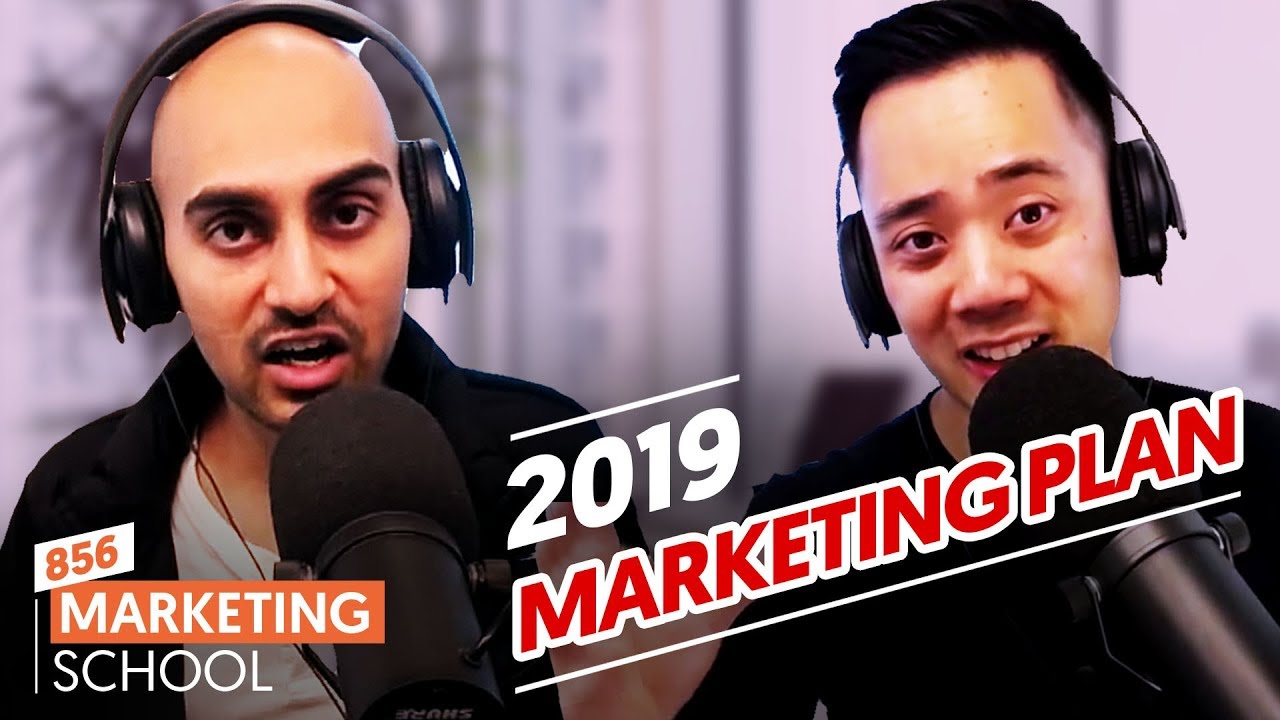
Eric Siu and Neil Patel walk through building a 2019 marketing plan: set quarterly rocks using the Traction framework, audit what worked and scale it, document failures, increase customer lifetime value through CRO and upsells, test new channels, and ask five strategic questions. For new companies, they say throw spaghetti at the wall.
Chapters
Welcome to another episode of Marketing School. I'm Eric Siu.
And I'm Neil Patel.
And today we're going to talk about how to create a marketing plan for 2019. So the new year is coming up, 2019 is approaching fast and furious. So I'll jump into a couple of things that I like to do with my team and then Neil can talk about what he likes to do and we'll kind of go back and forth. So for me, when I, when we look at our team, I've talked about this book in the past, but the book called Traction, it's the entrepreneur's operating system. We've actually rolled that out to our other teams. So let's say our client services team, our internal content team. And what we do, this is every quarter actually. So this happens before the new year, is we plan for the next year. You know, we talk about all the big issues. We talk about all the rocks that we need to accomplish. And then these rocks are kind of the guiding point for the next quarter. These are the things that we need to get done in the next 90 days where we're super focused. And then what we'll also do when we start that offsite meeting is we'll talk about, hey, Here's what went well for the last year, right? Because this is basically, we're going into the new year. Here's what went well, here's what needs improvement. And then we'll also have a list of issues, big issues that we want to discuss, things that will make people feel, you know, uncomfortable because growth is uncomfortable, right? So, we'll talk about things, there's going to be some tension, heavy debate sometimes. And we'll talk about what needs to happen from a marketing standpoint to continue to grow. You know, what's getting too saturated, what's not, what's working, what's not working, what are you seeing other people do? All that kind of stuff happens in a discussion in a room and you're going back and forth. And I recommend, look, if you're going to, if you're, if you have a remote team, do it through Zoom and do it with video on. That way you guys have some sense of, you know, more camaraderie that way.
If you already are up and running in marketing and you're generating traffic, if you're going to be planning for the new year, which I hope you are, you should take a look at everything that's worked and figure out how you can scale that up. You should take a look at everything that didn't work in 2018 And ask yourself, why didn't it work out? Ideally, you should be documenting every time a marketing experiment fails, what you guys learned from it, and how you're going to be moving forward. Now that you got these 2 things out of the way, one of the channels, as I mentioned, is to scale up everything that's worked and double down. The second thing I would plan for is how you can increase the lifetime value of your customers. Marketing is getting more expensive each and every single year. That means you need to optimize for conversions as well as increase how many more people or how much more people are going to be spending on your website. So from upsells to downsells to cross-sells to creating and optimizing a funnel, those are all things that need to be in your marketing plan as well as CRO. In addition to that, once you get those things going, then you should focus on, hey, here are all the new potential channels that we should test out that most people aren't. Here are also the new channels that have just come to the market. You don't want to be the first mover. That's typically when you waste time, spin your wheels, but you want to be an early adopter. That's where I'd start off if you already have a business that's up and running and you're already doing marketing.
Yeah, so I'm going to give you a list of 5 questions I like to ask and I actually put this in front of my team. And even if you're a solopreneur right now or solo marketer, you can still ask these questions and you can still do this on your own. And the idea is that The better you get, you're going to eventually have a team around you. So, it's best to get this muscle rolling anyway. So, one thing to ask yourself before the end of the year is, and this doesn't just apply to marketing, but it applies to kind of general business, is what's something I could do that's really extreme, right? So, maybe we'll bump our prices up by 10x or whatever. Like, that's kind of extreme, right? Number 2, what could we add to something we already do to make it more extraordinary? So, what Neil's talking about is what's something that's working already? So, what more can we do to make it even more extraordinary, right? Doubling down, tripling down, quadrupling down. Question number 3, what could we strip away from what we already do? So, this kind of relates to what Neil's talking about, like, what should you eliminate? Because you can't try to do everything, especially— it doesn't matter how many people you have on your team, you can't try to be everything to everyone. So, ideally, you know, Neil and I have talked about in the past, you're focusing on those 1 or 2 channels that work really well for you. Don't try to— just because you see a new channel, try to jump on it. Just because we talk about all these cool things on this podcast doesn't necessarily mean we're doing all those at the same time. So, keep that in mind. Question number 4, what ideas could we take from other industries and apply them to ours? So, maybe there's something we see around, you know, ridesharing, for example. Like, I'm picking something obscure, right? How can you apply that to your business? Maybe surge pricing or whatever. I'm just making things up right now. There's always ideas you can pull from other industries and what you see, what things you enjoy. Think about what you can steal ethically and then use it for yourself. The last question I have, question number 5, is, What can we steal from competitors and make a slight change to, right? If your competitors are doing something that's productized, a little different, a little novel, what can you pull in and then make it your own, right? You don't necessarily need to make something brand new. You can pull inspiration from different areas and then you're going to have your own little new thing. So that's all I got from my end. Neil, anything else?
No, that's it from my end. If you are— one last thing, if you are a brand new company and you're just starting off marketing, you're trying to plan, there's not much to plan other than take 5 or 6 or 7 or whatever tactics that you're familiar with. Think of it as spaghetti, throw them against the wall, whatever sticks, that's what you should be focusing on next. But if you're starting off and you're brand new to marketing, you're going to have to try quite a few tactics and just test out the waters. They all won't work, most won't, but the one that does work, double down on that. After you get that channel scaled up, then you can expand. But at the beginning, just focus on one if you're brand new. Lastly, as you guys know, we're throwing an event in person for free. If you want to attend, go to marketingschool.io/stats. We'll do this once we hit a million listens a month. By you going there, you'll see where we're at. Plus you can rate, review, share, tell everyone about the podcast, which helps us get there faster. Thanks for listening in. Goodbye.