How to Dominate Video Marketing with Vidyard CEO Michael Litt
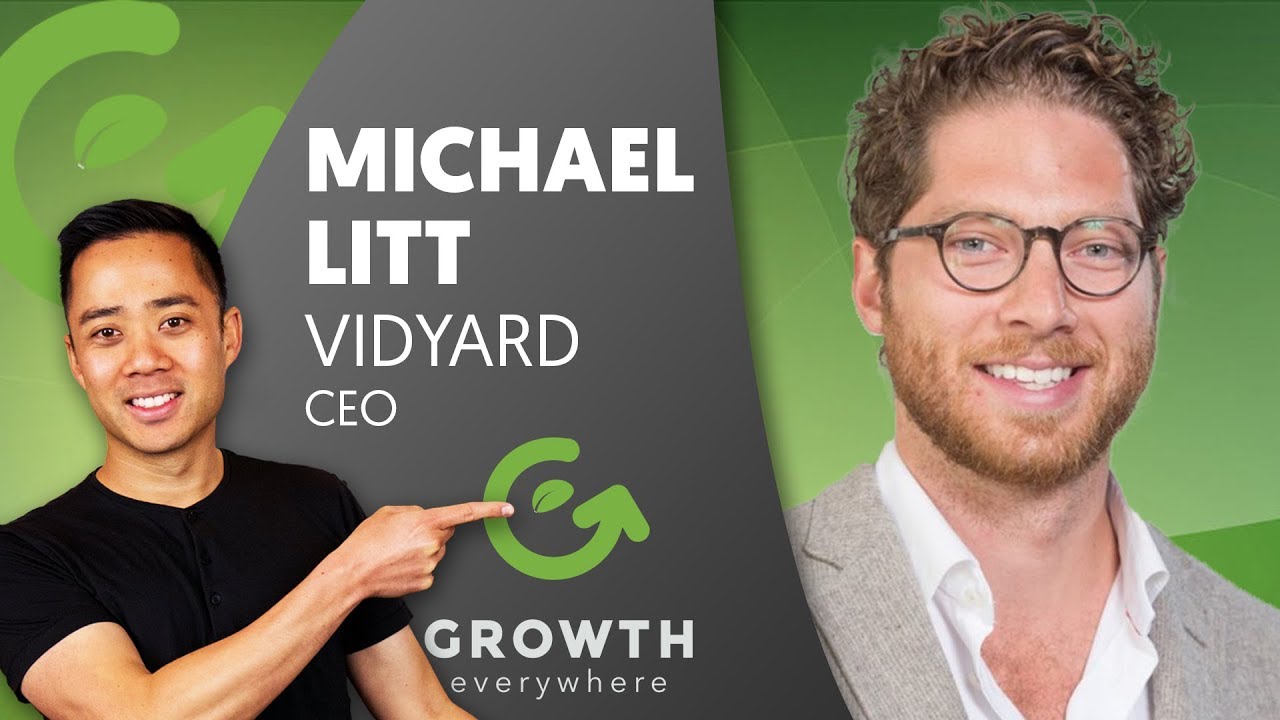
In this live interview, Eric Siu talks with Michael Litt, CEO and co‑founder of Vidyard, about the company’s evolution from a small video‑production agency to a $70 M‑backed SaaS platform serving over 1,000 enterprise customers. Litt explains why Vidyard shut down its agency to focus on scalable software, describes its product portfolio—including the free GoVideo Chrome extension, video personalization, real‑time personalization, and integrations such as the HubSpot OEM—and shares growth metrics (300 employees, 1 M+ video users, aggressive revenue growth). The conversation dives into concrete use‑cases for marketing, sales, and support teams, the dramatic 4‑8× lift in click‑through rates from one‑to‑one video, and the importance of “digital body language” analytics. Litt also discusses the rise of Gen Z in the workforce, their preference for visual, video‑first communication, and how Vidyard’s tools align with those habits. The interview expands to broader visions of the future of work, including VR‑enabled offices, multilingual collaboration, and the impact on real‑estate, transportation, and sustainability. Finally, Litt outlines Vidyard’s go‑to‑market strategy: agency partner programs, chat‑bot sales acceleration, thought‑leadership events, and channel integrations, and provides contact information for listeners.
Chapters
Alright everybody, today we have Michael Litt, who is the CEO of Vidyard. I didn't do that, neither did Mike. I farted.
Just kidding.
Anyway, welcome to the show. We're broadcasting live. I apologize, there's a little background noise, but trust me, we're the real— we are the real audience. I mean, we're the real, like, speakers right now. It's the real deal. It's the real deal, yeah. We even have Florian in the audience as well. Welcome, Florian. Anyway, so Mike, if you can give us a little background on kind of who you are and what Vidyard does, that'd be a good starting point.
Yeah, for sure. My name is Michael Litz. I'm a Canadian. I was born in Canada. I work in Canada. Vidyard is a video platform for business. So we help companies market, sell, and support their customers using video. About 300 people. We're located in Waterloo, Ontario, right beside the University of Waterloo. Vancouver, Boston, and we have a small team in Shoreditch. So we're starting to expand globally.
Great.
We've raised about $70 million. We're venture-backed. Bessemer, Battery, SoftTech VC, Salesforce Ventures, the usual crew. And basically our mission is to help businesses succeed through the use of video. So marketing teams are trying to use video to tell stories to their customers. Sales teams are trying to break through the noise and do outbound prospecting. Video is a great way of doing that. Support teams are trying to explain how to use the product and service, and so video can help them do that. So our tools are designed to help companies do that. We started as a video production agency, and I was working in Silicon Valley at a company called Cypress Yeah. My co-founder, Devon, flew out with me to drive back to Waterloo, and it was a 3-day drive. And after like the first 3 hours, we ran out of stuff to talk about.
Yeah.
And so we started talking about business ideas and opportunities.
Because you had nothing else to talk about.
Yeah, it was just, you know, we're super geeks.
Yeah.
We'd been doing day trading together and a whole bunch of other stuff.
Yeah.
And so ultimately we realized every company we worked for, we'd helped them use video to explain their software in some manner or another. So we decided we could actually make videos for companies because we had the skill set. And we started a business called Redwoods Media, and it was a video agency.
Yeah.
And then as we rolled that service out and we started working with more and more customers, the question was always, well, how do you put this video on our website? What's the recommended tool? YouTube was the answer. The limitation with YouTube is what happens at the end of a YouTube video, right? They show a bunch of other pieces of content. If your competitors are smart, they make videos with the exact same name as your video, shows up on your website. And YouTube's model is to get you there and keep you there. And then like day becomes night, you've got like this cold sweat You're watching dogs riding skateboards. You've like gone down the YouTube rabbit hole, and that's what their business model is, is to keep you there. So we started building technology just to solve that problem of helping our customers own the video experience. And one thing led to another, and we realized we have a way bigger opportunity to build a software, and we can work with video production agencies as our customers. We got funded by Y Combinator, and the rest is kind of history. But there's obviously a lot inside of that history, which we're probably gonna talk about now.
That's powerful, and the way you've condensed it, it's so concise too. So there wasn't like really wordy history. So thank you for that, first and foremost. Yeah, yeah, yeah, no worries.
I felt like that took like half an hour.
No, no, you're good, man. We got all day here anyway. So for you guys, I mean, this is always an interesting conversation because a couple people I've had on the podcast before, they've gone from agency and they always end up shutting the agency down and then they, you know, focus on the software. But my question is like, you know, the video production company, video agency was doing well, why not just like hire a CEO and then like just go focus on the product?
Yeah, that's a great question. We were seeing more and more competition inside of this video agency world, and we knew that we could be kind of like the Switzerland of technologies that help these agencies succeed within their customer base. And so we didn't want to be seen as competitive, and we didn't want to kind of split our focus. And even if I thought, you know, we could hire a CEO or somebody to run the agency side, at the end of the day, it would still be a distraction, right? And, and as like the primary shareholder of that organization, I'd still have to be responsible for hiring and firing that CEO.
Right.
Look, if we're gonna do this thing, we're gonna build a tech company, 120% of my time and energy and life needs to go into this to make it successful. Because building a SaaS company is a grind, it takes a long time, it's slow to start. And so we really decided to kind of go nuclear, shut it down, move some of the clientele we had into partnering agencies, and just focus on the tech.
How big was the video agency at the time?
At the time, we were approaching 8 people, and then about 3 contractors. So still pretty small.
Got it.
But it was profitable and we were using the money that the agency was generating to fund the development of the technology.
That's so funny because that's literally— I'm like, you know, agency is such a good cash flow business. You know, we work with a ton of SaaS companies. We basically cash flow, you know, the other projects we work on using the agency. But over and over, it's just, you know, the same thing I hear. It's just like, why don't you just focus, right? I'm like, but you know, you can hire a CEO. But what you're saying, your argument is Look, even if you dedicate 5 to 10% of your mindshare towards it, it's still a distraction.
Yeah. Yeah, like we looked at the agency business as something that could scale with additional heads, right? We looked at the SaaS companies as something that could achieve nearly unlimited scale with a smaller subset of people and have broader global impact. And, you know, the saying is almost true, I think. More people in your business generally starts to create more problems, right? And you start becoming a leader that doesn't necessarily just focus on a product and solving a problem. Now you're focused on building a business with people as the very Instead of zeros and ones, as a variable in code. And people are way more unpredictable and it's hard to scale. So we just talked to a bunch of people that try to do both. And again, they were like, look, if you're gonna go for the gold and try to build a billion-dollar company in some category and you think the time is now, just go and do that because you can always go back to the agency at another part in your life.
Right. And by the way, for— because I know there's agency people that listen to this, it's like when you are an agency, you're focused on A, marketing yourself, but then you have to focus on doing the work for like 10, 20 other clients or so, you're like in 20 different directions, right? So I think that lack of focus is huge. So Vidyard right now, how are you guys doing today? You said you have 300 people or so. What kind of numbers can you reveal around revenues, growth rates, whatever, just whatever you're comfortable sharing?
Yeah, yeah. So I mean, in the trailing 12-month period, we hired well over 100 people. We're north of 1,000 customers. On the GoVideo side, it's kind of a new effort So GoVideo is a free Chrome plugin. It's also what powers HubSpot Video. So they released an OEM of that product inside of Sales Hub and Service Hub just in September. There's tens of thousands of users on that product now as well. So that product has approaching a million users globally that are using video to communicate the sales process, communicate internally, and ultimately to support their clients. And the growth of that side of the business Right. And so really what we're trying to do now is organize our business into these kind of buckets that sell to multiple segments with multiple products, right? Because again, we sell to marketing teams, we sell to sales teams, and we sell to support teams. The sales and support teams use a very similar product because it's seat-based. The same segments use the same product as well. So we can sell to a business and work with a business that has less than 50 seats, and we can sell to a business employees that has 1,000 seats. all the way to a business that's doing $10 billion plus in revenue.
Right.
And so for us, the effort right now is just optimizing the coverage of that product and optimizing our effectiveness at scale without continuously spending more and more and more money on scaling because efficiency becomes the most desirable thing at a certain point in your life. So right now I'm thinking about, you know, as we approach 300 people, how do we double if not triple everyone's productivity? inside of that business while maintaining the same growth rate, which has been aggressive. Great.
So for you guys, what are some example use cases? Because the way I understand Vidyard, I've looked in the past, I've gotten emails from people, and it's like, it shows a pic, it's like a video, and it also shows my name, right? It's like, hi Eric, and it's like, hi Mike, for example. That's how I understood Vidyard, and you can feel free to go into that, but I'm just curious, like, how are most people using it? Yeah, for sure.
So in terms of user penetration, it's absolutely on this GoVideo side, right? So the way GoVideo works is you install the Chrome app. It's free, vidyard.com/govideo. And it sits inside your browser. It sits inside of Gmail. So instead of writing an email, you're actually able to do either a quick webcam recording— so sit in front of your computer, got a whiteboard, write Eric's name on it. Hey Eric, how's it going? You're probably going to click that if you're like, wow, this person's sitting in my inbox, they obviously thought of me, what do they have to say to me? We see a lot of people being like, hey Eric, you're an agency owner, I know that you're worried about X. You're like, oh my God, I'm actually worried about that, what's this person going to say?
Yeah.
The other way to use it, which is actually the way most people use it, is to do a screen recording. Do a quick Google Presentation, do a quick PowerPoint, show somebody what's wrong with their website. Help somebody solve a problem with your technology. And so that's where we have the most users and kind of the most growth of adoption and like growing the Vidyard brand as a number of users as an end. On the marketing side, we have a platform that helps a marketer own all their content. And so it's essentially a hub where all your content sits, allows you to analyze the performance of said content. If your sales team and support team starts using it, the platform tells you that and gives you insights and advice on how videos are being used across your funnel. And then you can integrate that product into your CRM or integrate it into your marketing automation system. So at the customer level on the contact record, you can see exactly which videos they're watching for how long. And when it comes to selling and marketing and supporting, you know, a lot of companies use emails, they use white papers. The problem with those 2 products is When someone clicks a link in an email, yeah, they click that link, but did they actually read the content at destination? You don't know that. If somebody downloads a white paper, it's the same story. But you can tell if somebody watches a video, and you can actually see second by second what they consume. And so by inferring what your audience is doing, using this thing we call digital body language, right, which is their attention span in the video, you can infer so much more about what they're doing when you're not talking to them, which makes it easier to sell to them. support them and to market them. So it's kind of a complete video solution and starts to function as a video system of record for businesses at scale.
Got it. And just clarification point, if I have a whiteboard, my understanding— I could be totally wrong— is Vidyard would actually put in like, hi Eric, or whatever. I can like type it in and it just appears as real text. Is that true or false?
So that's our video personalization product. That's kind of in the premium category of our How much is that?
There's a new product.
Well, it starts at $10,000 a year, so it's not that expensive, I think, for what it does. You know, you append that to one deal for a lot of companies. We also have this new product called real-time personalization. The way that works is, okay, so you see this video in your inbox, you click the link, you go to the company's website, we know it's Eric, every single video on that website is now customized for you in real time as you arrive It's kind of like this Minority Report experience, right? Because hyper-personalization is the future. Human beings have this like limbic trigger where they want to feel like individuals. They want to feel supported. They don't want to feel like a number. And most companies are doing spray and pray marketing messaging where they're clicking a button and sending out 10,000 emails and hoping that like 5 people respond.
Right.
That's not the way you market. That's not the way you build relationships. That's not the way you connect with Generation Z. Gen Zs, or Zeds, as we call them in Canada and Europe, because they're used to having these personal communication experiences with their friends, with their peers, and with consumer brands. And so we're helping businesses do that same thing.
Great. And so, you know, for the— I mean, entrepreneurs and marketers, we all like numbers, right? So kind of what is the difference between, you know, Vidyard videos that are personalized versus like typical emails, like open rates or conversion rates? Anything you can share?
Yeah, so we generally see a 4 to 8x, so like massive order of magnitude in terms of click-through rate when personalized video and when, you know, one-to-one video is used in email messages. And I mean, it's amazing results. I was just over at HubSpot, we did a fireside chat. That team has increased their meeting bookings using outbound one-to-one video by 4x across the entire organization. They've got about 650 users.
Wow.
And so they're so much more efficient, meaning they can either grow faster or spend their time doing other things. They choose to grow faster. Sales Hacker, it's a really great resource, just launched a report which is called How Modern Buyers Buy, and they looked at the preferred media channel for executives and for salespeople, and the number one preferred media channel for salespeople is one-to-one videos at 23%. of the surveyed audience said, yeah, one-to-one video. The next most popular media channel was webinars.
Yeah.
So 43% of respondents preferred video to any other form of communication, beating out LinkedIn, beating out traditional email. And so there's obviously something to this technology and the way it works. And again, I think it's just in this world of automation where it's so easy to contact hundreds of thousands of people, we as humans, again, we crave this like actual connection with someone who's done the work to build something specifically for me, and that's what you get out of one-on-one video.
That's powerful. So how do people know? They still have to read the email headline first, right? So how do people know that's a personalized thing? It's just like, hey Mike, I just made this personal email for you. How do they know?
Yeah, so there's a lot of hacks with respect to subject lines we've seen. One of the best-kept secrets in subject line hacking is animated GIFs.
Okay.
You know, I think GIFs are a very underrated form of communication in the business. Again, back to Gen Zs and millennials, like, we use this stuff all the time in our personal space, and you can say a lot with an emoji.
Yeah.
And so responses are generally pretty high.
This is in the subject line?
Yeah, because you can't, you can't like embed a video in a subject line.
Yeah.
But the other thing is Say like, hey, I recorded a video for you, or just getting really hyper-custom, right? Because when you're producing this video for someone, it takes a bit of time. And so it's not just a generic message. And so let's say I'm contacting a VP marketing, and I know that VP marketing is probably concerned about efficiency of spend on marketing channels and like actually understanding ROI. You'd be like, hey, I recorded a video for you, or I made you a video that talks about your marketing efficiency. Somebody's probably gonna be like, oh, that's kind of interesting. They'll click it, and then once they click it, they see somebody sitting there with a PowerPoint that says, hey, hey David, I made you this video that talks about marketing efficiency, or the whiteboard, or the personalized message. You're gonna watch that, right? Because somebody was sitting there thinking about you, clearly understanding your problem. You're gonna give them the time of day, and that's what results in these meeting bookings and these subsequent conversations. Great.
So I want to Kind of talk about, I mean, one of the passion points you're mentioning is just kind of the future of work, and even before that you're talking about Gen Z. So tell me more about the Gen Zs first, I guess, and kind of what you're working on around there, what your thoughts are.
Yeah, yeah, so there's 63 million Gen Zs in the United States. I don't think they're all in the United States, it's just the only data I could find. By 2020, 20% of the workforce is going to be Generation Z, Gen Z, Gen Z, and it's going to become a stronger component of the workforce than ever. We hire Gen Zs and Gen Zeds in kind of our outbound and inbound sales roles, right? Junior roles inside the organization. And one of the crazy things I noticed about this audience and this demographic specifically, born in 1995 plus, is that they don't use email. They don't know how to use email, right?
Really?
Yeah, yeah. To them, email is like the fax machine was to me, and I'm a millennial.
Wow. How old are you?
I'm 32.
Me too. 1986. Yeah.
So the reason being is like in their personal interactions, I was emailing with friends. Yeah, you know, I was IMing with friends. They're not emailing. They're using Snapchat, they're using Instagram, using Facebook Messenger, they're using WhatsApp. It's crazy. And so we have to teach them like professional email etiquette. And so then we realized like, why are we actually doing this? Because they have this method of communication which is emotional, it's visual, It's using GIFs, it's using images, it's using video. Let's just like support that and see what happens.
Instead of trying to change their behavior.
Yeah, and so one of them was continuously sending out videos and it was really, really productive. So her name was Holly and what she'd do is she'd use QuickTime to record a webcam video. She'd upload it to Vidyard. She'd like click grab the thumbnail, grab it off her desktop, dump it into an email, hyperlink the thumbnail to a landing page. And then go to our Insights tab in the Analytics service and watch that counter go from 0 to 1.
Yeah.
And when that person watched that video, she'd follow up and she was having great results. So we were like, wow, we could actually build that into the product, which became GoVideo. So once we started listening to and engaging in what Generation Z was doing at work and how they wanted to work and how they communicated, we weren't stuffing them into this box of like professional communication, wearing ties and stuff like that. they're really productive. And, you know, this is hitting all sorts of industries, right? The finance industry has a really interesting problem right now because boomers are divesting their assets. They're like spending their money. And if your parents are like my parents, they're like, hey man, I'm not giving you anything. I'm not taking it to the grave with me. I'm gonna spend this because I'm gonna enjoy my life just like you're enjoying your life, right?
Yeah.
Millennials and Gen Zs are like all about experiences. They're not saving money. The banks are in this dire position where their most robust customer base is divesting and the next generation isn't putting any money into them at all. What are they doing? They're using video to actually communicate. Santander, the great Spanish bank, actually won a film festival award for creating a really dynamic 12-minute short film about the future of banking. Industries are becoming way more formal in the way they do things, right? I go see a bank, I don't wear a suit and tie. I probably wear something fairly similar to this, which is way too formal for an event like this, but I just came from a bank. And so I think, yeah, the Gen Z is this like secret to the way we're gonna work in the future, and we have to really start integrating ourselves into the way they think, the way they work, where they want to work, because they're gonna be our future customers as well.
Interesting. Okay, and so I mean, talking about the future of work a little bit, what else kind of piques your interest Yeah, yeah, this one is a real passion of mine.
We have constantly run out of office space, so we are on our 8th office space. We're looking at our 9th right now. It's a frustration. It costs so much money to house people and to give them benefits and yada yada yada.
Yeah.
And so I think a lot about the augmented workplace, right, where if you were able to actually use exist in a physical space like this wearing a VR headset. I can be sitting in Waterloo, you could be sitting in LA, we could be physically rendered and represented and have this conversation with facial reactions and all this amazing stuff, but not have to travel anywhere in the world, right? So as it relates to work, you could build an infinitely scalable workplace, and people could work in that workplace from anywhere in the world, right?
Yeah.
If you wanted to hire somebody in Japan who only speaks Japanese but is a very developer, the system could also automatically translate everything they say, right?
Yeah.
So persons with disabilities, persons who speak different languages, it's amazing. And so if people then don't need to be in physical colocation spaces, why would you live in a big city, right? Right. So you could live anywhere in the world, which has a massive impact on the food industry, the transportation industry. All the congestion issues we have in big cities would start to go away because I would go live somewhere in Switzerland, right, in the mountains.
Totally.
And I can get all that sweet fresh air.
You could be wearing boxers, have it render clothes for you too.
Yeah, actually funny story. One of our very first customers was a company called Webcam Wear.
Yeah.
And it was like this, you would send them a suit jacket, a tie, and a shirt, and they would sew you a bib that you could like, you could be sitting around topless coming out of the ocean at the beach, just having a surf, riding your Lime scooter into the workplace, and then you attach this bib behind your neck and looks like you're now, you know, in this like formal attire.
Yeah.
So I mean, people have been thinking about this for a long time, but yeah, I think there's just so many interesting things there. Facebook's working on it with Oculus, obviously, and they have a platform called Altspace, which is starting to capture some of these unique experiences. But again, like, you know, we build a 30,000-40,000 square foot space, it costs us $1.5 million, $2 million to retrofit that space. You know, 200 employees, let's say if you gave every single one of them a $1,000 VR headset to create this experience. It's like a fraction of the cost of building the space. And when you run out of meeting space to stuff everybody into, you just expand the walls, right? So you have like a 3D architect on staff that can just design the most beautiful VR workplaces in the world.
God, whoever does the VR workplaces are gonna be crushing it.
Yeah, I think it's amazing. I think it's gonna change the way we work and communicate because then again, like As we automate every single process that human beings do, right? Data entry and CRM.
Yeah.
The way we communicate, the way we nurture, like, AI is really becoming this big component. What's left for humans, right? If you're fatalistic, absolutely nothing. The cyborgs are gonna take over, they're gonna cut off our supply chains, and we're gonna die.
Yeah.
Because we're rotting the planet. But if you're optimistic, you know, what's left is for us to be humans, right? Humans are gonna create these interactions and do these personal things. And smile at each other and trigger that limbic response. And are we going to see that in a lifetime? Probably, right? Like, I think the technology is there and the way it's moving and developing is at an incredible rate. So I think it's a very exciting time to be alive.
Great, I agree. We're probably going to live longer too. We'll see what happens.
Yeah, Ray Kurzweil told me that we're going to live to be 300 years old.
Yeah, I'm all for that. If I need to become a robot too, I'll do it. It doesn't matter.
Yeah, yeah, yeah.
It's great to live. So for you guys, kind of going back to Vidyard for a little bit, what's working for you guys nowadays in terms of customer acquisition? So Vidyard's obviously working, right? Open rates are great. But what else are you guys doing that's really helping push awareness? Yeah.
Well, I guess there's 2 parts, right? There's pushing awareness and then how we transact. On the how we transact side, absolutely, GoVideo is like core to what we do. We are our own best customer. Customer use case, which is an amazing thing about being CEO of Vidyard. We get the feedback from the team. Another thing that's really amazing is chat, live chat, right? So when people are interested in buying and they've done the research already, they don't want to come in, click a button, submit their information, have a quick conversation with BDR, and get punted 2 weeks out to book a meeting with an AE and a demo. They just want to buy the software and start using it. And so reducing that time frame between The conversation and the sale is what chat really does for us. Using chatbots, stuff like Drift, really helps us manage those conversations. Intercom is our sponsor of this show. Really great technology there as well. On the awareness front, in today's world, it's really just about big, impactful brand things. Thought leadership, right? Coming to events like SaaStock and talking about future of work. We're going to talk about the Generation Z impact in an hour or so here. That type of stuff really gets people thinking, and it helps them connect to what you're doing on this, like, limbic and cerebral level. Because we live in a world where the martech landscape has 7,000 companies, and when we started, there was 150. And every single one of these companies sells the same thing, right? More pipeline, faster close rates, better connections with your customers. And so how do you stand above that? You have to be a thought leader. The third one is channels. So we work with agencies, we have a really robust agency program where we help them understand our technology, and of course they can add a bunch of value-added services to implementing a product like Vidyard that makes them money and helps their customers be more successful. Same thing goes for product integrations, right? So I mentioned that we have OEM'd into HubSpot, HubSpot. So we are available for free in Marketing Hub, Sales Hub, and Service Hub, and there's an upsell path for us, so it is revenue generating. But again, it's all about expanding that end for us and getting more users. The last one is when someone uses GoVideo and they send it to someone else, they're always generally— they're like, hey, that was really cool, how do you do that? But the link that, that the video comes in is a Vidyard branded page, and they can go and install the application Got it. So yeah, we've got all sorts of channels. We're always looking to optimize them though. And of course, we can always be doing a better job.
Cool. Just working towards wrapping up here, a couple more questions. I'm curious because this is similar to— it's top of mind for me right now. How are you sourcing all your— how did you start your agency program? How did you source all the agencies in the first place?
Yeah, that's a great question. So we are— our number one source of inbound leads is agencies. Because I think what's happening is the world is trying to figure out how to do stuff with video. You know, Sales Hacker is releasing this data, Cisco saying that by 2020, 80% of all internet traffic is going to be video. People are like, okay, video is a thing, we get it. How do we actually do it? And so they talk to their agency, and the agency is like, wow, we better talk to Vidyard. So they come in. For the longest time, we were just selling them like they were customers. Now we're like, okay, we've got resources to support you. We can do co-sell. We can do wholesale stuff. I was in London last week spending a bunch of time with HubSpot SIs. The HubSpot London User Group was founded and is powered by a group called White Hat SEO. They're right in London. HubDo is involved as well. I'm going back to Oxford to spend some time with BabelQuest at the end of this week for an event they have called the Revenue Summit. It's just about, again, establishing ourselves as thought leaders in this ability to help Customers receive the video, and of course the agencies provide this value-added service around it.
And how did you source these agencies? Like, did you go to agency conferences? Did you like make a lead list? Like, what was it?
They're coming to us, you know, for now. In the very beginning? Yeah, yeah, in the very beginning, in the very beginning, it was part of our outbound sales method. So yes, good question. So when we were starting, I would split my day. I would do 20% agency outreach and 80% direct, and that agency outreach would be like Hey, we're Vidyard, this is what we do. I think you can resell us, and here's an example of the type of services from video production down to integration implementation with other systems that you can provide on our behalf. And that's what got the wheel turning.
Oh, I love that. So what kind of cut does the agency get?
I actually don't know the program off the top of my head, but yeah, on a co-sell arrangement, there's obviously Yeah. Which then gives the agency recurring revenue, which is really sweet because now they have this recurring bucket that they can invest in growth and marketing and other things. And then again, there's the value-added services. And so for personalization, for instance, is a really good one because it's not an easy product to use, right? There has to be some custom work. The video has to be built with personalization in mind. You have to do some frame-by-frame work on the agency side. And so there's hours that can be booked. And then of course You integrate that product into your CRM, into your marketing automation system. So agencies are doing some of that work for us, and they're doing that on ongoing retainers to maintain our campaigns. Got it.
So it's like white-labeled?
Yeah, yeah. Well, we— in a lot of those cases, it's actually black-labeled. Like, the customer knows they're using Vidyard, but the agency's just helping them deploy it.
Got it. Cool. Well, Michael, this has been fantastic. What's the best way for people to find you online?
Yeah, so you could email me. Email's michael@vidyard.com. On Twitter, I'm Michael Litt. On Instagram, I'm Michael Litt. On LinkedIn, I'm Michael Litt. I look like this.
There you go.
I'd be happy to connect anytime.
Cool. Thank you so much for doing this.
Yeah, chat soon.









