How to Scale your Paid Ad Campaigns to the Moon with Nick Shackelford
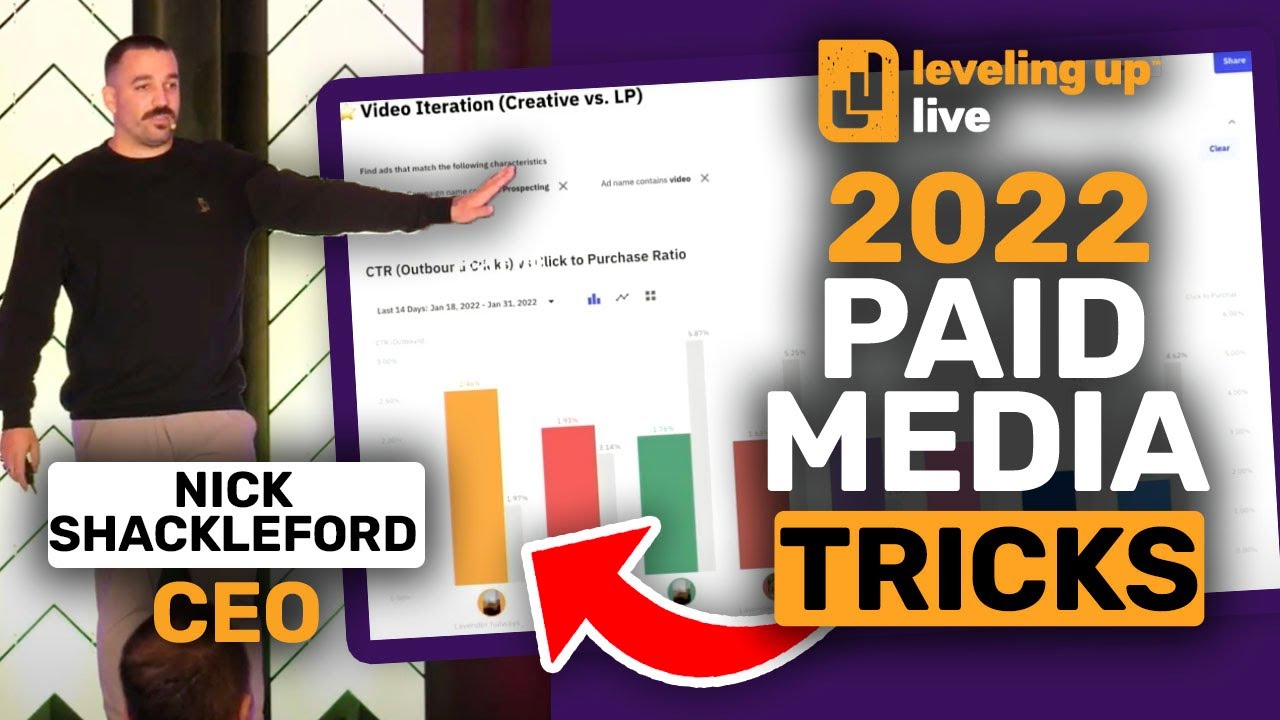
Eric Siu and Nick Shackelford break down how to scale paid ad campaigns from launch through growth. They cover creative frameworks like hooks and copy-visual pairing, key metrics like CPM and video completion rate, and how to structure your team with roles like creative strategist and media buyer.
And yeah, Nick's just been great. And yeah, we had the pleasure of hanging out with him for really 2 days, right? So it's been good. And he's got a lot of interesting insights to share in terms of not just where we go in terms of Facebook, but also just marketing in the future. Hi, everyone.
Specifically, our background is paid media on any vertical. So right now, I think the biggest— a lot of the examples you'll see is for e-commerce because that's the one that I focus more on. But a lot of these changes and updates aren't specifically just for e-commerce. It's for all the paid areas. Here's how we used to do it. We'd have one isolated asset test. So this is our campaign structure. If we're in Facebook, this is what it looks like visually. Total campaign. And if we were to Our various broad ad sets at the ad set level, which I'll go over here real quick. We had no targeting, nothing really mattered. A single asset at a 1 by 1, which is a square, and then 4 by 5, which is kind of like the tall feed images that you guys see in your feeds. And we just isolated it. So it was CBO prospecting, straightforward, broad angle specific. So these are like the structures of how a campaign would be set up overall. And then we'd have the sizing and the copy specific right there. And this worked to a degree. It still kind of does, but you have to be a little bit more specific on the type of content you're putting into it. And what happened, we found 7% to 10% of overall hits. That's all I needed. I needed a couple that would keep me going because if it didn't, then the brand would probably lose or we'd probably leave or the relationship wasn't as smooth. Now, if we get lucky, it's probably 3% to 5%. On a good day, 3%. We went to a pre-launch, develop and launch, scale, and then we went to an overall analytical viewpoint of this. This is what our marketing team does on a regular basis and it never changes. Here's the roles that we needed specifically. Creative strategist, copywriter, channel specialist. Channel specialist is like, hey, I'm great at Facebook. Hey, I'm great at TikTok. Hey, I'm great at Snapchat, YouTube, et cetera. So we go pre-launch. This is what always looked like. It was what we call the ALO effect: avatar, angle, ad, landing page, and offer. This is the process that we're always going to go down towards, and it will never change. So specifically what I'll talk about right now is the A's. So avatar and angle started out with who you guys going to sell to? What are the pain points that determined who you guys were gonna sell to? What was the platform that you're gonna highlight the pain points of the person that you— which you were gonna sell to? What placements on that platform highlighting pain points of who you're gonna sell to? Does that lander that you're dropping on highlight from the placement that they came from on the platform putting out the pain points to the person you're selling to? And lastly, are they educated enough to understand where they're coming from, from which placement, On what platform, highlighting which pain points, who you're selling to. Then we came into develop and launch. Like overall, this is like the nitty-gritty part of it outside of understanding that first behavior of it. And this is when we go back to our content bricks.
If you—
these are the only areas that each product, brand, info, service, website needs to communicate. And these are the only areas that your creative person and your media buyer should be communicating against. So if you have an agency or someone that's not here, This is a cheat code that they need to be fully addressing now. At least they're not gonna get it done because this is what the concept of communication should look like. We won't go too deep on this again 'cause we already did. This is what the— this is as simple as it gets. This is our sheet and everybody contributes to this sheet. We have our channel buyer, the person that's fully understanding, hey guys, I need this point, I need the bold statements. What does that look like? Then the copywriter comes in and is like, I got you covered, fam, don't trip. Best shoes I've ever worn, how it looks like for you. And then we have our overall, you know, our creative strategist, the person that's gonna be creatively leading this stuff. They're filling in the rest of the gaps. So you can see how all 3 of these combine. It's literally as simple as this stupid sheet. Here's an example that we guys can run through. It's gonna continue all the way through. A little bit faded on the back. You can see the bold statements, the hypes, and what's going on. This is a shoe. It's a brand called Kizik, and it's a shoe that you don't need to even put your hands in. You can literally jump in, step into it, and go, which is like a hard feature to explain. But when you do it visually like this, it's pretty interesting, especially with the text. It all supports itself. So you can see how someone from the segment, like, okay, we go content bricks. From content bricks, we get to the copy. And the copy, like, okay, how do we show this visually? And then how do we repeat that process? So I'll give you a couple more of this one. Same thing as well. What are your hooks? What you're going towards? Very raw and organic. I will tell you the biggest thing. Once we found a best performing creative, the thing that we added in—I wish my shoes did this. It was just a wishing statement. I wish what? I wish my product did this. I wish my body looked like this. I wish this team looked like this. As soon as we found something that worked, we literally just added top and bottom bars. And it ended up going well. And another interesting fact around creative, if you're able, don't put it at the bottom, put it at the top because a lot of the text, it'll auto-generate on some of these platforms. You're just gonna get mixed, right? So if you're looking at your phone, the bottom part's gonna be auto-generation of the actual like, what is it called? Voiceover, not voiceover, subtitles, subtitles, sorry. It's called Amazon 5-3-1. You go to Amazon, you're gonna filter by the 5 stars, the 3 stars, and the 1 stars. 5 stars because Amazon's, if you know the ecosystem, it's pay to play. You can jack up the listings by getting a bunch of people that really just leave you 5 comments or 5 stars all the time. So you go to 5 stars, you go to the 3 stars, because 3 stars are usually the ones that are actually loving or trying the product or have something, a flaw for the feature. And then you go to the 1 stars where you just have a bunch of Karens. So for this product specifically, you can pull out some nitty-gritty stuff like my balance and my hand strength, in a hurry, too lazy to put it on, some actual stuff that you can kind of put into your ads. So Then we go into Canva or a thing called PickFu where they're able to like just put placements on there. And these are the things I want them to click on. Hand strength holding you back from wearing shoes? Are you old AF, unable to bend down and tie your shoes? I just want clicks. I don't want them to— I want what is popping off and what are the colors that actually make sense for my brand. I don't care what this looks like. I just need to see, hey, I need a little bit of smoke before I go make some fire. That's pretty much what we're doing here. So then we go into a little bit of analysis. So more of like the landing age, the landing So we've done a lot of the upfront time, which is stuff we didn't do before, but the investment of the time was where it makes all this rest of the part extremely easy. So if I were to go into overall analysis inside of our ad accounts, we can still do this. What we find in the ad account, there's still some key metrics that help us on the actual overall performance of things that I'll show you so you don't have to spend too much money on an outside service on this. If we're in the account, It goes under these 3 steps. CPMs, CTRs. So CPM, cost per impression. CTR, click-throughs. Overall clicks, link clicks, cost per click, et cetera. These are the ones that we all should know if we're in this room. Next is video completion rate. This is something that might be a little bit different for people. This is something that's a little bit newer. Video completion rate, 3-second video views, how long are these people watching it? And this one right here, I'll highlight this. This is what we're gonna call our thumb stop overall ratio. How many people are gonna, at what point of 3 seconds are they gonna click or click off and move on? That's to me the measurement of like, is this convincing enough and are we going to earn that click? Is this content doing its job? So if I were to look at all 3 of them, this is where we start. This is the only metrics that matter to me and my team overall because all the other ones are a little bit convoluted. Thumbstop, CTR, and CTR clicks to outbound. These metrics are how we're measuring things. And this is not just for e-commerce, for info, this is for SaaS, this is for your NFT project. If you do it on any sort of channel or platform, this is what will tell you what you need to do. So if you are like, hey, that's awesome, but I want like a tool to tell me how to do this, this is what Motion looks like. This will tell us overall and it'll rank all the creative based upon this. All of our spend runs through this. So we're able to kind of see what type of creative's working, how it's working, at what point is the drop-off rate. It's called Motion App. It's a great team. I really do believe in them. Again, you can get all these metrics on your own. And it'll tell you even what's the outbound rate to the overall purchases. And it'll measure and compare all the creative to itself. So it's pretty interesting to see like if this is the outbound rate of various colors or if it's the outbound rate of various products, you can see that overall comparison. If this doesn't get better, we had to do a second thing, which just trying to prepare. So now we're getting into like the org structure that I think makes most sense. Who's a media buyer or understands what a media buyer does? Most of us. Okay, media buyer buys media. They're also a creative strategist, and they're also a growth strategist trying to give us feedback on how things work. And they're also that media buyer. So they're doing multiple things in one, and this is generally what their role looks like. But it's, it's when we reevaluated, we went into the team like, holy crap, you are doing so many things here. And I think you are better at a certain area of this. And so it was really more of like an analysis of who's the team and what. And we found this, that one role is 3 roles. And that role is more important as a creative strategist, someone that's speaking creative rather than spending the time in the platform. And this is where all their time goes. Our growth strategist, that's relationships. So this is the new name that we came up with. Because it's actually expectation setter. So head of growth, this is what a media buyer does then. We took away all the other responsibilities. I just want these people sticking in their place. I want the nerds doing the nerd stuff. Hard stop. So right now we're sitting— this took us about 128 and 4 acquisitions— sorry, 3 acquisitions, working on our 4th. And this allowed us to kind of hold like net profit around 30% to 40% overall, even with the human capital that we are allocating towards problem solving. What this looks like for my acquisition department. So now picture this, you are an agency or a team looking to build towards growth or looking to use it towards acquiring more traffic, acquiring the teammates. This is what my team would essentially look like built around this overall pod structure. This is how we're able to build. This is how we're able to acquire. This is the biggest call-out here is again, it's this creative strategist and the growth strategist. That's a lot of like the direct benefit. back and forth. Admin, you can get away with a little bit more project manager. We did try to have our growth strategist be a little bit more project manager focused. It did not work. It actually failed tremendously 'cause they weren't necessarily in the metrics. They were more trying to help projects along or trying to keep communication clear. This is what our retention department looks like. So anybody running email or SMS, this is the overall play. I will over-index on design. So if you have a designer or copywriter, this is where a lot of your time will go to. And this will probably be the hardest area to hire at this current time. If I had a blank check, like Shaq, build something that you would be like, hey, this is incredible. Build whatever you want. This is exactly what this would look like. So I have my creative acquisition and retention team. This is basically Elon goes like, Nick, I'm gonna buy you. Here's $45 billion. This is what we're doing with it. Creative, again, I'm over-indexing here. This is because the paid media used to be like, I needed a quant, I need a smart nerd, I needed someone to be in this and kind of direct all of this or run some tech for me doesn't make sense to me anymore. It's not important as it was at once. I still think it's a skilled position, but I want more of my time and effort going here. This one right here, 3D animation, especially in product, especially in development of the NFT space where we're going, 3D rendering is so hard to find. And we've gotten very lucky again in Ukraine. They do a lot of this stuff already. Acquisition, I would say 3 channel buyers to let them be a specialist. You know Facebook, you know TikTok, you know Google, stick there, do your job over there. And over here in email execution, you could probably get away with 2 email executions, a senior and a junior. The senior, the only difference there would probably be that they are working more on partnerships or they're working more like an affiliate program. Now if I had money, and now if I didn't have money and I had to build this like really, really nitty gritty, here's like bare bones you can get away with this. And I do think Some people try to do this, editor and videographer as the same person. Do not. Do not. They are completely different people. The videographer needs to be a little bit more visionary, they need to be a little bit more creative. And the overall editor, they gotta sit in a dark little home and just hammer away and then ship it out because they prefer to be there from what I've experienced. Travel's gonna pick up, which means a lot of the products that we weren't buying before, we are buying now. of higher ticket stuff. So I think it's important, especially more outfits, more bikinis, more things are happening. It will come. We're already seeing it. And then something that we've experienced here, kind of like what Eric's doing, is access and experience over materials. So access and experience is something that I truly, truly believe in, which is why I'm doubling down on events, doubling down on this personal connection, because there's been a lot of good communications here. And we've kind of just been locked away in our rooms for quite a while that I think it's better that we're, we're kind of out there and above. Thank you guys for your time. Thank you.









