How To Think About Buying Businesses with AI in Mind (Strategy Exposed)
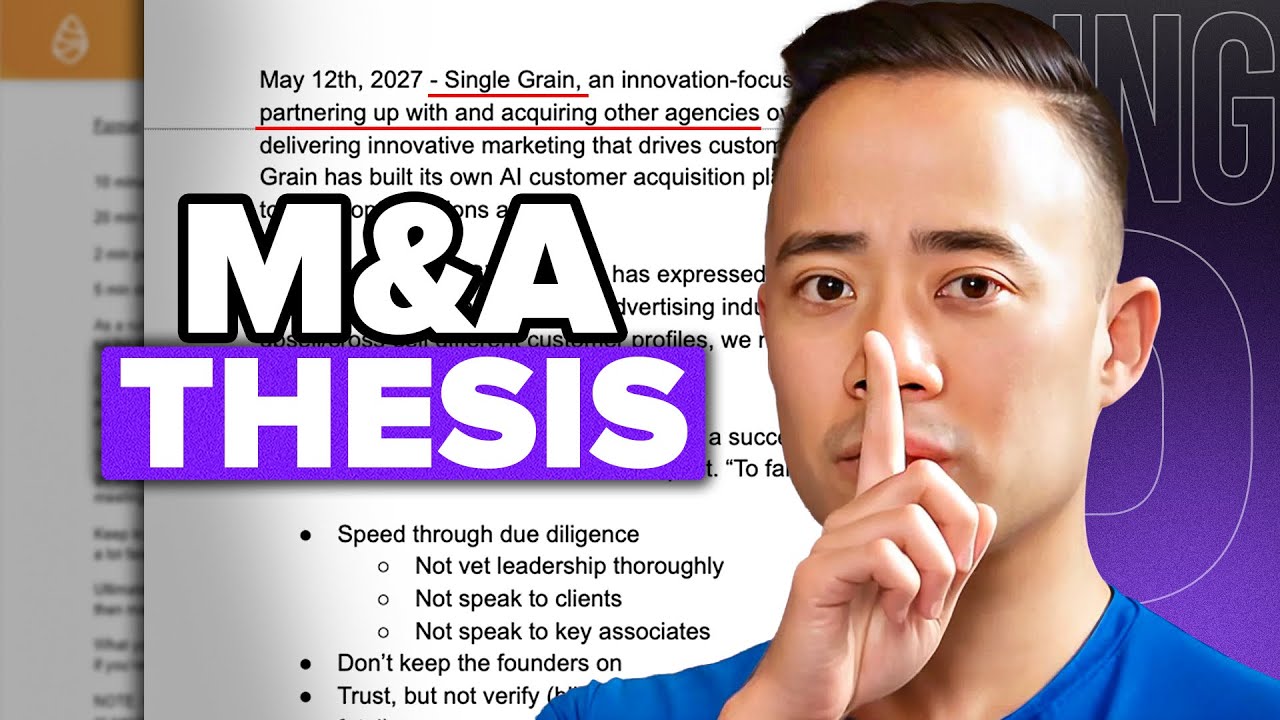
This content was created by Eric Siu. This content was uploaded by Eric Siu. This is a YouTube video titled "How To Think About Buying Businesses with AI in Mind (Strategy Exposed)" (posted May 29, 2024) featuring Eric Siu speaking in a long-form solo format about M&A strategy for his agency Single Grain. Siu walks through an M&A thesis and an internal memo: lessons from past acquisitions (poor due diligence, founder retention, hiring mistakes), deal structures (51% stakes, earnouts, multiple arbitrage), and practical checklists for diligence. He also analyzes AI as both threat and opportunity for agencies—forecasting automation of repetitive tasks, the need to hire/retain top 5% strategic talent, building an AI customer-acquisition platform (crawl → walk → run), new monetization models (usage- or performance-based), cultural/training imperatives, timelines, and risks (job displacement, ethics, client trust). The video also plugs Single Grain and the Agency Owners Association and invites viewer feedback.
Chapters
If AI is a threat where there will be potential job loss, how should I then think about acquisitions? I wanted to go through an M&A thesis with the threat of AI looming. My name's Eric Siu. I've bought a couple of agencies and main agency is called Single Grain. Looking at doing some acquisitions, but also I have to keep in mind that the threat of AI is very much looming right now. Keep talking about AI. What's going to happen in AI? Intelligence of a non-human form. Implications on productivity and efficiency in So it's more of a conundrum, right? It's knowing that agencies can grow through acquisitions and a lot of businesses can grow through acquisitions. That's the value that you might get from this video. So I'm going to walk you through my thought process here. And then also you get to see how we do things at my company when it comes to writing memos, right? So there's 2 memos that I actually wrote here. And my objective here is for you to figure out if it makes sense for you to go about buying companies and how you might want to think about the perceived threat of AI. I actually think it's an opportunity, but some people like to look at it as a threat. So the first memo I'm going to take a look at here is the M&A thesis, right? So you can see here, I wrote up top, the goal of this memo is to articulate my thoughts on the future of mergers and acquisitions for Single Grain. Single Grain again is my ad agency. And then I also, in some cases, if it's a big, bigger type of idea, I'll like writing a press release, right? So in the context of this one, There's a book called Working Backwards, and this is written by 2 Amazon executives. One guy worked there for, I think, over 15+ years responsible for the launch of Kindle, for Prime and things like that. And another guy was a chief of staff for Jeff Bezos for 2, 3 years and he followed him around. And one thing they like to do is they like to put memos together like this. And so this is a nice process that you can take together, take for the company that you're running and hopefully help you run your business better. That's my hope. And you can see here, I wrote this memo for May 12th, 2027. So this is basically 3 years out, right? And I'm not going to read everything to you here, but you can just see that I'm basically, I'm painting a picture here. I'm telling a story here saying, Single Grain, an innovation-focused marketing agency, has quietly been partnering up with and acquiring other agencies over the last 3 years. The company's mission of delivering innovative marketing that drives customers has never rang more true. In fact, Single Grain has built its own AI customer acquisition platform that plugs into its customers. Databases to make optimizations at scale, right? And so a lot of this is very, some of this is pie in the sky. A lot of this is visionary, and that's what you have to do as the leader of the company, right? You have to be able to paint a vision. And for me, I kind of speak through writing, right? And I speak okay. I speak decently well. I speak at a lot of different conferences. And so that's built a muscle there, but I think it's better to articulate your thoughts onto the proverbial paper over here, right? When you're able to do that, you're able to think clearly because writing is actually thinking at the end of the day, right? That's what it's all about. And just to back up a second, when I think about the— we've acquired 3 agencies, right? And I even remember buying a company when I was 22 years old. I bought like an e-commerce website for a couple thousand dollars, right? And a lot of lessons learned through all of them. You'll see how I'm thinking about this in the future with also considering— I'm also considering the mistakes that I made in the past, right? So you see that right here. So Eric Siu, that's me, founder of Single Grain, has expressed the need to acquire agencies due to the relationship-based nature of the advertising industry. In order to globally expand, expand and upsell, cross-sell different customer profiles, we need to continue to focus on acquiring customers that align or companies that align with our values. When asked about his core tenets of successful acquisitions, Siu instead led with what hasn't worked with failures of the past. To fail, do these things. And so those of you that are watching the video, you can see over here, I believe that's— that should be Charlie Munger over there. So Warren Buffett's on the other side. So Charlie Munger, he passed away 2 weeks before, I believe, his 100th birthday. And he's been Warren Buffett's longtime partner. And together they built Berkshire Hathaway. And I believe that the return that they got, they've gotten since inception, basically like a 64,000 times increase, right, on their investment. And so that's pretty impressive, right? And they're sitting on like $188 billion in cash right now. And so, you know, these 2 guys, I mean, you know, well into their 90s. I mean, you know, Charlie's gone, but Warren's still playing right now. He's still in his 90s, right? And so You know, Charlie likes to talk about inversion. And inversion means instead of thinking about all the things that need to go right, think about all the things that need to happen for you to fail and then just reverse that. So Charlie likes to say, always invert. And so you can see here, these are the things where we made mistakes with acquisitions in the past, right? So speed through due diligence. So we went through due diligence far too quickly. We didn't vet leadership thoroughly. We didn't speak to clients, nor do we speak to key associates. And so what I would do in the future with M&A is I would speak to at least 10 or 15 of their key associates and I would speak to them for probably 90 minutes each at minimum, right? Just to try to really understand them, understand what's going well in the company, understand what's going poorly, understand what they would change about the company and try to build a relationship that way and try to build a dialogue that way. Because when you come into a new company, what happens is people are freaked out. They don't know if they trust you. They just came from a— they just went from a trusted entity to someone that's unknown. They have no idea what your plans are for them. They need to know if they're going to be secure because that's what they're looking for at the end of the day. And rightfully so. Again, people are looking for stability. They're looking for security. They want to be able to secure things for their family, their loved ones, their friends and family at the end of the day. Right. And rightfully so. And so that means that if we're going to do acquisitions again, which we are going to do acquisitions again, we have to be very— we have to be mindful of doing deep due diligence. Right. I'm not saying due diligence for like 8 months, 12 months, or over a year. That just takes too long. But don't try to speed through it and take your time, right? Talk to some of the customers, understand if they have a good product, if they have a good service at the end of the day, understand what other assets are available because what the seller has an advantage in is an informational advantage. They know everything. They know all the skeletons in the closet and they're not going to tell you everything at the end of the day. So, it's on you to have these conversations. It's your responsibility to have these conversations. The other thing I would say is the other mistake I made was not keeping the founders on. And agencies are very relationship driven. So a lot of the clients, a lot of the key associates, they know, like, and trust the founder at the end of the day. And the founder plays a big piece of it. And so what I would do in the future is just to make sure that if we can keep the founders on, fantastic, right? If we can keep them on for the— in the company long term, there's a role for them long term, great. If not, there needs to be some type of earnout mechanism Meaning that maybe they're, aside from the cash upfront, there's maybe some additional payment terms. But usually what happens, especially in agency acquisitions, is that the founder will stay on for a couple years. And that's to ensure that there's good knowledge transfer. That's to ensure that they are helping keeping things stable, right? They have an incentive to keep things stable. They have incentive to make sure that their key associates are still aligned with what we're trying to do as the acquirer, right? Because the worst thing would be if the founder doesn't have the incentive to push people and make sure that the deal stays together, that the deal is successful. If there's no incentive there, then what's going to happen is clients will leave and people will leave. And you don't want that to happen because that means the deal's going to fail, right? So you want them to be aligned with you on making sure that this deal works. And that's the only way it's going to work, right? The founder has a lot of power here. And if they're not aligned with that, then don't do the deal with them straight up. All right, quick note. This is about my company. It's called Single Grain. And Single Grain is an ad agency where we're focused on driving innovation. And so I want to talk about a couple of new strategies. And if you need help with marketing, great. If not, here are a couple of new strategies that you should try out. One is programmatic CRO. So we are doing programmatic conversion rate optimization on our site where building products that will automatically optimize your site to increase conversion rates. We're also auto-optimizing, auto-updating from an SEO standpoint. And we're constantly thinking about what else we can do in terms of enriching the visitors that are hitting your website, and also tailoring custom messages for them using AI. And so there's a handful of things that we're doing from a marketing standpoint. And our mission is just to drive more innovation. So if you want to learn more, just go to singlegrain.com, grain like rice. So, singlegrain.com to learn more and we'll see you inside. Now, the other thing I would say is if we want to fail, we would trust but not verify. And what I mean by this is blindly giving trust to people without verifying their work. And that can be fatal, right? And so, in some cases, we made some recruiting decisions that were very suboptimal. And I don't necessarily blame anyone that helped bring those people on. I blame myself at the end of the day and I blame— Yeah. I really just blame myself at the end of the day because it was on me to spot the patterns and see what was going on. And what ultimately happened, one of my mistakes was just I felt so bad because we needed additional people that I just kind of said yes and we let these people in, right? When I knew deep down inside the gut feeling there, and you have to trust your gut feeling because your gut feeling comes from experience. If your gut feeling tells you that this person isn't someone that you would admire, someone that you think is is necessarily smarter than you, someone that you might hang out with, someone that you know, like, and trust, someone that you think is humble, hungry, and smart, then don't do the deal with them. There's a lot of other deals that you can swing at. You don't have to swing at every pitch. I'm actually reading a book right now called How to Make a Few Billion Dollars. Now, okay, that's, you know, interesting title, right? But this guy did a ton of acquisitions. He, in fact, the 7 companies that he built are multi-billion dollar outcomes. And, you know, for him, He wants to make sure that, you know, if it's not an A-player, then you can't bring them onto the team, right? And my point of saying all this is that if you trust but you don't verify, even if you accept, even if you make an exception on, you know, 1 out of 10 people are going to be subpar, eventually that's going to spread throughout your entire organization and you're going to build a subpar organization, right? And so trust but verify if you want to win. Trust but don't verify if you want to lose, right? And that means you have to stay involved. You have to stay involved with the details, right? Which leads to my next point. If you want to lose, don't be involved, right? And one of the mistakes that we made was hiring a GM and then just backing out pretty quickly, right? After a month of onboarding, you know, I kind of just backed out and I went to go work on other things, right? So the lack of focus too can hurt a company too. So, but if you get these other things right, look, if you stay involved, you trust and you verify, you keep the founders on, there's some type of earnout there, there's an incentive for them to continue to work hard and you take your time with due diligence, these deals should work out and you want to structure it where it's heads you win and tails you also win a little bit too, right? So even if it's a bad outcome, if it doesn't work out, it's still not terrible for you, right? And you want to make sure it's ideally a 1 1 3 situation. And so, you know, for me, I realized that sure, you can do, you can do smaller deals if you want, right? You can do deals that are maybe around $1 million in profit. a year and maybe up to like $5 million a year. So these would be smaller deals. Usually the larger agencies, the holding companies, they're looking at deals that are larger than that. And what I would say is just, sure, you can combine a bunch of these together and have a multiple arbitrage. That's how you might think about it. And what that means is you might take 10 $1 million profit companies a year. I'm oversimplifying this right now. And so just to back up a second, if you have a $1 million a year company and you sell it, maybe you can get a 3 to 4x, maybe 5x. multiple on it so you can sell it for $3 to $5 million or so. But if you combine 10 $1 million companies together and it's a well-oiled machine and it's doing $10 million in profit a year, well, in the good times, the last couple of years, you might be able to get a 15 to 20x. Now, not so much. I'm just saying at the high point, you were able to get 15 to 20x on it. But the difference between that is $3 to $5 million and potentially we're talking $150 million or $200 million or so, right? So that's the multiple arbitrage at the end of the day. So you want to be buying companies that are, that, that where you can do a multiple arbitrage at the end of the day, right? Because that's how you gain, that's how you gain value there. And there's a lot of different ways to structure a deal. And this is where we'll go into this part over here. And I actually put like a little quote in my press release, right? So focus involvement is what it would take to succeed long-term, right? So quoting myself in this press release over here. So the other thing to think about in terms of structuring, and this is how we think about it, right, is looking at taking 51% stakes in $1 million EBITDA businesses that we see as complementary, right? So from a service or geographic diversity perspective. So it could be companies that are in Europe, for example, companies that are in LATAM, companies that are in Asia, and that will expand our footprint. And where I think there's a lot of value here, even in AI-driven world is the relationships at the end of the day, right? So, you know, if a business has services that Single Ring didn't have, plus it fits clients that fit our ideal client profile, our ICP, that would be worth considering them, right? So for example, right now we offer paid media, we offer SEO, and then there's an element of creative and CRO. But if we have something that's around influencer marketing, for example, or analytics, that's something that we might take a look at, right? So again, we want to look at service expansion, international footprint, logo expansion into the custom AI products that we're building right now, revenue expansion too, right? So a quote from Scott Galloway that I like to carry over to this is, we've kept our sales up for a long time and we believe that the winds are finally blowing favorably in our direction to capitalize on the latest technology trends while growing through acquisitions. So at the time of writing, Single Grain is doing $40 million top line Hopefully more than that in the next 3 years or so, right? And so the overview here, so that the press release finishes and it moves into an overview, right? And there's actually a lot more that goes in this memo, about 8 pages or so, but I'm not going to read the whole thing here. But, and hopefully this is helping you with the thought process. And let me know in the comments right now what you're— how are you thinking about this? Like what have you learned so far, right? And what have you taken away? And we'll continue on. And hopefully this is helping you in terms of thinking about this. From advanced standpoint, quick message from the Agency Owners Association. So this is the peer group for agency owners that Neil and I both put together. This is for people that are doing six figures, seven figures, eight figures, even nine figures as well. And we're all here to help you grow your agency faster. In this group, we share leads. We also we share learnings with each other. It's a community where people can ask questions, their most burning questions personally, professionally. We'll share templates, reports, things like that. We're constantly. adding more value to the group. I will tell you that the price is continuing to increase. The good news is that there's no long-term commitment. So you can just learn more by going to marketingschool.io/agency. Once again, that's marketingschool.io/agency to learn more, and we hope to see you inside. So the overview here says basically we've sat on the sidelines with M&A for the last 3 years or so, right? Basically because we, of some of the mistakes that we, missteps that we took from, you know, prior acquisitions, right? So there's a lot of cleanup to do. And what I can share around that is you, not all acquisitions are going to work, but if, as long as you can avoid the mistakes that I mentioned above, the whole inversion thing, you're going to be fine, right? You're sure you're going to make some mistakes, but I would say the biggest thing is just make sure that you're trusting but verifying and you're staying involved. And so for us, we're going to continue to fortify our financial position because that's going to make it easier for us to get favorable terms when it comes to thinking about loans or deal structuring, things like that, or how we might even think about equity partnerships. And, you know, I even put in a potential structure here, right? So you could offer a company doing $1 million in EBITDA a 5x multiple with 2x being paid upfront and then 3x being paid over the next 3 years, right? Which is similar to a seller finance structure that we've done in the past. And this just shows kind of where we're trying to go, right? So continue to fortify our financial positions 2024, 2025. If you find a really good deal, we'll swing at it, right? And just going back to the book, How to Make a Few Billion Dollars, the thread I wanted to pull on was that this guy, Brad Jacobs, he only swung on, I think around 18 deals out of 2,000 deals that he looked at. So when you do the math on that, that's like 0.009. And so that's a really low percentage, right? It's actually 0.0009, I believe, percent. So look, if we find something that fits our deal box, we're going to swing at it, but we should be very cautious about what we swing at at the end of the day, or vigilant is the word I'm looking to use, right? And so that's what I'll say. And you have to think about the why do you want to do M&A in the first and why do you even want to grow in the first place? And so my why behind this, and I talked to my coach about this the other day, is I feel like I'm playing the ultimate game. And I played a lot of games growing up, a lot of competitive gaming, right? So from ages 10 to 20 or so. And I look at business as the ultimate game. It's really fun and I just want to keep playing, at least for right now, right? I want to keep playing. And for me, it's like, so why do you want to hit to Why do you want to get to potentially nine figures in revenue and potentially ten figures in revenue? Because because it's fun, right? And hopefully, you know, with these these these video formats where I'm sharing the memos, I'm sharing my thought process about how to grow the business. That's going to help you ultimately, and and maybe we can do a deal together in in the future, right? And so that's the first piece on M&A. And I want to pause for a second and move over to the or take a little pause and talk about AI, right? So. If a lot of these agency holding companies have 500 people, 1,000 people, 2,000 people or so, how many jobs is AI going to potentially consolidate in the next 5 to 10 years or so? Could it be 25% of those? Could it be 50%? That's a huge number. 50% is already a huge number, right? Could it be even more than that? How I'm thinking about this is how do we balance this? How do we— what's the crawl, walk, run here? Because we know AI for sure, is going to add to a lot of productivity, but that also means people are going to lose jobs, right? And so the thinking here is, okay, well, if we go and we acquire a bunch of companies and they aren't able to adapt, they haven't adapted to AI, they aren't— they're kind of resistant to it. Well, then what's happened is we bought something that might be a sinking ship and we might have to cut a lot of heads. And ultimately we're left handling a cleanup situation, which you don't want to be doing. You want to focus— you want to be focused on serving your customers at the end of the day. So that's the thought around this. That's the conundrum here is when does the M&A thesis start? So the goal of this memo is outline how AI will disrupt agencies. We'll explore risks and opportunities as well as timelines, right? So overview, anything repetitive will become automated and those jobs will unfortunately go to the machines. What won't get automated away is strategic thinking. Strong strategic thinking comes from top 5% talent. That's why we must keep the talent bar exceptionally high. Sacrificing our talent bar will mean sacrificing the company. So what does that mean? I believe, and I've told my people this at the company, I said, look, I don't want to work at a company where people are— they're not adapting, right? We need to be— we can only afford to hire top 5% talent moving forward, and that means our talent bar needs to continue to be very high. And because the top 5% of people that can think strategically, they can— they're very creative, they're very innovative. There will always be jobs for those people. And the way I'm seeing the future is that those top 5% of people that are at Single Grain, hopefully they're going to be managing strategy and they're going to be basically directing traffic for these tens or hundreds or thousands of AI agents for each customer that we have. And these AI agents will be doing the jobs of entire companies. You know, the cost will be deflationary. Hopefully, you know, we're charging potentially on different models, on a usage-based model, on a per-use model, right? I think the agency model is going to change quite a bit. A lot of agencies are used to charging, you know, big fees and, you know, RFPs and agency of record, all these things. And maybe that still might be around. I think it's a little antiquated, but a lot of, you know, big companies are still used to doing business that way. But the model where we take a percentage of spend Maybe that still might be there at the end of the day, right? But I just continue to think about— I've asked this question to a couple people already. I said, look, if you had unlimited money and you had unlimited resources, and if you can wave a magic wand, what one solution would you like to have to solve your customer acquisition problems? And without fail, a couple of them in a row have said, I would like to have something that can basically qualify all of our leads, talk to them, and then close them. Right? They basically want an agent that can help them with that. And I think that's the world that we're going to go into. Voice LLMs have just gotten better and better, and the technology is just going to get better and better over time, right? It's going to continue to compound over time. So just some examples I have over here for you. Look, we can have some examples: customer support agents who can solve support tickets on their own and escalate tickets if needed, sales agents who can close deals and escalate deals if needed, customer retention agents who can help retain a customer and escalate tickets if needed, community agents, right? A lot of these things that are repetitive processes, they're going to be handled by an agent in the future, right? The jobs that are going to be available are strategic jobs for people that are in the top 5%, right? So you can even call these human leaders AI strategic leads. They'll direct the theory around execution while relying on these agents who are trained on the human's Philosophies plus previous data that it's learned from. So in terms of timelines, opportunities, and risks, here's what Gemini came up with. I'm not going to read through the whole thing here, but you can just see short term, right? Talk about AI tools that are being adopted. That's already happening right now, right? Mid term, AI will be more integrated into core agency processes. We'll see more AI powered creative tools. Long term, AI could fundamentally reshape agency roles. While some tasks may be automated, new roles focus on AI strategy, ethics, and creative. Collaboration, right? And you can see here, like we talk about opportunities, risks. This is all the stuff that happens inside of a memo. If I were to just simplify it for you, overall, you think about the risks, right? So job displacement, skill gap, dependence on technology, ethical concerns, client concerns. These are all things that are potentially issues, right? Now, what I would say is using the Charlie Munger inversion thing that I used from the first half of this video, Is if we want to think about acquiring agencies, let's go back to the let's combine this with the the M&A thesis. Now, if we want to go about acquiring agencies, then we need to have a checklist, right? There needs to be an M&A checklist, which is traditional, but you need to have an M&A AI checklist. Okay, so you have to be thinking about okay, how is the future agency going to fail in the next five to ten years? Well, here's how they're going to fail: they're not going to invest in AI talent; they're not going to embrace AI as a tool. They're They're going to look at it as a threat. They're not going to develop new service offerings because the world's going to change very quickly. They're not focused on ethics and transparency, right? So there's AI, there's ethics around AI, around content creation, how you might go about doing sales, marketing. They're not going to build client trust and they're not going to create a strong internal culture of training and education. And with a pretty fast-paced world that we're continuing to move into, or a faster-paced world that we're going to move into, you have to have a strong culture of internal training and education. And you know who does this really well? Vista Equity. So Vista Equity, they are a private equity firm that rolls up software companies, right? They take majority stake in most of the companies that they invest in and they just have a playbook and they run everything through this playbook. But what's really world-class about them is that they have 26 events a year for their portfolio companies. Some might be like a CXO event or an event might be for all the people leaders at companies, right? CXO could be Chief Operating Officer, Chief Marketing Officer, CEO, right? They're just trying to knowledge share as much as they can. And so I think that's going to be very necessary. If we're not going to invest into people that look at AI as a tool and look at people that are very much embracing AI, then that's going to be a losing bet, right? Because that's a cultural thing. That is a behavior that's already built in. And so we're going to be behind the 8-ball already if we don't Add this to the checklist at the end of the day, right? So let me just go through now our our crawl walk run here, right? So enough of reading through the documents. Hopefully that was helpful, and hopefully that will guide you in the future. But our crawl walk run here is to look at the product that we're developing right now, make sure that it works internally for ourselves first, then slowly roll it out to other other people. And other people have mentioned that they're that they're actually really interested in in in what we're building, right? But talk is cheap at the end of the day. We need to test on ourselves. Prove that it works, and we're looking at building a complete AI customer acquisition platform, right? And what does that mean exactly? That means it'll optimize CRO for you and handle the optimizations. You can improve the optimizations if you want. You can see historically what the the product has done over time, and we'll do the same for for SEO, right? In terms of updating internal links, updating content, and creating AI-assisted content or programmatic content, right? That's all gonna that's stuff that we're all thinking. And, you know, down the line thinking about, okay, how can we solve problems in terms of generating qualified meeting bookings for these enterprises that have a lot of— they have a lot of signal-based data that we can take advantage of. Nobody has really done that yet, right? So, you know, how do you build a marketing agency in the future? Well, if you believe that a lot of stuff will be driven by AI, then that's where things are going. But in the near term, We got to make sure the product works. Once the product works, we can start rolling things out. Then that will be the signal for us to start looking at other additional companies. And our product has certain— it's going to have certain subsets. So again, one area focused on CRO, one area focused on SEO, right? As we continue to expand, then we'll expand our client base there. And then that will help guide our M&A thesis at the end of the day, right? Now, long term, Long-term, what that means is if we go about buying these other agencies, we probably will be able to get some efficiencies in terms of the work that we're doing from the product. And then we can have almost like a managed service, right? You have people that are managing the product because this product is— we're just looking at it building multiple agents for customers and we're looking at building custom solutions for clients too, right? And in some cases, there might be some talent consolidation, right? Unfortunately, that is an efficiency thing. Like, labor is often the biggest cost. And in that case, you know, it's thinking about how can we offer a generous severance package to people and making sure that those people are taken care of, right? Because that unfortunately is a reality of doing business. But, you know, again, if we're thinking about M&A, then that's part of business at the end of the day, right? What that means ultimately is if we're able to— if our products and services are able to do what we think they can do, then that means we're going to be able to capture more efficiencies from a labor standpoint, but also from a work efficiency standpoint, we're going to be able to charge on a different business model, right? So instead of just charging on a percentage of ad spend or a monthly flat fee, we can now charge on a per usage basis. So maybe every day you're using 1,000 of our AI agents, per use we're charging you $1. So you're paying us like $1,000 maybe for like 5 tasks a day. So that's $5,000 a day, right? I'm just making things up right now. Or we can charge on a performance basis, right? So for each qualified meeting that we book, you pay us $800 to $1,000, which is what a lot of enterprise companies are willing to do right now. And so I'm trying to do right now in this video is to really get you to expand your thought patterns and how you think about the future, right? Because a lot of this stuff is going to change quite a bit. And I see a lot of agencies that are kind of stuck. What I'm interested in is yes, absolutely acquiring other agencies, but I'm also going to— I'm cautiously optimistic. My crawl right now is making sure what we have is working and making sure the AI stuff that we're doing for clients is working. And then we can start to walk a little bit, start to do a couple acquisitions here and there, and then continue to scale product and continue to just make sure we're hiring the top 5% of people. And then the run's going to be, we're fully running, we have product market fit, we clearly have a solution that works there, like a new solution that works. And we can move into this new world. But, you know, I don't think anybody knows how this world's going to look for the next couple years or so. It's going to be completely different. And, you know, I think the most generational AI companies still haven't formed yet. I think it's going to take another 2 to 3 years or so. And, you know, we have to be ready. Timing matters a lot, right? So we've got to make sure that we're not too early, but we're also not too late, right? So that's the trick with this. And so let me know what you think about this format. I'm going to be doing more long-form videos like this. Just so I can share the thoughts around how we're scaling when it comes to business or marketing. I want to share those thoughts with you because I have a lot of thoughts to share and there's a lot of cool stuff that we're doing and you can watch our journey as it continues to grow. The interviews aren't going to end, but we're going to be doing— we're going to be more focused on videos like this. So, you know, maybe 20, 30% of the time we're still going to have interviews with people that I actually want to talk to and, you know, just nerd out on business, nerd out on marketing, nerd out on personal growth. But that's what it is at the end of the day. So I hope you enjoyed this. Let me know what you think in the comments. Do you want more videos like this? Less? And that being said, we'll catch you in the next video.









