How to Use Data to Skyrocket Growth in Your Marketing - Heather Zynczak
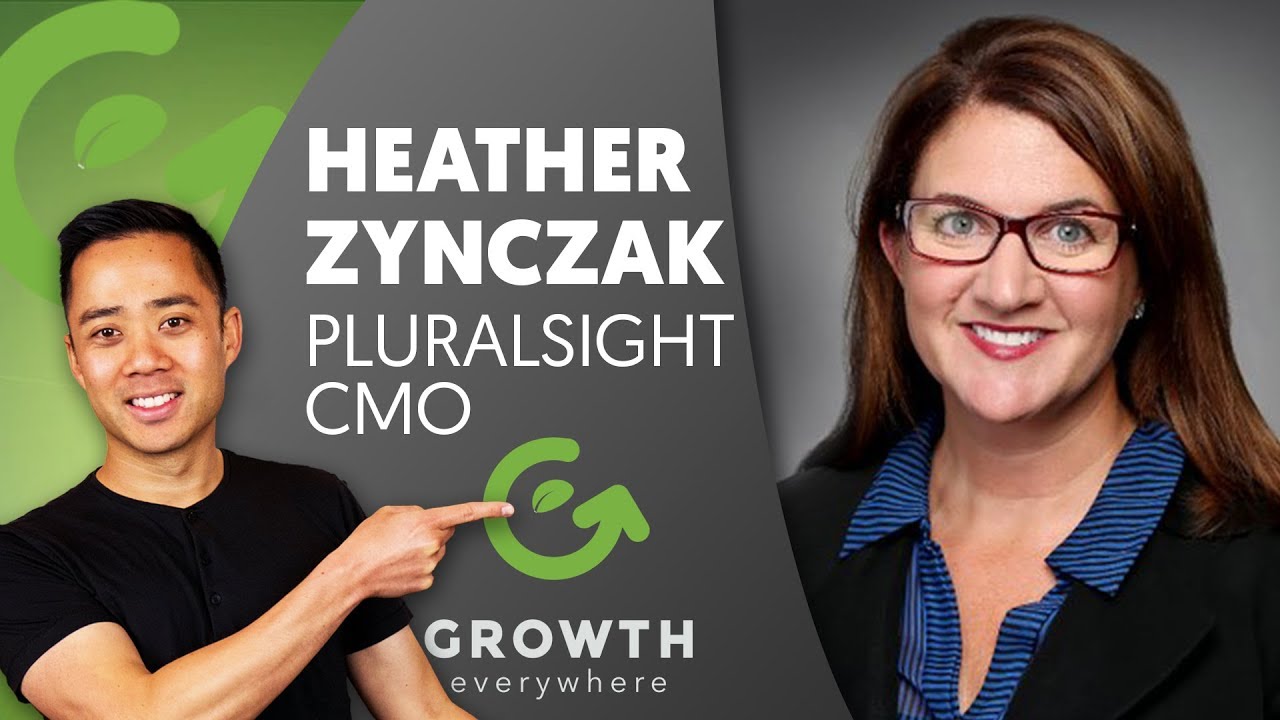
Eric Siu interviews Heather Zynczak, CMO of Pluralsight, on using data to drive marketing growth. They cover Pluralsight's B2C2B model, tools like Domo and Tableau for analytics, and how SkillIQ helps assess organizational skills. Zynczak discusses building data-driven teams and the role of product marketing in scaling.
Chapters
All right, everybody. Today we have Heather Zinsack, who is the CMO of Pluralsight. Previously, she was the CMO at Domo, and she was at Oracle, and she was at SAP. So we are here live at SAS Doc '18. So Heather, how's it going?
It's going great. It's a fun conference so far.
Yeah, it's great. First of all, thanks for being here. And how we like to usually start these is just really learning more about you, kind of what your story is, and kind of what Pluralsight does. Okay.
Well, I started out my career as a developer and then moved into different product management positions and then moved over to the dark side of marketing about 12 years ago and have held marketing positions at, you name several of the companies.
Uh-huh.
And one of the reasons I joined Pluralsight is I just absolutely 100% believe in the mission of the company. So we are bringing tech skills to everyone and democratizing tech skills. So basically it's a learning platform that however you want to learn, whether that's through courses or project-based work or mentoring, we provide tech skills to the individual. And then for tech companies, we allow them to understand their technology skills they have in-house. Like, do they have 200 professionals who know Docker for the next project? And they allow them to assess them and then create learning paths and ways of learning to get those individuals skilled up so they can meet company goals.
I love it. And so coming from a developer background, because I know a lot of developers typically don't like marketing, they don't mix well, right? Why did you decide to go into the dark side of marketing?
Well, it wasn't a quick jump. It took me 15+ years to get there. I always joke that I don't think I would have been a marketer 20 years ago, back in the Mad Men days. I don't know, do you ever watch that show Mad Men? It's like they had this wildly creative idea, and then they took naps on their couches, had 3 martini lunches, and 9 months later won an award for their brilliant ad campaign. Today, marketing is wildly different. Everything can be measured. It's extremely analytical, super data-driven, and that's how my mind thinks. I've always excelled at challenges where I can use data and analytics to solve it.
Got it. Yeah, whatever developers I've worked with in the past on the marketing team, eventually they start to warm up to it and they say, oh, I can do this marketing thing and I actually quite like it. So I think that's what happened to you, right?
Yeah.
Cool. So Pluralsight, I mean, how do you guys make money and what kind of companies do you work with?
So about a quarter of Pluralsight's customers are individuals, people who come in and swipe their own credit card. credit card and really want to uplevel their skills. They are already in their career, they're working at a company, they have some tech skills, but they want to stay cutting edge. 75 to 80% of our customers are businesses, so they come in and buy our product for their technology teams. They realize that technology is mission critical to what they're trying to achieve as a company. You know, I think Jamie Dimon just did an article recently about JPMorgan You know, they're a technology company disguised as a bank. Well, how do you become that technology company? I mean, your tech strategy is your corporate strategy, you need skills. So these companies will buy Pluralsight for all the members of their tech groups to skill up and understand where they have pockets of brilliance in the organization.
Got it. And what kind of pricing tiers do you have? Is it— I'm assuming you're charging per seat, but I'm sure you have like upper, middle, high tiers.
Yeah, so we're charging per seat. So there's an individual SKU that individuals can buy on their own, and then And there's company-wide or corporate SKUs. And we have both a professional and an enterprise version. And it kind of depends on the advanced analytics and the integrations that you want.
Got it. So if I'm like a 5,000-person enterprise, you know, how much am I typically paying per seat?
So our enterprise is $699 a seat.
$699, that's annual?
Annual fee per person.
Got it. Okay, cool. And so, you know, coming from an online education background, we kind of talked about this beforehand, and there's a lot of players out there, but Pluralsight, obviously, you know, you're a publicly traded company, so you've done something that other people aren't What do you think separates you from the others?
I think the interesting thing for us is we are uniquely positioned in the marketplace. So there are vendors out there who are providing training and skills and skills development across a broad range of things, everything from cooking classes to photography, and we're really focused hardcore on tech. So we go a mile deep on technical skills. So for dev teams and IT teams, we have really in-depth content and courses and knowledge. Whereas a lot of the other vendors in the marketplace kind of go a mile wide and an inch deep. And the other thing that makes us unique is there's a lot of vendors focused on entry-level folks, folks that are job changers, job switchers, maybe either just out of college or decided to quit college, and we're not. Most of our folks that use our platform have at least a couple years experience. They're already in their career as a tech professional, and they really want to stay cutting edge. They want to further their skills. They want to stay on top of it. It's not necessarily an entry-level platform. Got it.
Okay, and so the— I'm just so curious. I mean, the enterprise version, what do you get? I heard like advanced analytics and all that. What does like a company get where they're just like, I need to have the enterprise version?
Yeah, so if you're a CIO or a CTO or a dev leader, you want to understand, you know, you want to look at analytics. So we have these quick assessments called SkillIQ that are for basically almost any tech skill a person can come in and within 5 minutes understand where they sit. Are they just proficient? Are they an expert on Angular, on Docker, on AWS? And then as the leader of that department, you can look across your organization and say, hey, I have these 3 big projects coming up. Do I have the individuals that have the skills to get those projects across the line? And if I don't, I'm going to create custom curriculum that they can take and then assess them along the way. So you really, as a dev lead or an IT lead, your best— your main resource of how you deliver is your people. And so it gives you great insights, analytics do, into your people and how to continue to evolve your people.
That's great. So publicly traded company, what numbers can you share around the business today in terms of how big you are, how you're doing, and all that?
Oh wow. So we're a little over 1,000 employees. We're in 150 countries globally. We sell our solution and have customers. What other metrics? I got to look at my stock thing to see what our current market cap is.
Yeah. What was it last time?
Last time I checked, it was over $4 billion.
There you go. Great. So obviously doing something right. So I do want to talk about— I mean, you talked about being very— coming from a very data-driven background. That's what was one of your talks you did in Amsterdam. Can you kind of go a little more into that? Because literally, I remember you had a couple slides where you're showing that LinkedIn looks really good, but in reality, Google Yeah, so I think it's interesting.
Marketing, as I said earlier, has become extremely data-driven and extremely analytical. And I actually think every job function has. If you look at how we develop products, for example, or how we determine what new content and courses to create, we take an analytical, data-driven approach to it. And I do the same in marketing. So for every dollar I spend, I have targets for how much pipeline it has generate to generate. So you're not just throwing money at it. or how much revenue it has to make. Everything can and should be measured. And so when you really look at the lens for B2B marketers, especially across the entire funnel, not just how much does it cost to get a lead in, but how much does that lead cost when a sales rep says, yeah, I'm going to work this? Or how much did it cost you to have a closed deal?
Right.
So if you look the whole way down and understand the lifecycle and the costs along the way and what it's actually getting you, You can make changes. And sometimes it's not just the cost. It might be, you know what, we're going to do a program to accelerate our sales cycle. You know, this chunk of deals are stuck in the last stage. We're going to go create marketing programs that we know work based on data that accelerate the sale close.
Right.
I mean, or you could do it based on customer retention. I mean, but if you can have a goal, And understand the outcome you want and quantify it, then you can march towards it.
Right. And do you have any— because the charts you made were really pretty. I'm just wondering, like, data-driven person probably knows a couple of really cool tools that marketers would like. So are there any tools that you can speak to that you really love?
You know, I think we use a lot of tools at Pluralsight. So we do use Domo, my former company. We also use Tableau. We use reporting out of Salesforce. I think it's not so much about the tool, but about the data in it. So the hardest part of being data-driven is if you put junk in, you're going to make decisions on the outside that are junk. So I would really focus, instead of looking at what tool do I use for displaying my data and my great reports, look at investing in the people and the infrastructure to get the right data.
Great. And actually, this is a good follow-up question, I think. So what kind of people are you looking for on your data team, titles-wise and all that?
So my marketing team, we have across the board a ton of folks that are super analytical and data-driven skills and tech skills. We also have a centralized data team at Pluralsight as well, so that sales and marketing and product and finance are all looking at the same set of data. I personally, for example, own a revenue number. So I'm responsible for all of our digital revenue, which is about a quarter of Pluralsight's revenue. So for us, it's a significant number. And I can't have a different number, for example, than the finance team does, because when we report earnings at the end of the quarter, if I'm like, hey, I made X million in digital revenue, and they're like, no, you actually made Y million, that's a problem.
Right.
So we have a centralized data team, and in that area, it's everything from data analysts to data engineers, to data architects.
Got it. Okay. And what, what do you think is working well for you from a marketing perspective right now? What do you think that you think is unique?
It's interesting. When I joined Pluralsight 2 and a half years ago, I shifted the mentality to be more data-driven. So every team has targets, and every— in terms of opportunities and pipeline, pipeline amount that we're going to create. Not top of the funnel leads, but actual dollar amounts in the pipeline. We also look at, you know, how long our leads take us to get through. Do we need to do sales acceleration? We're constantly evaluating and updating. So I changed kind of whole culture, and we started these marketing stand-ups where literally 30 minutes every person has to stand up and say, these are my targets, this is where I'm hitting, here's where I'm not hitting, here's what I'm doing to change it. And we go around the circle and we do these once a week. So one thing I So what I think we're doing really well is being much more data-driven and accountable for excellence.
Got it. And how do you train your team to become more data-driven? Besides, aside from the stand-ups, I mean, let's say I'm a junior person coming into Pluralsight, have no idea what that means. What would you say to that person?
I would give you targets that are part of your OKRs or MBOs, whichever acronym you want to use, but which you're measured on quarterly and annually. So if you're a junior person coming in and you're— let's say you're going to own webinars or you're going to be a part of the team that owns webinars. Okay, how many people attended the webinar? How many opportunities came out of the webinar? You're going to have a goal per webinar for how much pipeline it creates. You know, so giving you goals. Or it might be that, hey, we're using webinars as a tool for content syndication. We're going to go syndicate those webinars. How much content syndication leads did we get out of XYZ webinar? So if you give people numeric and quantitative goals, even as the most junior individuals on the team, they'll start to think that way and just mentally be more data-driven.
So to clarify, this is every single day you're doing this stand-up and people are reporting on their metrics every single day?
So people look at their metrics every single day. I do a weekly stand-up in my team. So my leadership team comes in and does a weekly stand-up and they will bring people in. We bring different people in every week.
Right.
So if you're a junior team member, back to the webinar example, that maybe owns the webinars, you might come in once a month to that standup and quickly report on how webinars are doing.
Got it.
But your leader that has webinars plus 10 other things underneath them is reporting weekly on it.
Okay. As, you know, entrepreneurs, marketers that listen to this, they're lazy people. They like templates. They like process. It feels like you've already nailed this down into process where you might have written like a blog post somewhere. Do you have anything like that?
You know, I should. It's funny, I've been advising. I joined my first company recently as a board member.
Yeah.
And I went in, in my first advising session, we went through on the whiteboard and wrote out what does their pipeline look like, how many leads are coming in at the top of the funnel, how many leads, how many opportunities at the middle of the funnel. And really, you start from the bottom. You say, how much revenue do you need? Okay, how many sales reps do you need and how much quota? And then you move your way up until you get at every stage and how much everything costs you. And we did an exercise where we spent 2 hours with this startup and we mapped out where they currently are. We then compared it to industry best practices and then we created targets. And you don't need a lot of targets, you need 4 to 5. And so I've been thinking a lot lately, like, could I create some kind of a tool or blog post that would help people go through that?
I would pay for it. I would. Just use it as a training tool.
Let's co-author it.
Let's make it happen. I'm in. We will make it happen. Okay, cool. Before we started, I mean, you talked a little bit about diversity and kind of women in tech. Can you speak a little more as to kind of why that's important to you?
Yeah, so it's interesting. You know, I started out my career as a developer, and I sat in a room about double the size of this with 8 dudes, still some of my best friends in the whole world. And so my whole career, I, you know, moved on up through the chain to being the only woman on my C-level executive leadership team at SAP. So I've always been the only woman in the room. And so I didn't realize, I didn't set out on a path for this, but I kind of became a pioneer out of necessity.
Amazing.
And now at the later stages of my career, I really want to be an example, and I want other women to have more folks that they can relate to and see. I always say you can't be what you can't see.
Amazing.
So I'm really trying to be the example and at least be someone that women coming up through the ranks can see. Because I think we need more diversity in tech. We need more diversity of thought. We need more women. Not just women, we need all diversity, but it really makes better outcomes. Like, you look at the stats, companies that are bought are acquired for more if they have diverse leadership. ROE, return on equity, is higher if they have diverse leadership. You know, operating margin is usually higher if they have more diverse leadership. So it's really good for industry and company outcomes.
Jack Ma of Alibaba said his secret is women, right? And that's why he's got like, I think he's got like a women-only conference. So he's all about that. I think, what do you think you, what are you doing right now, I guess, personally to kind of draw more awareness to kind of using you as an example and inspiring more women?
I think a couple things. One is me personally. So the last 2 companies I've been at, both Domo and Pluralsight, I co-founded a group of women at Domo and women at Pluralsight. And we've— Pluralsight established a mentoring program. We have quarterly meetings.
Great.
We've really tried to bring women together and provide not only a network but also provide tools they need to succeed so that they can be promoted, they can move up. So that's one thing I'm personally doing. The second thing is I'm really— Pluralsight is really committed to this. And we're trying to solve this problem at a global level because we're looking at— there's not enough skilled workers in the marketplace, period. Last year, the US had 5 million jobs that went unfilled because we didn't have the skilled workers with the right tech skills. And if we can change the pipeline, if we can train and teach more women, more people of color, more people in underrepresented groups tech skills, it will change what technology companies look like. It will change— will help with the pipeline. And so I really believe in Pluralsight's mission. They founded an organization called Pluralsight One that partners with groups of underrepresented, whether it's women or minorities, to help give them tech skills. And so at a bigger level, at a macro level, Pluralsight is trying Got it.
And would you say Pluralsight mostly targets mid-market to enterprise companies? I know there's a lot of people that sign up by themselves, but for your sales team, I guess.
So for our sales team, so the cool thing is we have a B2C2B model.
Yes, I remember you talking about that.
Yeah, so think about Slack or Dropbox or some of these other companies where 25— 20 to 25% of our customers are individuals. They're swiping their own credit card, but 85% of of them have jobs. And in fact, 60-some percent of them we can tie to accounts in Salesforce. So it's an awesome lead gen. It's like the Trojan horse. You have these people that they love your product so much they're willing to pay their own credit card and pull out their own wallet. Now we've rolled that Trojan horse into the organization and it spreads. And then 75 to 80% of our business is in, is in the B2B side.
Uh-huh.
And our fastest growing segment is our enterprise business, because large companies are just recognizing they don't have the skills they need. They have massive skills gaps, and they can't innovate without technology skills as a core competency.
I love it. Okay, and I remember in that talk, you also talked about why a product marketer is the secret to your success. Can you elaborate on that?
Yeah, so every— I mean, if you think about ultimately you want revenue. Where does it all start? The starting point is identifying your buyer. Who is the person that's going to buy your product? And identifying what matters to them and how your product uniquely fills that need. And if you don't get that right, everything else downstream fails. Your marketing campaigns fail. Your sales activities fail. Everything fails. Really strongly who the buyer is and what's important to them. And it's funny, when I joined Pluralsight, we shifted a little bit who our buyer was, or not a little bit, we shifted a lot. And we started whole new campaigns, and it's been the secret to our success. It's why we've seen the massive upleveling and growth in the last couple years. It's because we went after the right buyer with the right message.
Got it. And how do you find— I mean, product marketing can seem like this nebulous thing, so how do you go about finding the right product marketer to join your team?
So I grew up the chains as a product marketer. I moved from dev to product manager to product marketing to marketing. And it's— they're an interesting group of people, as myself being one, I feel like I'm not picking on them. And it's hard to find really great product marketers. I think it's one of the tougher skills. Because it needs to be somebody that's really analytical and can massively evaluate, you know, total addressable markets, understand TAMs, and look at data. But they also have to be a strategic thinker because they're setting, in a way, the strategy for the company.
They're the CEO of the product.
Exactly. And they have to have empathy. They have to be someone that can really relate with the customer and a prospect to understand their needs. And those skill sets don't always go together. So it's a little bit of the Holy Grail.
Got it. Okay, there you go. I guess, where do you go find these people?
That's a good question. I think I've had the most success in my past looking at my own networks. So having grown up through product marketing in Silicon Valley, I still keep a strong network of folks. That's been my most successful tool, but I'm sure there's better ones.
Got it. Makes makes complete sense. That's fair. Working towards wrapping up here, what is one new tool or it could be an app like a Peloton bike or like a like Evernote that you've added in the last year that's added a lot of value to your life?
Well, I haven't added in the last year, but my favorite personal app is Strava.
Strava.
So my husband and I are big bikers, and we always joke that if it didn't if you didn't happen on Strava. It didn't happen.
Got it.
Okay. So just being able to understand, it's helped with our training schedules. And we go every other year for a giant bike ride through Europe and really being able to track our progress. And, you know, as we get ready for the bike ride that we're both going on, we look at each other's accounts and we're like, hey, you're not going to be able to keep up with me because you haven't been putting in the miles I have, or you haven't been climbing the elevation.
It's a competitive thing.
Yeah, totally. So Strava is probably my favorite personal app.
Got it. Wonderful. And what is one must-read book you'd recommend Could be the first one that comes to mind.
Yeah, so I'm, I'm, I'm, I joke that since I left my MBA, I don't read as many business books. So I, I'm an avid reader.
Could be fiction.
It is. That's what I'm gonna say. I read like at least a book a week.
Great.
And for me, it's It's an escape. It's the thing I read— it's what I do at night before I go to sleep. It quiets my brain. It helps me stop thinking about work. I don't lay in bed and think about the 25 emails I need to send.
Yeah.
And so the most engaging book I've read recently is Red Notice.
Okay.
It's actually a nonfiction book, an amazing, very interesting, timely story with everything going on with Russia about a Stanford MBA who started a fund in Russia and ultimately went head-to-head with Putin.
Wow.
And took him on. And it's just a fascinating story and a great read, and you will definitely go to sleep not thinking about work.
Red Lotus?
Red Notice.
Red Notice. Okay, I'm actually more curious to learn about how you even found that book in the first place.
A really good friend of mine recommended it. So again, I'm a crowdsourcer of things, and I put out to my network of people, including my book Great, so you got a book club, you got a women at Pluralsight club.
Cool, what else do you have?
I actually started just a year ago a group of women in Utah specifically. There's not— I had the impression that there's not as many senior women executives as when I worked in the Bay Area, for example. And the truth is there's actually a ton of us And we're amazing. And we just don't see each other that often.
Yeah.
Because, you know, back to you can't be what you can't see. So I started a group and I've now had 2 meetings, but we come one night a quarter to my home because I found if you invite people to your home, it just— it's a whole different vibe.
Yeah.
And we have drinks and a casual dinner, and it's all C-level female executives in the state of Utah. It's just been really wonderful.
That's great. What's it called?
I don't have a name for it. It's just my tribe.
Yeah. Well, Heather, this has been great. What's the best way for people to find you online?
Probably Twitter. It's @HsinZak or I'm on LinkedIn.
Heather, thanks so much for doing this.
Thank you.









