How We Adapted Our Marketing in 2025
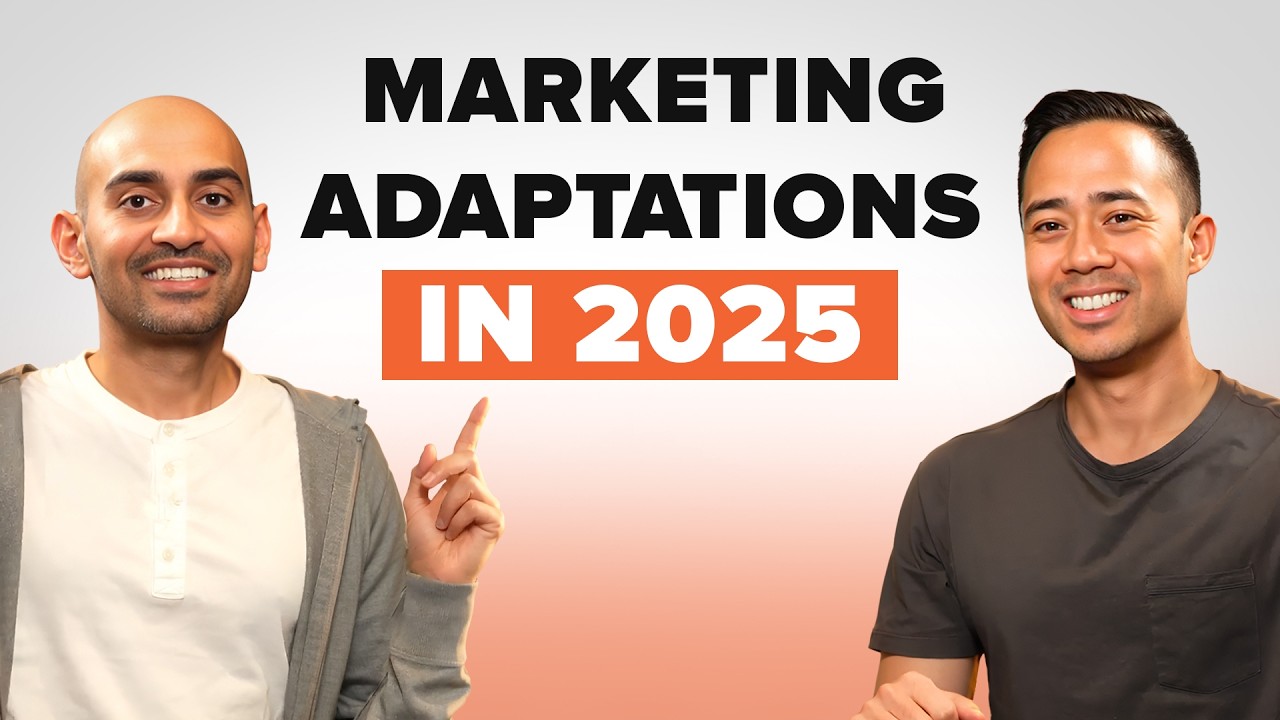
Eric Siu and Neil Patel walk through their 2025 marketing changes: using HeyGen avatars and ElevenLabs voices for short-form video, Gemini for scripting, and heavy retargeting across platforms. They're also shifting budget from in-person events to podcasting and paid virtual talks to reach CMOs.
Chapters
For our marketing in 2025, actually, this is very recent. I started testing this yesterday. I'm going to make— I'm going to make separate Instagram and YouTube channels. And I'm using my HeyGen avatar with my ElevenLabs voice. And then I'm combining it with Opus to make the B-roll. And I threw up a video on my Instagram yesterday. I think you might have seen it. And that video actually performed better than a lot of my other recent reels. And it actually got shares too. I'm like, oh my God, it's getting shares. And so I'm like, I'm just gonna go to town on this thing and just make it because it's not hard for me to make it into a process.
Yeah.
And making the script's not hard either because I can use Gemini and I can just go to Neil's channel, for example, and pull all his videos, or I can pull any marketing channel's videos or any, any news channel. So that's a starting point. And Rowan Chang, Chung, that got 92,000 Instagram followers and 8 million views in a week.
And so that is one angle that we're But what else are you doing that you're adapting in 2025 that you are doing differently than 2024 specifically? So that's one, you must be doing quite a few more things that are different.
Yeah. So a big one that I have a lot of my focus on right now is Carrot ABM, which is my SaaS. So it's scalable personalized LinkedIn ads. And we are shipping a lot of different things in there right now. We're— the way we're doing that, So when I talk to my team, I'm like, guys, a lot of the features we have, we're going to splinter a lot of them off and just give them away for free. And they'll collect leads. And a lot of these things can stand on their own. And that's going to be the primary biggest thing, I think, for this year.
Cool. Any other strategies that you're adapting or changing?
Well, you go and then I'll go more with more.
Alright, so in 2024, we started the year posting a piece of content on our social profiles each and every single day. We ended up ramping it up to roughly 2 towards the end of 2024. So 2 pieces a day. We started getting really specific with our target demographic. And 2025, the way we're adapting our social media organically is we're going to still post the 2 pieces a day, 1 short-form video, 1 graph or chart that's data-rich, but we're going to add a 3rd piece in another short. And we're going to also add in a long-form video. And I would say the biggest difference that we're testing in our 2025 strategy is we're trying to go more top of funnel. I don't think it's going to actually drive revenue.
Neil's going to take off his clothes, guys.
Yeah, I don't think I'm going to go that far. But in 2025, the way we see it is we're spending more money on advertising than we did in 2024. If I had to say roughly in 2024, From an ad perspective, like just let's say advertising on search and social, call it maybe $400,000 in the year. So not much at all. We're trying to spend, call it $3, $4 million at least at minimum this year. And our belief is if we create more organic social content that is top of funnel, when I say top of funnel, it's not going to be targeted towards a CMO, but it's going to be targeted towards marketers, entrepreneurs, people working in marketing departments. We believe that'll help increase our ad click-through rate and make our ad costs cheaper. So that's the arbitrage there on producing more social content. Another thing that I mentioned is we're running ads. We're running ads for our agency right now. We were doing that last year, but we're ramping up the spend.
So just straight ads?
Straight ads.
Like with the bald head team or like what is it?
We're doing that one for remarketing. We're running just simple 30-second clips for, For, you know, YouTube, Facebook, or Meta. We're also going to start running ads for our software as well, like people using the software and talking about how it's helping them, and then run ads to people signing up.
Yep.
Because when we're looking at our ecosystem, a percentage of the people that use the software become discovery calls, and we have the number each month from each software. Yep. And our goal is to increase those numbers because that's additional revenue that we're not really baking into the software side. But that allows it to pay for more of the cost and makes advertising for us cheaper because there's more revenue that we can add onto a potential customer. The other big thing that we're doing too is I started a podcast just interviewing CMOs of large corporations. One, it allows us to learn more. Two, it gets our brand out there with our ideal customer. And these are ideally CMOs of global companies. So that way, hopefully in the future we get included in more RFPs. We think that'll have a big impact 3, 4 years from now, but not really in the next 12 months. What else are we doing? I took over the blog. I'm creating more short-form content than longer-form articles. I'm deleting a lot of the content. I'm going to put things in a more organized fashion so people can more easily find the content, but more so get people answers to their questions when they're researching our content quicker. I'm trying to run tests to see if I can remove the exit popup because it drives a good amount of revenue. I just hate having an exit popup even though it's upon exit.
You hate— you've had exit popups for decades.
Yeah, but our team's made it aggressive.
You've had exit popups since you were born.
I know, but my team's made it aggressive where it doesn't just cookie you and only show it to you once. They're showing it to me like 3, 4 times.
Oh, that's too much.
And I'm getting irritated. Exactly. And they're like, look at the revenue difference. And they are showing positive numbers that are great from it. But there's a certain point where it's just ruining my experience and I don't want to go to my own website. I'm like, this is just bad. I'm like, we got to remove this. We're using HeyGen more to translate and transcribe all of our videos into other languages and post them on the social web. And then we're going to build up social channels in all the other major languages like LinkedIn and channels like that. We haven't done a ton of that yet, but we are in the process of working on that. And I think some of that stuff will roll out over the next 2 to 3 months. And yeah, I also don't think we need as big of a marketing team. We can be efficient with the people we have without having to hire tons more, and still be able to spend more and get more done. Cool.
To finish off on my end, what's interesting is with the, the calls we do for Carrot, which are SaaS discovery calls, separately, my Single Grain sales team reaches out to all the leads and say, hey, this is— thanks for your interest in Carrot. By the way, this is the parent company Single Grain. And, you know, here's what we do, right? And then here's like some 3 bullet points. And that actually has booked, it's booked a couple of meetings and these are all, let's just call them SQLs. Similar to you, I'm cracking down on the marketing team and my internal brand team as well. I'm just way more involved, it sounds like you are too. So the little thing, like to me, I don't know about you, but I've just been sitting on the sidelines and expecting people to kind of figure it out. But now I'm just like, no, no, no, just like this, this, and this. And like, by the way, oh guys, you could just, you know, you can just go to take your export from Google Analytics, Google Search Console, and also your Ahrefs and then just combine them all and then, you know, have a nice big spreadsheet and you know what to optimize, right? So, I'm just like pointing in the right direction now and nudging them a little more. I actually made— because Neil's so good at checking, Neil's memory is pretty good. He'll just check in and start calling people, right? I have bad memory. So, I made an Asana board called Delegated by Eric and it has so much stuff now and I just keep sending. And sometimes when there's no due dates, I'm just throwing random due dates on there and I'm constantly checking in. And I have recurring tasks too. So, even if I complete it this week, it pops up again next week, right? On the LinkedIn side, we're going to move forward with a guide that works with some of the biggest LinkedIn creators. So I'll let you know how that test goes because you're doing a test right now as well. That one's exciting to me. And then similar to you, the way we're doing ads is you and I both create a lot of content, you and I have different offers as well. So it makes sense to have 14 or even 20 different touchpoints where we're just retargeting people with all these things, right? If they see one thing, we retarget them with a bunch of other things. One could be a software offer, the other one can be like one of the other features. The other thing could be, oh, here's like a podcast episode over here. So it sounds like you're doing something similar. We're trying to be more omnipresent. And this, to me, it's not exactly search, but it is everywhere optimization. If you're an agency owner looking to break high 7 figures, 8 figures, or even 9 figures, the Agency Owners Association is for you. It's ran by my partner, Neil Patel, and myself. And we've been there, done that from an agency And if you want to learn more about it, if you want to grow faster, get more clients, take yourself out of the day-to-day, just go to marketingschool.io/agency to learn more. Yeah.
And I would say the last thing that I'm doing, you're doing something similar on the conference end. We're both cutting back on in-person events.
Yeah.
I don't know if you're doing this one, but we've been pitching conference organizers who hit me up to speak, to have me dial in virtually through Zoom or whatever it's called. And then I speak. We've been booking probably 1, Paid virtual engagement a week. That's great. It's not as high of a success ratio as in-person and the money's not as good, but we look at it as you're getting paid to promote your brand and your business. So why not?
Yeah, no, it's good. You know what I'll say? Sponsorship dollars are back. You know, we talked about, we talked about the Super Bowl deal and there's a lot of these influencer deals. It's, it's interesting because in D2C, when I talk to my team, they're like, D2C influencers are kind of going a little downwards. And I've listened to a couple of podcasts where a lot of these guys are D2C like marketers.
But the interesting thing is because B2B marketing lags behind D2C marketing.
Well, B2B influencer stuff is kind of on the upward trend now because it lags behind. So yeah, yeah, that was good. See, we should do more of those. I'm sure people like that one. So anyway, guys, that's it for today. Please don't forget to rate, view, subscribe, and go to marketingschool.io/agency if you want to join 50+ other agency owners to grow your agency faster.









