How We Run Standing Meetings As Leaders
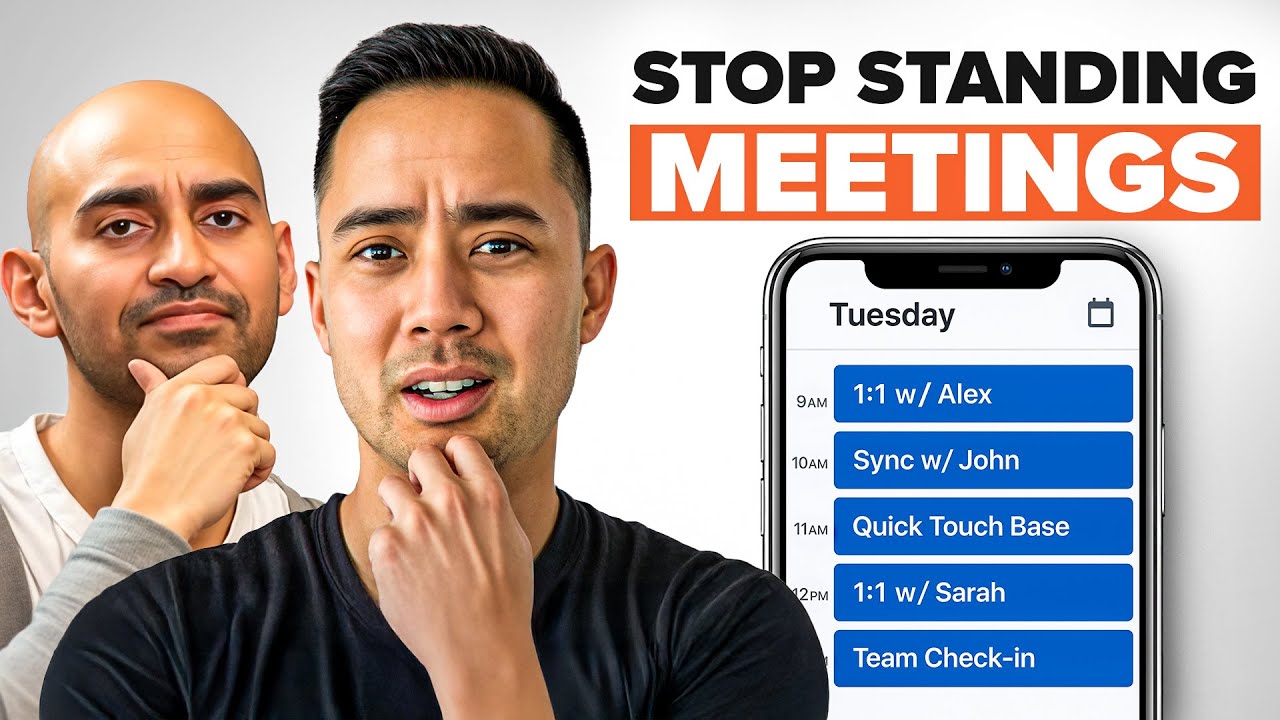
Eric Siu and Neil Patel discuss how they structure standing meetings as leaders, covering one-on-ones, exec meeting cadence, and the difference between coaching and execution. They weave in examples from Intel and Nvidia, plus practical tactics on outreach, contractor payments, and scaling content.
Chapters
Do you do any standing one-on-ones with your exec team or whoever right now?
What do you consider standing one-on-one?
So every Monday at 8 AM, you're going to meet with me for 30 minutes. And then right after that, you're going to meet with Noah for 30 minutes.
Like in a group setting or individual?
Individual setting.
No, I haven't. Okay.
And how many standing meetings are you in overall per week? Like a group meeting, executive meeting, anything like that?
I just got added to my second one now.
So it's— So you have 2 per week? Yeah. Each one's an hour?
Um, no, one, one is every other week, one is every week, and the one that's every week, I don't even know if I go to every week.
Okay. So the one that, the new one, I mean, how are, how long are these meetings?
These 2? 10, 15 minutes. Okay.
So, and then what happens in these meetings? Quick overview of the numbers. Are we good, bad? Does that warrant another conversation? Right?
No, no overviews on any of that. I expect people to send me the decks and the information they want to talk about beforehand.
Uh-huh.
And I read it beforehand. It may take me 10, 15, 20 minutes. Um, and then on those meetings, I expect to discuss solutions to make the numbers go the way we want.
So quick discussion and actions.
Uh, I just discuss actions. I don't really discuss, hey, why is it down or why is it up? I said reviewed.
Yep.
This is what I think we should fix.
Yep.
And then other people throw out their ideas. Some may disagree with me and we discuss the disagreements or if there are agreements, then a decision is made. Then a decision is made and then we expect execution.
And they're not assigning any Asana task to you, right? There's no project management task. My point of saying all this is the real question is, are standing one-on-ones stupid? Now, okay, Jensen doesn't do standing one-on-ones. Mark Zuckerberg doesn't do standing one-on-ones. You don't do standing one-on-ones.
But I'm not as successful as them.
Whatever. But my point is, are standing one-on-ones stupid? That's the question.
I don't know. I've never really done standing one-on-ones. I didn't understand the purpose of them.
I'll give you my thoughts.
Do you do them?
Yeah, I do. It just depends on who. If there's someone that's very up-and-coming and talented, and if they're younger in their career, a standing one-on-one is helpful because it grows them a lot and it builds them up. But if someone's like an executive, not really, because we talk all the time anyway. I don't really need to do that. Um, but if I, if I, cuz a one-on-one to me is, is coaching. It is almost like you're, you're a therapist as well. So, and I think people that are more junior, they need that. And I'm willing to bet a lot of money that your organization does do standing one-on-ones for kind of probably more mid-level to junior level. Um, right?
Uh, standing one-on-ones for more mid to junior. I honestly don't know.
Even if it's like 2 weeks or every 4 weeks or something like that, cuz they, they must. Even when I worked for WPromote, like my manager would meet with me like every, every month at least.
Yes, they do. I know our CEO meets with each the country leaders that are under him, and then he meets up with the regional leaders that are under him and he does one-on-ones with them.
Yeah. So I, my point of saying this is that case-by-case basis, we can't say we're Jensen Huang or Mark Zuckerberg because their teams are really, really, really elite. But even when you look at Neil's team, the exec team, like that's an elite team, right? So you want your, your elite team to just be, You wanna be talking to 'em all the time. If you're just doing one-on-ones, I don't think it's enough.
Yeah.
Um, now the other thing, then, then maybe we, we get some more out of this. Um, this one's funny. So I've been buying a lot of Erewhon, um, candied walnuts and I buy turkey chili as well. Um, and they give you these nice jars, right? These nice Erewhon jars. Now they charge you for these jars. They charge you. It's like, uh, an escrow, like $3, right? So you have to return the jars to get money back. Now, I think California requires this or something like that, but I think this is Erewhon's sneaky way to bring customers back by having those jars and getting people— when you come back to the store, you're going to buy something, right? Yeah. So you're going to get the money back, but you're going to buy. And then the average order value at Erewhon is super high. Like, I just ordered breakfast today, like $55, right?
So Jeni's Ice Cream does the same thing. If you order a lot of ice cream, they give you a bag, and then if you bring it back, you can get some rebate. But speaking of clever marketing, I was talking to one of the head of marketing at Marsec. I'm probably pronouncing it right, but the shipping container company where the family's on the Forbes list. But it's you. Everyone has seen the company logo. People just don't know.
It's like a star. It's like whatever.
M A E R S X or something like that. M A E R S X, I think. Yeah. Yeah. M-A-E-R-S-K. Sorry.
K. Yeah.
K. Yeah. And it's a Danish shipping company. They're massive. You know, they do billions and billions and billions a week in revenue, or at least a billion a week in revenue, worst case. But we were talking about B2B marketing. Dude, one of the most clever marketing campaigns that, you know, that's been around in B2B that no one talks about, even though the company's struggling now, is Intel.
Hmm.
A lot of products in B2B world, um, or in products that we all use from phones to computers and laptops, they, they had Intel chips, but no one knew it. And the sticker where it said Intel Inside, I thought was a genius marketing, uh, call.
Yeah. Cuz you remember that like everything was Intel Inside and that made me want it more.
Yes.
Like Nvidia in the back of the day, it was only marketed very well to gamers like myself. And the GeForce, like the, the, you know what, what, what, what made it stand out? It wasn't its features. It was more so the, the design of the, um, the packaging that made me want it more. Right. And then everyone started talking about it more. And what actually helped Nvidia win, by the way, was they came out with this OpenGL thing. So I used to play Quake back in the day and Quake is a first-person shooter, right? It just made the graphics look so much better. And then it, that marketed everything. And then that's how they really started to take off. Like without that technology, um, I think they would've gone bankrupt.
So it was their launching pad, was like Quake and games like that.
Yeah. Games, um, and then that technology OpenGL, 'cause that, that was just the best looking games. 'Cause all the other games looked very pixelated, like when you're playing, but then it smoothed out like your face and everything. And then that became its marketing. Like the product actually became the marketing 'cause it was like a ton of word of mouth. 'Cause you can, you can start chatting in these games.
Yeah.
So, um, by the way, I mean, we kind of talk about this bad economy right now, but I will say that leads are picking up for us.
Same.
What would you be saying? Like, how much better are leads now after this China deal got done? China-US deal?
We'll be up, I think it was 6% over last month.
6%, okay.
That's not a lot for us, but 6%.
I would say for us it's a little different. I mean, because you guys have a lot of RFPs and things like that. I think for us now, so before, maybe a month or two ago, actually no, I have the Google Analytics data for this. So this is We were getting previously, let's call it, um, from Google Analytics, 800 leads a month or something like that. Then when April hit, when I looked at our GA, it dropped down to like 230 or something like that. And then it's been going down, right? I will say though, previously almost every day we would get like one really good lead and that stopped completely for, for quite a while, like maybe one per week or something like that. Um, 1 or 2 per week. Now it's back. It's like, you know, 1 or 2 per day. And I'm like, okay, it's coming back. Um, so I think the economy right now, to, to my opinion, is people are cautiously optimistic because we still need to finish off this. Hopefully we can get this, this Russia-Ukraine war done with. Hopefully we can, you know, end these wars and then inflation's coming down too. But who knows how long that's going to happen because you still have tariffs. Yeah, but I think the tariffs will be done with and everyone's going to be at like 10% base level. Most people will be. So I'm cautiously optimistic right now.
So I judge a lot if marketing is going to come back from local businesses. So for example, I go to a chiropractor here in Beverly Hills. The guy's name is Dr. Ash. He goes by the Chiro Guy. Okay, so let's just take his Beverly Hills office.
That's a rich office though.
Yes, exactly. But just check out this data. Okay, because his people are are either local residents or they're people who work in the area and are coming here for work. Now, 40% of his revenue is from insurance. You get in a car accident, you get hurt, a lawyer sends you to a chiropractor, he'll adjust you, he doesn't get paid. Once a case is done, he then gets paid. So this chiropractic, I think it's called lien or chiropractic on loan or whatever it is. I don't know the exact term for the industry. That part of his business hasn't been hit. 60% of his revenue comes from local people, right? And the— and going back, the reason the first part, the insurance people, like who got in car accidents, don't get— that part of his business didn't get hit, those people don't pay to actually see him. It gets paid from part of the settlement. 60% of businesses, people who work in the area or live in the area, you would agree in Beverly Hills, homes cost millions of dollars. They're not all like the TV. But there's homes that are $100+ million. There's also homes for $2-3 million. People have money in general. You agree with that statement here, right? His business is down 15%.
Over what period of time?
Just recently, like when he looks at all this economy stuff.
Before and after.
Yeah. So 15%, but you can't look at 15% on $100. 40% of his business is insulated from any economic activity. It's not really a good judge for the economy, but the 60% is. If he's down 15% on that 60%, it's more realistic he's down 25%. So businesses are down like his 25%. I know that's only one data point because of things like the economy, money. And I asked him, did you increase rates? Nope, haven't increased rates. He's like, it's just— He's like, I'm starting to see things pick up. But it was definitely bad when tariffs started coming out. Like, he noticed it right away of people canceling appointments and not coming the moment they introduced tariffs and stuff like that starting in April.
So I think we need to look at the next 2, 3 months or so to see how things pan out. But the University of Michigan consumer sentiment thing, so that index was 73 in November 2024, probably because, you know, yeah, new election, right? New, new president. And so that was the highest sentiment for a while. Right. And then April 2025 at the end was significantly lower at 52.2%. Um, 52.2, not percent, but, um, and then the final thing I'll give you here is in April 2025, the Conference Board Consumer Confidence Index fell to 86, down 7.9 from March, reflecting a sharp decline in expectations for future economic conditions. But, but this all like all these predictions, like all these people like Bloomberg or I think JPMorgan retracted the recession statement. Right. So like these things change very quickly.
I thought Jamie Dimon was talking about a recession today, or what did he say?
Um, on Bloomberg I saw that JP Morgan retracted the recession statement, not Jamie Dimon. Uh, and it—
I, I could be wrong, but either way, I don't think these big corporations want to pick political enemies because it can hurt their businesses. It's just like Trump talking about Tim Cook. Yeah, he, he said it was something online like— and I'm paraphrasing here— he had a little problem with Tim Cook.
That was today.
That was today, yeah. And it was about him creating iPhones in India. And I'm not here to tell people where to— what to do with their company or what country. That's for people who have a ton of money and are publicly traded to figure out, and politicians. But, um, I don't think people want to create enemies. Like, remember the Amazon thing? Amazon, uh—
The tariff pricing?
Yeah, the tariff pricing. Uh, what was it saying? Like, that, that lady Caroline whatever, I don't know her name. Uh, the press girl. Yeah, press girl, Caroline something.
Yeah, Levitt. I don't know, something like that.
Something like that. She was— Scott Bessen was talking about it and someone asked a question about Amazon and he just moved to the side. He's like, uh, I'll let Caroline answer that. And she's like, that's a direct like attack on the US.
And they backed out.
And then right away they're like, oh, this was never confirmed that we actually are doing this.
Yeah.
I'm like, no one wants to pick a fight with the government.
You know what I will say though, like, um, So this is the, the, the only politics we'll talk about today. But I do like the, the MAGA health or the MAGA investment thing for the kids where the $1,000, because that can compound to, I think they said $300 grand or something like that if you just follow the S&P like returns. But I think that's smart because you should teach kids at a younger age how to invest. And I do like how he's bringing drug prices down 50 to 90%.
Yeah.
Right. And I do think the speech he gave, like if you put Obama's voice over it, That would have been a pretty damn good speech.
Yes.
Right. And so, like, they're like, again, it's— I think if people are doing something that's good for the people, like, credit should be due. I want to call this out, though, real quick. So, again, we're not saying we support or don't support Trump, but check this out. This guy has a 100% response rate from sending $1,000 custom swords to the owners of failing companies. So check this out. It sends you— he sends you these custom swords over here with your name on it, I think. Remember, I sent you a knife with your name on it. And then you remember I had to give you money. Give it back to me. Yeah. You give me a dollar. You sent me a dollar on PayPal. Yeah. Yeah.
'Cause my wife said it cuts friendships.
Yeah. So, okay. But going back to this, 100% response rate, sends $1,000 custom swords to owners of failing companies. Why does he do this? Because he's trying to buy their business. So each closed deal represents 7 figures in net profit. So he just says this note says, business is war. And I noticed you lost the battle recently. I just wanted to let you know if you ever need a few extra hands in battle, We've got your back. 100% response rate. Go do that to the people you're about to buy. Buy them some custom swords.
That's cool.
That's 100% response rate. I just made you a lot of money.
I like it.
You're going to do it. Are you going to do it?
Uh, no. Come on.
These are so nice. Can you buy me one?
We've slowed down on how many companies we're buying. I think we're at this point doing 2 to 3 a year instead of trying to do one a month.
Yeah. Okay. But, and then how many do you need to look at before you make an offer?
We have a pipe. I can do 10 deals tomorrow.
Okay. Yeah. But how many do you need to look at before you make an offer?
No, no, I already have 10 deals I can close on that are good. Okay. Okay. Okay.
So you're probably gonna slow down. But just—
You can't integrate them all. Even if I had all the money in the world, my problem is, is my team can only integrate so many. And if I give them too many, there's just going to be problems.
And you also dilute your team quite a bit too.
Yeah.
Yeah. You don't want to dilute the people. Okay, we got one more here because we started a little late. Um, I want— the last thing I wanna talk about here is how we're planning to ramp the F out of YouTube. So here's, here's one thing I noticed. Um, you and I, we've, we've kind of changed it up and I'll let you speak to it in a moment, but I actually watched our Miami interview, or not interview, but we did an episode in Miami in my hotel room. Right. And I actually watched the whole thing. I didn't mean to watch the whole thing. I just wanted to see a piece of it. I ended up watching the whole thing. Like it was on 1.5x. I noticed on our Marketing School podcast YouTube channel, The latest one that we just posted, the long form where we just— you and me talking— that usually our long-form videos might get like 100 to 200 views. This one got 1,000. I was like, whoa. And the average view duration, 10 minutes or so. I was like, well, this is really good. And what is it that we changed?
We just talked about our lives and what's happening in marketing and business and how to grow from there.
Yeah. And so I think we're just going to do more and we're just going to post the whole thing to YouTube. But Even on our own personal YouTube channels, like we're both recording at Visible Audio Studios in Century City. And you're record— when I met with them earlier this week, it was like, oh yeah, Neil records for like 4 hours at a time, um, 6 hours at a time or whatever.
2.
2, 2, 2 to 4 hours.
No, no, I pay for 4 hours. We record it in 2.
Got it. So like same thing for me. It's like I'm probably, I was doing like 1 a week. I'm probably just gonna jack it up to like 2 hours or something like that. But, um, we're, I, I think the thing about our YouTube is that we know that the more time we put into it, the better results we get. Um, and now that we've gotten so many comments about people just letting us talk and like not wanting us to talk about politics, they said that you, you said someone wants to, if they want to listen to politics, they listen to All-In. We're offended by that, guys.
Okay.
I'm not offended. I'm just kidding. I'm not really offended. Um, but anyway, anything else you want to add to that?
Uh, I'm with you. I think we're taking over a lot. Um, I use a contracting company to help out with YouTube and then we mix that with our internal. And one of the guys who runs this contracting company, which Eric knows who it is, they say, hey, long time no talk. Because I'm working with someone on his team, but this is the owner. Just want to let you know, we got your feedback on slightly heavy-handed clickbait-style hooks and confirming we're happy to tone those down on outlines moving forward. Also, please keep giving feedback and sharing experience on your— on how your experience is going. Love to continue to make sure that we're providing the best possible experience for y'all. And I responded with, I changed 2 of the videos from the last outline. So they try to give me outlines and then, uh, like, or outlines are probably the wrong word. They'd give me ideas and I create the outline, but they'll try to give me like, uh, bullets. And I don't really even look at the bullets. I just look at the title and then I just riff on whatever I want to riff. And I said, I changed 2 of the videos and I just literally changed the topics, made my own outlines.
Mm-hmm.
I'm like, to be more on topics I want to cover, but it's getting better. What I learned from this batch is use the topics you give and make up my own ideas for the ones I don't like and have your team just work on them, right? Because I'll give them script, but then they gotta put the script in order and make it nice and all that kind of stuff. Uh, and then I'm like, by the way, uh, then I actually mentioned this was random. I was like, by the way, I keep getting an email on invoices not paid. If that's the case, let me know. I'll ping accounting, but we typically pay once every 2 weeks. Um, and then he said, this was interesting. This is a smart move to use in this economy. Yes, we usually send out invoices invoices minimum of 7 days before they're due.
Yep. To get paid faster.
Yeah, before their due date. And they're always due at the beginning of the month. So they start work at the beginning, he's sending them before to get paid before work even starts on their end. We typically pay after the work is done. And then we send an invoice and you get paid within 30 days.
Yeah.
But he wants to collect money before he even starts doing any work.
Dude, we used to do that with Amazon back in the day when we worked with them. And they're like, okay, we're net 60, but just send us the invoices like 60 days ahead or something like that. We're like, okay, sounds good. But anyway, guys, that's it for today. Please don't forget to rate, review, subscribe, and we'll see you tomorrow. Bye.









