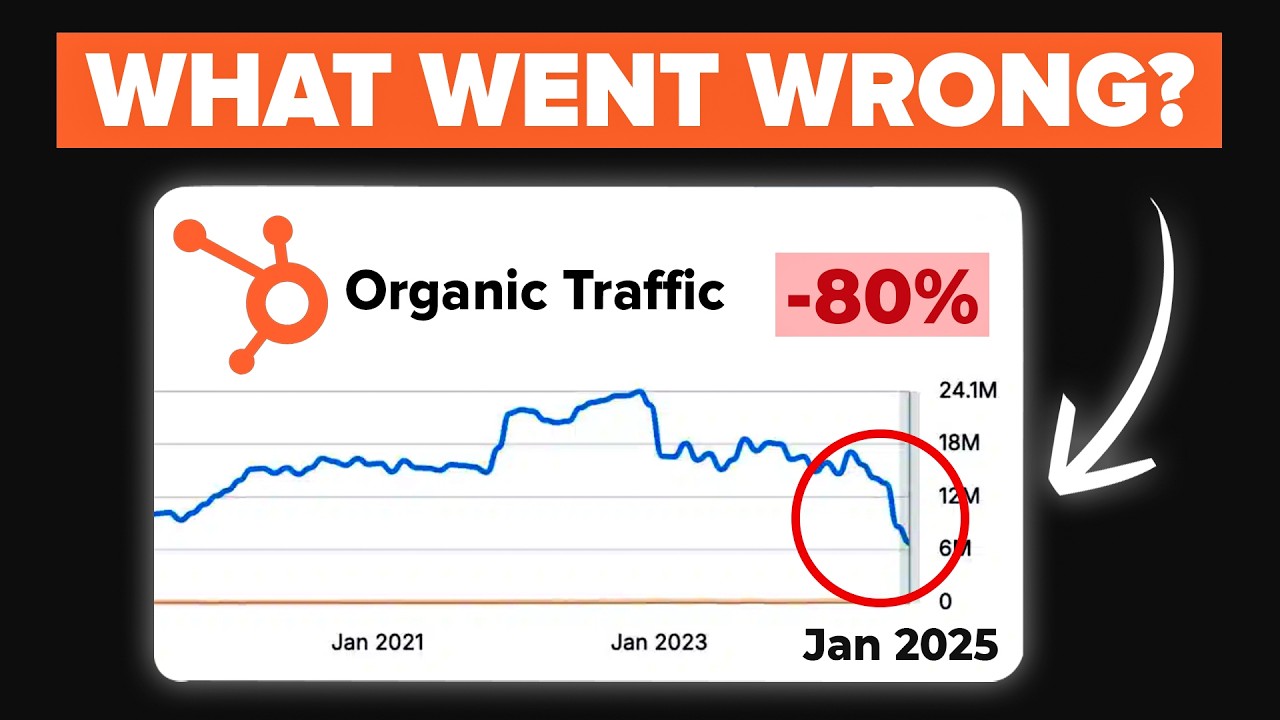
This content was created by Eric Siu. This content was uploaded by Eric Siu. This is a YouTube video titled "HubSpot LOST 80% of their SEO traffic: Is it bad?" (published 2025-01-29). The excerpt is a conversation between Eric Siu and a co-host (labeled Speaker A) about a reported drop in HubSpot's SEO traffic and why it likely won't materially hurt HubSpot (sales-driven motions, upmarket focus, Dharmesh's agent strategy). They discuss their analytics habits, SEO intent (who actually converts from generic queries), AI's impact on content creation, and internal data on how long it takes to produce blog posts that rank. The clip also includes a promotional ad read for Eric's agency Single Grain and a plug for the Agency Owners Association on marketingschool.io/agency. Overall it's a marketing/SEO-focused discussion with practical takeaways for agencies and content teams.
Chapters
HubSpot's traffic going down. You saw the pages that caused HubSpot's traffic to go down 100%.
Yep.
Disclaimer here, it's not actually HubSpot's Google Analytics. So what percentage did they go down? Who knows other than HubSpot?
Yeah.
I actually don't think their SEO traffic going down is going to affect their business one bit.
Well, at this point you want to talk about like they are known, they're known, and a lot of their sales are— they've been going upmarket for a while. And so, and again, they're, they're a known entity in the CRM space. Look, HubSpot's a great company, they have a great SEO team, but just know now a lot of their stuff is driven by sales motions. And then the other thing is Dharmesh is going hard on agents. And that's going to be— I think he's going to be able to capitalize on that. And that's going to somehow— I think that's going to drive traffic and conversions. And that's going to relate to HubSpot in the long term. So I think they'll be fine. They have a strong team.
They have a really strong team. You and I are on the same page. We don't really check our analytics that often. The update happened in December. Did you check your analytics since then?
Nope.
I haven't either. Did you check it the day after the update either?
No. And like, I didn't even know when the date was. So like, yeah, but I do put pressure on the team just to check, for them to check and then for them to keep things updated. But that's about it.
Yeah. And I keep up to date with what the updates are and what's happening. But for us, we generate most of our revenue from RFPs, referrals, whether it's from employees, clients. So we focus on the channels that drive majority of our revenue. We do keep track of our SEO traffic for the page that drives leads and the keywords that we rank for that drive, you know, real customers. Like we used to rank on page 1 for the term SEO and our team used to spend a ton of time updating it. So I asked my team, all right, Go back for a whole year and find out all the people that we got as a customer from that page. And we did this for a few years and it was a whopping zero. And I was like, cool, who cares if you're using it in a pitch presentation? Stop wasting your time updating this page. They're like, you sure? And I was like, anyone who's typing in the word SEO is usually looking to learn about the subject. They're really, really far off from paying us to do their SEO.
Yeah.
Because we tend not to work with smaller businesses. I'm like, this is just going to be a waste of time.
Intent matters. You know, interestingly enough, head strategist today, he shared a call with me and then he was on a pitch with a prospect. And the prospect was like, hey, look, like great presentation and everything, but come on, like I can do a lot of this stuff using Claude and AI now. And like, I just want you, like I want to understand from you guys, like where is your business going to go? And sure, we're paying X amount here, Y amount here, Z amount here. But like, you know, isn't this stuff just all going to be like machines in a couple years? Um, and so I think we're going to— that thought is probably pretty prevalent and, um, we should probably talk about it at some point, how to optimize for search everywhere optimization.
Yeah, but going back really quickly to people complaining like, hey, isn't Claude or ChatGPT just going to take over a lot of this stuff? We used to get that when some of this stuff came out. We don't really get it anymore. I don't know if you get it often.
No, that was only the first time. So he, he sent, and I didn't, Like the team responded beautifully to it. And so, but I think the people that do understand that machines will replace repetitiveness, but they won't replace creativity.
Funny enough, this will go live on my X profile in a few days. We did analysis of this and what Eric's looking at is how long are people spending to write a blog post that actually ranks on page 1 of Google. And I remember at our agency early on, people used to tell us, hey, we don't need you for content, we can just end up doing it. And we ended up losing some revenue over it. Majority of those customers ended up either A, coming back, or B, their traffic just declined and they didn't come back and they felt that they can figure it out and they're just going to keep doing it through AI. But we didn't really see anyone successfully just transition with pure AI-related content. So we were starting to look at data on how long it actually takes to write a blog post. And back in 2015, the average was around 2 hours and 10 minutes. This is for a blog post that actually gets traffic and ranks, right, from SEO perspective. Go to 2022, it ramped up all the way to 3 hours and 52 minutes. That's a huge difference. That's almost double. And the big reason being is blogging and ranking on Google has gotten more and more competitive and it's much more saturated. And there's only so many results on the first page, whether there's 10 results, 8 results, or 12 results, it doesn't matter. There's still only so many results and there's only so much people are going to scroll down. So you got to put in more time to do the research, create something that's a masterpiece, something that's amazing so that way it can actually rank high. When AI came out and in 2023 it really started taking the worldwide storm, it went from in 2022, 3 hours and 52 minutes that people were spending 2 hours and 11 minutes to produce a blog post that ranked. But what we were finding, because we were working with a lot of these contractors and companies, is those blog posts didn't do as well in the long run. So you shoot up to 2024, the time went to 2 hours and 51 minutes, which is still more than 2015, but less than 2022. 2025 is forecasted on our end through our surveying and internal data around 2 hours and 59 minutes, so roughly 3 hours. What we're finding is—
All right, so I wanted to take a second to tell you about my ad agency, Single Grain. We're a performance digital marketing agency and we focus primarily on working with B2B companies and e-commerce. So performance marketing, that's SEO, that's paid media, that's CRO, that's ad creative. And there are a whole host of other things that we're doing with AI that's really cool. You can go to singlegrain.com to learn more. Again, that's singlegrain.com to learn more, and we'll see you on the other side.
AI can help you save time, but it's not at a place yet where you can just click a button and it can just replace humans. It's far from it. And counterintuitive, even though AI's getting better, people are actually spending more and more time to create content even though AI's getting better. And the reason being is it's more competitive than ever, and you need that special touch of originality, which you're not getting with AI.
Like I said, machines for repetitiveness, And humans for creativity. All right. So that is it for today, guys. Go to marketingschool.io/agency to learn more about the Agency Owners Association. And that's the group where you're going to see our churn numbers get even better. Goodbye. Goodbye.