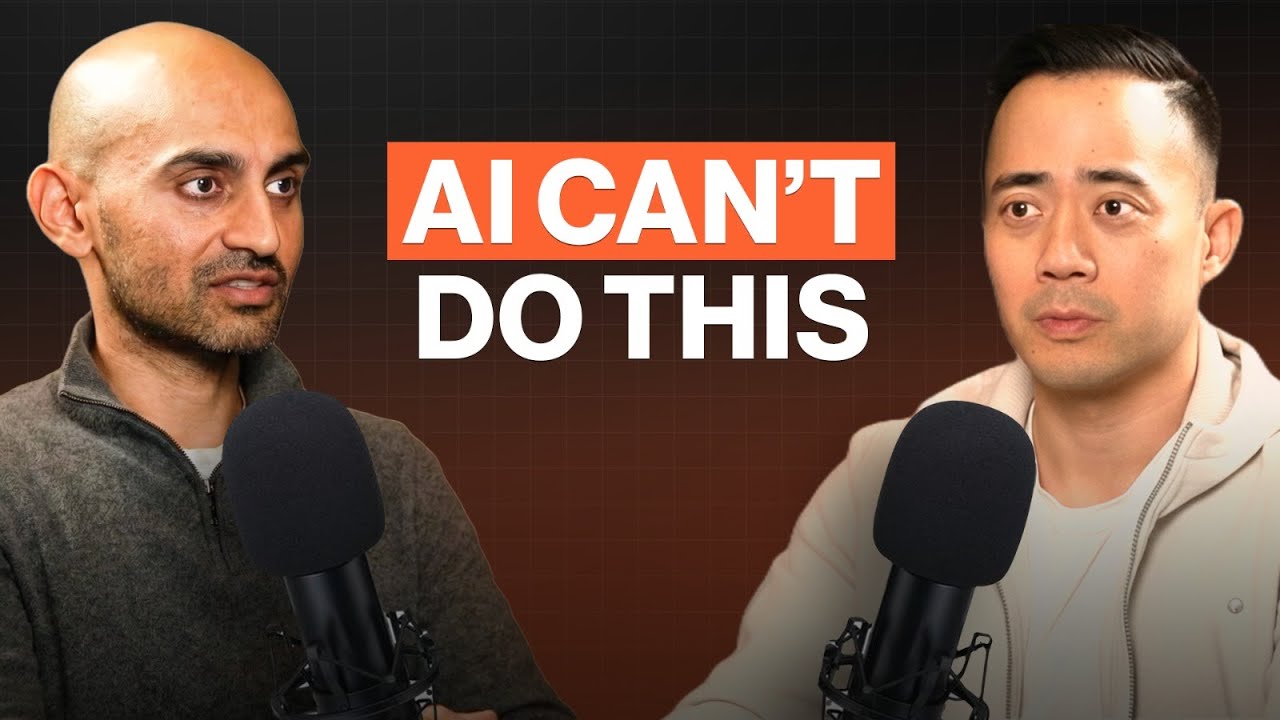
This content was created by Eric Siu. This content was uploaded by Eric Siu. This is a YouTube video titled "Is Storytelling The New Marketing?" (created 2025-12-26) — a conversational episode featuring Eric Siu and Neil Patel. The two discuss storytelling as a marketing discipline (hiring trends, historical context, storytelling techniques and books/seminars), how storytelling compares to data-driven/LLM-friendly content, practical examples (MrBeast, South Park, StoryBrand), and tactical content strategy for YouTube (video length, title length, thumbnails, text, median views) plus platform distribution and enterprise sales differences. They also touch on agency/SEO thinking from Single Grain, AI tools (Grok, Perplexity, ChatGPT/Google), and include personal anecdotes and brief side conversations. The tone is informal and tactical, aimed at creators/marketers.
Chapters
Did you see the Wall Street Journal piece and how they're looking to hire more storytellers?
I did not.
So this is again from Akash Gupta. So the storyteller job title doubled on LinkedIn in one year, and then Wall Street Journal just did a piece on how people are trying to hire more storytellers. So Vanta is paying $274,000 for a head of storytelling, okay? Executives mentioned storytelling on earning calls 456 times in 2025, up from 359 in the last year. Everyone thinks this is a marketing trend. The actual story spans hundreds of years of professional storytelling, and the current spike is a reversion, not an innovation. The job title dates to medieval Europe. And so I think what's worth calling out here is in a world where things are going to be a lot more AI heavy, you want a way to stand out. That's what marketing is at the end of the day. How do you go about standing out? So look, IBM had a chief storyteller in 2010. SAP had one in 2013. Microsoft brought on Steve Clayton. I don't know who that is. So all that to say, Neil, I think you and I, I would say, let me just speak for myself. I wouldn't say I'm the best storyteller in the world, but we're constantly out there, constantly trying new things, and that's our way of storytelling because we share examples of how things are going.
I think I'm actually a pretty good storyteller.
Do you? Okay. I don't think I'm a good storyteller. You should share some of these dynamics around storytelling then.
Yeah. With storytelling, I used to do a lot of storytelling when I used to write a ton of blog content. And with storytelling, you want to take people through an emotional rollercoaster, what I found to be super effective. It's not just the hooks, it's about the ups, the downs, being super descriptive so they feel that they're there. You have the happy moments, the sad moments, the scary moments, the exciting moments. And what you're really doing with storytelling, I hate to say this, is you're creating content with more fluff. Seriously, like if you just think about content that has tons of storytelling, it's just a lot of fluff and it goes against what a lot of the LLMs like when it comes to content. They like content that's short, to the point, that just has the data, the facts, whatever point someone is interested in. It just highlights it, structured data just makes it as quick as possible. But I found if you want to captivate readers, you need to do storytelling. And a great example of this is MrBeast. My son who's 4 loves watching MrBeast videos on YouTube. He doesn't know who MrBeast is, but he now kind of knows MrBeast videos. And what he loves about it is the stories that they tell. Oh, if you do this with this Lamborghini, if you can have the Lamborghini survive, you'll do well. And, oh, this is so-and-so. He was on a previous MrBeast show. He almost won a Lamborghini, but he lost it at the last minute because of this. We're going to give him a chance to win it back, right? They really tie in storytelling into the whole thing, which keeps people engaged. And even when they're doing the Lamborghini contest, they'd be like, oh, uh-oh, he lost on this phase last time in which, will a train go through the Lamborghini and crush it? He's going to have to do it again. What did you learn from last time? What are you going to do differently? Right? And I think storytelling works really good for video format as well. So here's what I say about storytelling.
There's a really great video on YouTube with the South Park co-founders, and it's a very simple video. It's about 2 minutes or so, and they're talking to a group of students saying, when it comes to storytelling, what you're looking for is, let's say when William tells you a story, it's, hey daddy, and then? This happened and then, and then, and then, and then, right? That story is— you start to tune out after a while. But if there are more buts in it where it's like, Daddy, this happened, but then this happened, but then this happened over here, it gets crazier and crazier and crazier. That sucks people in more and more and more. What you're trying to do ultimately is you're trying to create tension. And what happens with the best Shorts that you see? There's tension, there's a hook that sucks you in, and there might be something that maybe inflames you, maybe something that you don't agree with politically or something like that. But storytelling is really good at keeping tension. And then what Neil was kind of talking about earlier was the hero's journey, right? You start at the very beginning, and then maybe the hero believes something, and then the hero runs into a challenge, and then he goes on the journey, or he or she goes on a journey. And then, you know, what happens is maybe they get a setback, and then what eventually happens is there becomes like a climax period, and then, you know, the story resolves, right? And so I'm kind of oversimplifying it a little bit, but I would say the fact that these companies are hiring more storytellers Ideally, usually the chief storyteller is the CEO. You want to have at least one chief storyteller in your company. And I think if your founders lose the juice there and you're looking to hire a chief storyteller, I'm not saying don't hire a chief storyteller, but I think the founders, at least one of the founders needs to tell— needs to learn how to tell stories at least decently well.
Yeah, I don't know who created it, but I learned a lot about storytelling. I forgot who the writer was. He had this soap opera writing formula. and he was a copywriter and he would take the formula—
Ben Settle?
Who?
Ben Settle?
I don't think it was him. And this guy would just try to incorporate elements from soap operas when he was writing sales copy and it worked really well.
You know what's a great book too? So I actually, you know what's funny? I actually went to a storytelling seminar before in 2018 or 2019. It's from a book called Storyworthy. Oh no, no, it was a different story. But Storyworthy is a great book to learn how to tell stories. But I think more than anything, you can read all the books you want, you can watch all these South Park videos and watch people talk about storytelling. I think you have to practice yourself because I remember one time, Neil, we were at a dinner and you were making fun of my storytelling. This is a long time ago. This is like 14 years ago or something like that. And you're like, because my storytelling was so bad, you're like, hey, Eric, tell a story, tell a story.
It was so bad.
So, oh yeah, Donald Miller's book, Donald, that's the session that I went to. StoryBrand. Okay, so StoryBrand is Donald Miller's book and he has these seminars you go to and I, well, Neil, do you remember Eric Rivera, pet guy?
Uh-uh.
Okay, well he went with me and then my former VP of marketing, Zach, went with me. And so StoryBrand's a great book. I would say Storyworthy, I would say is at least for me, a simpler book to think about storytelling. But anyway, go ahead.
Yeah, when I Google soap opera series and sequences, the only thing I really see is ClickFunnels and it's the soap opera sequence that sells.
Is it Russell Brunson's then?
It's, uh, he, the person who created it was Andre Chaperone.
Yeah. Don't know who that is.
Me neither. But the concept works really well. I've used it a lot to sell.
Do you, I mean, when I think of, okay, when you think about your ads, okay, let's continue on the storytelling thing and then I have an SEO thing we can talk about to wrap things. But, um, you, when do you weave storytelling? Because I don't think you're weaving storytelling into your webinars or your ads, are you?
No, we don't weave it in anymore. Storytelling and things like, we do kind of in our pitches, but not as much. Enterprise pitching is really different. If I'm selling a product for $99 or $200 and I'm trying to sell to a mass audience, I think storytelling works really well. When you're selling someone a million or $2, $3 million worth of services, And you're dealing with procurement, they're like, here are requirements and what is going to be the results of the potential ROI? Like it's more black and white and you have tons of decision makers in there and it's not as much storytelling. It's more so come with proof on why you can actually deliver on this promise that you're making.
That's what we call de-risking.
Yes. And I think that's how enterprise sales are because it's like I've had so many, I get so many of these messages on Instagram and email every single week. Hey, we can help you grow your business 20, 30% by fine-tuning your sales process. We'll teach you how to sell better. We'll do workshops. We helped X, Y, and Z company, like, you know, and it's all this bombtastic stuff. You know, Ramit Sethi loves using that word, or that's where I at least got it from. And it's just like, dude, by me using these bombtastic words and by telling them like, hey, if you don't want it, no problem. I only got one slot left. And if you want it, you need to pay upfront and claim it now. Like, none of that shit works with enterprise. Enterprise would be like, okay, that's good.
Goodbye. I got to say something right here. Like, so we, um, you have nothing to do with this, but I got to say something. And this is actually calling a company out. I'm not going to name names actually, but there's a software that we tried to buy recently. And usually sometimes I like to test these things. Um, but they were so high pressure and I was like, dude, you got to stop like this direct, like internet marketing style where you're putting pressure and saying, hey, hey, um, it's, it's expiring tomorrow. We need you to do it right now. And you keep calling me and texting me like every, every minute of the day. It doesn't work. And like, we— Neil and I were both taught this style a very long time ago.
It's terrible.
It doesn't feel good for you doing it. It doesn't feel good for the other side too. So you want to think of yourself as someone that's trying to be helpful. And if you're not— and by the way, sometimes you're not going to be the one that can help. That's okay. You can refer to somebody else. But don't try to just win everything. Because what happens is when you don't leave any room for the other person, you end up causing resentment and they end up saying negative things about you. And I'm not going to name names here. I really want to name names. But I'm not going to.
Do I know?
But it was a really bad experience.
Huh? Do I know?
Um, it was, I'll just say this, it was one of the blue link, uh, blue text messaging companies. I'm not going to confirm or deny.
I don't know them. Yeah, I don't think I know.
We'll just leave it at that. Yeah. Here's the problem with most marketing agencies. They don't understand what is happening with the world of AI. With my agency, Single Grain, we think about agentic workflows. We think about creating agents for the future. When we think about SEO, we think about creating different products such as internal linking products or content consolidation products. And on the other side of things, we think about building products such as Karat. We just think about making marketing easier overall. If you want to stay at the cutting edge of marketing and at the same time leverage the power of AI, go to singlegrain.com and we'll see you on the other side. Okay, one more thing before we, before we take off here. So this guy, Richard, the YouTube strategist, he analyzed 62 billion views from 2025. to find out what makes a video go viral on YouTube. So I'm going to share this because I think it'd be interesting to talk about our YouTube strategy for next year. So why are you smiling?
My daughter, it's hilarious. This is a random note because we're going to go to my mom's house for Christmas. So my daughter asked my wife, hey, is there going to be a Christmas tree at grandma's house? And this is, we're not going to go on Christmas Day, we're going this weekend. So before Christmas, and my wife's like— I said, I don't think they will have a Christmas tree. And then my daughter's like, she said, oh, is it because they don't have enough money? Like, she's learning a concept now because she— our kids, my kids grew up in a house of privilege. I'm not saying I'm the richest person, but I've done decently well where I think they've grown up in privilege with drivers, cooks, nannies, etc. And we're trying to teach them, we cut a lot of stuff off, no more drivers, no more cooks, et cetera, but make them do their own chores. No one makes their bed, they have to make it themselves. But it's more so like we're trying to teach them the concept that life is tough. So now they're looking at everyone else and like, oh, when she was at my mom's house last time, she gave her very little ice cream because my wife said, don't give too much ice cream because she doesn't want them all hypered up with tons of sugar. And then my daughter goes to my wife and be like, oh, it's because they don't have a lot of money, so you get small scoops.
That's funny.
And I don't mean in an arrogant way. Like, my, my daughter is actually like, she's trying to understand that not everyone has everything, so you should be kind and appreciative. It's just she's really young, so sometimes kids do it in a cute way because they don't understand. Yeah, totally.
You see my screen?
Yeah, I see it. That chart looks really cool. I like the coloring. Copy it.
Okay, so I think what's interesting for you and me is, um, so median views. Okay, so 80,000 median views, like 170-minute video. Okay, a really long video. But let me go down. Let me get some interesting data points here for you. So, okay, it studied 323,000 outlier videos, 50,000+ channels, 300+ data points per video, and it cost us $10,000 to create. So how long should your videos be? So more than 50% of videos we studied were shorter than 15 minutes, but shorter does not equal better. In fact, longer videos, 1 hour plus, tend to perform better on average. And for videos under an hour, the sweet spot is 15 to 25 minutes. So there's one thing they have around education. Like check this part over here. So this graph, you can see that for business over here, the sweet spot is actually 28 minutes. And I have to imagine that a lot of these business ones are, they might even be podcasts. So tech is like 28 minutes, business is 28 minutes, finance is 21 minutes. But your videos and my videos, typically my videos right now are anywhere from 8 to 15 minutes. How long are yours on average, you think?
I just tried a YouTube video that was 56 minutes long. It was one of the worst performing videos with 4,000 views.
Wow.
It should have been more of a podcast style. It really was more of a podcast style than a YouTube type video. What I mean YouTube type video, I'm talking about like the normal style you and I do where we're just teaching. But what I found is I like videos under 15 minutes. Want to guess why?
Why?
Because I can upload it to all the platforms.
That's fair.
The moment it gets too long, I can't upload on all the platforms. And LinkedIn, you can't upload, I think, more than 10 minutes if it's your phone, but they give you a little bit more time, I think 15 minutes if it's a desktop computer.
Dude, this one's useful for people. Title words versus median views. So if your title word count is 5 or less, median views is 65,000 for the high performers, and then it goes down over time. That's interesting, isn't it? I feel like that's kind of interesting.
Yeah, we actually have an internal chart on something different. Our results, I think, are somewhat similar but a little bit different. I should actually publish it.
Yeah, you should. Okay. And then, okay, when we split this by educational versus entertainment content, a big difference appears. The title length matters far more for entertainment videos than it does for educational ones. This is because educational content is watched with intent, AKA I want to learn X. So as long as the title clearly signals the topic, extra words don't hurt performance much. Okay, that's interesting. Entertainment content is clicked on impulse, The title has to create curiosity, trigger emotion, win attention, and send— I think this is actually a very helpful one because most of the time we're looking to teach and educate and we're looking for people in a different mindset.
Yes, I agree with that.
Do faces help thumbnails?
Uh, no face, has face. So educational helps more, entertainment hurts. I, I think the faces are more so if the person has a strong brand. Like if you have a strong brand like MrBeast, Or Gary Vaynerchuk, I think it helps.
Yeah.
Michael Jordan, you know, the list goes on and on.
Oh, this is cool. Should you include text in your thumbnail? So 84% of videos in our report included text in the thumbnails, but actually thumbnails with text get 19% fewer views on average.
Interesting.
That's interesting. I should just take this and Grok and just give us all the insights and just have it in like bullet point.
Yeah, you should actually do that.
Yeah, I'm here. I'm going to do it right now. Hey guys, real time. If you're watching on YouTube. Summarize the main points into neat bullets so we can use this for future YouTube recordings.
Dude, I was talking with Mike, my co-founder today, and our team was talking about Perplexity. I'm like, man, very few people use Perplexity. I'm like, if you're going to show marketing data, people only really care for Google and ChatGPT or Gemini and Google. And then I'm like, if you had to put a third, I would actually put Grok.
I think it's context dependent. I love Grok. I love ChatGPT, just different use cases. I do, I do use Perplexity quite a bit because the deep research is pretty fast. It's like 3 minutes.
And if you see the stats on the growth rate for some of these apps, Grok is actually growing extremely fast.
Yeah. Cool.
All right. That's it for today.
Is that it for today?
Yeah. What do we shoot? 1 hour, 15 minutes?
Yeah. 1 hour, 15 minutes. Okay guys, that's it for today. Neil came in sick. Thank you, Neil, for doing this sick. And we'll see you guys next week. Um, hopefully we'll be in person. So goodbye. Bye.









