Is using fake haters for engagement effective?, Kourtney Kardashian's genius brand, and more
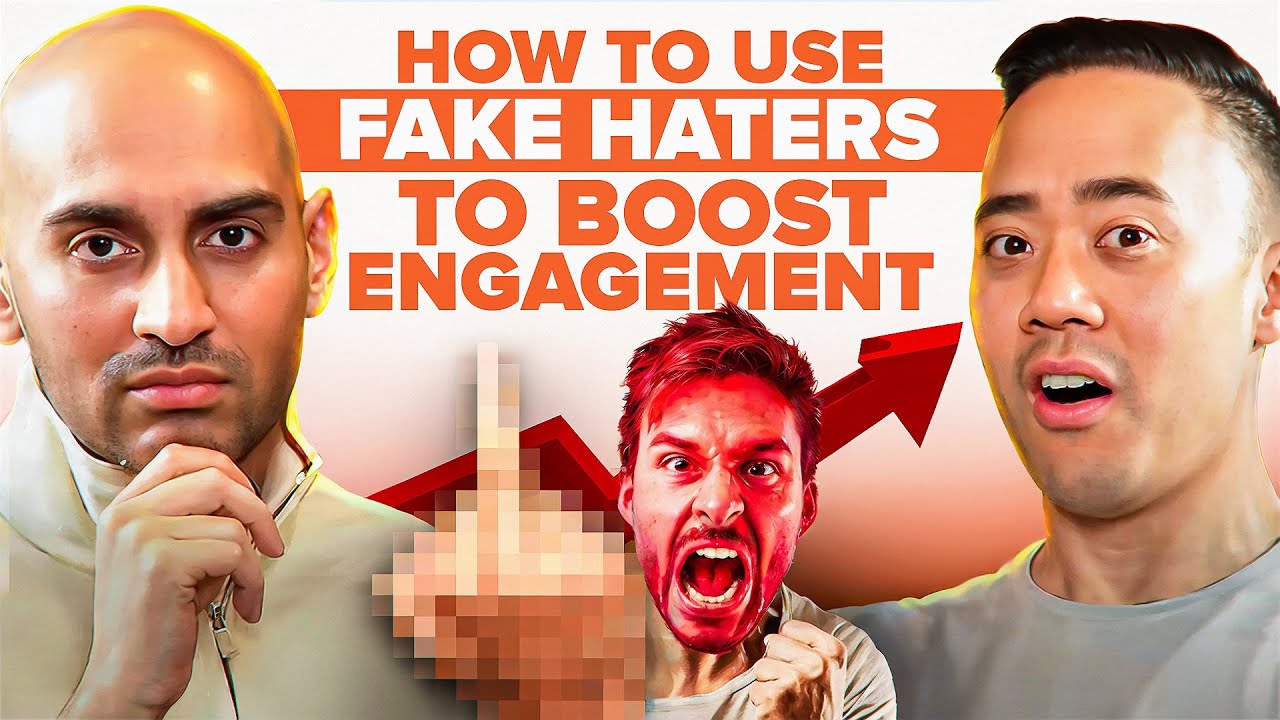
Eric Siu and Neil Patel discuss whether fake accounts boost engagement on Instagram, how Kourtney Kardashian's Lemme brand dominates Amazon, and why zero-click searches are reshaping SEO strategy.
Chapters
Do you want to know about how you can use fake haters to blow up your engagement?
Fake haters? Yeah.
Yeah. So here's the cool thing. So there's this, there's this tweet over here. It says viral Instagram content with a comment from a fake account. Brand owner owns the fake account. I'll kind of give you an example in a second. Fake comment is pinned so everyone will start hating the fake account. Controversy sparks more comments hating on the fake account equals more reach equals more sales, right? And so This one viral video over here, you can see there's one pinned comment, right? It says, you know, link in bio to get your memory frame. So it's basically to buy the product, right? But then the second pinned comment says, sorry, but your dog is kind of ugly though, right? That one got 40,000 likes on it and 28,000 replies, right? And then right below that, someone says, okay, here's the hate button for the fake account. And that one gets 76,000 likes on it, right?
Wow.
So the move is, Create a viral video, create a fake account, and then have the fake account say something hateful, and then everyone hates the hateful account because everyone likes to fight.
And did they talk about what happened with the sales? Because the first thing was buy the product, right?
They don't talk about the sales here. I would like to know about the sales, but if someone wants to look up on the internet, the product is called Snap Frame.
Snap Frame was a product that did this experiment.
Yeah, I think it's a pet product. As a pet parent, we started a small business and hope every pet owner's Can find comfort in their cherished memories. Yeah, maybe it's like a frame for like pictures or whatever.
What social network was this on?
It looks like Instagram.
That's crazy.
Yeah, so maybe the move is to buy a really ugly dog too.
No, that's a lot of work. Yeah, so whether it's ugly dog or a pretty dog, or it doesn't matter, a dog is a lot of work.
I just think it's really interesting how all this stuff is going because when you look at Kourtney Kardashian, She launched a brand. Do you know the brand?
No.
It's called Lemme, right?
So—
Vitamins? Yeah. Wow, how'd you guess?
I was once watching an episode of Keeping Up with the Kardashians.
Wow, of course you were. It's not called that. It's called The Kardashians now.
Why isn't it called Keep— it's not Keep— they changed the name?
They changed it to just The Kardashians because that's how— that's what they are now. But anyway, so she has— okay, like for example, Lemme Focus, Lemme Debloat, Let me sleep, let me chill. So they're all vitamins over here. So you can see there are these big vitamins over here, right? And then—
Oh, I got it. Like, let me sleep, let me—
And this one says, let me live, right? And that's her wearing it. So it's crushing it on Amazon right now, doing $2.5 million a month. And I think that's pretty impressive. It just goes to show that the Kardashians are for real.
76% of NVIDIA employees are millionaires and 37% are worth over $20 million. How crazy is that? I don't know.
I saw that and I was kind of like, whatever.
But it just shows that too many people are short-sighted. If you actually look at— if yes, Nvidia has ballooned up and grown to be a really large company, but a lot of people made money because they've been there for a very, very long time. And it just shows in business, in marketing, you know, if you do something really quick and you expect results in a year, you may get something, But most people can't look at things over a 10-year period, 20-year period, 30-year period. They're just not that patient. And that's really how to grow. Everyone's like, I got to hit this number for the next quarter or the next year. And yes, you can push it, but sometimes by pushing so hard, you can put strain on the team, take too much risk, make things go backwards quite a bit by adding too much risk. Sometimes it's just good to be patient. And a great example of this, we've both experienced this, you know, You've once done, taken on a little bit too much leverage, right? Buying companies. And you learned from the hard way that you would have been better off just being a little bit more patient and growing slower, right?
Mm-hmm.
And then on my end, I expanded into so many international countries so fast because I just wanted to grow my revenue. I was like, we're getting all these leads globally. Let's just add in, you know, 10, 15 countries in one year. And I think the number was 16 countries in one year. That was our goal. And I think we got close to it or hit it. I don't know if we got to 15 or 16, either way we're at roughly 19 or 20 countries that we're in in total. Dude, one, the teams overall globally, it's hard to manage everyone and teach them all the systems and process. 2, they all start selling different ways. 3, it's hard to do marketing in all these different languages all at once perfectly and take the learnings from the regions that have worked and implement them. You know, and what I learned was we wouldn't have grown as fast, but the regions we were— we would have been in if we only selected a handful would have done much better than if we tried to do, call it, 15 at once or 16 at once. Sometimes growing slower is actually better than just trying to grow too fast.
You know what's interesting? It's not funny. When you told me you wanted to expand quickly, I saw this coming, but I was like, but Neil's personality is not built to listen. Neil's personality is built to experiment. experience at first, which is fine, right? You know, we learn the lessons the other way. Like after you had kids, you change a little bit. After you did that, you change a little bit. After I took on maybe a little too much, you change a little bit. Some things you have to just kind of learn through experience. It doesn't matter how many things you read. Remember all the things that I've read and I just kind of took it at face value and I started implementing it and I just realized like that's not me at the end of the day, right? But the reason, going back to your original point here, why I say this is whatever, it's not that the news isn't interesting. It's because you and me probably We used to read all these headlines growing up. It's like, oh, you know, if you worked at Google, you would have been a millionaire. If you did this, you would have been a millionaire. It's because these media companies know how to blow this stuff up. And after a while, it's just like, okay, we've seen these headlines before and, you know, move along. And that's kind of not what the main thing is at the end of the day, right? The main thing for Nvidia, the main thing for your company, for my company, is to keep adding value to customers and then thereby building shareholder value.
Bingo. And if you look at the Nvidia stat of 76% of Nvidia employees are millionaires, that's nothing mind-blowing. What was actually mind-blowing was 37% are worth over $20 million.
Okay, that's impressive. That's actually huge.
That is huge. Yes, the company has ballooned up. But how many people have been there for a while to have all these shares that are worth over $20 million? Right? That's quite a bit of people who have been loyal to the organization that have stuck around. It just shows Good things happen with patience. You can't always rush things. And I think that's a big problem with marketers. We want results right away and algorithms just don't always work that way. And it's funny because you and I talk about like the YouTube sandbox and then people from YouTube will be like, there is no such thing as a sandbox. But how many accounts have we tested this on?
Too many.
Exactly. And other marketers that we start sharing data with, we're all like, oh, there's some sort of a sandbox. Google will tell you one thing about their algorithm, but the leaked documentation tells you a lot of other things that they told you were—
Google's documentation says basically there's a sandbox.
Yeah.
And so if you make an algorithm like that, why wouldn't you just carry that over into this property that you bought, YouTube? I would carry it over because it works well.
Yes, but what's funny is they're like, oh no, no, we're transparent, we're not hiding anything. Dude, they tell you whatever they want to tell you and they do whatever they want to do on the backend. It's business. And you know what? I don't fault them for it. It's their business. They can do whatever they want.
I got to take a minute to tell you about the Agency Owners Association. This is a peer group for agency owners. Think YPO or EO, but for agency owners. And I just wanted to read you a couple of testimonials. So this first one comes from Carrie, and we asked her, what do you like most about the group? She said, having a group of people to discuss and bounce ideas. The leads are great too. Yes, we share leads in this group as well. This one from Ollie, and he says, the ability to really post Whatever I want and need, and the group responds. Great experienced members. Getting a lot of insights from conversations with other members. Getting a lot of value from sessions from Eric. Getting advice from others as well. And so if you want to grow your agency faster and you want a peer group to do so, just go to marketing school dot io slash agency. This is a group that both Neil and I created, and our hope here is to create a vibrant community of agency owners and do a lot more with it in the future. So again, marketing school dot io slash agency, and we'll see. See you inside.
Rand Fishkin posted something about the number of click-through rates have been declining.
Zero clicks.
Yeah, zero clicks. And I think he was saying the US was somewhere in the 30th percentile. EU was in the 30th percentile as well. There's a SparkToro article on it. I just pulled up this next one.
I have it. I have it pulled up right here. Oh, cool.
Pull it up.
So, okay, it says new research. So SparkToro. Okay, so basically here's what the high level is. So it says zero-click searches in 2024, EU and US compared. Searches per searcher over time. If you're watching on YouTube, we're pulling this up right now. So the graphic that Neil's talking about here is it says in 2024, here's what happens after American search. So 41.5% leads to a click, right? And then of those people that click, only 1% go to paid ads and then 70% go to unpaid organic results. And then 30%, 28.5% go to Google properties like YouTube or Google Maps.
Wait, it's 41.5% click for what timeframe or what region?
So this is just any click in general.
Oh, okay.
Yeah. So 41.5% leads to a click, right? And then it breaks down what happens inside of that click. So—
But the click could be a video on their own platform.
Yeah. So 28.5% of clicks go to those videos, right? Or Google Maps or something else, or like a local pack. 1% go to paid ads, which is like nothing. And then 70.5% go to unpaid organic results. Now, so 41.5% lead to a click, 37.1% do nothing, like nothing happens, right? And then 21.4% goes to another search. So 58.5% of clicks Are zero-click searches.
Yeah. And what's funny, the reason I bring this up, this is great that Rand did this and SEMrush did this.
Was it SEMrush?
The data came from one of SEMrush's companies.
Datto's. Yeah, yeah, yeah.
Yeah. So, but when you look at that, it doesn't matter. It's Google's own company. They can make clicks go down to 20%. If marketers want to complain, don't use the platform. Put a noindex on your website. Oh wait, they're not going to because Google drives a lot of traffic. Like, I look at this data piece, it's great, but like you can't really do anything with the data. It's just a reality. And it's just like Facebook, Meta, they have their own platforms. TikTok has their own platforms. People will do what's in their best benefit. You can't control anything. Your best bet is to take an omnichannel approach and not rely on one platform.
I wonder why Rand is getting more into SEO again. Like he published this study, it doesn't really help SparkToro.
Does not.
And then I think he did another study or he—
The Google Doc, the reveal.
Yeah.
He blogged about it.
Yeah, and so I wonder what his incentives are. Maybe this is fun to him, I don't know. What do you think?
I have no idea, but it doesn't look like SparkToro is going after the SEO space.
Yeah.
I'm assuming he had a non-compete when he sold the company. Typically you do for X amount of years.
It's been a while though.
It's been a while, the non-compete's probably slowly, you know, getting over. But what is he trying to do? I have no idea. I think SparkToe being a— it's not an SEO software. If he goes back into that space, I think it'll be difficult, not because he can't, you know, I do believe he can build a good product. More so, I think it'll be difficult because of the time. When Moz was out there, one of the first players in this space, had a huge community.
SEO was the wild, wild west back then.
Yes, you look now, it's a very saturated space. Times are very different.
Yeah.
Doesn't mean he can't get traction and make money. It's hard to build another SEMrush or Ahrefs.
I want to take a second to tell you about my podcast co-host's agency. So NP Digital, so Neil Patel Digital. What they do is they do a whole host of marketing services and they are global. They're worldwide. They have SMB services as well. They have mid-market to enterprise services as well. They cover the entire gamut. So you could just go to npdigital.com. To learn more about it. And now back to the episode. Let's keep talking about SEO more. I got this post from Tim Soulo over here. So it's The Rise and Fall of Donut Hole. Okay. So also, a.k.a., what happens when you scale your content with AI? So this graph over here, okay, shows at the very bottom this donut website over here. So they add 25K pages in 2 months.
Well, let's clarify. You're talking— is Donut Hole a website or is like a concept?
It's just— he's just calling it Donut Hole. I don't know if that's the actual website, but just know it's a donut site. It's a site that publishes content around donuts.
Okay.
Yeah. So you can see this graph over here. This is the, in the orange, the amount of pages they have. It's like nothing before. And all of a sudden it ramps like crazy. They add like 25K+ pages, right? And then their traffic ramps up to 1 million visitors per month. And then all of a sudden it just drops like everything. Now it's basically nothing. Their pages are all gone. Their traffic is gone. And so—
So the bottom orange line is traffic or pages, or is the top line pages?
Sorry, the orange is organic pages. Sorry, the organic traffic is orange. Okay. Orange. So it drops to nothing. And then the yellow line is the number of organic pages.
That are indexed.
Yeah, yeah, yeah.
Got it.
Yeah. So that, I mean, it just goes to show you that we talked about, we've been talking about this, like the programmatic SEO stuff works, but don't abuse it. It, like, I think people go overboard with it because just they see it working in some areas and then they just go too hard on it and then their site gets torched.
Yeah, dude, you've done programmatic SEO. A lot of people have. I've played around with it a lot. The, the big problem is, is there's some people who just go crazy in programmatic SEO where that's their main strategy.
Yeah.
And you have tons of junk content. And I bet you will see this with Perplexity. Eventually they will get whacked by Google. That is my take on it. I know you have a similar take, um, with all their programmatic pages that are just being released and indexed because their traffic's been spiking. It's the abuse that's the issue. You want to create a handful of pages? No problem. You want to create 1,000 pages? Eh, you're going to have some good ones, but you're going to have majority being junk. And the junk hurts your good pages and your overall site when it comes to rankings and traffic.
What do you think about this prediction from this guy, Ethan Smith? So he has an agency. So he put this LinkedIn post out there. It's basically saying AI answer optimization is the new SEO. So we talked about a couple weeks ago, community is the new SEO, whatever's the new SEO. Now it's like, AI answer optimization, which is basically generative engine optimization. So he says this, I'm going to kind of read out the key points here. So key points, AI search is increasingly used for search and discovery. And then, you know, there are agencies building strategies for this. Okay. And then optimization for AI search will likely be similar and an evolution of traditional SEO versus something entirely different. So that, I mean, this to me isn't really saying much actually, but I think what it does reinforce, because I went to Gemini, I went to ChatGPT again, And I searched for what's the best marketing podcast. So on ChatGPT, we're number 2, right? And then for Gemini, I think we're number 4, number 5 or so. But the results have been changing so much since 2022, I think. Before, we're like number 1 for all these, right? And now it's changing, it's pulling from different sources. So these LLMs are going to continue to change. More people are going to continue to use them. But what we've been saying in the past, ever since the very beginning, is citations matter. The number of reviews, the number of times we appear.
Yeah.
All these things, like it's pretty easy to see who's actually being talked about a lot on the internet versus who isn't. So just like traditional SEO, yes, yeah, your links matter, your— how often you're cited, how consistent are your citations, those things all matter.
Dude, roughly a month ago, we surveyed, you know, our community on what channels they use to search for their questions, right? Specifically questions, not just like Hey, I want to buy red shoes, but specifically questions. And it used to be 98% of them, because we surveyed our audience in 2000, 98% of them were using Google or search engines like that, 1% social media, and then 1% other. And when we surveyed them in 2024, we found that 61% use search engines, 17% use social media, 30% use AI chatbots, 2% other. I know that adds up to more than 100%, but people are using—
What was the percentage for AI chatbot?
AI chatbots was 30%. Well, that's pretty high. But people are using multiple platforms for both. You can use Google and you can use AI chatbots, right?
Yeah.
And we've talked about this in which you can optimize, you shouldn't just be optimizing for Google, you should be optimizing for multiple platforms. AI, whether it's Perplexity, whether it's, you know, Google's version of it, if they want to change the name again, or if you want to end up using ChatGPT or any other solution that comes out there, Dude, they're getting so much traffic. Why wouldn't you want to have them mention your company name, your products, your services? And it's just an easy way to generate more business. And we've seen leads come in through ChatGPT.
Mm-hmm.
We've seen leads come in through some of the AI, other AI platforms. We haven't closed any clients that we know from any of the other AI platforms other than ChatGPT, but GPT has the most traffic out of all of them. But yeah, why wouldn't you want to optimize for them? And a quick stat is there's roughly 8.5 billion Google searches a day. 680 million of them are questions.
Oh, questions.
That's a lot of searches on a daily basis.
And 10% of them are brand new.
15%, roughly 1.2 billion are brand new searches. Oh, that's gone up. It's been 15% for a while. Really? I thought it was 10% before. Uh-uh, 15%.
All right.
I believe 8% is the number for, 8% of the searches each day are questions.
Yeah.
15% are brand new searches.
So that is it for today. Please don't forget to rate, review, and subscribe, and we'll catch you later.









