Junior Roles Are Dying, AI Is Quietly Replacing Workers
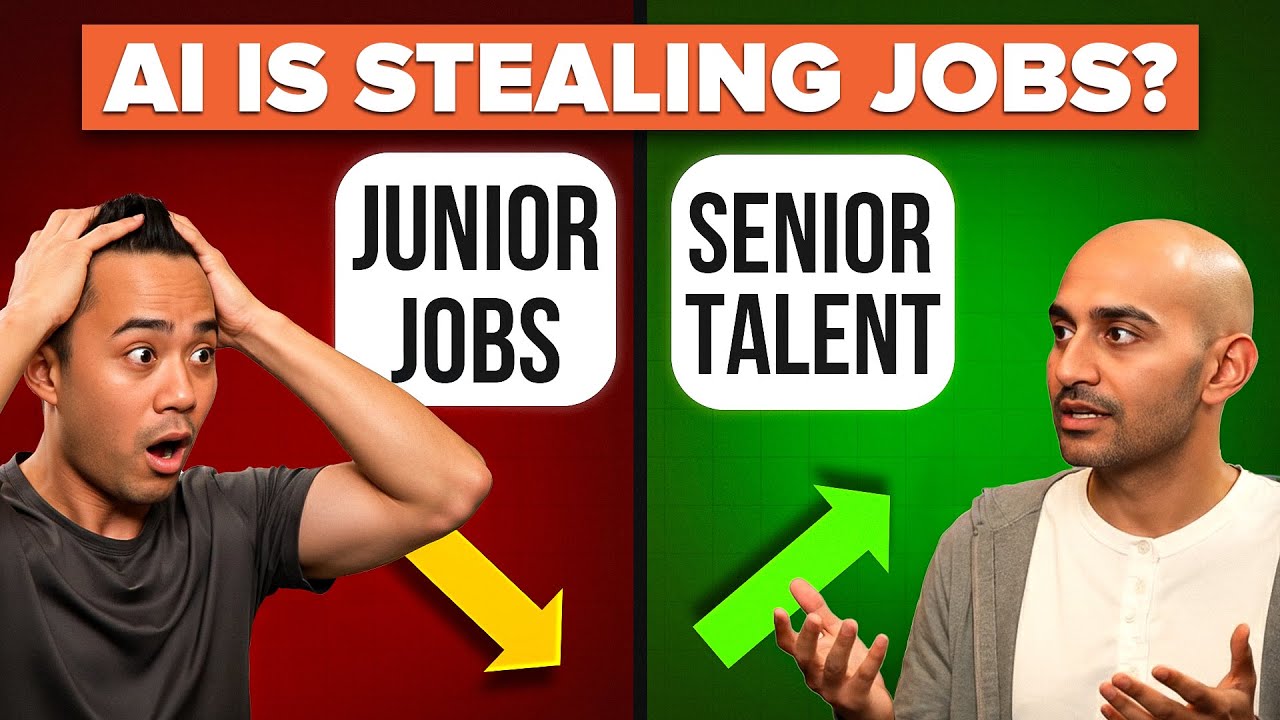
In this extensive dialogue, Eric Siu and Neil Patel examine how AI adoption is reshaping the labor market, especially the sharp decline in junior/entry‑level hiring across 62 million workers and 285 k firms. They unpack a U‑shaped college‑tier graph showing that elite schools (Harvard‑type) see a smaller drop in junior hires than lower‑tier schools, and they note sector‑specific trends (healthcare seniors up, manufacturing juniors down). The hosts argue that hiring now demands AI fluency; candidates must demonstrate real‑world AI workflow experience, not just certifications. They segue into broader AI implications: hallucinations in LLM‑generated research, the need for context‑engineered sub‑agents, and the limited context windows of current models. The conversation shifts to SEO, revealing that LLMs source facts mainly from Reddit (40 %), Wikipedia (26 %), YouTube (23.5 %) and Google (23.5 %), prompting a call for new content strategies beyond keyword‑centric SEO. They discuss personalized, gamified education (Alpha School), modern marketing tactics (Gymshark sponsorships, low‑CPM TikTok‑style ads), and the challenges of outbound outreach and RFP‑driven enterprise sales. Burnout is explored through anecdotes (Boom, Vision Hosting, their own agencies), concluding that motivation, milestone‑driven work, and realistic goal‑setting are essential. The dialogue ends with a brief foray into political discourse, illustrating how data‑driven arguments often clash with ideological beliefs.
Chapters
Okay, so get this. There's an AI study on 62 million workers, over 285,000 companies or firms, and it shows that relative junior hiring has dropped by 12% at AI adopters. So I'm pulling up a graph for you all to see right now.
What do you mean junior hiring?
Okay, so junior hiring. Look, if you look at this graph over here, seniors mean like someone that's a senior level hire.
Oh, you're talking about like entry level?
Yeah, yeah. Entry level hires like interns and things like that, or people coming out of college, right? So you can see here juniors over time, you can see the different quarters like 2023, 2022, and all that. After AI comes out around 2022, it starts to decrease over time. And then in the blue here, seniors are still continuing to go up. And so this is— there's been a couple of these studies already. We talked about the 70,000 Filipino study and how the recruiters, 72% of people or so, they prefer the AI. And so this just shows that the gap is getting larger and larger. And I just saw something the other day where on, I think it was CNBC, your favorite channel, where they were talking about how it's actually going up the stack now. Yeah. juniors anymore, but it's going up to seniors. And what I also think is interesting here is check this out. So there's this U-shaped graph over here. This is tier 1. Number 1 here is like a Harvard, for example, a tier 1 college. Okay. And then you have tier 2 college, tier 3, tier 4, tier 5. So 5 is like tier 5 is like the lowest college. Okay. So you can see for a Harvard type of deal, the decrease in juniors is less than the other ones, tier 2, 3, 4, it is significantly less versus, you know, tier 1 and tier 5. So that's interesting to me, 'cause if you're a tier 5 college, for some reason you have the least decreases, and then Harvard would be the second, or like a tier 1, like a Harvard would be like number 2. So we're seeing a massive decrease.
Tier 1 colleges are seeing some decreases, but tier 5 is seeing the least amount.
Correct, yeah. And so my—
And what, for what type of positions? All positions or just the junior positions or just—
Just juniors.
Okay, just juniors.
And then one more thing before we kind of react to this, one too, is it's not just IT related too. So if you look at seniors versus juniors, juniors are in the red over here, seniors are in the blue. You can see for health, seniors are still continuing to— wait, percentage change in number of hires. Okay, so in healthcare and social, it's gone up the most. And then you can see the percentage change for juniors over here, -20%, -40%. So seniors are getting hired more, right, for health. And then when you look at these other roles over here, it's almost all decreases for juniors.
So the right side, of the chart is going up. So that means they're actually seeing increases. Correct. The left side is seeing decreases.
Yeah. Manufacturing seniors, they're not hiring as many. It's almost a zero.
Yeah.
Yeah. And then manufacturing, oh my God, it's like -20.
Oh yeah, you're right. Because the seniors for healthcare is actually increasing, but the juniors are actually decreasing.
Yeah. 25% up for healthcare. But then you go all the way to manufacturing on the left, it's basically zero. So they're holding steady at these other ones or they're increasing a little bit for seniors, but for juniors it's less. And so what this tells me, because we've talked about this, you're doing this and I'm doing this and we have friends doing this, the only juniors that we're hiring are extremely big on AI. They have to give examples, they have to talk about workflows. And I remember I was interviewing someone recently, I was like, so rate your AI fluency on a scale of 1 to 10. She's like, 10. I was like, uh-oh. Like you never want to rate yourself a 10 first and foremost.
No.
But then I was like, okay, so 10, like, so you built like agentic workflows, you built like agents and things like that? Oh, she's like, oh yeah, I've done all of that. I was like, okay, so can you give me an example of like a tool or workflow that you built? And she's like, Oh yeah, I'm sorry, I just got certification. Let's say, oh, so you basically lied to me.
And then they rate themselves as a 10.
Yeah.
That's like a 1.
How could you rate yourself as a 10? You're just doing certifications, right? So, you know, in my mind, I'm like, look, it's— this is how if you're a leader in your company, you have to— if you're going to hire juniors, you have to hire people who are AI native, who are really big on it, who are obsessed about AI, because this gap is going to get bigger. And this is already starting to bleed over into more mid-senior level roles, and it's going to bleed over into senior. And I'm not— Particularly, I don't think this gives you and I joy by any means, but it's happening. Look, you look at this graph over here, seniors is going up, but look, it's starting to flatten over here, whereas juniors is starting to trend downwards, total starting to trend downwards. This is going to happen for a lot of roles, even for your role and my role. If we're not on top of it, yeah, we're gonna be in trouble too.
Dude, I totally agree. But this chart, I'm assuming the total is accounting for mid-level too, because juniors are entry-level, seniors like executive.
I think I I think if you're— I think it's just looking at this graph, it's only seniors and juniors. I don't think it's accounting for the middle.
Got it.
Yeah. What do you think?
Yeah, I think AI is going to have an impact on a lot of jobs. It already is. It already is. Google, there was an article that ended up coming out that Google has decreased mid-level managers, but it was by 30%. Google mid-level managers. I see so much stuff. Yeah, 35%.
Yeah.
So Google has eliminated 35% of managers overseeing small teams in the past year, and no one has proof of it, but they're saying, is AI the reason? Is, you know, is this is why Google doesn't need as many people?
Yeah.
And I don't know for certain, it could just be a restructuring. It doesn't look like Google went out there and made a statement being like, yeah, we're eliminating a ton of people using AI, because that sounds bad itself. And I don't see corporations volunteering that information. Yeah. True or not, yeah. And that 35% could have been for other reasons as well. But you're you're going to see it, and you're also going to see the flip side in which people aren't certain yet what AI is better than humans for or what it's worse. A great example of this is Taco Bell and their Wall Street Journal article. Their drive-thru, yeah. They're thinking about getting rid of AI, so they did a small test in which for the drive-thru assistance they had some. Humans going out there and saying like, or AI saying like, hey, what would you like to order? And in some cases it worked really well. Some cases it worked so bad. I think one person asked for like 1,800 cups of water, something ridiculous like that, so he can get in touch with a human.
Yeah.
But yeah, different organizations are testing different things and Taco Bell's just like, oh, for our drive-thrus that are busy and have long lines, we're thinking of keeping humans. For the ones that are shorter, don't have as much lines, we're thinking of using AI. But in essence, what they're saying is for busy lines, it's not necessarily just about efficiencies. It's— how I'm reading this is when you have a lot of lines and you need people constantly, that of course costs money, but it shows that the human's probably messing up less.
Yeah.
So it just moves the line through. But if you have a drive-through with very few cars coming through, use AI instead, you're saving some money because you don't need a full-time human. And even if they mess up a little bit here or there, the cost of fixing it is probably cheaper than hiring a human.
Yeah. So I think it's what's going to happen is even if we use the Taco Bell example, maybe AI will do 70 to 80% of the work, but you still have a human look for 20 to 30%. And that's still a lot of efficiencies ultimately. And I do think we're going to move into a world— this is a little more philosophical, but Most people will have universal basic income to supplement. And I think I also believe in what Elon said about universal wealth. I think universal wealth will happen probably 10, 15, 20 years out. There's going to be a period of adjustment. But I think if you want to get ahead of this and maybe you don't want to rely on universal basic income, what you do is you arm yourself with the knowledge here, you stay curious, and then you are constantly building on yourself. You're building skills to make yourself more marketable, and then you won't have to worry about this. This is why I think tier 5 schools, Maybe those people are, they might be a little cheaper. But also you have, I think a lot of people that go to tier 5 schools, like sometimes they are more, for example, you went to a Cal State, right? A Cal State is like a, it's a decent school, but it's not a tier 1 school by any means, right?
Decent school?
It's an okay school. It's an okay school.
It's probably towards the bottom end.
Okay. So what do you think? What tier do you think that's in?
Definitely tier 5. That's the last tier, right? There's no tier 6?
No, there's only tier— let's just say in this scenario, there's only tier 5.
Okay.
So, and I went, I barely got into UC San Diego, right? Transferred from UC Riverside.
I would consider that a tier 3 school.
Tier 3? Well, I think I was at a tier 4, tier 5 at UC Riverside.
Okay.
So I'm saying we're like the same person.
You know, you're UC San Diego.
I finished at UC San Diego, but I started at UC Riverside. Yeah. So, okay. Let's assume I'm tier 3, tier 4, but you and I both worked our butts off. And I think people that go to tier 5s, a lot of them will, not a lot of them, but there's a, there's There are a select few that will work their butts off. A lot of the people that didn't do well in school end up doing really well as a business person or a leader.
So a lot of my friends that are wealthy ended up going to Ivy League or Stanford. You can say it's not Ivy League, but close enough. Stanford's up there.
Yeah. Stanford's tier 1. Yeah.
Yeah. And I've hired a lot of people and my buddies have hired a lot of people. And there's one thing I would say most of us feel really consistent about. When we tend to— we've all hired from these tier 1 schools all the way down to tier 5. It's not this case always, but a high percentage time. And when I say high percent, well into the double digits, what ends up happening when we hire people from tier 1 schools is they feel not necessarily privileged or act privileged. It's more so they felt that they spent so much energy and they put in so much effort to get into one of these tier 1 schools that they deserve a lot. Right. So maybe some sense of entitlement, not with all people, but quite a few of the people we've interviewed. And that's a lot of the reasons why we feel candidates from tier 1 schools don't always work out. But on the flip side, when we interview people from tier 5, tier 4, tier 3, they're more hungry. Like my CEO, I believe he's from Arizona State University. I don't know what tier that would be, but I'm going to guess 5.
I think tier 5. Yeah.
And the guy just works his tail off. He's in Cuba right now on a family vacation. All right.
He's Cuban?
Uh, no, his wife is. Okay. And they're going, seeing their parents can't always get out of the country, so they go see them. Yeah. And it's a holiday. I know he has a client call today, a potential client call and a pitch, and he'll figure out internet and everything. And everything today, it's Labor Day. Yeah, he doesn't care.
Wow.
Right? Because that was when their assistant gave time. And this is a multi-billion-dollar company, not like 1 or 2 or 5, like well, well, well into the billions.
Yeah.
Doesn't care.
Yeah.
He'll do whatever for work and business and grind it out. And I don't know the last time he didn't work on a Saturday or a Sunday.
Yeah.
I know he's been better now and he doesn't work Christmas or Thanksgiving, But when I say he doesn't work Christmas or Thanksgiving, he probably spends at least 30 minutes to an hour checking emails, making sure there's no fires or anything, even on a holiday.
That's fascinating. But you remember, so again, like you and I have met a lot of people, tier 5, they maybe they aren't necessarily the best book smart-wise, but they're very street smart, very, very practical. When you look at tier 1, you look at what Jensen said. So I was rewatching a video today this morning, and one guy was asked, so, you know, what would you say to the Stanford students over here? This guy's like, sitting, right? He's kind of like a little overweight too, but he's like, yeah, so what do you think about like, you know, the Stanford, like what lessons would you give to our students here? And then Jensen's over here, he's like, he pauses, he's like, you know, if I were to say any one thing, Stanford's an amazing school. You guys really work really hard, you know, best of the best students, you know, top school and one of the top schools on the planet. But, you know, what I've learned is that people that go to schools like this, right, have very high expectations and people that have very high expectations have very low resilience.
And there's a certain entitlement that he's basically saying that, right?
Yeah. Yeah. And he's saying like—
So similar.
Yeah. Similar thing to what you're saying. And I do see that. I will say though, there are a couple of Harvard people that I worked with. We have someone on our team from Harvard and they're amazing, right? They work really hard. There's a massive chip on their shoulder. And I appreciate that. But I've also worked with people at Harvard where my first job that I got coming out of college was data entry. So I was making $30,000 a year. I was only like 22 years old or so. And I saw a guy, that was doing the same exact work I was doing, data entry, 30 years old, went to Harvard and had no energy. No, no. I think he thought life was done after he went to Harvard. And I'm just like, yeah, it has nothing to do with the school that you go to. It really has. It really just comes down to how hard you continue to push and how hard you're willing to push.
Yeah. And Stanford and Harvard produce great people, especially the ones who are willing to grind it out. And I've seen a lot of amazing entrepreneurs come from there. There's There has to be tons of amazing workers. I hear more about the entrepreneurs, of course, because a lot of them have made billions of dollars and you know a lot of them as well. And we're not talking about personally, but you know, you just go on the Forbes list. A lot of those people went to Stanford and Harvard, at least in tech. But when you look at employees, I find that you get people who are just willing to grind it out after they graduated from like the Arizona State University is like, all right, I got to get my crap together. I got to get my life and just push hard. And a lot of the people that I've interviewed from, let's say, Stanford are just like, I did so well and I got into this school. Yeah, you know, my life should be easier, but that's not reality. Yeah, they just believe in that.
It's because we've been brainwashed as kids. I don't know about you, but for me, I was always like, oh, go to Stanford, go to UCLA at the very least. So it was very much a brand thing growing up Chinese, right? Asian. And so, but you realize none of that matters at the end of the day. What matters is how much you contribute to the world. And if you want to contribute more, that means you have to continue to grow.
So So I look at Thiel. Thiel went to Stanford. I don't know where he got his law degree from, but let's just assume Stanford. I believe he has 2 kids, right?
Actually, I don't know.
It's something like that. And he has a program and a lot of good companies, like I believe Figma was one of them, came out of his—
Thiel Fellows.
Yeah, exactly. Where he'll pay you money not to go to college. And I'm a big believer that in today's world, you don't need a tier 1 college and you don't even need a tier 2, 3, 4, or 5 college. It's all pretty much useless for most professions. Not all. Some, like maybe a doctor is still required. Architect.
Yeah.
Yeah.
Yeah.
Uh, architect, do you even need to go to college for that?
I don't know. I think there's a, there's a good amount to study. You can ChatGPT it.
No, it's like shaking his head.
Yes, I believe that. Architect, doctor, um, like a, I don't know, like an engineer type deal.
Yeah. So, but here's what—
Engineer? No.
Not a computer engineer.
I'm talking about like structural engineer.
Oh God.
Yeah. But do you know what's interesting? You take a look at this. I don't want to digress too much, but take a look at Alpha School for your kids. There's a guy, I think his name's Joe Lamont. He founded Trilogy Software, very successful back in the day, right?
Yeah, I know.
Very successful guy, right?
So he created Alpha School?
So I think it was his friend that created it. He's now the principal of it. So the way they make it work is he gamifies it, I think, for the kids and he makes learning very fun, right? And he believes that because generative AI came out a couple of years ago, now he's all in on Alpha School and he wants to change education. And so check out Alpha School because I think future of education is it's all going to be personalized for children and it's all going to be gamified. It's all going to be fun. And you and I, I think we would've figured out by age 5 or 6 that we were probably entrepreneurs already. Because I think by age 9, I was already building websites and things like that. I just got detracted by, distracted by games. You were probably in the, like, you started your first business at what, 12 years old? You're selling CDs at what?
15-ish.
But when'd you start selling CDs?
I don't know, like 13, 14.
Exactly. So it was there the whole time, right? But what if you got to, I think you and I, even at age 6, we could have started.
Yeah.
Yeah.
Oh, cool.
Yeah.
I didn't know Joe was a principal of Alpha School. They don't have one in Los Angeles, but yeah.
You know Joe?
Yeah.
Okay, great. There you go.
I worked with him.
There you go.
At Trilogy.
Okay, there you go.
So I know quite a few of his team. Andy ended up leaving Tribe and then he ended up creating his own fund. But yeah, Joe is a billionaire from Apple and Amazon stock.
Yeah, he bet hard. He pressed hard. That's another thing.
It's a—
so they talk about slugging percentage, right? How hard are you willing to bet when the timing is right? And he pressed his chips. And we talked about this last time too. You have to be willing to press your chips.
Yeah. No, I didn't know he was in charge of Alpha School, but I was talking to Lloyd and he's in Austin. He was telling me about Alpha School. We sent him to a really great school here called Merman.
Yeah.
And it's an amazing place for education and they just teach your kids as far as they'll go. So if they're like 5, but they do college-level math, they'll give them college-level math and encourage everything.
So here's the thing. Joe Lamont has been a billionaire for a very long time, very low profile. He hasn't done a podcast for a— I don't think he's ever— that was the first podcast he did on Invest Like the Best. So I'm listening to that, right?
He spoke. He has public speaking gigs.
Yeah.
And his daughter goes to Stanford, if I'm not mistaken.
I think he sent his kids to Alpha School too. So originally someone that founded it, I think her name's Mackenzie or something. He was like, oh, I'm not going to send my kids to this. Eventually it got better. And then I think he's like, okay, I'm going to send my kids to this. So I think it was Alpha School plus you send them to Stanford. But—
He's really book smart.
Yeah.
And then his dad was number 2 at GE under— was it Jack Welch?
Jack Welch.
Yeah, his dad was number 2.
That's cool. So good upbringing.
Well-connected family.
But I think the future of this is personalized, gamified education. Personalized to personalize it to your likings and then gamified to keep you engaged. Yeah, that's what's going to happen. And you're probably seeing it with your kids as well. All right. So I wanted to take a moment to tell you about my podcast co-host Neil's agency called NP Digital, and they work with a whole host of global companies or global organizations. Also, Neil has SEO tools such as Ubersuggest and AnswerThePublic. All you have to do is go to npdigital.com to learn more, and we'll see you on the other side.
Let's go with creating the content for generative engines, like how to go and create content generative engines. The biggest nuance.
Is that yours? Yeah, that's yours.
Uh-huh. So right now people are like still focused on keywords. I already know, you know, you and I agree that it's all topic-based. I want to give an example of how people should think about content in today's world. You probably have lots of examples as well, but let's go through a journey of like buying a car. You have a nice, beautiful car. At least your color of your car is amazing. I don't know what kind of car it is, but I think it's a Porsche. Electric Porsche?
Porsche Taycan.
Okay. So when you go about buying a car, you're going to look at specs, right? You're going to look at potentially resale value, how much it costs new, used, how much it loses value, safety ratings. You may ask some friends about it. Did you ask friends about your car?
No.
Okay. Did you do or watch YouTube videos about the car?
Yeah.
Yeah. So you're looking at a lot of different elements. You looked at safety ratings, mileage, range, stuff like that.
I look at range. I don't look at safety rating. I probably should have. But yeah, I've researched a handful of sites. Yeah.
Yeah. And then you probably compared other cars in similar price points.
Yeah, I did. I did. I looked at multiple. Yeah. Yeah. Right.
So you're not just typing in, you know, electric sports car and just going and clicking on a website and reading an article and buying. You're looking at a lot of different factors, like, you know, to recap, specifications, what other people are saying, whether it's a friend or YouTube videos. You're looking at competitors. What's the pricing of competitors? Are their range faster or lower? Are seats more comfortable? You're going really into it. Color options, right? Is it 4-door, 2-door? All these types of things. So when you look at those kinds of things, that's your whole cycle of trying to figure out if you should buy that car.
Mm-hmm.
The problem though, when people create content in today's world for blogging, They just look at like, is a Porsche Taycan the right car for you? And they just try to shove everything into one article, breaking down specs, reviews, and saying like, here you go. People don't buy cars that way. And in the generative engine world, people want you to cover the topic so thoroughly, and that's really hard to do in one article reviewing a car. You would need images, videos, and the list goes on and on.
Mm-hmm.
And together that allows you to figure out, should you buy that car? And the problem that I think that people are still having when it comes to creating content is they focus on one simple thing. That one simple thing is, well, what are some keywords? And let me go super thorough on those keywords versus covering everything around that topic.
You know, I'll go on a little tangent and I'll come back to this because I have a graph that's related to this, but What's bothering me right now is when I talk to my team, when we talk about YouTube is a major factor with LLMs, right? Or Reddit is, they look at YouTube with an SEO lens. Oh yeah, with YouTube you have to do keyword research. With YouTube you have to get the tagging right. I'm like, dude, none of that matters like as much as the packaging that you have, the idea that you have, the 30-second retention, your thumbnails, your titles, all those things, right? So every game, whether it's Reddit or YouTube, whatever these LLMs are sourcing from, they have a native way to play. And I think the problem is, if you're an SEO, SEOs like to look at things, oh yeah, you're going to do keyword research, you're going to do these things. It's like, dude, you can't look at this the same way as you used to. Even if you're trying to play traditional, even that's evolving quite a bit now. And I think all these SEO companies, even the stuff you have going on with Answer the Public and Ubersuggest, it's shifting so quickly that you have to adjust your product. And so when you look at this, coming back to what you're talking about, so you've seen this graph already, but where AI gets its facts, I have this on camera right now. But Reddit is 40%, Wikipedia is 26%, YouTube is 23.5%, Google is 23.5%. So yes, this is why you and I are getting a lot more inquiries for Reddit and YouTube because it's top 3 here. But Google is still a major player. So you should, yes, still do traditional SEO, but YouTube and Reddit and even Wikipedia up here, you can't just try to play it the standard SEO way. Oh, we're going to optimize for keywords because when you search for a query, when you search for something on ChatGPT, It usually pulls up 30 to 60 different sources. It's looking at all these things at once. If you go deep research, it's pulling a lot more sources than that.
Dude, I agree. And this is why it's more important than ever to participate in all these community sites. I think businesses have the issue and they're like, oh, we'll control our own narrative. We'll just go and create content on our own website. Oh sure, we'll pay someone to help us with the Wikipedia page, but they're forgetting about what users are creating on Reddit, on YouTube, and all the other sites. That's really easy for people to publish content. Wikipedia is a little bit harder, but those other sites are really easy and they're starting to pull from everywhere and it can screw you over.
Yeah, dude, here's the thing though. So like when people are coming to us for Reddit, when they're coming for, for YouTube, they're all— they're looking for all different things, which shows to me that people don't know what to look for yet. Right. So, okay, if, if I'm coming to you for YouTube services, That means I can't just go to an agency and say, oh, you're going to make videos for us. It doesn't work like that.
Yeah.
Right. We actually need you as the client. Let's say you're the client. I'm the person coming to you for YouTube services or like I'm going to do YouTube services for you. Maybe I can help with strategy. Maybe I can come up with ideation. Maybe I can help with the thumbnails. Maybe I can help with the editing as well, right? There's not much more I can do. You still need to publish at the end of the day. You want me to do it for you? I can't do it for you. Okay, that's number one. Number 2, you take a look at Reddit. Oh yeah, we'd like you to just you know, make thousands of accounts and post for us. So you want us to spam Reddit? Like, no, you can't do that either. You need to have really good community managers. And the best we can do to make sure that we don't get you into hot water is we probably need to make a page for you and just hire multiple community managers to manage that for you. Okay. Okay. Some reputation management, all these different things. People just don't know what they're looking for. And 2, guys, don't try to game these platforms. Try to play the native game. That's what I'm getting at.
Dude, I'm with you. And when I look at what's happening with Corporations, when they're looking at these sites and these profiles, they're looking for shortcuts and they don't want to spend the time really investing in the community. And it doesn't work without that. I just haven't seen anyone do it successfully. But even if Reddit's— these AI platforms are pulling data from Reddit and YouTube, it's just like people can create their own narratives. But interesting enough, my team and I were working on a chart that I'll publish in, I think, today or tomorrow or the next day.
Okay.
And this chart didn't have really tons of proprietary data. It was more so on Google's growth over time. Okay. And the rise of zero clicks, which a lot of people have published data from. So we're gathering from different sources. So I was using ChatGPT to do research and I was getting it to really think and it was going through, it was taking a while to come up with it. I don't know how many minutes, but a while.
Mm-hmm.
And it was, crawling the web, looking at images, deciphering it, because you can see when it's analyzing, it actually tells you what it's doing, like verifying out of the images what percentage is actually no-click. And it starts giving you a table of the results. Some of the stuff that it pulls from these external sites or social networks is just really off. Like, I know, like it'll say like analyzing SparkToro's graph or image or whatever. And then I'm like, I can see it myself. And you pulled the wrong data from that graph.
Yeah, it still hallucinates quite a bit.
It hallucinates so much. I found that when I'm creating blog content, which is a similar type of topic, but I love using AI for research, but it hallucinates a lot when it's super technical. If it's not technical and it's basic, it doesn't hallucinate too much. But when I get super technical, it's just like, In many cases, it creates more work than actually helps.
Yeah, for me. I've noticed that too. So, but that goes back to user. I mean, I want to call this user error, but it's user knowledge. You have to understand how to use these tools and understand when it's wrong and when it's right. And if you're not playing around with it enough, then you're not going to know. And then what's going to happen is you're going to get in trouble for publishing misinformation.
But it's not just that. Yes, it's knowing how to use these platforms to its best ability. But you and I know this because we've been in the marketing industry for like, call it 20-ish years, right? I'm rounding here. But if you're new to marketing and you want to write like an expert and you do the research and you start pulling it, a lot of it you just won't know.
Yeah.
We know without actually even referencing the charts and the articles because we've just been doing this for so long. We know a lot of the original research pieces out there. We know when something's off, but a lot of people wouldn't. If you and I were doing this in the medical space, and creating blog content, I bet it would hallucinate and we wouldn't catch it all the time.
So this is what Aaron Levy from Box, the Box CEO, says, and he's been tweeting about AI agents a lot. If you're going to create subagents or AI agents, subagents are more focused on one type of role. You have to understand how to context engineer and you have to put in the right data. You have to— you have to— only someone that knows the craft is going to know the right context. And so that's why it was really easy or not easy, but simple to build like Cursor or Windsurf because it's the developers that know the problems to solve. But someone like you and I are very deep, let's say, with marketing, with SEO. And so when you're rebuilding, retooling Ubersuggest right now and AnswerThePublic, and I guess even Crazy Egg now.
Yeah.
Yeah. So you guys understand what to do. When I say you guys, Hiten, your partner has gone back to Crazy Egg to focus on that. So I'm like, okay, well, that means that if you have deep domain expertise, you're going to have a big edge with building these agents and sub-agents in the next couple of years because You're going to know the right questions to ask and you're going to know how to prompt it and you're going to know how to feed it the right information. You're going to know how to call it out too.
So yeah. I was talking with Ethan a few weeks ago because I was in San Francisco and he was talking to me about Crazy Egg and the developers and what they're working on right now with AI and hallucinations. And he was just like, you know, when you're running A/B tests and you want to modify your website, Why can't the AI just figure out your brand guidelines and help you rejigger the page both on copy and with design elements? And then when you don't like something, you notify it, it creates variations, but it also learns from why you don't like it. So then it gets better and better over time. And he was just like, you know, because he was showing me it and I was like, oh yeah, it works actually pretty good.
That's where it's going.
Yeah, that's where it's going. And I'm like, You think about the whole marketing ecosystem, AI's pretty good at seeing what's there, learning what you like, and adapting over time as long as you keep feeding it data. May not be perfect on the first run, but it can get better and better over time. I just think the issue that I see in corporate America, especially in marketing, they want it perfect the first time and they're not willing to invest to make it better over time, and that's a big mistake.
You have to keep feeding it. It's just like, imagine it's when you feed these agents, it's like onboarding a new employee. You have to give it as much context as possible. The other problem is you have limited context Windows right now is up to 250K tokens to a million tokens. It's going to get higher over time, but that is a problem and you can't try to feed it too many things at once, otherwise you're going to confuse it.
But what are you saying with 250K or a million tokens?
So there's a context window, like with each chat, right? You can only chat with it so much, otherwise it becomes overloaded. Yeah.
So I thought you meant you're only allowed 250,000 tokens in total.
Oh, no, no.
Like in their API.
Just like one shot.
I'm like, no, no, no, they won't make as much money as you want to give them.
But yeah, anyway, so that's that. But by the way, if I switch directions on this one, this is interesting to me. I think you'll like this. So check this out. So you know the company Gymshark?
No, I haven't heard of Gymshark.
Gymshark's like a very successful like athleisure or athletic type of wear company. They're big in the UK. The founders, I think he's only 30 years or so. I think he's a multi-billionaire or maybe billionaire, but check this out. So Gymshark, They're sponsoring a Big Ten sorority. So a Big Ten sorority is one of the divisions in like football, like Ohio State, Oregon, USC, for example, right? So you can sponsor a top-tier Big Ten sorority for under $3,000. If the video gets a million views, this would be a cheaper CPM than a Pornhub ad. Not saying you should advertise on Pornhub necessarily, but it's just, you can see in this video, they're dancing around as Gymshark, right?
Yeah.
Some of these videos can probably get a million, maybe tens of millions of views or so. That's a good deal. I, I, so for me, this is underpriced attention and I'm like, why would you— this will work for consumer companies.
Yes, but I'm going to tell you right now, because Eric's showing me a video of these girls dancing, uh, people are going to get called out for being sexist, womanizing if they go this route.
Woke crowd?
Uh, whether they're woke or not, I think people are going to get called out for it. And I think it works more for Gymshark because of their appeal.
They do wear it. Yeah.
Yeah. So it works for them. But let's say if you or I did this as a B2B company, we would get eaten alive.
Yeah, it doesn't work. But consumers, this stuff can work, right? Or you could, I mean, if it's like food apparel, for sure it works. But if it's like food type of stuff too, maybe there's someone that's exploding. There's a format that's working because this format right now is working. Basically, there's a lot of celebrities posting it and everyone on Twitter is like, America's back. America's back. Like, we like this. We like this, right? So this is also the most— The Sydney Sweeney stuff, right?
We talked about that a few weeks ago. We're back.
We're back.
And yeah, I think American Apparel stock's still doing decently well and their sales are up. American Eagle. American Eagle.
Yeah, yeah, yeah.
What'd I say? American Apparel.
You said American Apparel, which I think they're gone.
It could be. I have no idea. I meant American Eagle, but thank you for the catch.
Neil, have you ever been burnt out before?
Yes, I have.
Okay, tell me the story. When have you been burnt out? When's the last time?
Typically, I've been burnt out many times, but the last time I really remember it is when I tried to create Vision Web Hosting, and we changed the name to Surf. It was a cloud computing hosting company back in the day before like AWS. I'm not saying we were going to beat them or anything like that. Picked a bad team for it, poor execution, spent millions of dollars of borrowed money on it and lost it all and had to pay it back, but really felt burnt out from that.
Would you say true or false here? Burnout is caused by a lack of believable motivation, not working too hard. So Basically you not seeing that there's a way out of this.
Yes.
Okay.
Because of working hard, I've worked very hard for many years and not felt burnt out. It was more so when things don't work out, that's when I feel burnt out.
So how many times in your life have you been burnt out?
I don't know. It's hard for me to count, but that one was definitely one.
Uh-huh.
KISSmetrics probably was number 2. The losses really screwed us up at the end. I'm only counting the failed businesses, but that's probably because I've always had this notion of working hard. I don't really look at it as working hard. I just love work. It's more so when I can't figure out how to make things work, that's when I feel burnt out. When I feel like there's a solution, like even NPD, my digital ad agency, the overall ecosystem right now for marketing Most agencies are struggling right now. You agree with this, but I still see light at the end of the tunnel and I still see a way out and a way to grow even in a bad economy.
But you guys, even in a bad economy right now, and we'll come back to this topic in a second, but I feel like you guys are moving, things are picking up because things are picking up for us.
Yeah.
Yeah. So I see the momentum, but anyway, I want to come back to this real quick.
I'm cautiously optimistic.
Same here. So, you know, the founder of Boom, the airplanes, the new supersonic planes, this guy's name is Blake Scholl.
Okay.
So he wrote this, Everything You've Been Told About Burnout Is Wrong. So he says, burnout is caused by a lack of believable motion— motivation, sorry. Burnout is caused by a lack of believable motivation, not working too hard. Breaks won't help, engineering motivation will. And so what he was saying was, look, in 2020, the entire Boom team, again, they do these supersonic planes, Have worked extraordinarily hard to get the XB-1— that's her model— ready for its October 20th public rollout. Many worked 6 to 7 days a week, 12 hours a day. People skipped vacations, missed kids' birthdays, and went all in to get XB-1 into beautiful shape for her debut. The rollout was a magnificent success. The world was introduced to a soon-to-be historic aircraft and the role it would play on the journey to supersonic renaissance. We were in the thick of COVID so the main event was streamed, but we still had in-person celebration for employees and their families. The families had been making sacrifices on behalf of the mission, and we wanted them to enjoy what their loved ones have been working to birth. Now, long story short, what happened afterwards was like he noticed that people were getting burnt out, so they— he gave them a week off.
Okay.
So, you know, you're working 6, 7 days a week, 12 hours a day. So they— he gave the week off. They came back complaining of burnout and overwork. And his first reaction as a CEO was like, dude, what the hell? Like, I just gave you guys an entire bonus week off, which is actually not a lot of time if you've been working 6, 7 days a week. But point here is He realized that the goal was so unattainable. It was so far out. And him as an entrepreneur, he can take a lot of pain. He can wait, wait, and wait, right? But for the Vision Hosting, like if it seemed like the goal was so far out where like you're just getting punched in the face, you continue to sink money into the company. Or for example, situations where I had to face with Single Grain back in the day, where it seems like you're staring into the abyss, that is when you start to lose motivation. But other than that, I don't really feel burnout. Other than that, you don't really feel burnout.
No.
The key here is that he's like, oh, he realized that You need to give your people like milestones, break up the things into chunks so you can celebrate these things. Just like Elon is with the different Falcon versions, you can't put it all in one because otherwise it feels like it's too far out and your people get burnt out a lot faster than you will.
Yes, I agree with that. And I, every time I felt burnt out, it has to be— it's related to feeling like something is failing. And if you can start breaking up things into small wins and you celebrate them, It really does motivate and bring the team together, creates a stronger culture and people push harder forward.
Also, you and I are very bad at celebrating things, so you need to find someone on your team who's really good at it because I don't care to celebrate. Like you'd even celebrate your birthday. I don't really celebrate my birthday either. I just keep going.
That's right. I didn't celebrate my birthday. I was speaking at—
Yeah, you're at the YPO event.
Yeah, but I did have a free ice cream.
You had 2 free ice creams.
Yeah.
You didn't even tell me it was your birthday that day. I didn't even know.
I don't want anyone to know. But yeah, we're really good at celebrating failure. When things fail, we make it known and we try to learn from them. And then when things go well, we have the personality of like, okay, let's do it again.
Yeah. That's why when you compliment me or I compliment you, it doesn't do anything. I like, but if you tell me where I failed, I'm like, I get a lot more value from that. Yeah. So, because by the way, so Neil and I, we, we, this is a little side tangent, but when we both took the personality test, you're, we're both 99% receptive to criticism. That's not like that for a lot of people that I've really— no, a lot of people aren't like that.
You know, I haven't really looked at anyone else's personality test.
Oh no, I've looked at a ton. I have a ton in here.
I only took the personality test because Eric made you. Yeah. Eric's like, take this test. I was like, okay.
Yeah. Okay. You want to pick one?
Let's talk about what we're seeing in the agency world, because you hinted on a little bit and I did as well. You're slowly starting to see things pick up, right?
It's been picking up, which is why when you— the signal from my end is when I tell you my main focus right now is on recruiting a lot of my time, that means things are— it's a good problem to have. But yeah, the leads are flowing pretty well right now. And then plus outbound is working for us.
How about revenue-wise?
Revenue-wise, it's picking up. So we can't hire quickly enough right now because the bar is getting higher and higher. And so, yeah, you're looking at numbers right now. Neil's looking at numbers on his phone.
So if I look at last year August versus this year August, I don't have the last few days in, but if I look at the numbers of what they sent me in a screenshot, of sales of last year's August versus this year, it's up 170-ish percent. It should be more than that. I just don't—
Sales are up 100%?
170%.
Wow. Okay. I think for us it's—
Of signed contracts.
Yeah.
That wasn't the last day of August. That's a few days before the last day.
Yeah. I think we're pacing to maybe double, potentially triple.
So— Of last year?
Yeah.
Oh, that's awesome.
Yeah. So, which is good, but it's—
For the whole year or just— The month.
The whole year.
Yeah. So you'll double last year.
Yeah.
Yeah. We will not double last year.
Well, you guys are much bigger revenue-wise. Yeah. So it's different. Different story. I would love a double. Yeah, yeah, yeah. But the point is like we've sat through this because we did see a light at the end of the tunnel. But this just, again, this reminds me again that you need to have people on your team that can call out these celebrations and we can make it a celebration where people feel like they're winning. People need mini wins, but you can't, again, if you're listening and you're an entrepreneur, you're a leader, you probably don't celebrate as much as you should. And that, but that does burn people out. So.
But where are you getting the, you're doubling? Okay. Let's say this year you're projected to double. Is it from Q1 to Q2 where you're really seeing the growth or you started seeing the growth really in Q3?
Q3. Well, the, we had a major difference. Let's just say that we had a, Nick does well for you, right? Yeah. Let's just say we, we, we, we did, we started doing a lot better on the sales side.
Yeah. I know who you're talking about.
Yeah.
Yeah. Okay. But when did that kick in?
Q3.
So your Q1 numbers were similar to last year?
Yeah.
Q2 were similar to last year?
Yeah.
So your Q3 and Q4 will be way more than double last year, you know, maybe 3x, I'm making up a number, to get you to double for the whole year.
Yeah. So we got a better, a lot better at driving even more leads. We're already doing, we've always done decently on lead flow, same for you. But then And now we're doing a lot better on the sales, the inbound and outbound sales closing side.
But I'm assuming outbound is not for Single Grain.
Outbound is for Single Grain.
It is?
It's working.
Yeah. Oh, okay. Good for you guys.
It was the experiment I was telling you about.
What was the experiment?
It was, we're basically, we tested like 14 different emails and the one that's working right now— Oh, with the gift card? Yeah, the gift card's working. So it's like a 17 to 20% response rate or something. Yeah. And then, yeah, it's booking legit.
Legit meetings.
Yeah, you should do it.
We found that we haven't done outbound well for enterprise. Yeah, for services.
That's interesting.
Do you do mainly for SMBs?
No, we're doing— no, we're doing it for B2B SaaS only. That's all we're targeting. Okay, some, some we flip for Carrot. It's just Carrot demo with no— no, it's naked, no gift card. I don't know why I called it naked. But anyway, the second one is just gift card for Single Grain.
So we will do outbound, but we don't call this outbound. Yeah, we're me My co-founder, CEO, and a lot of the executive team will continually hit up people that we're connected to, our companies, even if we vaguely know them and pitch them taking a call, but without saying it. Like, let's say if you're a moving company or— that's a bad example. Let's say you're a CRM company.
Yeah.
Okay. And you're Salesforce. Okay, I'm making this up, by the way, this is all fictitious, but the concept is where it's at. And we crushed it for you. For internal reasons, your budgets got cut and you're no longer doing SEO, paid advertising, CRM, et cetera. What we would do is, and let's say I know someone at Adobe who's in a similar department, I would message them and assuming my Salesforce data was all public and I was allowed to release it and we have a case study, I would I would email someone at Adobe that I know, let's say their name is John and they're in the CRM division. I'm like, hey John, hope all's well. You know, not sure if you knew this, but we crushed it for Salesforce in the CRM division. We got them X more traffic, X more conversions. We had amazing team on them. We don't work with them anymore because of budget cuts. But if you're open to talking, we would love to schedule a call.
And it was very brief, very brief message. Yeah.
That works out really well for us.
Yeah, I can see that working out.
And we all do that. So all the executives, I don't know if that's cons— you would consider that outbound or not, because we're going after like LinkedIn connections, people we kind of know but not fully know.
I think that's still outbound. Yeah.
And that is how we're getting included into more potential deals that aren't RFP related. The problem with our space, and you know this better than anyone else because you're in it, is On the enterprise end, although actually you may not face it too much because you don't get a lot of enterprise, right?
We don't do RFPs right now.
Do you get a lot of RFPs?
We get a couple a month, like 1 or 2 max.
So the RFPs, the marketing world is very different in which most of the big engagements are RFP driven.
Yeah. And you guys, you guys are global. So RFPs, you can, you can win those. We know we can't win the RFPs because we're not global. So different, different type of story and it's not worth the time suck for us. It is for you guys.
It's very Expensive.
Yeah.
Because when you lose them, a lot of times we'll spend hundreds and thousands of dollars.
That money's gone.
Lose the RFP.
Yeah.
It sucks on that end too.
Yeah. But you've done the math on it. Like, you know, it's just like, okay, well, I'm going to spend a couple hundred grand, but my conversion rate's this, it's conversion rate's this, LTV is this, like it's worth it. So.
Yeah. But no, that's interesting with your outbound. We've tried outbound on the SMB side. We can't get the numbers to work out for us on the profitability end. We can get it to work out where we're closing deals. It's just not profitable. Yeah. And the cost per close is pretty decent, but just the margins are so low.
But you're lower, your SMB, it's like a couple thousand dollars a month, right? So it's hard to make the numbers work out.
It's really hard to make. Yeah. Because let's say, let's call it someone could start off at $2,000, $3,000 a month.
They might only stay for like 3 months.
No, you want them on a year contract. But the problem with that is like sometimes you're only doing like 15% margins, 10% margins when they're paying you really small amounts. So there's this, there's not that much profit. And when you're doing outbending and you're spending all this money, you also run into cash flow crunches. So we look at the business in 2 separate ways. We look at it from, is something profitable, but also how long before we recuperate that—
Payback period.
Because with the SMB, you're doing work, the margins are low, You may get paid 60 days later.
Yeah.
So now you spent all this cash to get a customer. You're telling me it takes you, let's call it like 8, 9 months to start breaking even. So there's a few months worth of profit left, but your cash flow is so bad, like, is it even worth it? So then we just shy away.
That makes sense. I do think though, the, if you go kind of, let's say mid-market enterprise level for these outbounds, it does work because the people that are responding now, they are significant companies and they are saying, hey, Hey, this is hitting us at the right time because the gift card one also includes the whole AI SEO angle. And so everyone's like, oh, this is hitting us at such an opportune time right now because everyone's like losing their minds over it.
But we're seeing something interesting with AI SEO in which companies are all about it right now, but the budgets are not there.
No, they talk about it because they're scared, but they also, you know why the budgets aren't there? Because they don't know, they don't even know what they're looking for.
No, and they don't know what the ROI is and most of them don't track even though they say they do track because they have data and analytics divisions. So they don't want to say no.
If you're an executive at a big company right now, you need to CYA, cover your ass, right? And you cut the way you cover your ass. Hey, do we have the AI SEO cover? Oh yeah, we're working with Single Grain or NP Digital over here. Okay. If Single Grain and NP Digital aren't doing great, you just fire them. You just blame it on the agency. Yeah, that's the game.
But what we found for the AI SEO, it's a great way to get into the door with large enterprises because they typically have agency of records, but AI SEO is not covered under there. So it gets our foot in the door. But then we got to work with them for a lot smaller of a budget than, than we would like for a year until they do a new RFP or 2 years. And then, you know, you try to expand.
If you're in B2B, here's the deal. LinkedIn account-based marketing sucks, but it doesn't have to. With Carrot, it allows you to create personalized ads towards your customers and also personalized landing pages that align with the ads, you're going to have higher conversions and influence pipeline reporting to prove that your ABM works. So if you want to learn more, just go to karrot.ai and you can join the waitlist. Again, it's karrot.ai. And we'll see you on the other side. Yep. I have a funny one here. Not funny, but it's interesting. So this is, this goes broader around business in general. But you know Patrick Bet-David?
I saw the video where he even paid for her to fly to any communist country she wants.
Yeah. So you saw a clip. Okay, so Patrick Bet-David did this video on Jubilee. Jubilee, they do this whole like, you know, 1 billionaire versus 20 anti-billionaires or whatever. But this video was called 1 Capitalist Versus 20 Anti-Capitalists. And so the way this works is that he sits in the middle of the room and then he picks a topic and then, you know, people can go up and debate him and people raise the red flags or whatever. Once a bunch of red flags go up, that person has to get kicked off the stage. So anyway, I think this is interesting because what Patrick Bet-David, very successful entrepreneur, he came from nothing. You know, I think his family immigrated from Iran.
Insurance company, right?
Insurance company guy.
Yeah.
I think $400 million or something.
Bought part of the Yankees.
Bought part of the Yankees. Very successful podcast and just good entrepreneur all around. And so a lot of the way his talking points are always like, because his argument is like, oh yeah, capitalism is the best form of, you know, best ways to kind of drive the best outcomes for the economy. Or he has another one where it's like incentives matter and then everyone's arguing with him. His sticking point is always to the point that you saw. It's like, hey, okay, so if you're so into socialism, so into communism, why don't you just— why don't I pay for you a one-way first-class ticket to live in one of these countries. And then he's arguing with one of these students, young woman. And then she was like, he's like, so she's like, name some communist countries. He's like, Cuba, Venezuela, North Korea. She's like, those are not communist countries. And then she's just there. Whenever he puts a point in front, they're not willing to argue it. And it's interesting to me, all you need to do in situations like this is just say, hey, if you love it so much, why don't you just move away from America? If you love us so much, just move. And they'll just like they can't argue anymore.
They can't argue, but people still do argue because I have some friends and Eric and I aren't political. You know, we tend to be in the middle.
So we are political, but just in the middle.
Yeah, but we don't really lean left or right. I would say we really are in the middle.
So just to clarify this, I think socially we're more liberal. I think fiscally we're a lot more conservative.
Yeah. So I had a friend, you know, him. When Trump got elected, he was really pissed. Trump announced the new tax plan. He was really pissed. And he's like, I pay more in taxes because of Trump. And I'm not saying I like Trump or hate Trump, but I was just like, where the heck are you getting this from? So then I end up showing him the tax brackets over the last, you know, few administrations. And I was like, and I calculated based on his income because he told me his income. I was like, this is how much you actually have to pay. Oh, you actually went through this? Yeah, well, I went through it and I'm like, here's how much And he's just like, I don't believe it. I need to verify all this information. I believe I'm paying more money and that the tax breaks only benefit the rich.
The wealthy. Yeah.
Yeah. And I'm not saying the tax breaks don't benefit the wealthy. They definitely do. And it may benefit the wealthy more than the lower class. I haven't looked at the data on this, but you can even try to make that argument. I would've had to double-check that. But I was telling him, I was just like, dude, the data shows that you are actually saving money. And they wouldn't just accept the data. And then, you know, we were talking about marketing and how hard it is to get a job right now in this ecosystem. And they're saying, what could I be? How could I be better as a marketer to get a job? And I said, you could be more objective and look at data.
Yeah.
And I was like, what do you mean? I'm like, I presented you with data.
Yeah.
And you can't take your opinions out. Data is data.
Yeah.
You know, this is pretty black and white data.
Yeah.
And I was just like, and then we started going over marketing examples.
Yeah.
And with some of the marketing examples, they had their opinions in place with certain types of marketing campaigns because of what they politically believed. And I was like, dude, people are paying you to get them a result.
Yeah.
You got to stop talking about your opinion.
Yep.
And what you think. If the data shows it's great and you're doing something that's ethical and you're not breaking the law, that's what the client's paying you for. You may not like it, but this is the reality and the companies don't care because they're bored and their investors and shareholders just want an ROI. They give you a dollar, they want 2. If someone can create 2.50, they're going to fire you and go with the person who's getting them 2.50 on that dollar.
So these people in this video really hated the whole idea that incentives drive the world and they're like, no, like profit is the wrong incentive or whatever, right? And then Patrick Bet-David is like, look at North Korea, I think it's $17 billion or something like that is their GDP, maybe a little higher than that. But you look at South Korea, it's like $1.7 trillion or something like that is their GDP, right? And then to your point, when you bring up data, they're unwilling to accept it. So the final thing I want to say around this, this is interesting too, is there's a guy who applied on that thing. He applied for 477 jobs. He couldn't get one job. And then Patrick Bet-David offered him a job. He said, hey, I'm going to move you to Florida.
I'm going to give you a job. You work for 90 days.
Okay, I'm gonna want you to work hard. And the other guy was like, the moment he got a job offer, he's like, I'm gonna have to look into it, right? So like, it's like, dude, you just got offered a job right there.
And he applied to 470-something.
Yeah, couldn't get something. And then Patrick Bet-David said, why do you think that is? Why you guys? Oh, this and that, this and that. Just excuses the whole time. And then another girl came up and she was like, it's like, yeah, so she has mental health issues. She's just saying whatever. Like, he's like, okay, great. He was actually concerned. He's like, did you go to a psychologist? Whatever. He's like, okay, I wanna do this. I will pay for you to go to a doctor. Okay. Because nobody— she's like, I can't get any support. He's like, I will pay for that support. But would you be okay if I also helped you find a psychologist as well and paid for that? She's like, oh, you're going to find me a psychologist? No, I'm not going to accept that. Screw that. Right. And a bunch of red flags got up and then she got kicked out. But one other thing I want to call out too is—
And on a side note, I look at this as more entertaining content than political content.
It's entertaining to me. Yeah. Because it's— because I think in your 20s you do think more like this, right? More socialist, communist. I mean, just in those senses. And because you're broke at that time, of course, right? In your 30s, you're a little more prepared.
I was more capitalist when I was in my 20s.
Yeah, but you already knew how to make money starting at age 15.
Okay, fair enough.
Yeah, so same for me, but I still thought like I would like to be rich. But anyway, did you know that 1%, the top 1% end up paying 48% of taxes and the bottom 50% end up paying what? 2% of taxes.
Wait, the top 1% pay 48%?
Yeah.
And the bottom 50% pay 2%? 2%. Yeah, that makes sense.
And another number. So guess this. So did you know that the— so we bring in what, like call it $4.5, $4.9 trillion a year in revenue as the United States? Okay. So guess the percentage that goes into welfare programs of that $4.9 trillion?
Let's call it 30%.
68%.
Oh, wow.
Yep. So like, and then he's like, dude, how much more do you need? Do you, would you like 100%? Like 68% is a ton.
No, no one will ever do this, but I think one way to really stimulate the economy and create a boom for at least the marketing industry and most industries, I wish someone will do this because I've seen stats that the top 1% pay the majority of the taxes and I know the bottom bottom, call it people who make less than $100 grand barely pay any of the taxes percentage-wise, right, of what the US collects. I'm not saying the people making under $100 grand are doing anything wrong.
Yeah.
But I just wish federally they charge no federal tax for anyone making $100 grand. If you're married, $200 grand in exemptions, pay zero. I'm not saying you or I need a break, charge us the same. And this isn't— this for me is not a left or a thing. This is a pure capitalistic thing.
Yeah.
Because if someone's on the making under $100 grand, which is the majority of America, and you charge them no federal taxes, what do you think they're going to do with that money?
Pocket it.
Spend it.
Yeah.
Right.
When I say pocket it, sorry, the government likes to spend. So—
No, but if the government doesn't collect that money from you, yeah. And even if they charge you and I in the top 1% a little bit more in taxes, I think we would actually make more money if they didn't charge anyone under $100 grand in federal taxes.
Yeah.
Look, they would spend more money on rent, cars, all consumer goods. Our clients sell goods and services. We would make more money.
Yeah. Look, this, I think at the end of the day, just to wrap a bow around this one, the capitalism versus socialism thing, we've tried socialism in many different— the world, we being human beings, right? We've tried it in North Korea. We've tried it in Cuba. We've tried it in Venezuela. Why Why is it that everyone tries to escape to the United States? Why is it that we have the border? We had the border issue before, right, which has since been cut down a little bit. But why is it that everyone wants to come here? Because they are escaping socialism, socialist countries, right? Capitalism is not perfect by any means, but it does allow for more greater, I think, outcomes, better outcomes for society. It's not— again, it's not perfect. There's always going to be inequalities, I think. But if you want equality, what's going You and I are not going to be incentivized to work.
No, we're going to watch TV all day long.
If we're all the same people, then there's no point in working hard. Like, let's just be the same people, right? There's no, you don't, if you get equality, you don't get freedom.
The problem with the younger generation, and Gary Vee has a video that he published recently on this, is parents will celebrate like 8th place trophies with their kids.
Yeah, participation trophies.
Uh-huh. And it's like, you lost.
Yeah.
I do not give my children 8th place trophies.
No.
You know, they won in the box cart, you know, box cart derby.
What's that?
In Beverly Hills where like you race cars.
Yeah.
Who won? Some kid got number 1, older kid, they call it maybe like 11, 12 years old. And he built his out of scratch. I was like, good for him. They also provide you kits. We use the kids. My daughter's 6, son's 4. My daughter came in second place. My son came in third place.
Oh, nice.
And they won and we're like, congrats. And then we broke down, we said, you guys did a really good job on your cars. And there were people coming into the room using ChatGPT to build their cars. We didn't do any of this stuff. We used common sense. And then people would come into the room because you would build the cars in front of the community or you could take it home. But a lot of them were building in front of community. People would walk and be like, I was the winner last year. And they had all this ego. And I was like, just chill. I'm like, we're just kids building a car.
Yeah.
My kids did not rub it in any other kid's face. They gave some of their balloons to some of the kids who lost to show good sportsmanship. And then our kids were happy that they won trophies, but we also broke down why they did not win number one and what they could have done better to beat number 1 potentially in the future.
Did they get 2nd and 3rd place trophies?
Yes.
Okay. So those you held onto?
We held onto them.
Gold, bronze, silver.
Yes. But we still wanted them to understand what they could have done better.
Yeah. And how did they respond?
Uh, they liked it. They were just like, so next year I can get 1st prize? I'm like, potentially.
Yeah.
Can't guarantee it, but other— it's gonna be more competitive next year.
Yeah.
Because every year it gets bigger.
Yeah.
But the— yes, you should celebrate wins, but you should also give feedback and teach people how they can improve so that way they know that they could do better and not just be like, oh, I won. Like my son races me down the hall. I'll beat him. Sometimes I let him win and he tries really hard and I'm not going to just let him be like, oh cool, I'm fast when I'm not fast. No, work at being faster and get better.
Yep. By the way, so what you just brought up with Gary Vee, I mean, that is a content format, right? When you look at the Patrick Bet-David episode, for example, it's 1 capitalist versus 20 anti-capitalists, right? These are formats that work. I actually watched a video this morning. It was 5 WNBA players versus middle school prodigies, right?
Yeah.
Guess what? They almost lost. So these WNBA players last time they played high schoolers, they lost, right?
the—
they played up to— they lost the 3-point game. They lost— there's like a couple other like one-on-ones they lost, like the women lost straight up. WNBA players, by the way.
Yes.
Professional women.
Yeah.
Then they end up playing 5-on-5. So the women won 21 to 18. It was really close at the end.
Right.
But it's— this is interesting because formats get repeated quite a bit. Like MrBeast just had a video where it's like $1 bunker versus like a million-dollar bunker or something like that, or like survive in a bunker. So when a format works, you wanna repeat it over and over. And that's what Jubilee has done really well, which is why they have so many viewers.
People like extreme content. Another example that I saw of this recently, I think one of MrBeast's friends went on this date with something Bear or—
Madison Beer.
Madison Beer or Bear?
Beer.
Beer?
I think it's Beer.
Is she an influencer or a celebrity?
Yeah, she's like a singer influencer type. Like everyone is like big on her.
Okay. I did Google her just to see how many Instagram followers she had.
Tens of millions, right?
Right. It's something like that. I thought it was more than 20 or 30 or something large, but it's funny how I use Google to find out how many Instagram followers someone has.
Oh, that's interesting. Instead of going to Instagram.
Yeah, yeah, yeah. But, um, you know, and the date was a failure and it was posted all over the internet.
She was dating someone. I think she's dating someone already. So that was like, yeah, forget it.
Either way, I watched it because it was pure entertainment. But people like extreme content like that. Like, uh, if you and I talk about So it's about why your content's going to get crushed by Google unless, you know, you adapt to this.
Fear-driven.
Yes. That also works extremely well in today's world of content marketing, whether you want to use it or not.
Yeah. Speaking of which, speaking of extreme, did you see the millionaire who stole the hat from the kid at the US Open?
Yes, I was really irritated by that.
Yeah. Okay.
So this— They said it was some European or something like that.
Polish CEO. So here's Here's the deal. This guy, I'm pulling it up. Okay, so he took this hat from this kid. Okay, his name is Peter Skrznic. I can't really read the last Polish name, but it's a Polish paving company. So after this happened where he took a video or he took a hat from a video, so this tennis player, I think, was signing autographs and then he flipped the hat over to give it to the kid and then this guy swiped it away. You see that?
Yeah.
Swiped it away. By the way, this tennis player afterwards, he saw the video. He's like, no, it was meant for the kid. He didn't realize it was taken away, right? And so what happened was everyone on the internet found this guy and the internet didn't just find him, they found his company and they're lighting up every review site they can find. And so you imagine you're getting negative reviews everywhere.
Oh.
And this guy is actually doubling down. He wrote a response saying, hey, like my life motto is like whoever gets there first like gets it, right? It's like, dude, you took it from a kid. And then his wife actually responded to say that, yep, that's our life model. Like if you guys don't like it, are losers or something like that. But my point is you probably shouldn't double down. You should probably have damage control. If you're paving, if you're just going to keep getting negative and each time you respond negatively, it gets millions and millions of more impressions. So you should probably stop.
Yeah. There goes a lot of his revenue.
Yep.
Yeah, no, it's terrible. That's what I like on some of the baseball games. Like some of these guys catch a baseball and the kids were also going for it. And after, you know, the adult catches it, he gives it to the Yep.
But then, and then karma happened and the kid caught it and then gave the next ball. Did you see that? He got the ball back. He got another ball.
Yeah, I saw that one. Yeah, yeah, yeah.
So anyway.
There's one where a kid got a ball from an adult and it went viral. He got the ball, you know, the adult gave it to him. The kid turned around and gave it to a chick that he thought was hot.
Oh yeah, yeah, yeah. I remember that one. I remember that one. I was like, all right. Dude, so I have one here and then you can pick the next one. But I wanted to talk about how you can become a visionary communicator like Elon Musk. And so if you look at 19 years ago, he had a plan for Tesla. So the first plan was to build a sports car. Okay. And then number 2, use that money to build an affordable car. So the sports car was the, what do you call it? The Tesla, the Roadster. Okay. The second one, the affordable car is the Model 3.
Okay.
Or sorry, was the Model S. Model S. Okay. That was more, that was affordable, still expensive. Then number 3, use that money to build an even more affordable car. So That's the Model 3. Then number 4, while doing the above, also provides zero-emission electric power generation options. And then don't tell anybody, he told everybody. But that all happened.
Yeah.
19 years ago, he called his shot. Then 9 years ago, he published part 2. Part 2, create stunning solar roofs with seamlessly integrated battery storage. SolarCity, right? And then he bought it under Tesla. Number 2, expand the electric vehicle product line to address all major segments. Cybertruck. He's got the big truck as well. Develop number 3, develop a self-driving capability that's 10x safer than manual versus via massive fleet learning, which is already happening with robotaxis. Everyone's talking about how it's so great. Someone did like a 4-hour drive with robotaxis, no interventions, and posted it. That's happening. And the last part here is enable your car to make money for you when you aren't using it, which he said that's going to be done in the next 12 months or so.
I bet you that's going to start getting a lot of people onto that.
Yep. And Elon afterwards was like, oh, like part 3 was too complex. He didn't want to explain it, but part 4 is coming. He's going to explain it. But he's— if there's any one thing people can say, oh, like whatever, he's this type of person, but he's very clear with his communication and with his memos. When I read the book Musk Memos, his emails are very clear.
Yes, he is a great communicator. One thing that's interesting with BYD, his competitor, the Chinese alternative, yeah, they They generated more European sales, uh, than Tesla. I believe it was for the month of June. They were seeing growth while Tesla's seeing a decline. Um, BYD published financials. They're publicly traded and, uh, they're getting hit hard because their profit margins are, uh, sinking. And the Chinese model, at least what I've seen from an external, you know—
You're seeing Tesla sinking in China?
No, the Chinese model. BYD stock was sinking.
Okay.
Okay, because their profit margins are continually sinking because the Chinese business model is continually beat people on price. Correct me if I'm wrong, but that's what I've seen from external—
It's one of the ways, right?
Yeah. So when you are continually getting people lower and lower prices, eventually the business just makes less money. Their goal is probably to take over market share, but if you're selling more cars but you're making a lot less per car, it's going to hurt you. It's just a question of when. And I don't think that is a long-term good approach to marketing in reducing your prices. And I see people constantly doing this. I know we're getting closer to holiday season, but people start doing sales and promotions with Halloween. Then you're going to start seeing with Black Friday, then you're going to start seeing it with Christmas. I think it's, yes, you can run promotions, there's nothing wrong with it, but continually having the model of we need to be the lowest price for most businesses is going to hurt them. If you're going to create a business out of it like Walmart or Amazon, great. But for most businesses, I think it's a road to Just folding up.
Yeah, I'm with that. I guess on the flip side, because we're talking about China right now, so you know the little toys Pop Mart? You know there's one at the mall?
I don't think that's Chinese. I thought that was Japanese.
No? No, it's Chinese.
That's Chinese.
Yeah. So this guy—
Yeah, my daughter has one.
Your son doesn't have one? You don't want one?
Only my daughter wanted one.
Oh, I thought it was for guys and girls. I thought it was for girls and purses. He's now the 10th richest person in China, so worth $28 billion. And so you look at this, these Yeah, my daughter has a pink one. Yeah, yeah, yeah. So this guy, dude, this guy looks so young. And so this guy over here, interesting things I learned about Pop Mart, the Chinese company behind Labubu, and its founder, Wang Ning. So that's for sure Chinese. And so basically Pop Mart started as a single variety mall store like Spencer's, Hot Topic, and then you had these big things and people line up for it, right? But oh man, that looks really nice, doesn't it?
Yeah, that looks really nice.
So he started the company in 2010, a year out of college, and then completed an undergraduate degree in advertising in a short stint. Spent 2 years selling third-party stuff on margins, trying to scale with debt, but hard to finance. 2014, he did his first, like, finds a repeatable format. So we talked about formats a little earlier. Blind boxes, you don't know what's in the box other than theme series. He figures out after stalking Japanese, Sony Angel blind boxes, they kind of look like this, right? So point I'm trying to get to here, Started in 2010, kept going, kept going, kept going. And in 2017, sales of Molly goes nuts. So this thing over here. So he just keeps developing new formats. They got the box thing going on.
So the latest one is the Labubu or whatever it's called.
Sales. Okay, so get this. 2017 sales was $22 million by end of year. And then sales in 2018 spiked to $73 million on the back of Molly. 2019, he begins selling Labubu blind boxes again. You don't know what you're going to get, which is cool because it's like when you buy Pokémon cards, for example, or Yu-Gi-Oh cards, you don't Play these games, but I did. Or sports cards, sports cards, right?
Sports cards, basketball. Yeah, yeah, yeah, yeah, baseball.
You buy sports cards?
Yeah, I had a lot of them.
Okay, so what ends up happening, you start to take off, and then they raise $100 million on a $2.5 billion valuation. So then now they really start to scale. And a few months later, IPOs in Hong Kong, stock rips, stock rips 80% on opening day. Ning's net worth doubles overnight, $3.2 billion at open, $6 billion at close. PM, Has $12.5 billion market cap at close. From IPO date to 2023, PopMart begins leaning into higher-end collectibles and goes international, snagging licensing deals. So partnerships, guys, with brands like Disney, Universal, Warner Brothers. So I mean, look at these Boston Celtics and Lakers cards. Like, I didn't even know they had these, right? Disney Princess. Oh, does your daughter have one of these? But she's going to want one of these.
No, not really. I'm not going to show So it explodes.
Check this out. Popmart is the top gainer on MSCI China Index in the black, right? So that's the index for China in the red, and then that's the last price. So 484 versus 21. And now that he— now he's the 10th richest person in China, and that's what it is.
Yeah, it took me forever to get one.
Really?
And I was excited. There's one at the Uh, I just went online.
Okay. So explain, how did it work for you?
I Googled LaBubu and I went to one of those e-commerce sites. I think it was PopMart's e-commerce site or something like that. Yeah. And I bought it. I don't know how much it was, but it was less than $100.
Yeah.
It was pink. That's the one she wanted. Yeah. Got it. She usually buys her own toys because we make her from our own money.
Yeah.
But she doesn't have a credit card, so I paid for it.
Did you take $100 from her?
No, I should, but I haven't.
Not brutal enough. Brutal sometimes in business, not brutal enough with family.
No. Just like the other day she was sick and I know she likes American Dolls, so I went to American Doll store and got her outfits for her dolls.
Dude, those things are creepy.
Yeah, but not just creepy, they're expensive. It was like $80 for outfits. I was like, man.
That's even more expensive than baby clothes.
Yeah.
That's crazy.
Okay.
To continue on this China thing real quick, and then we can move on to the next thing, but you know the phone maker Xiaomi? Xiaomi. So Xiaomi makes these handsets, phone handsets. They're number 3 in the world for handsets. Now, what you don't know is the founder, he hasn't— up to creating cars, he hadn't driven a car for like over 10 years because he has a driver, does well for himself. What ends up happening at Xiaomi is he goes to— he leaves a note on a bunch of people's cars saying, hey, I'm the CEO, can I borrow your car for a little bit? He wants to drive it, right? So he drives— he customer development, he does customer development on 170 cars and he asked these people, what do you like about it? What don't you like about it? Now these Xiaomi cars are better than US cars because Xiaomi went out of their way. Remember Apple tried to do a car? They actually— they made handsets and now they're doing cars. And but that just shows to me that you have to actually be there in the trenches doing customer development if you want to make an amazing product.
Is it an electric car?
I think electric, probably. I'm sure there's some hybrid.
How do you spell Xiaomi car?
Is XIAOMI.
I spelt it wrong, even though you it's IAO MI. It looks like your Porsche.
Yeah, they just straight up rip it. It looks like your Porsche.
Yeah, yeah, yeah, yeah, yeah. It looks like a copycat of your Porsche. Yeah.
So they probably knew that was because I do think the Porsche.
Dude, it literally looks like your Porsche, right?
Hey, whatever work. You know, so where I want to end on this—
I'd rather have the Porsche.
Yeah, me too.
See, I'm different. If someone copied a Porsche or Tesla or whatever, if I wanted one, I'd rather get the original.
Yeah, but you do well.
All right, fair enough.
Yeah. So, so if I—
but even when I didn't do well, I didn't want the copycats. I wanted—
Yeah, you probably just drive like a Honda Civic or Toyota, which are amazing.
You know why? Because from a brand perspective, and I bet you a lot of consumers think this way, as a little kid, I'd rather have drove a Honda or Toyota than a quote unquote cheap replica because branding-wise, I thought it would look bad. Like this guy is just stealing or whatever, whatever you want to call it. Like it just makes you look, to me, it makes you look bad versus buying the original thing or buying a Toyota. No one judges you for driving a Toyota or a Honda. I drive a Honda right now as my main driver. It works out great.
Yeah. So look, I think this all connects. We just talked about PopMart, we talked about BYD, we talked about Xiaomi. But what I find interesting is Chinese people study the US a lot, and they listen, they read all the books, they listen to all the podcasts, they watch all the videos. When's the last time you studied China?
I haven't studied China.
You don't study China, right? But the thing is, there's so much that we can learn from— and I'm not saying I study China a lot, But they study us. We don't study them. You look at how they're growing like crazy on nuclear and solar power. They got the number 3 phone maker. Look at how quickly, like the way they work, 996. I'm not saying everyone needs to work 996, but you look at how their cities are ran as well. And having said that, they do have some ghost cities as well. But I saw something the other day and imagine you're taking a train. So have you taken— when's the last time you took like a train, like the Amtrak or something?
Uh, I don't know, like 6 months, a year.
Have you been to Japan?
No.
Okay, so Japan, you take the Shinkansen, the trains, right? At each stop, usually you're just waiting and people are getting on. In China, at each stop, you can order food ahead of it, and then someone's going to come in and deliver you your food. Imagine if you ordered food. Yeah, train order food drop-offs. They have $10,000 electric vehicles from BYD. So they're just— I feel like there's so much we can learn from how they're running things. things, but they learn from us, we don't learn from them. And I think when you have a competitor, like we look at our competitors, we don't look at them all the time, but we still look at them.
I look at my competitors all the time.
Yeah. So why do you do that?
Because they're bigger than me and I want to figure out why they're bigger, why they're struggling right now, and what I can learn from them to not struggle and how I can overtake them.
So you look at the bigger ones. Do you look at any smaller ones for inspiration sometimes?
I do, because the smaller ones move faster. Like I recently, I was looking at this smaller agency. They've picked up some large enterprises. They do creative. And what they do is they constantly email people like at companies like X or Uber or whatever it may be. And they'll send them a new creative every single week that they could just use.
Yeah, that they made custom to them. And that's how you get people to respond to your cold emails. It's not, can I do one for you? It's, I just did it for you. Here it is.
Yes.
Yeah.
So we take all that because we believe that The larger players have really gobbled up most of enterprise market, so we try to learn from them on how they went down that path and how they got there. The smaller players grow much faster and do more creative things, so it's like, how can we do what the smaller players are doing to grow faster and the larger players are doing to go more upstream? So it's in essence the best of both worlds.
Yeah, but my point is you look at the big ones, you look at the small ones too, because there's something to learn from everyone, whereas China knows we're bigger as the United States, But we're not looking at them. We should be looking at them because they are moving faster than us, in my opinion right now. And, you know, it's when you're competing with someone that works 996 like that, and all they think about is money because they don't have— again, the only god Chinese people have, and I'm Chinese, is a money god. We don't look at anything else. So that's a hell of a competitor.
Actually, the last time I researched China was a few weeks ago.
You did?
And it just came to me right now. There's this girl I follow on Instagram. Instagram. All right. She's a rich Chinese girl and her, her, what is it called? Her social handle is @rebeccaxblue. Okay. All right. Her name is Rebecca. She lives in Atherton, California.
Okay.
All right. And she's just very transparent. She's not like, I'm rich, you're poor, any of that.
Yeah.
So I researched her to figure out how she came into Her parents created Camelot Systems, I believe it's called, which is, you know, cloud compute, cloud hosting company in China. And a lot of the American companies were using them to host so that they can be in China. And then from there, her parents invested in real estate and then became billionaires from that. I believe Camelot got into a few hundred million a year in revenue. But then from there, I went down the real estate rabbit hole. Dude, in China, a lot of people have made a killing from real estate. It's really big from an investment viewpoint. And the government actually encourages people to buy homes and invest in real estate. And what I also saw is I don't think there's actually property tax in China.
I don't know.
So I could be wrong on this, but is there property tax in China or is it really cheap or something like that? There is no national recurring property taxes on residential homes in China.
They're trying to undo property tax here. I think, I think DeSantis has said it, like, why would you keep getting paid, paying for your house after you paid for it?
Right. I don't think it's going to go in California.
They're making the money already. Why would you want that to stop? Right.
Yeah, they're not going to want it.
But anyway, I think it's interesting. I think our key point here is it's worth studying your competitors, both bigger or smaller, because there's something always to learn. And I think, you know, China's studying us, so we should be studying them. And that is it for today. We'll see you tomorrow.









