Marketing School LIVE with Neil Patel and Eric Siu
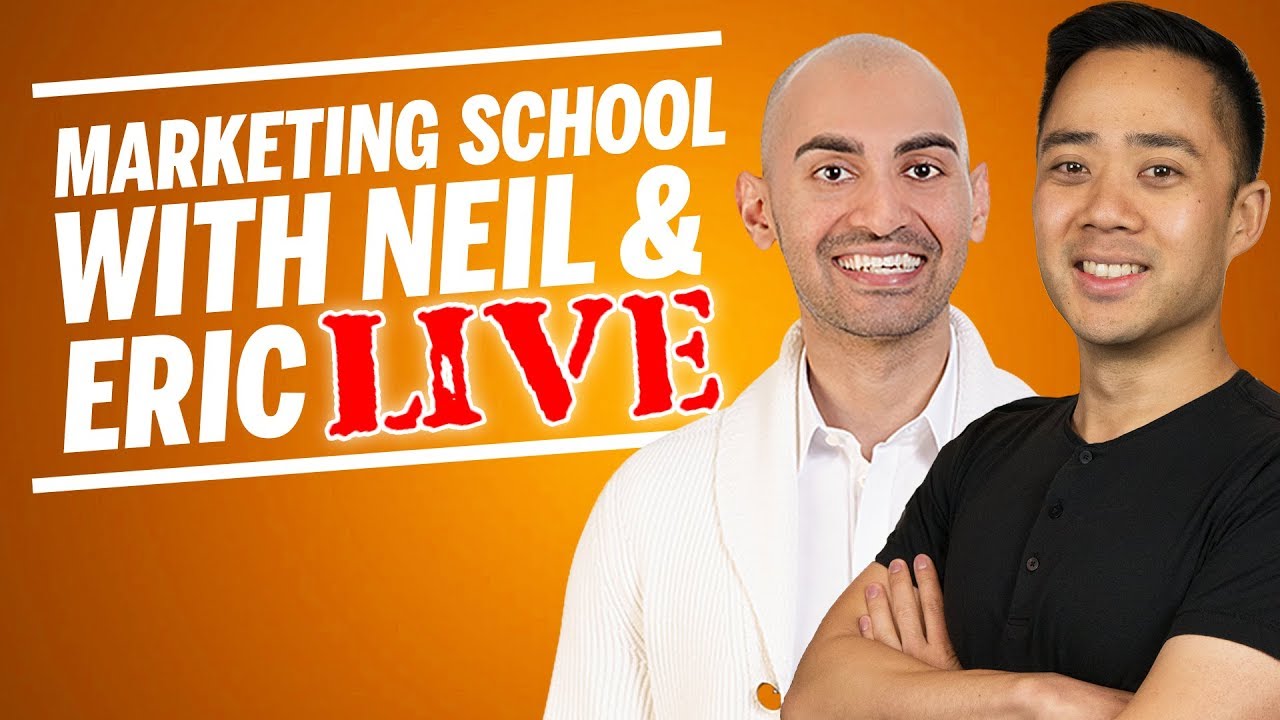
Eric Siu and Neil Patel break down how to turn one episode into 19-21 pieces of content across YouTube, LinkedIn, Instagram, TikTok, and more. They argue podcasting still has room to grow, discuss why live streaming offers massive leverage, and share their disagreements on tactics like buying Facebook likes and spending strategies.
Chapters
We're good to go.
Let's do it.
Online, online, yeah, you're live.
Alright everybody, from LinkedIn, from YouTube, from wherever else we're streaming, Facebook as well, hello, hello. Neil and I are streaming this live today, Marketing School. We're recording, probably gonna get in 10 to 15 episodes before we need to go do other stuff during the day. We're recording here in downtown LA. Drop in the comments too what your thoughts are, if you would like to see us to cut, If you want to see us cover a specific topic, put some questions in there too. We are going to answer you as we finish episodes. And it's going to be a good time. We'll probably go for probably an hour, an hour and 15 minutes or so. And then we'll be on our way. Hello, Instagram as well. Instagram, too bad there's no integration where you can hear our microphones. But hopefully you can hear us from this far away, Instagram. Hello, Instagram. All right. So I'm going to clap and then we're going to get going. So here we go.
1, 2, 3.
Welcome to another episode of Marketing School. I'm Eric Siu.
And I'm Neil Patel.
And today we're going to talk about how to 19x your content output. So, you want me to go?
Yeah, go for it. How do we 19x our content output?
Okay, this happened as of yesterday. So I was thinking about it, I was in the shower thinking about this, Neil. So I was like, man, you know, the content recorded yesterday when we went live, we recorded, let's say we record one episode of Marketing School, right? Well, guess what happened? We streamed it to, uh, we streamed one episode to YouTube and then, then it went to LinkedIn and the podcast obviously, right? And then it also went to where else? Um, we're on Instagram right now.
Instagram.
And I think we— did I say Facebook or no?
Facebook.
Okay. Facebook as well.
So we could have done Twitter as well. Live streaming.
Could have hit Twitter as well. That might've been 6, right? And then you take those 6, And then the content we produced yesterday, also we can make them into separate blog posts too. We can make them into separate social media posts too. So we can cut them up a little bit too and put them on IGTV as well. So I was averaging it out. It could be more than 19x, but averaging it out, that's actually 19x.
How are we at 19?
I got 6, 7 IGTV.
Okay.
IGTV.
Okay.
And then blog is 8.
Blog post is 8.
Okay.
Right.
We're still one episode.
No, we're— but, but okay. Like the Gary Vees of the world, they consider each social post, like each little social media post, like a story, that's considered content too, right? And snippets that we have, that's considered content too, so we can repost to other areas. So wherever we can post stories, we can post a story to WhatsApp, we can post a story to Facebook, we can post a story to Instagram Stories, that's 11, right?
Uh-huh.
And then also, also, if we take a vlog post, we can also repurpose it into a tweet, maybe multiple tweets, Let's say like 1, okay? Let's be conservative. 1 more tweet, that's 12. Okay.
Repost on Medium.
That's 13.
Okay.
Okay.
And then, now we have to try to come up with 19. You can also take the blog post and then repost that on Facebook. Repost that, like the whole post.
Yep.
Do a post on there.
Let's not forget about Snapchat too.
That's 14.
Yeah.
Snapchat is 15. You can repost it on Facebook.
Yep.
16. Does LinkedIn let you do long posts now too?
Yes, yes.
That's 17.
Yeah, yeah.
And then we went live on LinkedIn, right? So you can actually convert that into like a short-form post or a long— so you can post a blog post on LinkedIn, but you can also do a short-form post too. So that's like 18 now, right?
Yeah. Now you're pushing it.
No, no, no, no, no, no, no.
I really like creating quality content.
But the way— okay, if you're a GaryVee—
Let's get to 19.
If you're a GaryVee, right, each social post counts, right? So we can easily say it, we can do multiple tweets from it, We can do multiple stories from it. We can do— we can do what else? Where else do we post to? But we already— we only considered one tweet and we only considered one social post. We didn't even consider Instagram normal posts. There you go. 19.
That's 18.
That's 19!
18.
All right.
I'm gonna take one away.
All right.
We got to do one more. What could be the next one? Twitch?
Twitch, yes. Twitch. There you go. That's 19. That's 19 pieces of content without saying, oh, I'm gonna do—
I'm gonna share it on Pinterest, that's 20.
And we're not even saying 5 tweets. We're not saying—
Podcast, get the podcast on there. 21.
21. Okay. See, we've gone beyond that now. So we had to think about it a little bit, but that's it.
Yeah.
Yeah.
There you go.
So, but why? Why should people create? Why should people increase their output? You talked about this during your Marketing School Live talk.
It's not necessarily increasing your output. It's more so going after all the channels because no one channel these days is going to drive you all the volume.
It's all saturated.
You don't get the same results as you used to. You used to be able to build a business off of one channel, but now—
We talked about blogging getting tougher yesterday. Yeah, it's getting tougher.
You got to go after all the channels. You got to go after the rule of 7. Someone sees you in all these different places 7 times, they're more likely to connect with you, resonate with your brand, and that's in the long run allow you to get more sales and leads as well. Yep.
All right, there you guys have it. It's— we went above and beyond for this one. My favorite DJs, by the way, Above and Beyond. So that's 21. That's 21x-ing your content output. That's it for today. But if you're interested in the Growth Accelerator Mastermind that Neil and I are doing, we're gonna do it in amazing destinations around the world. Just go to marketingschool.io/live, that's L-I-V-E, to check it out. And also don't forget to rate, review, and subscribe whatever platform you're on, because we'll love you for that. We're gonna see if we can really try to ramp up LinkedIn today even more. So that's it for today, and we'll see you tomorrow.
Bye.
Cool.
Someone Carlos says, what about the the the audio?
That's your guy. Carlos is your guy.
What's his last name?
Martacho.
No, that's a different one.
Carlos.
Carlos is a common name.
I just assumed it was your guy.
All right.
You guys ready to go?
Oh, the lighting looks better today.
Yeah.
You know what? Maybe because the sun's on this side.
Probably because of the morning, but I also adjusted some stuff in here. Oh, okay. A little different settings. Let's—I'm gonna go ahead and put this on the screen also so you guys can see the comments again.
Have you ever seen Shazam? I have.
I liked it.
He's supposed to be a black guy. Shazam is supposed to be?
Yeah. Have you? Shaq used to be Shazam. Oh no, no. He was Kazam. Yeah, that's different.
I don't know about Shazam. It's supposed to be if he's supposed to be African American or whatnot, but I liked it.
Video.com. Oh, Viadeo.com. Carlos, we actually haven't heard of that before, so maybe you can assist us with that later.
All right. So I'm going to pull up the— pop up the YouTube chat.
Hello, Mukesh. Hello, Abdul Basit. Hello, Paulina.
Let's get going. Let's record a few more.
Yeah. Next one. Let's go.
All right. 3, 2, 1.
And we are rolling in 3, 2, 1.
Welcome to another episode of Marketing School. I'm Eric Siu.
And I'm Neil Patel.
And today, we're going to talk about if it's too late to start a podcast. So let's put some context in here. How many blogs are there in the world, Neil?
Over a billion.
Okay. And how many— do you know how many YouTube channels there are in the world?
I do not, dude.
About 2 million, I think. How many podcasts do you think there are in the world?
My guess is in the hundreds of thousands. In the United States or world?
World.
Oh, world in the millions. It's really popular in places like China is my guess.
Oh, you're probably right. Okay, let's just look at the US. Hundreds of thousands, you're correct. So let's just— it's 700,000, okay? Now, if you look at it, okay, a billion, and I did this comparison I think yesterday when I was shooting a video, the difference between a million versus a billion, I believe a million, if you did it in time sequences, it's like 11 weeks or so, like in terms of seconds. And I think if you did it in terms of billions, it's 31 years. That's the difference. So how do you, you know, if you look at it from that perspective, 700,000 versus 2 million versus a billion, it's actually not that bad, right? So the first thing I would say is if you just look at it from a numerical perspective, it's not too late to start a podcast.
No, it's not too late to start a podcast. The biggest thing that people have to think about when it comes to starting a podcast, it's not about being too late, it's actually still early, at least in the United States. You're going to have to be a bit more patient because you're not going to get the traction you want right away. If you're not patient, I don't think you'll do well in the podcasting arena. Eric and I are coming up on our 3-year anniversary.
Yeah.
And in general, when it comes to podcasting, I think we're still another 3, 4 years away from it being extremely popular, at least in the United States, parts of Europe. Parts of Asia, some parts of the world like China, they're blowing off and they're extremely popular and people even pay to subscribe to podcasts, but we're not there yet in the United States.
Yeah, and so look at it this way. There's actually— the New York Times had a piece about this, about like, are we at peak podcasting? And the answer is no, because in the beginning of that article, it was just these 2 friends talking about how they did 6 episodes and they gave up because, you know, they weren't getting traction. If you give up that early, of course podcasting is not gonna work out for you. Now, the other thing too is, it's the same thing to me, you know, it takes time to compound your audience. So if you get in now when there's only about 700,000 of these and you stay consistent with it, you should get better over time. And podcasting still, like, it commands, you know, look, if you're— first things first, you should be looking to deliver value to your audience and then, you know, have high-quality audio, things like that. If you come into it looking to make money, you're probably not going to do a good job. Like, Neil and I, we've been doing this for 3 years. We've never once put an ad up on this podcast, right? That's not what we're doing it for. So if you do it to add value to your audience, you should do well and you stay consistent with it. Because remember, the story I told was, with my first podcast, Growth Everywhere, only 9 downloads a day after the first year, only 30 downloads a day after the second year, but I stayed consistent with it because I looked at it from a long-term view. And look at it from a long-term view, look to add value to your audience, that's how you're gonna build a community, and then you should be able to do well.
And you're over 100,000 with your Growth Everywhere podcast, if I'm not mistaken.
Yeah, yeah.
Congratulations.
Thank you, thank you. It takes time. It took you a while.
But this is a good thing because I know it takes everyone a while, but you were just like, when you started, you weren't getting much traction at all. You kept at it, you kept marketing it, and look at it now. But that just goes to show that it's worth it. It takes a while. And even Growth Everywhere, it's not at its full potential yet. In 3, 4 years, it'll be much more popular. With Marketing School, we kind of cheated. I just did an email blast.
Yes. That just was like ramped up quickly. And I think even if you didn't do the email blast, like the sheer volume that we kept doing would have kept us going. It wouldn't be where it's at now, I don't think.
You got to 100,000 like in the first month.
Immediately. Immediately. Yeah. Yeah. And here's the other thing too. So the podcasting, the industry in the United States at least, I think it was $468 million in 2018. The year before was $310 million. I think it's slated to hit about $628 million this year. And then in 20— I think a little over 2020, it's slated to hit $1 billion. So it's gonna continue to grow. And that just shows you how nascent it is right now, because $1 billion is nothing in the advertising world.
No, it's not at all.
Yep. Anything else?
No, that's it. Make sure you guys check out marketingschool.io/live if you're interested in joining our mastermind. Fill out the form and we'll go from there.
And we made a video for you too, so check that out over there. And don't forget to rate, review, and subscribe, and we'll see you tomorrow. Oh, I like this one, because I just did a video on this yesterday.
Saving, great.
LinkedIn, Facebook.
We got some questions on YouTube and LinkedIn.
Abdul, you can start your digital agency on Upwork or Fiverr. Here, check this out, go to singlegrain.com/agency-accelerator, and then we got something cool for you over there, so check that out. Chad says, hey guys, we're posting LinkedIn a lot more. How many times should you post per day?
I post until I start seeing my reach die down. So think of it from that perspective, not necessarily in quantity, because most of these social algorithms have it where if you post and no one's engaging, the more you post, the more it's going to hurt you. So my posting strategy is as long as I'm getting good engagement, I'll continually post. And if I can milk it 10 times a day, I do that. If I only can milk it one time a day, then I do that as well.
I just got a new topic from Eileen. These are actually good. Good job, Eileen, these are good.
What?
Ready? Yeah. All right, let's do it.
Okay, we are rolling. 3, 2, 1.
Welcome to another episode of Marketing School. I'm Eric Siu.
And I'm Neil Patel.
And today we're going to talk about where digital marketing is headed.
So in general, digital marketing has changed a lot over the years. And I discussed a little bit about this in previous episodes. It used to be where you can leverage one channel and do well. Now that's no longer the case. You can't build a business just off of social referrals or SEO or paid advertising. You got to take the omnichannel approach. But we've already discussed that. You know, where I think the future is heading with digital marketing, and love to hear Eric's input as well, is I see sort of the offline and online world merging. And you're going to start seeing it where things like your fridge starts telling you what products to order and Google starts powering ads on your fridge or Facebook does. I start seeing it where instead of you Googling recipes, You know, your oven is telling you how to make a recipe while you're cooking at the same time. I really do think that there's going to be a divide between, or more so, there's going to be a crossover in which the online world and the offline world are going to start merging into one.
Yeah, a good example of this actually, there's a guy I know, he actually runs the Harlem Globetrotters and a bunch of other entertainment companies, theme parks too. And they're doing a partnership with Halo, and Halo's coming to Anaheim here in September. I'm going to bring part of my team, whoever wants to go. And it's an offline event, about 10,000+ people are gonna show up and they're doing an escape room, like a Halo-themed escape room. They're doing laser tag that's Halo-themed and then also there's a dome that you can go in where you're in the Halo world, almost like it's a VR type of thing. And then there's other, it's, there's other stuff you can do. When you're playing laser tag, you're basically, you're holding like a gun and you're running through like almost as if you're within the world. And yeah, you're just battling each other out and it's, like you're actually there. So that is happening more. I think the other thing is, you know, we've talked about this really good research done by Rand Fishkin and Jumpshot of how zero-click searches are continuing to rise. So you can't just rely on SEO, you have to take the omnichannel approach because look, Google has shareholders to report to and they're making more and more money. The funny thing is they're making more and more money just by increasing their click-through rates a little bit. And then the thing is, The zero-click searches are rising, which means people aren't going to get as much traffic going to their site. So what are you going to do about that, right? So on-SERP SEO, and then also optimizing your titles and meta descriptions, those are still important.
Yeah, and you got to think about other technology forms that people are going to be using from their mobile devices to doing search to Amazon Alexa, Google Home, all those kinds of things. It's not just about ranking. Sometimes it's about doing things like building apps and tools that integrate within these devices as well. so that way you can tap into a new audience. In general though, you're going to start seeing the online and offline world collide. And when they do, you'll start seeing all these devices and innovation coming to offline devices that are going to be using digital technology. And for that reason, if you're not tapping into these devices, you won't do well. Like, just imagine you cooking something on your stove and you can click a button and that ingredient comes and gets delivered to you within 30 minutes because you're missing it, right? That's what's eventually going to happen in the future. It's not that, oh, this stuff may happen. It's no, they're already working on it.
Yeah, and in the last episode we talked about where, well, if podcasts, it's too late to start a podcast. And look, that's still very nascent. You know, you look, you hear all about all these voice technologies in your home now. You got Google Home, you got Alexa, you got all these things going on. And voice is still very nascent, right? Even though voice is, you know, voice searches are increasing on mobile. But voice also, as a channel to build your brand, is going to get bigger and bigger. It's going to become a $1 billion market in the next couple of years. Just this year alone, it's slated to be $628 million. It's still really small. It's going to get bigger and bigger. And there's only 700,000 podcasts, I believe, in the US. That might even be the entire world. And there's only 2 million— there's 2 million YouTube channels, but there's over a billion blogs around the world. So take that into perspective. Because a million is a thousand million, a billion is a thousand million. So take that into perspective as well.
Yeah, so that's it on my end. Make sure you guys check out marketingschool.io/live if you're interested in joining our mastermind.
That's it for today. Don't forget to rate, review, subscribe, and we'll see you tomorrow. What's our favorite marketing channel?
You pick yours, I'll pick mine.
I'll even let you go first. I don't even know what my favorite channel is. Okay.
All right, you guys ready to jump right into it or you want to?
Yep, let's do it. Let's do it.
All right, we are rolling in three, two, one.
Welcome to another episode of Marketing School. I'm Eric Su, and I'm Neil Patel. And today we're going to talk about our favorite marketing channel. So as of right now. As of doing this right now, I love streaming. Do you know why I love streaming? Because we can produce so many pieces of content just from all the work we put in today. So it's like we're leveraging our effort at like 5x-ing it, 19x-ing it, 21x-ing it just from sitting here. So this video that we're doing right now automatically becomes audio and it automatically pushes to LinkedIn Live, YouTube Live, Facebook Live. We can push it to Twitch Live. We probably should even push it to Twitch just for the hell of it. And it's on Twitch? We're live on Twitch. Hello gamers. So yeah, I mean, look, great. That's what I love about it. It's— Neil and I are inherently lazy people. Actually, I shouldn't speak for Neil. I'm an inherently lazy person, and I like doing things that give me leverage, and this allows me leverage.
In general, my favorite marketing channel, and I was thinking about this for a bit, is probably—
Can I guess? Can I guess?
Yeah, go for it.
Paid.
No, it's not.
Okay, go.
I think all marketing channels are getting saturated. They're getting competitive. It doesn't mean you can't leverage them. We've already talked about an omnichannel approach, but what I found, and I've learned this over the last few years, nothing beats building a good product or service. If you build something that's really good, it naturally markets itself. And I know that's so cliché, especially me being a marketer and saying it. And I learned that from creating Ubersuggest, because it's like, it's the one thing I don't try and it just grows and it markets. And I'm like, oh, I'm growing 10% month over month without doing anything. I'm like, this is so much easier than creating podcasts and videos and vlogging content. I was just like, I found that I used to spend so much time trying to figure out how to milk the last like 10% of SEO or content marketing or social media. Now I'm just like, spend all that money and time building a better product and service. And I kid you not, It's so much easier to market than anything else.
Mm-hmm.
If you made me pick a channel, I'd probably say partnerships. So like, I'm doing partnerships with other people with huge email lists, and I'm just paying them to blast out whatever I want. And some of these guys have like a million people on their email list with like 20% open rates. I found that to be extremely effective, especially because their email list is full of buyers.
So Neil's is product-led growth. Mine is just because this is so new, just streaming high-quality stuff across the board to create massive increase my content output. So both are really good. I think both, I think you got to have both in my opinion. You got to have a good product, A, and then B, you leverage that with a good brand. And then you, and then C, if you're able to, someone wants to put money into your thing and blow it up, you got those 3 things. That's a combination and you've got a really nice combo.
But what you'll find is with your favorite marketing channels, it's going to be different for every person. What is right for Eric and I may not be right for someone else. Like for example, Gary Vee does amazingly well on video and social media. It fits his personality. I do better with text-based content than video-based content. You also have to look at what you as an individual enjoy and what you're good at, because if you look at those 2 things, those are probably the channels you'll excel at. For example, I have a buddy who just loves paid, and he's one of the best paid guys that I know. And for that reason, if you had to ask him, what's your favorite channel? He'll always say paid, and not just paid advertising like Google AdWords, he specifically likes media buys, and that's what he specializes in. And when I talk to him, he'll always choose that because he's like, I can make media work when no one else can. So if you're naturally good at something, that'll probably become your favorite marketing channel.
Yeah, I think we talked about this on an episode before too. Like, the advice that we're gonna give is very specific to ourselves. Like, if Neil really likes blogging, he's gonna give more blogging advice. If I really like podcasting or video, I'm gonna talk more about that. So keep in mind, like, to Neil's point, your mileage may vary. And before we go, before we go, go to singlegrain.com— sorry, not singlegrain.com, marketingschool.io/live, that's L-I-V-E— and check out a video. Neil and I got a video for you over there. And if the video makes sense for you, it's gonna help you grow your business, check it out. And that is it for today.
Don't forget to rate, review, subscribe, whatever channel you're listening to.
I understand where you're coming from, and we'll see you tomorrow. Eileen's question, we answered that in an episode in regards to when to upgrade a piece of content. And then let's see. Can you name 3 good strategic alliances that would be good for my Ooh, should we do one on strategic align? That's channel partnerships. Have we done one before? We have.
Let's get started and we can add in channel partnerships.
But how do does live cannibalize your podcast audience? That might be a good one to do.
Does live cannibalize your You only have like usually 10 minutes retention. Mm-hmm.
Does live cannibalize your video audience? Yeah. I changed it from podcasting to video. We can add— we can answer podcasting in that episode as well. Let's do it. Let's do the next one.
And you guys can answer this too.
Rolling in 3, 2, 1.
Welcome to another episode of Marketing School. I'm Eric Su, and I'm Neil Patel. And today we're going to talk about if Patreon is worth it. So Patreon, for those that don't know, Patreon is a site that you can get donations from your fans. So let's say we're doing podcasts right now. We have a Patreon channel. It's like, hey guys, go to our Patreon channel, support us, donate a dollar a month, five dollars a month, could be a thousand dollars a month. That we have different offers for you.
Usually not a thousand. Those are rare. Those are rare. But Eric's right. It's It's someone supporting you, usually small dollar amounts, $5, $10, $15, $20, maybe $50 on the high end. And it's typically used by people who have popular social profiles, specifically Instagram, YouTube, Snapchat. Those are the main ones that I'm seeing people promote Patreon on.
I've read some stuff recently about Patreon about how like it's a very long tail. You might have like, you know, a top like 1% and then everyone else barely makes anything. So that's how it is with Patreon. So I think if you're trying to make You know, maybe a couple hundred dollars a month. Maybe it's worth it. But I think if you're trying to make a living from it, I don't think it's worth it. Just to paint a little more picture around this, Tim Ferriss, even though he has a couple million downloads a month, he he canned his ads and he went with a he didn't use Patreon, but he went with a model that's very similar to Patreon where people can pay you, can donate whatever they want. He stopped the model yesterday. He started earlier this week. Yeah. So what he did was that he's like. I'm gonna test removing the ads. And we did an episode on this just to see. We were pretty sure it wasn't gonna perform that well, but it was interesting, right?
Of course, 'cause ads, businesses will pay you X dollars while individuals or B2C people won't pay you typically as much.
Yeah, so he just said, look, the maintenance was nothing 'cause people were just donating. There was not much people complaining or anything, but it wasn't even close. He didn't share specific numbers, but he's like, yeah, 83% of people were donating maybe like $1 to $5 a month or something like that. But he just found it to be much more lucrative, and also, He got, he started getting complaints from people saying, hey, look, we actually appreciated your product recommendations. Anyway, I don't want to go too deep into that. This one's more around, is Patreon worth it? So I think the short answer would be no.
Yeah. In general, if you're just asking people to give you money for the sake of it, you probably can make way more money having a good product or service or running ads, hands down.
Yep.
But if you want to use it, consider using it as Think of it like just extra free money. So you can still do the ads, like Tim Ferriss could say, hey, donate whatever you want and still run ads.
That's true.
You can do both. And it may not make you a ton of money, but a little extra.
Mm-hmm, yep. All right, so that's it for today. Simple enough. Go to marketingschool.io/live, that's L-I-V-E. Neil and I have a special video for you there to help you grow your business. You'll learn more about it there, marketingschool.io/live, L-I-V-E. And don't forget to rate, review, subscribe, and we'll see you tomorrow. Great. Marketing test. Okay, I got one. I feel like they can't really hear us.
Yeah, let's go for it. Let's do it.
All right, let's do it. You guys are so close to the mic. Okay, we are rolling. And 3, 2, 1.
Welcome to another episode of Marketing School. I'm Eric Siu. And I'm Neil Patel. And today we're going to talk about the marketing tactics that we disagree on. So I'm going to start first. I remember a couple of years ago, what I disagreed that Neil did a couple of years ago was buying Facebook likes. So for a period of time, Neil was buying the likes for really cheap and it seemed to work. And then all of a sudden organic reach tanked. And then those likes basically became worthless overnight.
They became worthless. Eric was right on that one. I had this philosophy back in the day of being like, Like when Facebook in their earlier days, I was like, you build a well, right? The last thing you want to do is keep buying bottles of water or paying for water when you can just build a well. And it worked for a very long period of time and I was ecstatic and I was crushing it. And then Facebook all of a sudden just decided that your organic reach is going to tank and you've got to pay more money for ads. That sucked. But yeah. Another one, what else do we disagree on?
I don't know. What else do we disagree on? We agree on a lot.
We agree on most things. I probably don't do as much as Eric. Like, he goes live more and stuff like that.
Yeah.
My focus—
It's maybe— I think you're more focused.
I'm much more focused.
Yeah.
I go for like big bangs. Eric will do— his approach is more do a little bit of everything.
Mm-hmm.
I personally disagree with that approach. Nothing wrong, it works for Eric. I've gotten better results for myself when I just focus on massive, big channels, big wins, all or nothing type of things versus doing a lot of small things. Like we're going live, there's nothing wrong with going live and it's great, we appreciate it. But I look at the effort from going live, it actually doesn't take much because we're already recording. But in general, doing like Eric, you create live videos Separately, correct?
Not anymore. No, that was a test, but that was another like shotgun approach.
Yeah. So it's like, I'll do like big hits. Like I'm working out a deal with someone who has an email list of a million buyers, right? So I'll do a deal where I'll just pay them and I'll get a big blast. And I know the chances of that working are really high. I'll go for the stuff that costs more money and typically can produce either a big ROI or I'll lose the money And I won't generate anything and I'll be out a lot of cash.
I think what's also different too is, I don't know if I got this from just taking a beating playing poker for a long time, but I'll stick with things like really long, sometimes to a fault, and then you'll quickly axe things.
Yes. You're more patient. You're more educational and keep trying. I'm very— and that's funny enough, we can discuss that in the next episode. Yeah. Oh, there you go. Yeah. Yeah. But in general, yeah, I'm much more quicker at cutting things and moving on. I'm also probably a faster executor. You're also probably much better at doing research or learning and thinking things through before you execute.
Yep. It's good to know your partners.
Yes.
All right. Anything else?
What else do we disagree on? There must be more.
There's more.
The biggest thing that I'll actually say is if you look at how Eric and I market, The big thing to take into consideration is not even what we disagree or not disagree on. We're at different stages of our marketing career and our entrepreneur journey. And when you find other people and you're at different phases, everyone's going to disagree at certain things. For example, I'll be different than you, right? Because I've been doing business a lot longer. Mm-hmm. And Yaniv, who's been doing business longer than me, and he's even more established.
Has he been doing business longer than you?
He's older. No. How old is he?
He's, he's my age. He's younger than you.
Really? Yeah. I thought he was older than me.
Yeah, he can look older. No, he's younger. Oh, okay.
Yeah. Yeah. Um, but he does things a bit differently than me as well.
Oh, for sure. Way different than me too. Yeah. He'll, yeah, he'll take swings on, um, on, on Like, you know, hires that I don't think we would even try.
No. Yeah, but it's just different and there's no right way. Eric's not wrong. I'm not wrong. Yaniv's not wrong. You got to find out what just works for you.
And by the way, the people that he tries on, like, he gives a lot of people chances, a super, super nice guy, but he makes it work for those people. Whereas you and I, we wouldn't have been able to make it work for those people. I just know both of us. Yeah. So it's a different philosophy.
I'm also a lot more impatient than he is.
Yes.
Right. And even more impatient than you are.
Yes.
I'm like, now, now, now.
Yeah.
I want—
Now, now, now, yesterday.
Yes.
Yeah.
Um, but again, that plays, uh, that plays with my strengths because one of my best skills is probably in business. I'm probably one of the fastest executors that I know.
Yeah, it's true. Anything else?
Um, No, that's it. You know, and when you're thinking about you and other people and other people are giving you advice, keep in mind that they may be in a different stage in marketing or business than you are. So be careful on, you know, just copying someone and trying to replicate exactly what they do.
All right, that is it for today. Go to marketingschool.io/live, that's L-I-V-E. Neil and I have a special video for you there that's going to help you grow your business. Check it out. And don't forget to rate, review, and subscribe to this podcast, and we'll see you tomorrow. This thing is great.
Having that there, the screen. Yeah. Yeah. Okay. Let's do it. Dive in or? Yep. Yeah. Okay. Let's do it.
Next one and then we can answer some questions. It's only 10:37. Rolling. And 3, 2, 1. Welcome to another episode of Marketing School. I'm Eric Siu. And I'm Neil Patel. And today, we're gonna talk about how the both of us see business a little differently. Now, keep in mind, we should give Just to give some context, Neil, how long have you been in business?
I think 17 years now.
Okay.
So I've been in business, I've had this company 5 years. So Neil's a little 3x over, right? So it's a little different, but we have different perspectives for sure.
Correct.
Yeah.
So you probably know more than this, but, or more than me, but how do we disagree on business?
So I think for me, I'm very, we talked about in the last episode, I'm very, I can be, More patient, right? Yes. So I'm very like long-term focused, and I'll take a lot of shit. I'll take maybe shouldn't cuss, but I'll take things. I'll take pain for a lot longer with the long term in mind, right? So like for me, the way I see things is, and I'm actually learning that you know looking at other people, they're actually when I see that oh that's what I'm doing exactly. Like when I look at you know the people that are like super successful, right? Most people, I think the average Joe. I'm not talking about you and I disagreeing here. I think the average person would say, oh you know if you make like a highest hour like two three hundred four hundred thousand. you should take that money and, you know, I think for the large majority of people, sure, put it into an index fund, right? For me, at my stage right now, it's constantly, because I come from a gambling background, I like to redeploy it. And redeploy it because my whole mindset is if I redeploy it, the pie's gonna get a lot bigger in the long term, compound interest, right? So that's how I see it. You know, we talked about pre-tax growth versus post-tax growth, that kind of stuff. So I see it for the long term. Yeah. And for me, I see it as a business, as a game. And I think you kind of see it that way too. But for me, it's like, oh, there's little pieces here. Okay. How do you, how do you retain people? Right. You know, how do you, how do you, this is why you play the culture game. This is why you play this game. This is why you diversify. This is why you do products, right? All these different things combine into making something for the long term.
Yeah. I think there, how many businesses do you focus on right now?
So, I mean, We could technically— this is a business, right? The podcasting that we're doing.
See, that's where we also disagree on. Yeah, you'll try to— Eric doesn't mind trying to coming up with— or Eric likes the idea of, hey, if we have a million listeners, why not try to monetize and create something? I'm on the opposite end of why create something.
That's true, right?
That's where we do definitely disagree.
I'm big on just one thing, one thing only, and that's Yeah, I would say, so my core focus right now is on ClickFlow, the software.
Yeah.
So, you know, I have my flaw in the past is trying to do too many things at once, but now that there's a little more leverage, there's the team that can take care of, you know, the agency, there's other people taking care of like when we do this, people are publishing it to doing show notes and everything. I can just focus on the software. So that is my core focus now, but in the past we did things differently where you would focus And I would try to diversify quickly because I didn't want one thing to fail and then have to like go back to ground zero.
Correct. Like the other day I had an opportunity where someone says, hey, do you want to do an incubator? I'll give you $10 to $20 million for it. It was very favorable terms. I said no. Right. Or I think you would be much more open to saying yes if it was done in your own terms, in your own way.
Yes. Also, I would say where we disagree too, I think, remember there was a, there was like a, Potentially like an 8-figure offer on the table. Yes. And then I quickly declined it. Um, and so I think in that scenario where, um—
I'm more logical with money than I think you are.
I just think so. My mindset there was like much more long-term. If I have to stop compounding right now on what I have, then that those like 4 or 5 years of compounding would go away.
But, but let's talk about it because you talk about your revenue publicly.
No, I don't. Yes.
Yes. And people know what range you're in?
No, most people don't. And I prefer not to.
Okay. Yeah. But with the job offer, based on your employment size, would you agree it's easy to say 8 figures, that's a lot of money?
8 figures is a lot, but in the lot— the way I looked at it quickly was I was like, 8-figure in the long term, sure.
No, 8 figures per year.
I thought it was eight figures total. No, it was eight figures per year. Well, see, this is where we didn't communicate that well, guys.
Because if you look at the math on eight figures per year, I'm like that compounds much faster. Yes, yes.
I thought it was eight figures total. No, no, no. So, okay, okay. So here's my logic, right? So let's just say it was an eight-figure payday, and I would have had to give up everything I'm doing for four years or so. There's no way I would have done that because of compounding. That makes sense to you, right? But it was eight figures a year for four years.
More than 4. I was just like, you're not going to end up making this in the short run or long run. You could use the money for more. Yes. That's why I thought you were crazy. I've been told, Mike, my business partner, I'm like, dude, I don't know what's wrong with Eric. He's like just so crazy. I'm like—
But, but you know my mindset now because I misheard you. I was betting on the long term, right?
This makes sense now. Yes. Yes. 8 figures a year. That's a lot of money.
Yes. Anyway, so now you get that. Okay. What else do we disagree on? Uh, I, I do give people longer. Yeah. You cut people fast.
Well, technically I don't have any direct hires.
Yeah.
Um, so I have a hiring philosophy in which you hire people who have done it at least 2 times, not even just for executive roles. I try to find people who have been in that role multiple times. Um, I also have a different business philosophy than, or it's not even different business philosophy. I've been, and it's not fair to say we're different in this because it's kind of cheating. I've been doing this for 17 years. So at this point, when I was younger, I was similar to Eric in which I would give more time. I'd be open to training a lot more, but I'm also at the stage in my career, which this is why I think is cheating. I'm able to just hire people and everyone who's done it multiple times, which allows me to grow faster, but it costs more. It hurts with margins, and I really like taking that approach. But before, I used to take the approach like Eric did, in which give people more time, hire people who are more junior and train them. And Eric does also hire senior people. He hires people all over the board because his businesses have been growing. But when he first took over Single Grain, that business was struggling. He turned it around and he's done an amazing job. But it's like when you're taking over a business that's struggling, you can't just go in and put tons of money into it, especially when you were starting your career at that point and you didn't just have the ability to be like, let me just throw in a million bucks and lose it and let's see what happens, right?
Yeah.
And it was definitely a journey. And I do believe you made the right bets. You even at one point sold your home and doubled down even more. You're just like, I'm going to keep going all in. I don't need a home. I can rent a home.
That's where we saw it differently too, because at that point, because you were a partner in Single Grain, everyone— you—
No, I wasn't a partner at that point when you sold your home.
No, no, no. Initially when I took over, right? You had a share and then you were, as a friend, you were looking out for me. You're like, you should get out. So your mindset was you should get out. It's worth nothing. There's no equity, right? My mindset was, if I make it work the long term, great. I've got a vehicle.
No, but you could have got the business for free. Instead, you bought people out.
That's true. But that's where we disagreed.
I didn't say that you shouldn't do Single Grain. I disagree that you shouldn't have never paid people out.
You said that part too. The other part was, and I do have this, you said there's no brand equity. You should get out. It's like not a safe business. Correct. Which is true. Yeah.
You could have started all over in a new business, or if you want to take over Single Grain, you should have been able to take it over at $0. Yeah, because then you wouldn't have had a big nut to cover.
At the end of the day, the nut was still worth it. We can talk about the nut after.
Yeah, you get what I mean, right? My big thing that I disagreed with Eric on was he spent money. Mm-hmm. I'm much more conservative, and when it comes to spending money, I think, than you are. I used to be more aggressive like The it worked out.
It was a good offer at the end of the day.
Yeah, either way. See, and when you look at it, I have my own ways, and Eric has his own ways. But they end up working out. Me, I'm not better than Eric. Everyone's gonna always have their own ways. Eric figured out how to make it work. There's silly things that I've done that I bet you Eric would look at me and think that I'm crazy. That's worked out for me. Neither of us are right or wrong. We just have our own ways. And some things when I thought I was right and Eric was wrong, like. Like the 8-figure thing, it was miscommunication from what I learned today. I should have probably hit you up more on that and try to force you because there was a miscommunication probably on my end. I should have communicated better on that one.
It's all good. I mean, I'm happy with everything, where everything is right now. I'm thinking about the long term.
I think when you look back at it, you've done extremely well. You know, you should be proud of everything you've done. Thank you for that. It wasn't an easy journey either.
Thank you for that. Here's the other thing. I think we should tell everyone like that, that's kind of starting out, like in the first 5 years, the first 10 years, 15 years, It becomes a different journey over time, right? The first, you just, you break them up into chapters and it's completely different. Um, but yeah, it ends up becoming a good story. And the thing we talked about this on the phone before, we're always going to be stuck in our ways. Like the older we get, Neil's going to do what he's going to do. I'm not going to change him. And the people that try to change him, those are the people he doesn't talk to anymore.
And we've learned, I stopped telling Eric, don't do too many things. Eric stops trying to get me to do too many things or do things that he wants. And then eventually, We've learned to work with each other really well. Um, for example, Eric will just do a lot of this stuff so I don't have to do it. Cause he knows I don't want to do it. And then eventually he knows he'll wear me down and I'll come convert over.
Well, conference, for example, once he sees it there, it's like all done for you. It's a little more like, oh yeah, we can make this work. Yeah.
Yeah. So even then with the conference, I don't want to charge. You're more open to charging.
Just different philosophies.
Yes, different philosophies.
All right, this podcast was a little longer, so hope you enjoyed that. Go to marketingschool.io/live, that's L-I-V-E. Neil and I have a special video for you over there to help you grow your business. That's it for today. Don't forget to rate, review, and subscribe, and we'll see you tomorrow. That was a fun one.
That was a fun one. I now understood on the 8-figure one why you turned it down.
And I turned it down so fast too.
Yeah, and now you probably understood why I was just like—
Yeah, and then I was like, why does he think I'm so crazy?
I'm just happy we're both aligned, so the next time that comes, I will let you know.
Whoa, we'll answer like one or two. Hello to Loopy. Sally says, be real. Is it good to be a jack of all trades in digital marketing? Hey, that's a good one. Should we put that in? Yeah, we should make that a topic.
Yeah, that is a topic. Is it good?
Thank you for that, Abdul Basit. Do you know how to pronounce that?
I do not. There's an interesting one from Raving Junk Removal Entrepreneur. Who would you say Neil and Eric are? Kobe and Shaq? Mike and Scottie? I think you're saying Magic and Kareem or LeBron and Wade?
I would say—
I would say, I would say—
I would say neither. You know why? Because we're not on the same team in theory. We run our own businesses.
No, but if we're doing this as a partnership, that's— we're on the same team here. So I would say, okay, well, Dwyane Wade executes very fast. Dwyane Wade's fast.
I have no idea. They're all great. I'd be honored to be either of them with Eric.
I would say I'm Kareem and Neil is Magic. You know why? Because I look at Magic, he's been in business, he says his businesses do over $600 million a year or whatever. And, you know, he's been at it, nice guy, been patient with it. And Kareem's the guy that dishes it out and tries a lot of different things.
Cool, that works. Either way, I would be honored to be 1/10 of any of those people that you mentioned there. They're all amazing.
Cool. All right, on to the next one?
Let's do it.
Let's go on to the next.
Rolling in 3, 2, 1.
Welcome to another episode of Marketing School. I'm Eric Siu.
And I'm Neil Patel.
And today we're gonna talk about if live cannibalizes your video audience. So we're live right now.
We're live. And let's answer one other question in there on, does it cannibalize your podcasting audience as well, assuming you do live video whenever you're recording your podcast episodes?
Yeah. And by the way, we have done live videos where we would push it to YouTube and those would get like, probably on good ones would get like 1,500 to 2,000 views or so. Keep in mind my channel's only like 22,000 subscribers or something like that.
It's grown since then, no? It's—
I think it's around that. It's growing by like, I don't know, like 30 or 50 a day. But anyway, it has not cannibalized our podcast audience. In fact, our podcast audience has grown faster looking at our Libsyn stats. So from that standpoint, no. And I would say from a discovery standpoint, when we go live on LinkedIn or when we go live on YouTube, there's a bunch of people there that have never heard of us because YouTube has over a billion users. LinkedIn has what, a couple hundred million users? It's not like everyone's heard of us. We're only getting a million downloads a month. And then we've also like split it into 30 episodes. So, you know, there's a lot more people for us to hit.
Where it can cannibalize is what you'll find is sometimes when you do live videos, um, you'll actually get less total views than if you just posted that video and not went live. Um, because when it's a live video, you're streaming live and then after it gets posted and people can go watch it later on. What we found is when you post a video beforehand, or when you plan a video and you're not going live, you're able to optimize it more based on what you're going to say in the video, script it more, all that kind of stuff, which then allows you to rank better, at least on YouTube.
Yeah. What we've noticed from a live perspective is watch time's great, right? This is why, like, if you look at Grant Cardone, he's going live all the time, right? Watch times are one of the main metrics of YouTube is your watch time, right? So, you know, when we produce live videos and then we also have our video audience too, we do not find that it cannibalizes. In fact, we see a little boost in terms of subscribers just because we're going live for a long period of time. People are joining, we're engaging with the people and things like that. So yeah, I do not find that live cannibalizes my video audience or my podcast audience.
Yeah. And I found that it to work really well. What I do in general is when it comes to live and all those kinds of things, if I were you, what I would recommend doing is with YouTube, you can try it, but create different content for live than you would for your normal videos. With podcasting, you can do them both at the same time.
All right, so that is it for today. But before we go, go to marketingschool.io/live, that's L-I-V-E, Neil and I have a special video for you over there to check out to help you grow your business faster. And before we go, don't forget to rate, review, and subscribe to this podcast, whatever platform you're on, and we'll see you tomorrow.
Great. Cool. Jump right in.
Let's see the questions, because there might be a topic or two we can add. Creative. Do we have anything about hiring good creatives? How amazing creators if you if you suck at creative, and then we have one more digital marketing agency outsourcing the work. Okay, so should you outsource work or?
I think we just did that on—
We did? How to— okay, how to supercharge your engagement. I like that. I like that one, Chad. I don't know if you're still in here, but thank you for that one.
All right, I think we can begin.
How many do we do today?
Ready?
Yep, ready.
And rolling. 3, 2, 1.
Welcome to another episode of Marketing School. I'm Eric Siu.
And I'm Neil Patel.
And today we're going to talk about if it's good to be a jack of all trades in digital marketing. Jack of all trades meaning, is it good to be like maybe like 50% or 60% at a bunch of different channels or really just focus in on one? So I'll give my feedback first. Keen to get Neil's thoughts. You know, when I first started out doing digital marketing, I focused on SEO in the beginning because, you know, trying to do too many things at once leads to kind of lack of focus and you end up not being that good at anything. So I got good at SEO. I got good at content. And then after that, I was like, man, I can't just be an SEO because the job safety, in my opinion, it's not that great. Because once— my opinion is once you hire an SEO, you might use them for like a couple months or so. Internally, and then all of a sudden they get sacked, right? Like, I know a lot of good SEOs that end up getting fired after a period of time because there's no more use for them to be there. So I was like, man, I got to get better at— I got to add on other skills. So I added paid advertising, I added email marketing, I added other stuff. But I would say if you're starting out especially, focus on one area, then you can branch out so you can kind of protect yourself a little bit and be dangerous enough to know those areas so no one's gonna run circles around you.
When I first got into digital marketing, there wasn't as many people. Companies were looking to hire people who knew everything. They were looking for that one-stop shop. Times have changed. There's too many channels now. There's too many algorithms. There's too many things that continually go up and down and are different every single day. Nowadays, companies are looking to hire specialists. So if you want to provide services, try to be a specialist. Don't try to be a generalist, aka the jack of all trades. If you are working for someone and you're trying to climb up the ranks and eventually be a CMO or something like that, you know, you can specialize, but eventually you do need to learn a lot of the other aspects. You don't necessarily know how to do them. You more so have to be really good at strategy over anything else if you want to become a CMO or really high up in marketing like a director or a VP or anything like that. But in generally speaking, providing services, specialized, you want to enter to be a CMO or something like that, you can start your career journey focusing and specializing one tactic. Eventually you need to transition into strategy and still understand the other aspects of marketing.
Ooh, that's a good topic. How to get good at marketing strategy. Just put that in there.
Yeah.
Anything else you want to add?
Yeah, that's it. Make sure you guys go check out marketingschool.io/live if you want to join our mastermind. Hopefully Eric and I can help you guys grow faster. We look forward to seeing you tomorrow.
Oh, goodbye.
Look at that, Noah, that's just more editing work for you, I think.
What? What is?
Is that— do you do the editing?
No, we send it to—
Oh, so someone will edit out the gaps and stuff like that?
Dude, everything's done for you, it's magic.
Yeah.
Conference is magic. This is magic. It just happens, guys.
Yeah, well, I do a lot of the— I just get it all batched out, send it, and then upload it to Google Drive, send them the link, and then they edit, they send it back, usually like a day before we have to publish. But, you know.
Cool.
Oh, that's scary. Is it really? Don't tell me that. Is it really like this?
Right now we're like on the wire, so.
Oh. Well, we shouldn't be now.
Yeah, we're gonna catch up, so it's good.
Yeah, this is not good. We're usually always ahead by like a couple weeks though.
Yeah. Wow. Why?
Hey, we recorded a while ago for these episodes. Yeah.
What threw them off was the the live stuff.
Oh. So it took a little longer on the live edits.
Oh yeah.
Okay. That that makes sense. Fair enough.
Yeah. All right.
Where Eric and I are like, this is not acceptable.
We need help. We need more help.
Okay. You guys ready? Yep. We are rolling. 3, 2, 1.
Welcome to another episode of Marketing School. I'm Eric Siu.
And I'm Neil Patel.
And today we're going to talk about how to hire amazing designers for cheap. So this came from one of our live viewers right now, and the question is, well, this person's not really creative, they're good at paid ads, so how do they go about finding, you know, great creatives? So Neil, I'm keen to get your thoughts first.
I usually go to Dribbble and you can look at other people's portfolios. Look at any country that has a currency exchange where their version of a dollar or euro or whatever it may be, you know, their currency is worth a lot less than yours. Find people within those regions, hit them up. And if you hit up like 10, 15 of them, eventually you'll get one of them to do amazing work for you at really good rates. But the key is to only hit up people that you love their work with. And when you're looking at their Dribbble profiles or their Behance or whatever site you choose, don't just look at like, oh, I like this one image. I like this one site that they did. You have to look at their whole portfolio overall and make sure you do like everything that they've been creating.
Yeah. If they're good at drawing cartoons, if their portfolios are all cartoons, they're not going to do like some like lifelike illustration for you.
Or they're not going to do, UI for your web app.
Nope, absolutely not.
So you got to like their portfolio and it has to be extremely relevant to what you're trying to do, but not just one example or two examples. You got to do multiple things.
Yep. What I would say, just to go a little deeper on Dribbble. So Dribbble does have a talent management program for people where they basically have recruiters that will go put talent in front of you. And you can actually see where these people are working, look at their Salary requirements, things like that. And it's something that's in addition to Dribbble, so you actually have to request this. But let's say you hire a designer for, let's say, $70,000 or something like that. And then what happens is you'll have to pay like a recruitment fee of maybe 10%, so $7,000 to Dribbble. But I was initially hesitant against this, or hesitant to this. And, you know, I've been— I actually worked with some of the designers on a project basis, and they've done some really good work. Like I had some new slides done, too bad I couldn't get it done for Marketing School Live, I now have a slides designer too. And I have, you know, some people that are actually like creative directors at other, you know, well-known agencies or things like that, where if I look at their, just their profile alone, it actually doesn't show that they're creative directors at so-and-so agency. Like I can't find that by keyword. They had to be, this had to be dug up from the recruiters. So that to me is value add. And instead of paying 20%, maybe I just paid 10%, might be a good bet for you.
Yeah. And in general, there's a lot of different sites that you can end up using eventually once you meet someone who's really good, just keep paying them on an hourly basis. The big thing that people make when it comes to creative people, they'll end up hiring them full-time being like, I love the work that you're doing. Well, I'm like, well, if you don't have consistent creative work, it's just easier for you to pay them on an hourly basis than it is to hire them full-time.
True, yeah. Oftentimes, actually, this is the awkward part because it's like, man, I really would like to have them full-time, but there's only so much work. So project-based.
Don't have them full-time. Use them hourly, there's nothing wrong with that.
This is where we agree on business. Here's the other thing too. One final thing on Dribbble. I actually use Instagram and I follow Dribbble and they highlight a lot of designers. And I actually end up DMing those designers. Just like I'll DM people that are good at, could be banners, landing pages, things like that. And oftentimes a really good price, like $500 for a landing page. So check that out too. If you use Instagram, follow Behance, follow Dribbble, follow all these different design communities on there and you'll find some good people. Oh, I guess you're done because you're smiling. I'm done. All right, that is it for today. But before we go, go to marketingschool.io/live. That's L-I-V-E. To check out the video that Neil and I made for you. It's gonna help you grow your business, the thing that we have to put in front of you. And don't forget to rate, review, and subscribe, and we'll see you tomorrow.
Okay. Cool. Now I wanna supercharge?
Yeah. Wow, we're all— we're almost into September. Are we?
Yeah.
Wow. We're coming up on Q4 already. It's good. Ah, okay. Are marketing certifications worth— I feel like we've done that before.
We have. Yeah. Yeah.
Let's start. Oh, this is the one that we— Which marketing— this is the one we just did.
Okay.
The guy asked something else about— I think it's—
Yeah, okay, so for outsourcing, Jude, we have episode 1028, that's May 25th, 2019. It's which marketing tasks should you outsource. You can go check that one out. It's 11:03, we'll be able to finish.
Let's go. We are rolling in 3, 2, 1.
Welcome to another episode of Marketing School. I'm Eric Siu.
And I'm Neil Patel.
And today we're going to talk about how you can supercharge your engagement. So this came from LinkedIn Live. So engagement is a problem because why? Organic reach is dropping. How do we supercharge our engagement?
So one of the things that you can do is encourage comments. I found that everything I've tested from the social algorithms, The more comments you get, the more your post gets shown. So when you're creating videos or you're releasing text-based status updates, you want to make sure that you're encouraging comments. You could try something controversial. You could even do something as simple as responding to every single comment with your response and maybe even asking them a question to encourage them to keep coming back. You could just ask a question in the video or in a text-based update by asking a question. All those little things will help supercharge your engagement, but out of everything I tested, it is purely about comments for social media.
It's true. Actually, if you look at, we'll just use this LinkedIn Live as an example. Yesterday I compared this to a video because we posted a video of one of our speakers, Larry Kim, the same day. And we got, this one got, when we went live, it got like 50 or 60 comments or so. Larry's got like, let's say 12 comments. And I think we performed maybe triple in terms of views over that video. And here's the other thing, on LinkedIn there's a guy, Patrick Campbell from ProfitWell, and what he does when he posts his content is like, look, I just did this pricing teardown, comment if you want it, right? And there's a guy named Chris Von Wilpert in Facebook, really good content marketer, always says like, hey, if you want this case study, comment, right? Everyone starts commenting, comment, comment, comment, comment. So same thing with contests too, ask for comments, right? Ask for comments, a follow, a share.
But I found that, 'cause I've done this strategy for a while now, It used to work a lot better in 2018 than it did in 2019. I bet you it's going to work less in 2020. You can't just ask for a comment. I used to ask for a yes or no.
You get in trouble now.
Their algorithms are now detecting if you're asking straight up for like a comment or asking a simple yes or no. They're looking for people to leave long in-depth comments for it to really help your post go viral.
Nice. Sorry, I said nice because I saw someone watching us on Twitch. Anyway, the other thing too, if you want to supercharge your engagement, is you play to the platforms, right? So comments for sure. And to Neil's point, yes, it's not harder for someone to write a script or add into their algorithm like, oh, leave a comment below to, you know, to get it right. It's not hard for them to detect that. So the other thing you can do is live is still very big. It's getting smaller on like Facebook or YouTube, but live is a priority right now on LinkedIn, right? So We're getting the benefit of engagement right now. We're getting, you know, people— we're popping up in people's notifications and things like that because it is a new thing. So if you're looking at social platform, they come out with something new, you're probably gonna get a leg up for a period of time, but it's fleeting. So you got to be careful of that.
Yep. That's really it. That's how you supercharge. Do you have any other tech? I found that that's the best.
No, those are the ways without spending money on paid. So anyway, that is it. That is it for today. Yeah. Oh, and your email blasts.
Yeah. Well, the thing with engagement is, here's the crazy part. So I used to just do email blasts and push notifications when videos and stuff like that came out and helped boost engagement. They're getting savvy on that and they know it's external traffic sources. They're not counting it the same. Like with YouTube, I used to do that a lot.
It doesn't work for you anymore?
Not as much, no. They know it's—
Because you've been doing emails with 3 links in them.
Yes. But what they're doing is they don't count a lot of the views. They're like, they're thinking that you're trying to manipulate. So the trickiest part is you need engagement from within their community, not external sources. That's how they're basing it on. And I've tested everything, like you get people to like, you get all this kind of stuff. I found that nothing beats comments. Some people say like, oh, if you go live, that helps, which it does a little bit because it helps reengage the audience like we're doing right now. But in general, it all comes down to one piece One thing in the algorithm, and it usually is comments.
All right, so that is it for today, but go to marketingschool.io/live. That's L-I-V-E. Neil and I have a special video for you to help you grow your business faster. And don't forget to rate, review, subscribe, and we'll see you tomorrow.
Let's do it. Do you think virtual reality will take off?
Ready? Uh, yes.
Rolling in 3, 2, 1.
Welcome to another episode of Marketing School. I'm Eric Siu.
And I'm Neil Patel.
And today we're going to talk about if chatbots are still worth it. So, Neil, first and foremost, what is a chatbot?
A chatbot is, you know, when you go to those websites and they're using things like Intercom and Drift, you see a little chat icon, you type something, based on what you're typing in, a computer tries to decipher what you're asking and they provide you automatic replies. And it could be series-based, they could try to drive you into a lead or sell you on something. And a human can also take over a chatbot and then start typing in manually as well, with a lot of the programs out there.
Give you an example of this actually working. We use Intercom on ClickFlow, and, you know, we're raising a round right now of funding, and people are messaging us saying, hey, how do we invest, right? So those are actually opportunities that are teeing up because of Intercom, and then we're collecting their email address in there. Otherwise, those probably would have fallen to the wayside, 'cause they don't know what to do next, right? So giving people opportunity to have that touchpoint, 'cause that's what sales is, right? Getting that conversation with people, Getting that started and then directing them the right way, collecting that information, even enriching that lead. You are able to do that with things like Intercom.
Yeah, and in general, they are worth it. They convert really well. Intercom works great. There's also a lot of other channels out there that work extremely well, or softwares out there when it comes to chatbots. You can also use ones that are just specific to Facebook Messenger. In general though, Just having a chatbot doesn't work. If the logic and the responses and the sequence you create aren't great, you're not going to do well. So think of it like copy. You use email marketing, you know email works, but just because you're using MailChimp doesn't mean you're going to get results. Does your email— is your email copy amazing? Are you putting the links in the right way? Is the deliverability great? All those things matter. It's similar to chatbots in which if you just Just sign up for Intercom and be like, all right, I'm off to the races, where's the revenue? It's not going to work if you have to come up with really good copy and good sequencing and logic.
Yeah, Neil was just talking about Facebook chatbots. If you look at ManyChat, they're kind of the 800-pound gorilla in the space, and MobileMonkey's good as well. But ManyChat, they raised $18 million from Bessemer, and that's a serious venture firm, so they're not messing around. You better bet, like, those VCs are looking really deep into it and looking at the engagement metrics. It's getting better and better for them. And this is why Larry Kim, formerly of WordStream, is also all in on bots too.
Yeah, and if you aren't into chatbots yet, you should get in. This is like the early days, it's like the gold rush, because eventually, at least with Facebook, Facebook Messenger is going to be combined with Instagram, WhatsApp, it's going to be a huge channel for marketers, so make sure you get on board right now.
All right, so that is it for today. Go to marketingschool.io/live, that's L-I-V-E, Neil and I made a special video for you to help you grow your business faster. This is only for the serious people only though. You got to be serious like this. All right, so that's it for today. Don't forget to rate, review, and subscribe, and we'll see you tomorrow.
You're like, you got to be serious like this. They can't see you. They can see it over there.
The live people. Oh yeah, it's fine.
Yeah, but I got what you were talking about. Yeah. Okay. All right. Jump right in. Yeah.
All the people who are listening live, they're like, I'm going there. I don't see a video.
Oh yeah, sorry guys, the live people, the video is not there yet. It's just the application, but the video is coming. We shot the video yesterday. We got to get it edited, so it will be there.
This is what happens when you batch record.
Yes, sorry guys.
Yeah, by the end of August it'll be there for sure. Okay, ready?
End of August?
This episode comes out end of August, right?
Oh yeah, yeah, yeah, yeah, yeah.
Rolling. 3, 2, 1.
Welcome to another episode of Marketing School. I'm Eric Siu.
And I'm Neil Patel.
And today we're going to talk about how to become a great marketing strategist. So in a couple— I think it was maybe like a month or two ago, we did an episode on the difference between strategies and tactics. So you want to check that one out first because a lot of what happens with marketing, because a lot's changing so quickly, A lot of people are trying to— they get tactics and strategies confused, and they often end up trying a lot more tactics versus the strategies. We talked about this. We basically agreed strategy is kind of the endpoint or the goal that you're looking for to achieve. So you might say, oh look, you know, we want to increase organic traffic, right? And that's a— that's the umbrella. And then within it, it's like, oh, okay, we want to try link building. We want to try, you know, On SERP SEO, we want to try all these different tactics within. So that's what it is. So the question, Neil, is how does one become a great marketing strategist?
The best way you become a marketing strategist, and I know we've mentioned in the past, you don't want to be a jack of all trades. You want to, in marketing, specialize. But in general, with strategy, the way you become really good at strategy is you don't have to necessarily know each and every single marketing tactic and how to implement it. But you need to look at a lot of different businesses and seeing how they're trying to grow. And I found that the best strategists tend to be consultants because consultants have worked with a wide variety of businesses. Even if you're, let's say, an SEO consultant and that's all you do, well, eventually you get to see how they're running their paid ads, how they're doing their email marketing, what's working, what's not, and you can learn from them. And it's going to be different in every single type of business, but when you're a consultant and you get to see this, this helps you strengthen your strategy muscle, and it gives you ideas and concepts on what works and what doesn't work. And some of the stuff you learn from one business, you should start trying to see if you can apply to other businesses and see what the effects are. And as you do that more and more over time, eventually you'll start getting really good at strategy.
Yeah, the way I see strategy too, and this doesn't just go for marketing, but I think business in general is, and Neil does this too, is talking to the right people that have actually done it before and then getting their input, right? How have you done it before? Also, what I do is sometimes I'll just find people on LinkedIn, I'll offer them like $100 to $200 just to get on a phone call for an hour, and I'll get a download from them on how they do things. For example, there's one thing we're trying at Single Grain right now where we're trying to do, you know, this pay-for-performance model. And yeah, I mean, we're paying this guy, he's actually a good friend of mine, but we're paying him for his time, right? So getting a download from them, learning how they do it, And then also from there, to Neil's point, taking a look at competitors. What are other people doing in the market, right? Seeing what they do. And then once you have a download, then you can start to put together a strategy. Then you can start to figure out what tactics, what other resources you need to create the perfect strategy. What you don't want to do is go into it just— you don't want to fire first and then aim. You actually want to aim first and then you want to fire. So ready, fire— ready, aim, fire, not ready, fire, aim. That's what you want to do to become better and better. And you're not going to be good initially at it if you're just starting out. But to Neil's point, this is why consultants are good because they have so many reps. So maybe find those people that have done it, maybe get them on your side, and then, you know, you can create a bulletproof strategy.
Yeah. And as long as you follow all of that, I think in the long run you can do extremely well when it comes to strategy. But, you know, you have to be patient. You're not going to be a great strategist overnight. It takes a long time and it takes It takes years and years of experience.
All right, so that is it for today. Go to marketingschool.io/live, that's L-I-V-E. For those of you that are watching live right now, the video's not up yet. For those of you listening to the podcast, the video will be up by this time. And go check it out, it's a nice little goodie for you. And we'll see you tomorrow. Don't forget to rate, review, subscribe, and goodbye.
Great.
Final one?
Yeah. No new questions.
We'll probably do another one on top of that, why not? All right.
Okay. Good to go? Good to go. Rolling, rolling, in 3, 2, 1.
Welcome to another episode of Marketing School. I'm Eric Siu.
And I'm Neil Patel.
And today we're gonna talk about if you should integrate virtual reality, or VR, into your marketing. Marketing. So here's the thing with VR right now. You have Facebook, they bought Oculus for I think $800 million, $500 million, something like that, right? Bought them for a lot of money. What's going on with that right now? And I don't know about you, Neil, I don't see a lot of VR in my world or in yours. I think VR is still a slow kind of growth trajectory. So I think as of this recording in 2019, I don't— I personally don't think VR is there quite yet. I do see a lot of applications down the road where like if you're doing real estate, Or if you're buying something for interior design purposes, I see a lot of VR happening there. I see VR happening in gaming for sure, but I think for the vast majority of people, I still don't think we're quite there yet. I don't think the timing's there, and timing is often the reason why a lot of startups end up failing.
Yeah, and what I see is augmented reality actually being used more in real life.
AR versus VR, yeah.
Yeah, I see that being used more, but Eric mentioned it's the market's not ready for it. You know, who wants to walk around with like this big thing, you know, form of like goggles that like comes out like 3 inches from their head or 4 inches and walk around with that? Like, it's just not realistic for VR to take off right now.
Mm-hmm.
Eventually I think it will. Like, I think there won't be malls in the future. I believe malls will be all VR-based where you just go and you're with your friends and you can all be, using VR headsets, see what's happening, try on some clothes in a VR world.
Shop it, buy it.
Yeah, and then you click the buy button and it literally comes to your house within a few minutes. Like, I actually even think going to the movie theater will be a VR experience in which you put on a headset, you're with your friends, you like see like—
I'll take you there, yeah.
Yeah, you feel like you guys are all sitting next to each other in a movie theater and you're all watching the same movie together.
Yeah, actually, I mean, we talked about the Halo Outpost thing that's coming out. That whole thing that when they put you in a dome, they put you in the world of Halo where it's almost, it's like a VR experience. And then when they put you in the laser tag thing, that's almost, it's a VR experience, but you are actually holding physical items too, and you're running into rooms and stuff. So in gaming, for sure, I think shopping AR is, we're getting there. I think we're already there. Anyway, that is it for today, but before we go, go to marketingschool.io/live, that's L-I-V-E, To learn about the mastermind that Neil and I are doing. You'll find out more about it, and we are capping attendance on that, so make sure you check that out now. And don't forget to rate, review, subscribe, and we'll see you tomorrow.
Cool. Save. Great.
Next. It's 11:19. Yeah, we're good.
We'll finish both of them by 11:30.
All right. 3, 2, 1. Welcome to another episode of Marketing School. I'm Eric Siu. And I'm Neil Patel. And today we're going to talk about when it is the right time. When is the right time to jump into a new social network? So for example, TikTok. That's right.
TikTok is a new social network. that's been taking off. And everyone's just like, yeah, you know, and they did this with Snapchat and Pinterest and all of them that end up coming out. Look, you know, they do say if you're an early adopter, it's easier for you. If you have money as a business, I would wait for them to be a bit more established because a lot of them don't necessarily take off the way you and I would think, where you can leverage it from a marketing standpoint. If you— aren't as established, you don't have as much money, in those cases, you're going to have to put in the time. Being an early adopter helps you, but it doesn't necessarily mean that that time is going to come to fruition because a lot of times you can join into a social network once it's starting to take off, but you won't be able to monetize. Just like, just because Snapchat's popular doesn't mean you can go in there, monetize, and do extremely well. It doesn't work for all audiences. I personally like to wait once the network is established and people have already figured out ways to monetize.
I think just, you know, thinking about, you know, people need— people might be wondering like, what does established mean? So for me, it's like, you know, do they have like a good volume of users, right? So if I'm— let's say I'm a city hall person or I'm a police officer in LA, it might make sense for me to hang out on Nextdoor now because there's a good enough volume around the area. You know, we're talking maybe hundreds of thousands, or, you know, maybe if you're trying to, you know, hit millions and millions of people, you got to make sure that these social networks have the audience and that you can actually do something to reach these people. But yeah, I agree. I think if it's starting out, you don't know if they're still gonna be around after a while. Like, what happened to a lot of these social networks? They end up shutting down. And so yeah, sure, you can look at TikTok. I took a look at TikTok. Nextdoor is a good example. And then, you know, they grew pretty Well, virally.
Is Nextdoor still growing?
Yeah, it's, it's, it's great. You don't get any invites? Are you in your community Nextdoor?
I'm not on my community in Nextdoor.
Dude, Nextdoor is awesome if you're in the United States, I think. So it's like—
My community gets robbed a lot.
Yeah, and so they show like around my area like where, you know, break-ins happen, robberies, murders. I see murders around my area too.
That's sketchy.
It is sketchy. You gotta move. Yeah, well, if I can move in with you, then I'll move. Anyway, so that's what I think. Keep going.
So My rule of thumb generally is, if a social network has less than a billion-dollar market cap, I don't pay attention to it. And you may be thinking, billion-dollar market cap, that's huge. Not really, because most of these social networks are valued based off of user growth, not revenue. So they're getting the valuations quite high really fast. Like TikTok early on was worth a lot more. They're worth way over a billion dollars at this point. Mm-hmm. But the revenue doesn't give them, in theory, a billion-dollar valuation. Like when you look at the revenue and profit, these companies aren't worth that much. I just look at it as one simple thing in which, look, if they're worth a billion, they're growing fast, everyone's talking about them, that's when it's worth considering looking into it. And then if you think it's relevant for your business and you can come up with some ways to monetize, then go for it.
Oh, this is crazy. I forgot TikTok is owned by ByteDance, which is— Yeah, that's crazy. You didn't know that? I forgot. $75 billion. Wow. $75 billion. Not TikTok, just ByteDance.
That's right. That's why it's hard to see TikTok's valuation, but they do post TikTok's revenue. Yep.
Which is what? What was the revenue again?
I don't know, but it's well into the millions on a monthly basis. Yeah. Cool. All right.
So that is it for today. Go to marketingschool.io/live. That's L-I-V-E. Check out what we got for you around our mastermind if you're interested in joining. And also, also, don't forget to rate, review, and subscribe. Helps us grow, and we'll see you tomorrow. Alright, last one. This will be 15.
This will be 15, alright. Let's do it.
Okay.
Who's ready?
Ready.
Ready.
Rolling. 3, 2, 1.
Welcome to another episode of Marketing School. I'm Eric Siu.
And I'm Neil Patel.
And today, we're going to talk about if growth hacking is still relevant. So, Neil actually ranks top 3 or maybe even number 1 for the keyword growth hacking. So, this was a phenomenon years and years ago. If you do, you owe me money. Years and years ago, probably even, I would even say in like 2012 or so, when actually one of Neil's partners, Hiten Shah and Sean Ellis, came up with the word growth hacking. And this is just, you know, it was a way of saying, oh, you know, growth hackers find Ways to pull levers to grow companies faster, like Dropbox found the referral mechanism and all these, so it's about finding these little hacks to grow. Neil's laughing, why are you laughing?
Because you said I owe you money, but let me try a new incognito window, 'cause the results could be skewed, you know? No, okay, I owe you money.
Okay, he owes me money, see? Okay, so growth hacking. You ranked top 3 for the word growth hacking. You know, what is your take on it, in addition to what I've said about it?
You know, it was funny because everyone's like, oh, there's this new term growth hacking. I just look at it as another way of saying it's a marketer. And eventually they're going to evolve. You know, marketers used to just be like, yeah, let me just buy Facebook traffic and make it convert. Now they look at copy and conversion elements and time on site and user metrics. Marketing's evolved. It's no longer marketing just drives revenue. Sometimes marketing's working with support and sales and figure out how to drive in better leads. Sometimes they're working with product and figure out how to put better upsells and downsells. Do I think growth hacking's dead? No. Do I think growth hacking is alive and kicking? Yes. Do I think it will for a long time? Of course. I just don't really care for the term growth hacking. I just look at it as you're just another marketer.
I don't use that word anymore. And I actually find the people that associate with that word have short-term thinking. So I prefer to stay away with it. Stay away from it. If you listen to the last couple episodes, actually, I would say both Neil and I think about the long term quite a bit. So if you think about the long term, the word marketing has been around for a long time. Why? Why do we need to change it? Neil's been called a growth hacker. I've been called a growth hacker. I've been interviewed on growth hacker like podcasts. So has Neil. But I don't think in general, like we've never really talked about how we like to growth hack things. I think we like to try things. We like to market. And I think that words, if you look at Google Trends, it's losing steam. And even the people that coined the term. Don't use that word that much anymore. So I would say, look, if you want to think long-term, think marketing. Don't think about, you know, this term that just came up and that a lot of people almost made it like this perverse thing. So anyway, you can see I don't really like that term.
Yeah, and I want you to think about growth hacking as you need to evolve your skills as a marketer from more than just traffic acquisition. You need to think about copy, you need to think about conversions, you need to think about user experience. You need to think about the lifetime value of a customer and not just the front-end value. All these things will help you become a better marketer, and those are some of the things that those quote-unquote, aka growth hackers, think about.
Also, the other thing too is, you know, the word hack in itself has a very short-term kind of connotation to it. Even some, like I remember Andrew Chen, I think he said growth hacker is like the new VP of marketing. I think he's kind of since backtracked a little bit. Andrew, you can feel free to correct me. And maybe if your sister's listening to this too, both of you, Ida, Ada actually can. Is she a growth hacker? She doesn't prefer to be called that. Oh cool. But yeah, anyway, that is it for today. Go to marketing school dot io slash survey, not survey, marketing school dot io slash live live live to learn more about our mastermind to help you grow your business faster. And don't forget to rate, review, and subscribe, and we'll see you tomorrow.
Cool.
That's it.
Great.
Killer.
Awesome. Thank you everyone for listening live.
Oh yeah, thank you.
Do we need to do anything?
Oh, you guys really do look good.









