Marketing takeaways from Andrew Huberman, Dr. Peter Attia, Bryan Johnson, and more
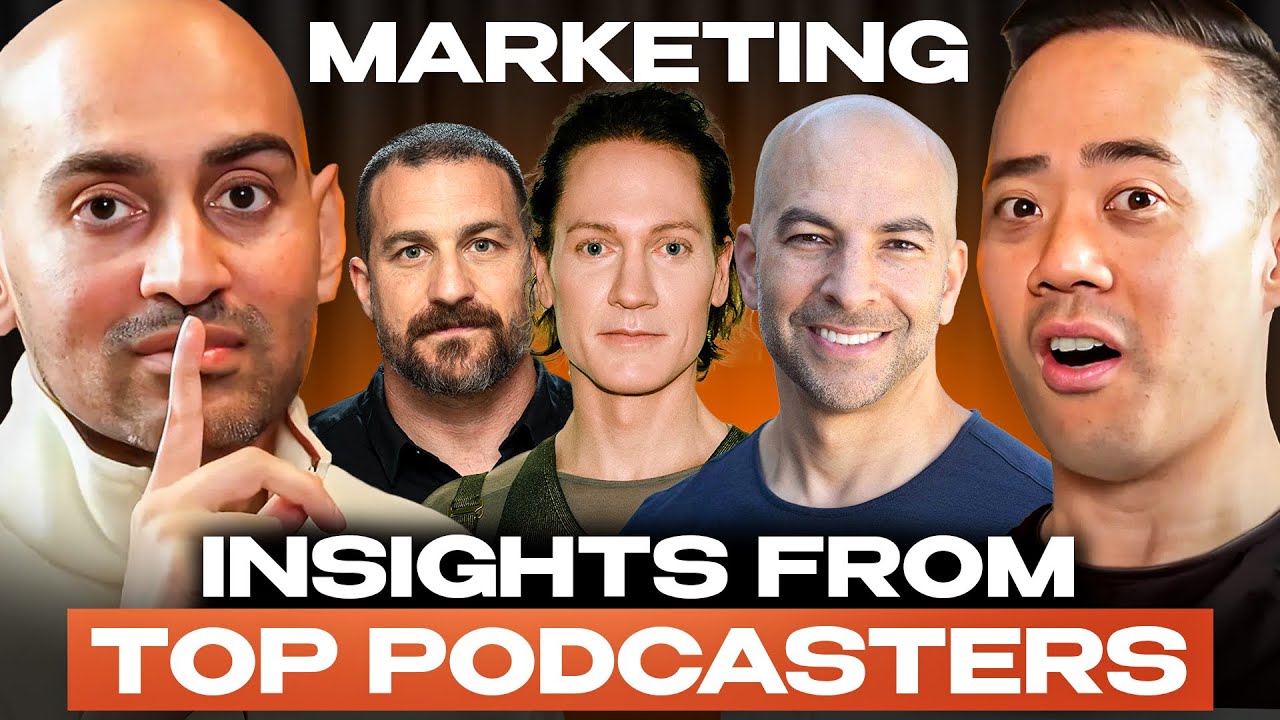
In this informal podcast episode, Eric Siu and Neil Patel recap insights from a high‑profile YPO conference featuring Andrew Huberman, Dr. Peter Attia, Bryan Johnson, Jim Kwik, Jay Shetty, Sarah Gottfried, and others. They discuss marketing tactics used by top creators—such as Huberman’s extensive podcast preparation, Jim Kwik’s subtle 2% self‑promotion, and the contrast between ad‑based revenue and product‑based monetization. They promote two of their own communities: the Agency Owners Association for scaling marketing agencies and the Leveling Up Founders mastermind for high‑growth founders. The conversation then shifts to health and longevity, covering sleep‑chronotype scheduling, the impact of adverse childhood experiences (ACE score) on autoimmunity, key longevity metrics (VO2 max and grip strength), sauna use for reducing all‑cause mortality, and the challenge of filtering the massive information overload of modern media. Throughout, they sprinkle personal anecdotes, humor, and promotional calls‑to‑action.
Chapters
I'm going to tell you what I learned from this conference with Andrew Huberman, Dr. Peter Attia, Jay Shetty was there, Jim Kwik was there, and this guy, Dr. Mark Hyman, and a bunch of other doctors.
Jim Kwik is the mindset—
Yeah, he's like this. He's always like this.
Yeah, I remember in the book, Asian dude, right?
Yeah, yeah, yeah. I'm going to share some marketing lessons first, then I'll share some longevity lessons too if you want some of them because this event was probably— so Neil and I were in this group called YPO. It was probably the best YPO event I've ever been to.
It wasn't just a YPO event.
It was YPO only.
Was it YPO or YPO Beverly Hills?
All YPO. It was open. So people flew from Dubai and stuff for this. And they're like, oh my God, this is the best conference ever. Because the level of speakers was incredibly high. And that drew like 400 people in. And then there's a waitlist of 600 people. So it was like super packed. And they did it at UCLA nearby. So it was easy access. So I'm going to share some of the marketing lessons because A lot of you, for example, when you follow like Andrew Huberman, he's got one of the top podcasts out there, medical podcasts. I don't know if you listen to it. You probably don't. But just context for everyone, Andrew Huberman, he's a doctor and he's a neuroscientist and he does research at Stanford. But he does these super long, sometimes 3 to 4 hour podcast episodes. One thing I would share is that he spends about 12 to 100 hours. That's a big range, 12 to 100 hours preparing for a podcast, depending on if it's a solo podcast or if he's group with somebody else. So, he does a lot of research and that's why his content quality is so incredibly high. And when he records, he basically spends anywhere from 3 to 11 hours recording. So, he might do like a couple takes and things like that. That I didn't know. Isn't that interesting?
That is. I did not know either way. That's quite a bit of takes. Yeah.
Well, and the other thing too, so with Andrew Huberman, Or actually, you know what? Let's move over to Bryan Johnson. So, you know Bryan Johnson? You know who that is?
I do not.
Founder of Braintree. He's like the don't die guy. He's like got the kettlebells and he's like naked. And his son.
He transfused blood from his son and his dad.
Yeah. So, okay, let's talk about the transfusion real quick just for fun. So, his dad had this issue, this medical issue, and they couldn't figure out what to do. And so, he's like, hey, Dad, like why don't I try transfusing some of my plasma over to you? And then, he did that and then a couple months later, his dad got all better. He doesn't know if it's just because of that but he's like, hey, like, you know, might be a correlation there. And then his son did it to him. I don't know what the effect is there but on the way out of the event, I pulled up right next to Brian's car as he was leaving and then we agreed to do a podcast. So, I will ask him all the details there.
Cool.
Yeah.
Okay.
So, some other marketing takeaways here. So, Jim Kwik, the Asian, the Asian brain expert or memory expert, I should say. So, Kwik Brain, that's like what he likes to call himself, I think. Maybe it's something else. But anyway, Jim Kwik. So, subtly from a marketing standpoint, when he speaks on stage or when he does a breakout, he keeps referring back to, yeah, you know, in my book Limitless, in my book Limitless, in this chapter over here. Or he's like, oh yeah. In my podcast that has 100 million downloads, he keeps referring back to his stuff. It's like 98% of the time he's delivering value, but 2% of the time he keeps going back and pitching because he keeps reminding people. He knows that if he keeps setting that anchor over there, a portion of people in the audience are going to take action. And it's just a subtle reminder that you can, if you have something, you can, you know, a nice ratio, you can keep pushing it if you want.
Have you interviewed him on your podcast yet?
He's supposed to come on in the next, I don't know, month or two.
You should talk to him about him 2% of the time pitching his books and services. Yeah, I get the memory thing. But what has it done to his numbers? I'm curious, because he must know. He speaks quite often.
He has to do pretty well too, because he sells so many courses and coaching programs. And this is such a wide audience, Tam, that he's probably doing well.
Yeah, yeah.
He does put a lot of QR codes up and that's, that's nothing necessarily new. All right, real quick, I need to tell you about the group that Neil and I created called the Agency Owners Association. And this is a group that's similar to entrepreneurial organizations such as YPO or EO. By the way, Neil and I are both YPO, but we thought it'd be really cool if we're able to create a group that's dedicated to agency owners to helping them scale. So you can be at 6 figures, 7 figures, 8 figures, we have different groups for different levels. All you have to do is go to marketingschool.io/agency. Again, that's marketingschool.io/agency, and you can go there to apply. And I will tell you right now, what we're doing is there's an online community. We do calls every now and then. There's stuff that we share in there that we don't share publicly. And you can, at least the online community, you can cancel at any time. So you can go there to learn more about it. And that being said, back to the video. The fact of the matter is, when you look at Huberman, when you look at Atiyah, you look at Brian Johnson, Jim Kwik, Jay Shetty, There's even this gal, she wrote a book, her name's Sarah Gottfried. Everyone's a content creator. Like all these people are content creators and some, they don't necessarily sell their own products and services. Some just sell ads, right? Like Huberman just sells ads. But the ones that are making the most money would be like a Jim Kwik for example where he's selling courses, programs. There's another guy, Mark Hyman. He's selling like a thing that will track your biomarkers over time. It's called Function Health. That's SaaS too. And so, I think that's the best way for them to make money. So, I believe everyone's trying to be a creator, but the best creators will eventually— and we've talked about this on the podcast— they're going to build their own products and services because you're only going to make so much off of ads. Yeah.
Now, with Bryan Johnson, did you see that he put something out there? I think it was on Twitter, how the hate actually motivates him because he gets a lot of hate.
I put that on Twitter.
Was it you?
Yeah, the video, right?
I didn't see a video. It was just a quote like someone put like that.
Oh yeah.
He's talking about how the hate motivates him.
He did say that. Yeah. But I think in the video, I shared another YPOers video on Instagram. And he just said, he's like, Darshan, who hosted it, who's in YPO Beverly Hills, he's like, so what do you do about all the hate? He said, like, what do you do about the people that say this? And then Brian's like, who said that? No, I have hate? And then he's like, honestly, it motivates me. He enjoys it.
That means I saw it from you. It was exactly that. You must have put the video up online somewhere.
Yeah. And then, the final thing I'll call out here is this. You can't— in marketing, you can't necessarily trust everything that you hear. You can't even trust everything that you hear from us because sometimes we're just off on our stats or sometimes I have bad memory, sometimes Neil might have bad memory. Maybe not Neil but more so me. But— so, one person at the conference might say, hey, the only types of meats you should eat are fermented meats, right? And that might be like beef jerky or like prosciutto or something like that, right?
Yeah.
Someone else might say, oh, you should do no more than 150 minutes of cardio per week, which I don't necessarily disagree with. But it all comes down to— because you have all these health practitioners recommending things and some stuff contradicts each other. And so, when you're listening to a podcast, when you're watching YouTube videos, you can't trust everything that you hear. You basically have to learn to think for yourself.
But that's the same that goes with most things because when you look at diets, it's not necessarily when someone says you shouldn't do this and you should do this instead. They have different formulas. For example, Some people are like, oh, you shouldn't do cardio, you should lift a lot of weights and only eat protein and be on a carnivore diet. That could work for some people and their body. Other people, they don't do well with protein. Other people, they don't do well with, you know, they don't weightlift as much, but they love cardio and they just do rowing for 5, 10 hours a day. I don't think there's a right or wrong approach. It's the same thing when people give marketing stats for their business or stuff that they see. Like I put a lot out on Twitter. If I crawl 5 million YouTube posts and I'm putting out stats and data about that, it doesn't mean it's the end-all be-all.
I didn't crawl their whole database.
I crawled 5 million, which some may see— think as a big sample size. But in the grand scheme of things, if over 4 billion pieces of content are being published each and every single day, it's actually a little bit more than that. 5 million in total isn't that big of a sample size.
Yeah, I think it just comes down to at the end of the day, what's important is there's so much information out there. Actually, Jim Kwik gave this. If you think about all the information generated from the beginning of humanity until 2003, how long do you think it takes for us to generate that information today?
What do you mean? Like if I have a question? I just type it into Google.
No. So like from the beginning of humanity all the way up to 2003, how much more information are we creating today? So how many days do you think it takes to generate that same timeline?
Oh, I think it's growing at an exponential pace.
If you were to guess, is it like how many months, how many years?
From the beginning of history? Yeah. I would say it's in— you probably create everything that we've had in a matter of a year or 2.
Every 2 days.
Every 2 days.
No joke. That's how much information. And so how do you know what to filter, right? And so part of this podcast is hopefully, you know, we're having banter. Oftentimes we'll disagree, we'll agree on things, but we have our own filter. And so you have to learn how to create your own filter. All right. So I wanted to take a second to tell you about Leveling Up Founders. This is an event/mastermind for people doing 7, 8, 9 figures. These are founders that are doing that amount. And we've been doing this event for a couple of years now. We've had amazing speakers, but more than anything, it's about the people. What I mean by that is like-minded people want to hang out with like-minded people, and this is the best spot to connect with people of a certain caliber. And we vet every single person that comes through. So if people are even though they make a lot of money, but their character, we don't really align with that, we're not necessarily going to let them in. We did this event in Beverly Hills and it's happening in the beginning of August. All you have to do to learn more about it is just go to levelingup.com/founders. Again, it's levelingup.com/founders. If you want to hang out with amazing people, Neil, my podcast co-host, is going to be there. I'm going to be there. People like Syed Balkhi, he will be there as well. And again, it's going to be a great time. levelingup.com/founders to learn more. And we'll see you inside. You want some health takeaways before we move on?
Yeah. Okay.
So, this one's interesting. I'm trying this right now. So, this guy, Dr. Bruce, he's known as the sleep doctor, right? And this is when I was having some insomnia issues. Actually, that day, there's one night where I didn't sleep again, right? And I was like freaking out again. So—
But you're good now?
I'm good now. Yeah. Thank you. So, he was working with a client. Let's call the client Sally, okay? Sally, Was not showing up to work on time. Sally was falling asleep at work. Sally wasn't doing a good job at work, okay? And so—
You sure you don't want to change your name to Vera?
No. So Sally, Sally, the sleep doctor says, hey Sally, can I talk to your boss? And so, he calls the boss and the boss is like, I don't care what you say, I'm firing her at the end of the week. And then the sleep doctor is like, well, can I change her schedule from 9 to 5 until 11 to 7? A bear does their best work at 11 to 12 or so, right? That's— but a lion, a lion's like you and me, we wake up early and we're most productive at like 8 or 9-ish, right? And so, he's like, based on her chronotype, he changed her— the time she was going into work. Basically, 2 weeks later, the boss called the sleep doctor back and said, hey, can you do this with 4 other employees that I have? Basically, it completely turned everything around. And I'm testing this right now with one employee that we have in Brazil. And he wakes up, he sleeps at like 1, 2 AM or so. I was like, okay, I'll tell you what. Why don't you come into work at 11 to 7? We're going to test this for 2 weeks and see how this goes. So, we're testing that right now. The other big thing I did with sleep was I couldn't sleep, right? Such a duh statement. He's like, dude, the sleep doctor's like, any clocks you have in the room, anywhere it shows the time, remove all of it. Because when you wake up in the middle of the night or when you're trying to fall asleep, you keep looking at it, you keep looking at it, it gives more and more anxiety. It increases it even more. And for me, like, because I'm so focused on having high performance when it comes to sleep, I obsess over it.
What about your Apple Watch and your phone? Because that has a time.
No, you don't have it far away. Ideally, your phone's in another room. You don't even think about it.
There's no way you put your phone in another room.
I put my phone all the way on a table. So, it's not near me.
Yeah.
Is your phone near you?
Yeah, it's right next to—
it's underneath my pillow. Dude, that's not good. EMFs is bad for you.
Is it?
Yeah.
Okay, I'm gonna start putting it on the ground.
See, there you go. Yeah. But look, I can go on and on here. There's so much interesting stuff. I'm gonna share my takeaways You can see this on my Twitter, but you'll like this stuff. I'll share it with you.
Yeah, that's cool. What else did you learn at the YPO event?
Well, okay, I mean, this one's interesting. So, your adverse childhood experiences can lead to autoimmune conditions. And so, this gal, Sarah Gottfried, she was talking about this. And she talks about this thing called the ACE score, so A-C-E, which stands for adverse childhood experience. And I thought for sure I would have like a, you know, some trauma or whatever, right? My— so basically anything above 0 is like you have some trauma. My score is a 0.
I was about to say your parents were great to you. I'm like, what trauma would you have?
I'm like, come on, I have some trauma, right? I was like, I have no trauma. But trauma, some examples of trauma would be like, you know, your parents hit you or your parents were, um, you know, mentally abusive to you, right? Or, um, you know, you didn't get like a home to sleep in, like a lot of that stuff. The more you have it, the more you're like likely to have, um, adverse conditions. Isn't that— No, I'm so shocked that you thought you had trauma. I was like, come on, give me at least one. Your mom and dad are so They're so amazing.
They give you a roof, they give you food, they put you in good schools, they pay for your college.
Sometimes you don't know until you do a test like this.
If you want to buy a home, they'll help you out even though you don't need their help. They would cook for you. They check in on you. They still like say, Eric, come hang with us on the weekend. Like, you got amazing loving parents.
You can't ask for anything better. But sometimes you want to feel like, you know, you want to feel like you're in the crowd, right? Like, hey, I have some conditions too. But when you look at it, it's like, nope, not really.
It's like me saying like my parents were really mean to me when I was a kid.
No, our parents were loving, mean, good.
Our parents were looking for school.
They were only tough on us because they wanted the best for us. Final thing. You know how I say I have a bad memory?
Yeah.
Jim Kwik says this, there's no such thing as a good memory or a bad memory, only a trained or untrained memory.
I disagree with that. Okay, go. So my daughter's 4. How does she remember that someone else took our luggage at the airport when she was a year old? No joke, a year old. Technically, she was a little bit less than a year old. How does she remember that? She's like, Mommy, Mommy. She was around 3 when she said this. She's like, do you remember when we lost our luggage at the airport? The only time we lost our luggage at the airport. She's like, someone took Daddy's suitcase.
How do you remember that at 1 year old?
I don't know. I have a really good memory.
It's your memory.
But she has amazing memory. She still remembers, like, if my wife will say like, hey, let's go to this toy store or whatever it may be. She'll end up saying like, oh yeah, it's next to the nail salon and it's next to Baskin-Robbins or wherever. She's like, is that the one that you're talking about? She has a great memory. But what memory skills did I train her with? Nothing.
Yeah.
There was no training. It's just like, I know some people who genuinely have photographic memory. What training did they get? I get what Jim was saying, maybe, but I think some people just naturally have a good memory. And some people naturally have a terrible memory. And thank goodness I have a good memory.
It's like basketball. You might have the God-given talents. Some people like can be LeBron James and then, you know, some people can be like us. I'll give you one more thing. You want to live longer, right? Yes, of course. Okay, here. Here's the last thing. There's only— there's 2 main things that are the best indicators of your longevity. One is your VO2 max. Do you know what that is?
No.
How well your body uses oxygen to make energy. And so, you can test that. You can go to like Equinox or something. They'll put something on you and you're just running for 20 minutes or so. And so, the other one would be grip strength. So, grip strength measures your overall body strength. If you got those 2 like high, then you'll be good. Bryan Johnson's VO2 max is 58, which puts him at like basically like near Olympian level. Wow.
He's really healthy. People make fun of him but I'm like, look, the guy is doing whatever he likes. Leave him alone and let him do it.
You want to live long? It's those 2 things, VO2 max, grip strength. Those are the only things you should— those are the main things you should measure.
So, how do you explain this with people like Warren Buffett?
I mean, Warren Buffett is 97, 98, 96?
I do not know his age. Warren Buffett. I'll tell you right now, 93.
93. I don't know how to explain it for Warren Buffett. Like, he's lived long.
He eats McDonald's every day and he drinks— is it Dr Pepper or Coke? Coke.
Yeah.
And sees candies. Yeah, yeah, yeah.
But that's the exception, not the rule.
Yeah, yeah. I, I'm just a big believer that I don't necessarily think there's a right or wrong answer, like if it's VO2 or grip strength. It's just Try to live a decent, normal, healthy life and, you know, optimize and whatever happens, happens. You can't control everything. Yeah.
Well, they talk about all-cause mortality, right? So, that's like not assuming you don't get hit by like a bus or something like that. It's like, you know, you can decrease your all-cause mortality by, for example, if you do sauna 4 times a week, 20 minutes, then you're going to decrease it by about 40% or 50% or so. All these little things that are— A sauna?
Dry sauna or wet sauna?
Dry sauna. I think both are fine, but just, I would just prefer dry sauna. So do it like maybe 2 hours before you go to bed. You have one here, don't you?
Yeah, I have a dry and a wet one. Just use it.
And I'm sure nobody uses it.
No, no one ever uses it.
Try it for like 2, 3 weeks and see what happens. Because the thing is, it, um, I saw someone else post, you know how the Finnish people are the happiest people in the world? That's another marketing thing. It's like, be the happiest country in the world, right? A big thing is they have saunas everywhere. Like even in your office, there's a sauna. Right. It's like saunas everywhere. And so that has to be part of the reason, right? Maybe correlation is not causation. But yeah, I don't do it enough because I'm sure everyone uses it at my place. So I've just been a little lazy.
Yeah, I've never been a fan of a dry sauna, at least because I feel like I'm just like wrinkling and it's taking the life out of me.
You are, but after you come out of it, you feel really good. Yaniv uses it all the time.
But he lives in a desert. He should just go outside. Oh yeah, it's free.
That's true. But that is it for today. Please don't forget to rate, review, and subscribe. Go to marketingschool.io/agency if you want to join the Agency Owners Association. That's a group Neil and I have to help agency owners grow. And yeah, we'll catch you later.









