Most New Hires Are Dead Weight Without These Two Things
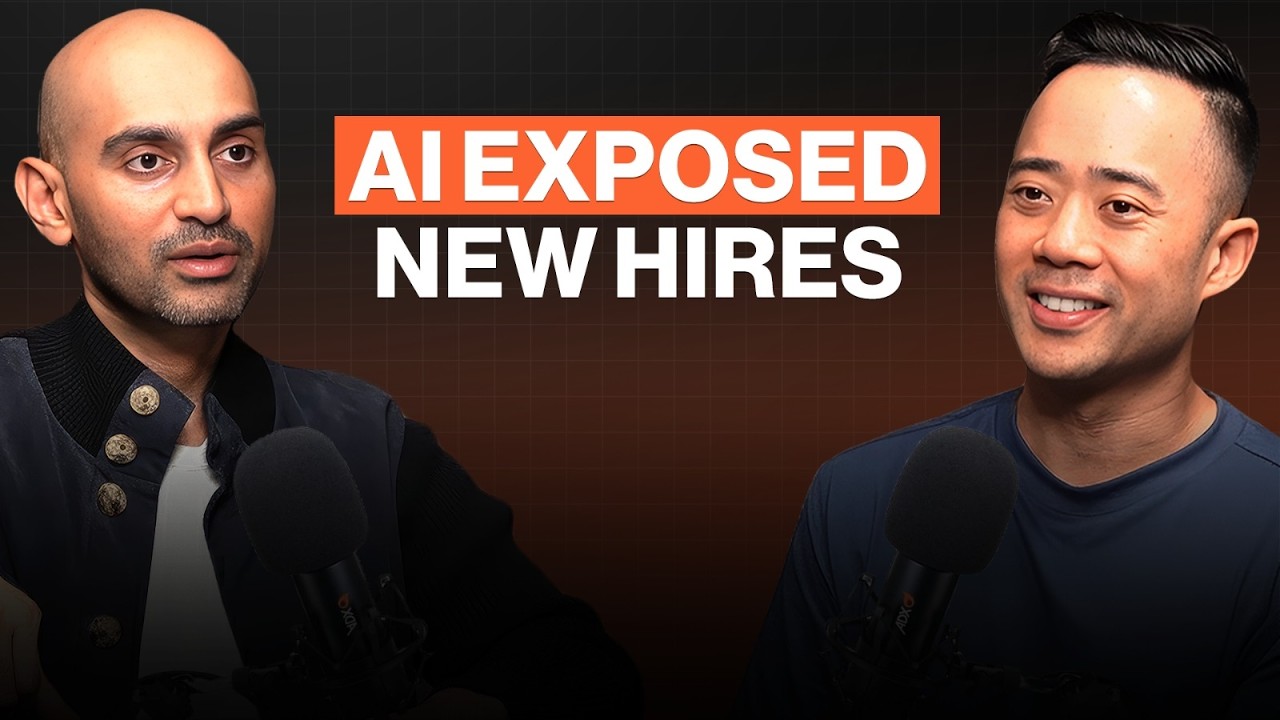
Eric Siu and Neil Patel argue that new hires need AI fluency and the ability to learn fast to be productive. They discuss how tools like Claude Code and Gamma are reshaping marketing roles, and share examples like building churn monitors and personal AI assistants that teams are shipping now.
Chapters
So this person Yash tweets this. So he says, I'm now significantly bearish on big headcounts and team. Opus 4.5 is clearly better than 90% of talent. Without taste and agency, any extra hires are merely a deadweight. New talent will have to adapt to AI or be prepared to be jobless or underpaid for the rest of their lives. Now, this actually goes back into the brand piece. Without taste— taste to me helps fulfill a brand's promise, okay? And a lot of people right now are talking about, Oh, you got to have taste, right? Which is kind of similar to what the other guy was saying. All these things are kind of intertwined. Now, the other piece here, any extra hires are merely dead weight, and then, you know, be prepared to adapt to AI. One of our initiatives now, Neil, and I'm curious to know kind of what you guys are doing here, but from an AI fluency standpoint, I'm like, dude, forget, you know, having people build these agentic workflows. Our mandate now, the— and I do think this is a code red situation for us at least.
Yeah.
Um, is everyone needs to be proficient at Claude code, um, in the next 6 months or so. And we're gonna get them there because literally, like, we had someone on our team, she was a little hesitant, but yesterday she started picking it up and today she's asking me for API access at this and that, right? Um, and the people who are using it right now are, are moving at warp speed. So, um, for us it's like, okay, we're gonna do the office hours weekly, we're gonna do the hackathons every quarter or so, um, we're gonna meet with people whenever they need. We might need to hire other coaches, you know, during off, um, off hours or whatever, but Um, to me, I would rather— I don't want to say these people are dead weight, let's get rid of them. I want to bring people along for the journey, and whoever wants to drink the water, great. And whoever doesn't, you know, that's— they'll— I think they'll, they'll kind of self-select themselves out. But I want to make it a situation where everyone has a chance to grow, um, because it's, it's, um, it's easier to, to bring— I hope it's easier to bring people along than to have to, you know, not, not, not have them.
Yeah, what we're doing on the AI front is we're really looking forward to people who not only understand where the world's going, where it's going, but how to adapt. And I'll give you a great example of this. We're doing a webinar soon. I forgot what the title is, but it's something like 51% of website traffic is now bots. Here's how to do well in a bot-first marketing world, right? So if marketers don't understand the concept on what's actually going to happen in the next year or 2, because I bet you even more bots are going to end up visiting websites and interacting with them. If they don't understand how to adapt and what that world looks like, they're not going to succeed for the customer. They're just going to succeed in the old game and the old game doesn't work anymore.
All right. So I wanted to take a moment to tell you about my podcast co-host Neil's agency called NP Digital, and they work with a whole host of global companies or global organization. Also, Neil has SEO tools such as Ubersuggest and AnswerThePublic. All you have to do is go to npdigital.com to learn more. And we'll see you on the other side. Yep. Dude, actually, you know what's interesting? Speaking of the old game, remember Gagan who founded Udemy and now he had— remember he had the Growth Hacker Conference? So he tweeted this today and you were just talking about the old way, right? So growth hacking is a term or growth marketing is a term that hasn't been used in a while. So I'm not going to read the whole thing here, but Gagan tweets this and he says, growth marketing was perhaps the most important trend in tech in 2010. Chamath literally got 1% of Facebook and became a billionaire for starting the first ever growth team at Facebook. I ran a conference called Growth Hackers Conference and it was sold out multiple years in a row. But by 2020, growth marketing was practically dead. Nobody was talking about it and most growth teams folded fully into product orgs. In 2026, I believe growth hacking will make a strong comeback, likely without the cringey name. Growth used to be cool art where super high IQ and high EQ practitioners leverage consumer insight, data, and product to create unique ways to launch their products. So he thinks what it's going to look like now, Is, you know, you're gonna have vibe coding, which we kind of talked about, right, to build micro products and micro workflows from scratch. Um, we've talked about this many times on this podcast. AI can ingest massive amounts of data and therefore create new insights. AE will become a massive growth opportunity. Um, and then I'm fairly confident OpenAI and Anthropic will offer an app store for ChatGPT and Claude. And finally, content marketing will look totally different in the age of unlimited creativity and productivity from AI-generated content. So there are a lot of fresh opportunities for growth marketers to play with and innovate on. The intersection of data, product, and marketing is going to have a rebirth. Game on.
Yeah, I agree with him. I think you're already starting to see a resurgence, but it's not called growth hacking or growth marketing. People just want marketers to think— when I look at the old school version of a growth hacker or growth marketer, or they would call it growth hacking or something like that, I forgot, but it was one of those terms.
Yeah, growth hacking, growth hacker. Yeah.
They looked at it as like, Hey, you're not a hacker that's breaking code. They didn't look at it as you're a VP of marketing. They looked at it as you're leveraging whatever to grow the business. Sometimes that's traditional marketing channels like Google Ads or SEO. Sometimes that's non-traditional channels like viral loops. Remember Dropbox? Get more space if you share this on social media or invite more users who actually sign up, right? That's a creative way to grow and you're growing in traditional marketing sense, but you can also grow through product or or referral systems, or you can do things like Lovable. I don't know if you've seen Lovable, but if you build something on Lovable, it's public. And them having all that stuff public helps feed more people into their ecosystem, which causes more signups to Lovable. And in today's world, because of AI and because of things like Claude Code, Marketers now have more skills without really having to learn all these skills, right? So I think companies are going to look for individuals who are more out-of-the-box thinkers and are leveraging the tools at their fingertips to get more done, even without quote unquote really knowing all those skill sets because the tools enable.
And these, I'll say that the people we're talking to right now, I mentioned a little earlier, Earlier on this podcast, the people we're talking to, they're interested in leaving their companies because their companies aren't moving quickly enough. So they're hungry. The cool thing, I think it's going to become cool to say you want to move to AI-forward company because you want a job in the future, right? But I think people are at the tip of the iceberg right now. They are looking to leave these companies, and this is your chance to hire these people. And I would just say this, you know, for you and I, like, sure, we have our businesses to operate, but to have these superpowers now, I do feel like growth hacking is back. Maybe I don't want to call it that, but these are things that I wish I would've had. You and I in our mid-20s, I wish we would've had because we'd have to wait for engineering to push to make changes, and then changes might take another 3 days or another week or another 2 weeks or so. Maybe it's not what you want exactly, but here you're just constantly keeping it going and you can have multiple tabs open where you can go all day. So I think really the sky's the limit. And by the way, if you are this type of person, reach out to me on Instagram or X. And, you know, both Neil and I, we are hiring these people. And so please reach out to us because you are very high leverage. And I think we're going to move into a world, Neil, where a lot of companies are going to have less headcount, but I think people are going to get paid a lot more.
Yeah, I can see people getting paid more. Also, the easiest way for people to think about this, everyone knows Superman. It's just like, would you want laser eyes or ice eyes where you can like make things freeze?
Would you like to be able to— You have ice eyes, why don't you just make— this is sloth, man. You're like a ChatGPT.
You don't have ice eyes. No, I thought Superman was able to freeze stuff too.
He can blow to freeze things and he has laser eyes.
Oh, so the eyes are only laser. Okay, my bad. He's using his mouth to— I knew he could freeze, but he's using his mouth to freeze. He can run extremely fast. He can fly. He has super strength. Think about a human with all these abilities. It sounds really cool. They can do way more than the average human. It's the same thing. Yes, you as a human, you're not really changing, but you have all these tools at your fingertips that can allow you to perform way better than you're used to. But here's the kicker. You got to actually be willing to use them and embrace them. It's like the person who works out but never takes protein powder, and they're like, why am I not getting muscle definition? Well, if you don't ever take enough protein, your body can't actually build it. So there's solutions like supplements and stuff like that. Some people choose not to take them. Some people do. It's— you have these things at your fingertips. If you don't use them, you're not going to do well in today's world. That's the hardest part that we're finding. Everyone says they're willing to use it, but then when you actually check what they've done and how they use them in the past during interview processes, people don't really use them. They just claim they're open to it and they do use it, but it's just a lot of BS.
Dude, as we talk about this more, I think when I do these interviews now, I'm just going to have a full AI conversation with them. If they can't keep up, I'm just ending the interview. Like, that's all I need because it covers all 4 of our values. I'm like, how much easier does it get right now?
Yeah, I think it depends on what role, but yes, some roles like HR, you may not need it as much.
Even the HR person we're interviewing right now is heavy on AI. And I'm like, thank God. I'm like, I'm like, hey, so how do you do that? He's like, I'm actually responsible for rolling AI fluency throughout the organization. I was like, sounds good.
Oh, that's cool. I've never seen HR being responsible for that.
So I asked him about that. I was like, so why are you guys responsible for it? He's like, if it's not coming in from the people team, the HR team, and we're not, it's not coming bottom up, we're not going to adopt it as quickly. And he's like, that's how we adopted at the current company that he's at right now.
So yeah, that's a good model. Never thought about that.
But to Neil's point, again, it's so maybe we can talk about the hows, right? The superpowers. And I can talk about some of these superpowers I gained in the last week or so. Again, for Claude Code, it's just there's actually a Claude Code for Marketing course. You can search for that. There's a lot of people talking about it on X. I think you just got to go out there and play with it, set it up, and then just get your feet wet, right? That's just a matter of getting the reps in and starting to build some muscle there. I think Manus is great, although it can get pretty expensive.
It's a great general agent.
Um, you know, dude, I'm talking to the CEO of Gamma, you know, that the, the presentation app?
No.
Um, so I'm talking to him about an hour or so, and I'm interviewing all these CEOs to understand how they're driving AI fluency and how efficient their businesses are right now. And, um, he's— they're valued at $2.1 billion, they have 50 employees, and they do $100 million in annual recurring revenue. So they have a mandate that revenue per employee needs to be above $2 million a year or so. But they— their whole thing too is like, we're only going to hire AI-forward people. Same thing with Lovable, we can only hire AI-forward people. So I think You just got to play with these things, whether it's Gamma, you're using Granola for note-taking, you're using SuperWhisper or WhisperFlow for dictation, um, and, and get out there and do it. Because if you start doing these things, you're gonna be way ahead of everyone else. Um, and people, again, like when I was talking to my, my friend group yesterday, everyone's looking to hire these people. In fact, I have people messaging me, they're texting me, they're like, dude, can we just do a call? Can you like tell me, like, I don't know what to do as a founder right now. And these people are, they're doing fairly well. Let's just call it like $50, $60 million a year. And, um, I had someone else text me. He has like a media company. On Instagram, he messaged me and he's like, dude, can you make a video on this? I'm like, what would you like the video to be about? He's like, I just need to know how to use all this stuff, right? And he does really well too. So my point is nobody really knows what they're doing right now. I don't think I'm like flying by the seat of my pants right now. The moment I convince Neil to do this, he'll be flying by the seat of his pants too. And I'm not saying Neil doesn't do this stuff. He does use it, but I got to get him on this Claude Code train. So.
Yeah. And the one caveat I would tell everyone is when you're looking to hire, depending on the size of your organization, You don't need AI fluency amazing for every single role. An example for this is, let's say you have someone whose job, or you're looking to hire someone who just acquires companies. All right. And we've had this role and this guy Carlos, you know, he goes and finds deals for us. There's other people in our organization who can help him source deals by using AI to send a lot of emails, but Carlos himself doesn't have Crazy AI fluency that let's say Eric may have, but Carlos' job is to evaluate deals. He, you know, we can use tech or our finance team can use tech to help evaluate deals and internal team can help also evaluate. But what his job is to really do is other than value— evaluating deals before bringing it to the team is once we like a deal to go figure out a structure that works, close the deal, create something that's a win-win scenario, or at least a win on our end. And you of course want to win on the other person's end because If you're not, they're not going to stick around. And someone like Carlos doesn't have to have the highest knowledge when it comes to AI, maybe understanding what AI is when he's looking for deals, but he's not going to know how to do half the stuff Eric's talking about. And I'd rather have someone like that who's like, yeah, over my career I bought $6 billion worth of deals versus someone who's newer who knows AI, And then sending them to go negotiate a $50 million deal and they screw it up and it costs you $60 million instead of $50 because they just don't have some of the skills that are needed to go close a decent-sized deal.
Yeah, so my response to that would be just your company, your own company, you'll establish your own guidelines for what AI proficient means. And I do think, I think you probably agree with this, Carlos needs to at least be proficient, whatever that means to your company.
Yeah, like how to use ChatGPT. Like he'll be able to put numbers in it and then it crunches it so he doesn't the finance team for basic stuff, right? But like, we don't expect him to like learn how to code stuff up. It's just, it's not really needed for his role.
I think they're— so one, every company needs to have baseline expectations for AI fluency. If you don't, I think that's the starting point. The second piece is whatever that means. It could be ChatGPT. For us, you know, we've defined, you know, we have one level which is unacceptable, meaning you're not using it at all. 2 would be, you know, you are capable, meaning you're using ChatGPT. 3 would be you're adoptive, right? or adaptive, that you're trying new things, you're building agentic workflows. Transformative would be that you're using cloud code. So the mandate I'm going to have, and I don't expect everyone to do this because I think it's a fairly high bar, but our mandate is everyone needs to be good at cloud code because it's not like we have tons of people right now. So I'd rather get us to that baseline fluency. And if people are capable and willing, then we're going to take them there. And if not, that's fine. You know, there's plenty of places that will.
So Yeah, no, and I think you're spot on. I don't know if they actually do this, but I do know we pay for some of these tools for our users, whether it's ChatGPT, Copilot, et cetera, and I don't know if they do this, but it would be really cool if they had a report on how many people in your organization actually use what you're paying for.
They do. The problem with the usage thing is, because I was thinking about this, I was like, okay, should we measure on usage? The problem is usage is very easy to game. You can just log in, log out. Um, I'd rather see shit that they've actually built. And more importantly to what you said earlier, shit that actually adds to efficiencies, which will help with revenue per employee. So usage alone, I don't think will be helpful enough, but there are reports like, um, our mutual friend, he actually has team accounts for everyone, um, for OpenAI, and you can see how much usage is happening. Same thing with Cursor. You can see how much code people are pushing.
Oh, that's cool. But I want to know like, hey, uh, if I tell ChatGPT, this is what we're looking people to use a product for in different departments, how many of them actually do it?
You can do that. Yeah. Yeah. So are you going to go buy it?
No comment.
Yeah. But look, I think before we wrap up here, I mean, I think maybe, you know what, I can share some of the stuff I built during AI Week as we wrap up here.
And going back to Eric's question to me, yeah, I would implement it if it's not implemented right now. I'm going to actually message the team about it after we're done with this.
Okay. So by the way, one thing I want to call out too is we— actually, no, I'll leave that one alone. Okay. Let me just talk about what I built over Christmas break or holidays. So I built a churn risk and expansion monitor that looks at all of our our client call transcripts, and it has memory. So it sees over time how we're doing with that client. And then there's a leaderboard at the end of the week, and it basically maps out, it'll say, like, for example, if Neil, you and I are on a call, and you said 2 or 3 things that showed expansion opportunity, it will actually say, hey, Neil said this and that. And we think that based on this account size, we can upsell this and that, right? And then we also think, here's some opportunity for goodwill. Here's, um, some churn flags that you should, you should, um, spot. And this will basically feed into that client Slack channel. That's one thing. But the key thing is you're able to build this with like a Lindy or Zapier, but you can build this using Claude Code and it has memory, which that memory then compounds over time. And you can see how you can see over time how that client is doing too. You have like a line graph, right? But before, Neil, like, I'm sure that'd be pretty valuable to you guys, right? But before, you and I would have wanted it, but like, we wouldn't know where to get it from.
Yes. Dude, I think 2026 is going to be an amazing year. And the reason I say that is we've had AI. I'm not looking for a new version of ChatGPT or Copilot or Gemini. What I'm looking for is tools that actually improve productivity more than just someone searching and getting an answer. And I think these AI platforms are shifting Towards creating more tools that make our lives easier as marketers.
Neil, I'll give you one more. Neil, you think you make pretty sound decisions, right? Most of the time?
Yes.
Okay. So imagine if there's an ambient Neil, you clone yourself and maybe it's trained on all your information, all the client, all the calls that you've been on internally, it's trained on all the content you put out there. So maybe it's not all the stuff that you say behind the scenes because you're on the phone a lot, right? But imagine it took, you know, your transcripts, whatever, you have a Neil Patel brain. Okay, that whenever something is slipping according to what the company's goals are, it can notify you if it's a big thing. Most of the small things you let go, but because you are good at being in different spots at once and coming in when you need to push, right? But at the same time, you kind of need to know what's happening. And if you're notified on these things, like you're quick to jump on it. How useful would that be to you? A little bit useful?
It would be useful, a little bit useful. One thing that we do have, I've written down Since my start of my career. So I'm 24 years in, all the major mistakes that I've made that have cost me a lot of money and the circumstances around those mistakes and the timing of it. So not only like the year, I don't always have the exact like day, but I have the month, the month and the year, the situation I was in, the way where the business was at and what happened. And I do have it uploaded where I can end up asking questions And it breaks down all the mistakes and all the big decisions that I've made that were worth it. It's just kind of like a sound check if I'm crazy or not.
Dude, I have— okay, see, the good thing about Neil is he doesn't even need to read these books. So you actually pulled that— you didn't read this book, but it's actually from a book called The Effective Executive from Peter Drucker. And it's only like a 50-page book, but it talks about feedback analysis, which is where you're writing out all the big decisions you made in your life and you're spotting patterns, right? Now imagine if you had that doc trained on all your content, trained on all the context in the company, and then it's mapping out, hey, it looks like this is happening again, Neil. Hey, it looks like this pattern might be happening. It might be a false positive, but if it's spotting it for you ahead of time, you can then decide what you want to do with that.
Yeah, and it's not that advanced. It's more so I ask questions and then it'll tell me based on past, not necessarily, hey, you're following into this pattern again and notify me. That would be great, but we don't have that yet.
Trust me, once I get you on this train, you're just going to go build this yourself and we'll take you out. Yeah, yeah, I know.
I'm thinking, I'm like, after dinner, should I just A lot of cloud code, including myself.
I'm telling you, you have nothing better to do right now. You're in a hotel. So like—
No, I have a meeting right after this.
Okay, fine. You have something better to do right now, but maybe after you can do it. Yeah, you can do it on the plane when you're flying back.
Uh, Friday, Friday early morning.
Yeah. Do it when you're flying back.
Yeah.
So that being said, we will catch you later.









