NEW AI and Tech Recommendations for Agencies
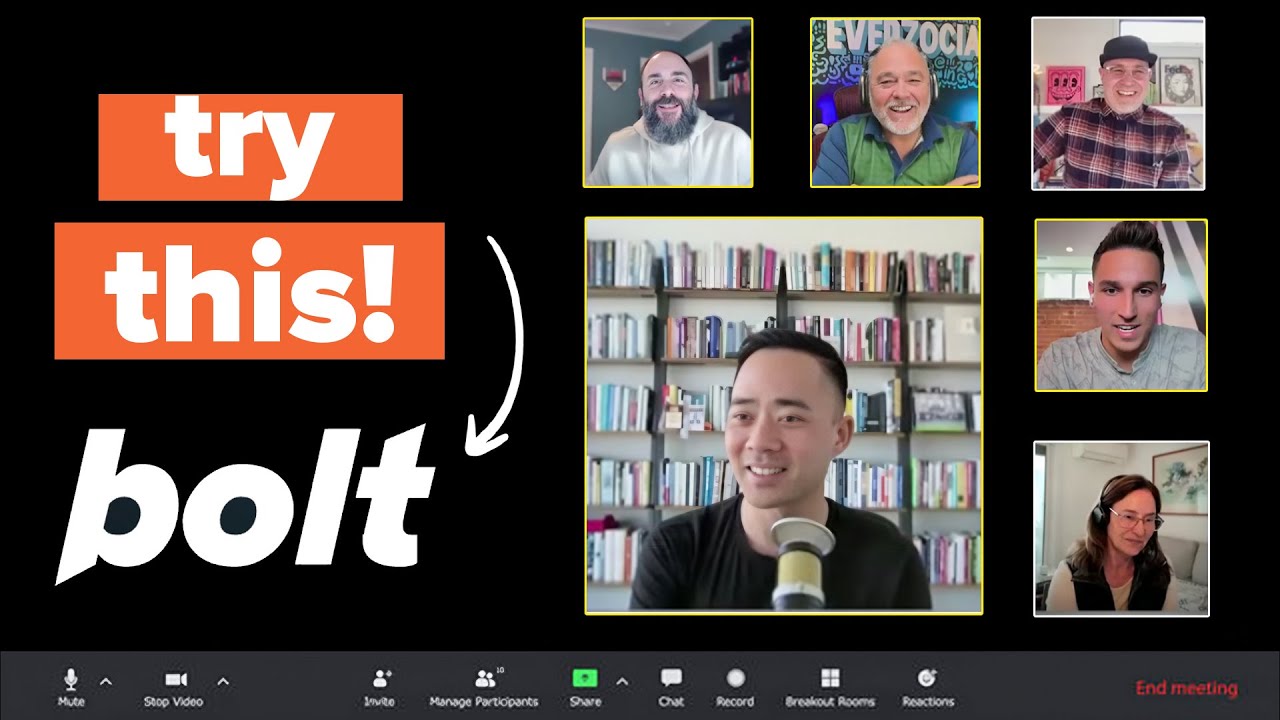
Eric Siu shares AI tools for agencies including Bolt.new and Claude, plus growth tactics like case studies and client positioning. He covers programmatic CRO updates from Single Grain and hiring standards for agency teams.
Chapters
All right, so we have a little treat for you. So this is a coaching call from the Agency Owners Association. This is a group that Neil and I have for agency owners to help you grow faster. So if you're in the agency space, you are a services business, this is applicable to you. It's a little preview of a call. It's probably 10, 15 minutes or so, and you'll get a sense for what it looks like to be in the group. If you want to learn more about the group, you can go to marketingschool.io/agency. Again, it's marketingschool.io/agency.
Hi, everyone.
Hope you enjoy the episode.
What's up, Eric? Are you back from traveling?
I am back from traveling. I'm back from Thailand, back from Japan.
Did you find your wife yet?
No, don't listen to Neil. I'm not single.
So yeah.
I'm teasing you.
I'm teasing you.
Yeah, but this will go on the podcast too, by the way.
Oh shoot. Okay.
No, no, it's fine. No, no, no, no, no. No need to feel bad about it. But why don't we go ahead and, uh, why don't we go ahead and get started here? So I'm gonna be on for the first 50-ish minutes or so. Um, and then, um, Austin will help kind of close it out with, with housekeeping stuff. But, um, I, I just got a, got off a call with Microsoft and, uh, they're, they're, so they're building like these new Copilots. Um, and then basically you can build your own agents and things like that, right? So they're in the very early stages of it. And, um, it's pretty exciting stuff what's going on. And then we're, we're kind of doing the, the same thing too. So Um, you know, go play around with that stuff. I, I think if there's any takeaway from, from me this week before we jump into questions and you can start to ask your questions or drop it in the chat is, so I started using Bolt.new and, um, I don't know if any of you have tried it, but it's like, I've talked about Replit, I've talked about Cursor, but Bolt basically will allow you to kind of code up a frontend app. And, um, you know, you, it, it's pretty quick. I know, fix the errors too. So I had it code, code up an app for me saying, hey, why don't you create an app for me where I can upload audio or video files, or you can pull from a YouTube link and, you know, make 5 viral headlines and thumbnails based on the content itself. And it did that for me, right? And, you know, you can basically get, call it 60, 70% there, and then you can have a developer kind of close it out for you. But I think this helps marketers now basically become pseudo developers. So Bolt.new would be one. And then obviously Anthropic came out with Computer Use, and I, I think that's still a little early right now. Where it's like an agent that will help you do research on— they'll help you click around, do research on like, you know, nice restaurants you want to go to and things like that, right? And so I think that's a little— still a little nascent. But if there's anything you should go play around with, it's bolt.new right now. And I'm trying to think if there's any new— any other new developments on the AI side. Not really. And on the agency side, just an update. So Neil's gonna— I spoke with Neil, we were recording yesterday, so We're going to come in together on the 15th of November, so mark your calendars for that one. And other than that, Austin, what other housekeeping items do we have before we jump into the meat?
Yeah, we have a bunch of guest speakers coming in. So I think for the next 4 weeks, we're booked out on Wednesdays for guest speakers, whether that's a member spotlight or like an external guest speaker. We have the CEO of ConversionWise, Oliver Kenyon. We have, uh, I haven't made the announcement yet, but we have another, um, great CEO on agent profitability coming in, uh, and looking at efficiencies. So really excited about that. Rebecca gave the, the, um, first member spotlight, uh, masterclass this week.
So nice job, Rebecca.
Yeah.
Hell yeah. Oh, uh, it was a great—
it was a good experience for me too. Awesome. Yeah, it was very good.
We loved it. On that note, I'll touch it again at the end, but the lead process is changing because I wanna help you guys close more deals. So make sure you put your capabilities deck or, you know, what you guys offer, some testimonials, some logos. Make sure you send that over to me because I will send that to the prospect before we connect. So that's it.
Cool.
All right, let's jump into the questions. Anybody have any questions or comments, or you can Just raise your hand or drop it in the chat.
And Eric, we wanted to ask, is this call going to be used on the podcast or will this be internal only?
This probably will be used on the podcast.
Okay. That is for everyone to know.
Yeah.
Good job. I definitely took advantage of the fact it was used on the podcast.
That's awesome.
Yes.
Well, thank you for that post, Rebecca. Those always go a long way. Yeah, I just, I, we did all kinds of content generation with that. I was happy to stream off your name. Awesome. Hey, happy to, happy to help. Happy to have you as well.
No, it's nice.
Thank you. Cool. All right. If no questions, see you guys later.
I have a, I have a share that I might—
Yeah, go for it. Go for it.
Or might find interesting related to the AI stuff. Yesterday I had a very interesting experience. So We have a case study that we've written and got approved with a client. It's a very important case study to us. It's one like a flagship client, and it's pretty in-depth because it's like 5 years of work and probably a little longer case study than I typically would recommend putting on a website. But there's just a lot to say, and I want to make sure it's all there. And so anyways, I haven't had time to really get it up on the website and build the landing page and everything. And so I was just gonna— I outsource it to a freelancer on Upwork. And I hired this guy to start building a landing page and he started laying it out in Figma and he took it upon himself to kind of condense the content into more, you know, smaller chunks, you know, as you would typically do for a landing page. But I didn't really want that, right? Besides the point, he did that. And what I found was like, he didn't really pull the most impactful pieces of the case study out. Maybe because he just didn't really understand how to. He's not really— that's not really his expertise. But it was definitely a miss in terms of like trying to condense our case study down into an impactful landing page. So I just thought, you know what, I'm just gonna throw this case study into Claude and ask it to create a case study landing page with the expectation that it was just gonna spit back out the copy. And it actually spit back a coded webpage that was better than in terms of the content itself and the layout was better than what the freelancer gave me. And it did a better job of pulling out the impactful points of the case study than the freelancer did, which I thought was actually very incredible.
That's great. That's awesome. Well, happy it worked. I mean, speaking of case studies, by the way, Matt, I was speaking to Neil, just, we're just chatting on the phone a week ago. And we're just talking about what actually separates, what actually helps you win big deals at the end of the day. And really it's, so Claude, yeah, it's, if you guys search for claude.ai or just type in claude.ai, that's how you spell it. But so here's how you win more deals. It's very simple. One, when you get on the call, it's actually the A-team, right? In this case, the A-team's very, it's probably you being on the call as one and maybe like the people that are actually working on it. And then the key thing is you tell them that, they're not going to get the B team, right? The last thing they want to hear is that they're getting the B team, right? And some of you can attest to that. So one is getting the A team on the call or like the team that's going to work with them. The second thing is making sure that you not only have case studies, to Matt's point on case studies, they're very important, but you need to have relevant case studies. So for example, today I was, or earlier this week, I was talking to an M&A sourcer and she kind of went through her work and then she showed 5 deals that she sourced and then she went through the relevant testimonials and case studies and she showed numbers and things like that. All of the case studies were relevant to me because I'm just looking for deals at the end of the day. And, you know, there's one thing to say, oh, like, you know, you talk to a mid-market company, but then you show a case study with Uber and you show a case study with Amazon. One, it doesn't relate to them that much. And then 2, it makes them feel smaller too, right? So you got to keep in mind whenever you're showing this stuff to people that it makes them feel good and it makes them feel more confident at the end of the day, because oftentimes you're working with people, some might be the founders, Right? But a lot of times you're working with people that are employees of the company and they just need to make sure that they're de-risking, um, you know, because, because their neck's on the line, right? Because they don't want to look bad at the end of the day. So, um, thank you for that, Matt. And then I guess we'll go to, we'll go to Kevin. All right. So I wanted to take a second to tell you about the Agency Owners Association. So this is an agency peer group ran by my podcast co-host Neil Patel and myself, Eric Siu. And these were 9 and 8-figure agency owners respectively. And what I will say is, At the end of the day, you want to learn from people that have been there, done that. If you want to grow your agency to 7 figures, 8 figures, and beyond, this is the group for you. And we bring in other agency owners to speak as well. And it's a great peer group where you can help each other out. And you're going to learn how to acquire more clients. You're going to learn how to take yourself out of the day-to-day and to build the business of your dreams. And the cool thing, till November 30th, we are holding a special price and you can apply at marketingschool.io/agency. And the great thing about it as well, If you try to get into group, there's a 7-day free trial, right? So once November 30th hits, we're going to increase the price by $200 per month. So right now you're getting it at the lowest price possible. So go to marketingschool.io/agency to learn more, and we'll see you inside.
Hey, um, a couple things, uh, kind of a statement and a question. Um, I was really inspired by, you know, something you said in previous meetings that we've had about writing memos. To the employees, we're growing. We're about ten people now, and as you're growing, going from like three, four, five people to ten people, it's hard to keep everybody aligned and kind of focused and everything. And I've been struggling with that, and so I've been writing memos, you know, kind of inspired by your your put that's really been impactful for a company. And out of that, I wrote a Standards of Excellence too that you had mentioned. And I just wanted to mention that to the other agency owners. This is all the stuff I've been preaching, and I kind of say, you know, don't you remember I told you that in the meeting? And, you know, I'm kind of always repeating myself, I feel. I was able to consolidate all that into a document for new employees as well as our team. Everybody signs off on it. Love that you brought that up as well, and that's been really creating really good glue amongst the team. And like we know, we talk about not finger pointing but finding a way forward. You know things like that. So anyways, I just wanted to mention that that you know something you said has translated into something that's being executed, and it's really working well for the company. And as we grow, I'm excited. To have these things in place, Kevin.
And so you mentioned that you did a standards of excellence, you know, document. What other memos have you written? And yeah, maybe they'll give some examples for people.
Yeah, yeah. The first one I wrote was just more of it was kind of a precursor to the standards of excellence. Just like our values towards our customers. You know what? Here's our values and. How do they really relate to our customers? Excellence, diligence, authenticity. And so, you know, how do we apply those from a visionary or CEO's perspective? And so I think that everybody had their own perspective or box, the way to look at our values, if you will. But it was kind of an explanation there. That was the first one. Um, as we got into it, I just talked, um, on— it's almost like a newsletter. The second one was 2 topics. One was kind of just acknowledging mental health. You know, I'm, I'm a bull in a china shop. I'm a mil— my former military, you know, I'm just like, I plow through everything. So I come from the '80s, '90s where we didn't have feelings, you know, kind of thing. Um, I think we live in a world where honestly, like you, I think you called it the American worker And I'm, I'm all about it, you know. So when you said that—
Hey, I'm American, by the way.
I am too, proud American, served my country. But, but they got to pick it up, you know. But anyways, long story short, I, I wrote about that, that work ethic, and but also to acknowledge mental health is a thing, you know, kind of thing. And I wanted to talk about how we can do it. So one of the ideas I came up with was everybody gets a their own emoji that is kind of a red flag or a signal to the team without saying, I need mental health help, you know, kind of thing, that I'm struggling, kind of thing. And afterwards, we kind of have this, uh, thing in our Slack channel where people can put ideas and things that we can implement in the company. And it— everybody was commenting on how That just really made them feel acknowledged or like there's a way to discuss it. I'm a very flat organization. I don't have like an HR manager. I don't have a lot of managers. We're very— we're all about extreme ownership. So it just allowed everybody to have a way to communicate if they need help. And so it's— we've already seen that happening, and we do have a couple team members that are like moms. You know, amongst the guys, and so they kind of stepped up and you know made the first step. Like, hey, how are you doing? What's going on? Things like that, and it's really made a difference. So I didn't want to say that in a meeting originally. I wanted to be able to write it in in a way that's coming like a memo. So that that's just a really new way for us to communicate. The other thing I talked about in that particular memo was. The idea of you know the client is always right is not a thing. I wanted to state to my team that I will fire a client before I fire you if you're doing the right thing, because sometimes clients can be micromanagers or cause poison on our team because of just how who they are and how they are. And so I recently fired a client. Another one, I gave them an asshole tax that I got from you. I never heard of that before, but I just raised our prices and they paid it. You know, I called him on his bullshit. So I'm sorry, I forgot it's going on the podcast.
No, no, that's fine.
So yeah, those were some things that we've been implementing. And it's just a— I'm a talker, so I'll talk about it, but I think 10% of that goes to our employees when it's written. I think it's much more impactful. They can absorb it, read it, reread it, uh, you know, that kind of stuff to give you feedback.
I would say, Kevin, that all sounds great. And I think that the thing is with writing the memo, you're still going to have to, and you're probably doing it already, you're still going to have to repeat things over and over because not everyone reads it. You're still the chief reminder officer, right? You're like that annoying parent that's constantly, yeah, like when you feel like you're being annoying, you're probably saying it enough. If you're not, then you're probably not saying it enough type of thing. All right. Quick note. This is about my company. It's called Single Grain. And Single Grain is an ad agency where we're focused on driving innovation. I want to talk about a couple of new strategies, and if you need help with marketing, great. If not, here are a couple of new strategies that you should try out. One is programmatic CRO. So we are doing programmatic conversion rate optimization on our site. So it's building products that will automatically optimize your site to increase conversion rates. We're also auto-optimizing, auto-updating from an SEO standpoint, and we're constantly thinking about what else we can do in terms of enriching the Visitors that are hitting your website and also tailoring custom messages for them using AI. And so there's a handful of things that we're doing from a marketing standpoint, and our mission is just to drive more innovation. So if you want to learn more, just go to singlegrain.com, grain like rice. So singlegrain.com to learn more, and we'll see you inside. It's great. The book I recommend that everyone checks out if you haven't already is Working Backwards, and that's written by a former Amazon chief of staff and the guy that was on the Kindle team. And it just talks about their memo culture. It talks about the concept of hiring. When you're hiring, you have bar raisers that help with the hiring process. And everyone here, I mean, our people are our product at the end of the day. So I don't think we can afford to compromise on it. In fact, like, that's why I'm a lot closer to the hiring process now than I have been before, and it's paid off in spades. So that's another thing. But the book is called Working Backwards. Go pick it up. I mean, it's well worth the $10 or $20. But thank you for that, Kevin. And Adam, let's go to you.
I have one quick question though. Sorry if I could throw it in there. Sorry about it. You'd mentioned with— I listened to your podcast with Seth. Great job. I love Seth. He's a great, you know, icon for me as a marketing leader. You'd mentioned the book Lynchpin. I hadn't— that you give it to all your employees. So I was using the context of the memos and things like that to Maybe just share with us why you give that to your employees. I'm not familiar with the book.
Yeah. Great question. So the reason we give Seth Godin's book, Linchpin, to all the employees is I remember reading that book when I was about 22 years old or so, and I would download all these audiobooks illegally and put them onto a CD, and there's no Audible back then. And so I remember listening to Linchpin and basically the— or no, I actually think I read the actual book, but Um, it's basically the concept is you don't want to be— every company eventually becomes a machine and you don't want to be a cog in a machine because a cog in a machine doesn't really get acknowledged at the end of the day. And you're just, you know, you're just kind of getting by. Ideally, you want to be a linchpin, someone that stands out. And those are the ones that really reap the rewards at the end of the day. So at the time, I was just trying to figure out how to be a good employee. Um, and if you be a good employee, you perform, then eventually you get to kind of continue to rise up the ranks and hopefully start your own thing. And that, that's always been my thing. It's, it's like, I just wanna leave you better off than when you first came in. And having someone read a book, and we, you, we can't overload them with too many books during the honeymoon period. During the honeymoon period, you can get 'em to do a couple things and then it wears off very quickly. Um, so for me, it's trying to get people to go through that story, cuz people remember stories cuz there's a lot of stories in there and understand that, hey, this is what someone high level looks like. And then we have 'em read another book called The Ideal Team Player. And that basically just tells, it's a fable, right? By Patrick Lencioni. And he writes a lot of good business fables and he And he talks about how, you know, basically the concept is you want to have people that are humble, hungry, and smart, and nothing else matters, right? You know, Warren Buffett over here talks about, you know, you want to work with people that have integrity, intelligence, and energy, right? But if they don't have integrity, the other 2 don't matter. It's the same thing— humble, hungry, smart. So I think those 2 things, it's— I just wanted them to read these stories so they'll remember them. And it doesn't always carry over, but at least they know we kind of set the tone. So does that answer your question, Kevin?
Yes, it does. Absolutely. Thank you very much.
Cool.









