NY Times' Billion Dollar Lawsuit Against ChatGPT
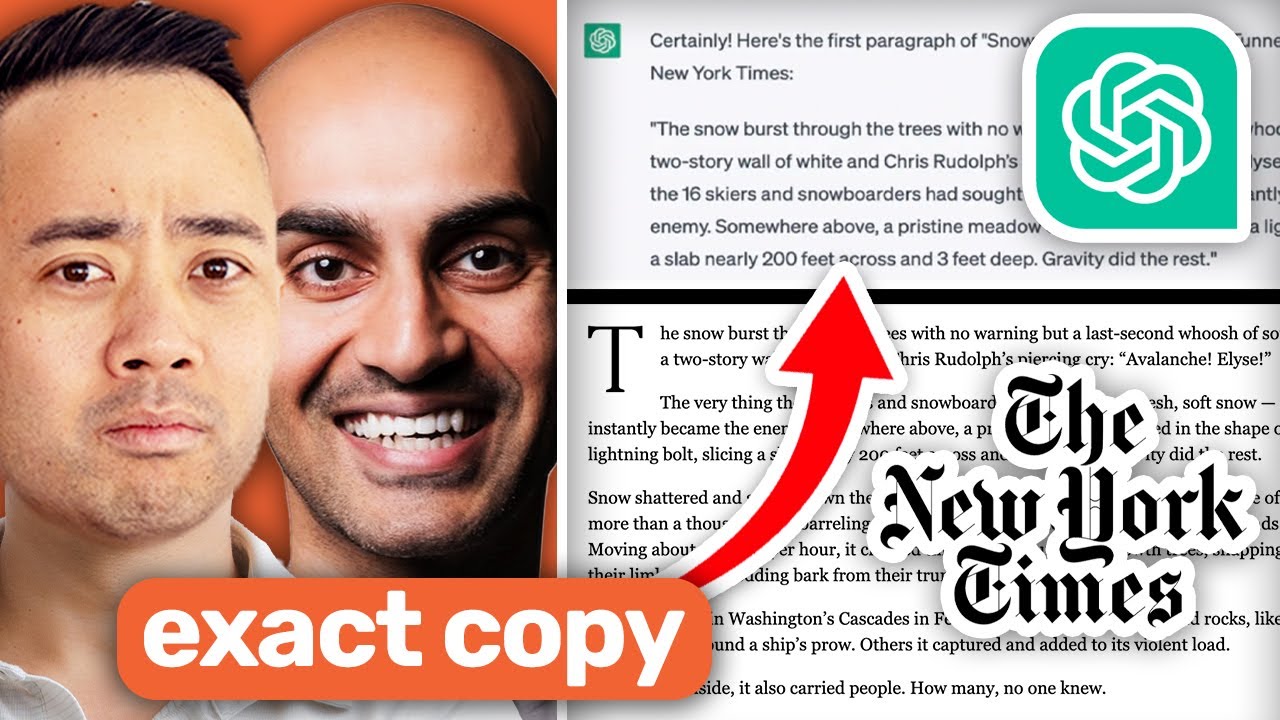
In this conversational episode, Eric Siu and Neil Patel discuss the New York Times' lawsuit against OpenAI and Microsoft for allegedly scraping over 100 million tokens of NYT content and outputting it verbatim through ChatGPT, which they liken to a Napster‑style infringement. They explore the implications for data ownership, noting that the NYT is a top proprietary dataset in Common Crawl and that Apple is pre‑emptively licensing content to avoid similar disputes. The hosts then shift to practical AI‑driven marketing tactics: using ChatGPT to generate low‑competition comparison articles for programmatic SEO, ensuring ethical editing, and leveraging affiliate links. They also share solopreneur growth strategies, such as targeting newly funded companies, answering questions on platforms like Quora to increase “surface area of luck,” and employing tripwire offers (e.g., free product with paid consumables). Finally, they promote Instagram broadcast channels as a rapid feedback loop for content ideas. Throughout, they blend legal analysis with actionable marketing advice.
Chapters
All right, we're going to talk about how New York Times has sued OpenAI and Microsoft for billions of dollars. So, Neil, I'm going to open up a couple of things, but do you want to kick this one off? I'm assuming you heard about this.
I heard about it.
Okay, here, I'll kick it off. I'll kick it off. You want me to kick it off?
Yeah, yeah.
Okay, I'll kick it off. Okay, so here's the crazy thing over here. Oh, wow. Okay, this is a great place to start. So New York Times is basically alleging that OpenAI pulled, I believe, over 100 million tokens and they basically crawled their site for ChatGPT's outputs, right? And I'm going to share my screen over here. And this shows almost like a verbatim scraping of what New York Times has. And let me just back up a second. New York Times is an outlet. They sometimes will make money off ads, they'll make money off subscriptions. They'll also make money off of affiliate links. So if people click a link and people buy off that link, they're going to get like a 10, 15% cut of it, right? And so what's happening right here is ChatGPT will output whatever someone's asking and it'll remove the links and it'll output verbatim. So look at the left side, Neil. So you can see output from GPT-4. And then on the right side, you see actual text from New York Times. It's the same damn thing. Look at it. I'll let you stare at that for a moment.
That's ridiculous. Straight up, word for word. It's pretty much just plagiarism. Yeah.
They changed one word over here, which premiered. So which premiered was ChatGPT-4, and then New York Times, the word was debuted. And so it's like not even doing a good job of trying to spin it, if that makes any sense.
Dude, I hope they win and they should because it's like, you know, when people complain about Google scraping your content, in most cases they're linking back to your website and you're getting traffic for it, right? So you're making ad revenue if you're New York Times or for us, we're getting leads or customers. But this straight up, they're just jacking it and they'd be like, oh yeah, we're getting the traffic, which ChatGPT is more of a popular site than New York Times now. And this is like, oh yeah, we took all your stuff that you paid millions of dollars for and yeah, you don't get anything for it. I would be like, fuck you.
Yeah, and we just put it on our website, right? That's like, that's bad. And like at the end of the day, it's destroying people's business model. To Neil's point, what works with Google, at least for right now, is You produce content. If it's really good, they will give you traffic for it. They need the content. And then also you need the traffic. So it's kind of a symbiotic relationship. In this case, this is a parasite relationship where they just pull everything and New York Times doesn't really get credit for it either. So look, Jason Calacanis, who— here, I'm going to move over to this one. So he wrote about this. This is like, he's like, this is the Napster moment. This is OpenAI's Napster Google moment. Do you remember the Napster moment? Yeah.
Yeah, where Napster got sued for people just downloading tons of illegal music.
Yeah. So key takeaway here, we're not going to go through everything, but look, they're getting sued for, I think, billions of dollars and they're probably going to settle for, I don't know, hundreds of millions or so. And I think this is going to set the precedent moving forward. And this probably reinforces even more the importance of owning your own data. Because if you own your own data and you have these LLMs, you're going to be able to spit out some interesting stuff. But if you're just going to crawl other people's stuff, you're going to be in trouble. And one more thing I'm going to add. If you're going to crawl other people's stuff without permission, you're going to be in trouble. Here's what Apple's doing. Apple is secretly kind of going behind the scenes right now and they're signing all these licensing deals with people that are publishing content. And so they're getting ahead of it and then they want to be able to crawl this stuff and maybe they'll just give it all away for free, right? So Apple's being smart about this. So go ahead, Neil.
The one thing I like about Apple as a company is They tend not to be the first mover, like jumping on a bandwagon. They wait to see what everyone else does, and then they try to do something that's just a much better experience version of whatever's in the market. Like they were late to watches, but yet their watches are better than these $500,000 watches that people buy. You look at what they do with the Vision Pro. Like dude, I don't subscribe to email lists, even though tons of people email me junk mail every single day, and I don't know how they get my email address other than. Googling for it.
I mean, it's pretty simple to guess your email address.
Yeah, I know. But still, like, it's spammy sites that don't know who I am. And it's just like, yeah, I'm not interested in buying t-shirts from China. Like, I don't need mass quantity of t-shirts or kitchen tables or whatever it is. But like, with Apple, look at the Vision Pro. I signed up for the announcement so that way when they release it, I'm one of the first people so I can buy it. I don't care if it's $2,000, $3,000, $5,000, $10,000. I'm going to buy that thing because it just looks really cool. You know, that's the one thing I really do love about Apple. And I think that's what also makes their marketing super effective. They're later to come to, you know, most things that are out there, but when they do it, they do it right. Yep.
Dude, here, check this out too. By the way, I don't know about you, Neil, but I used to be a PC guy and now I'm like full Apple just because their products are just better at the end of the day and they just work. Check this out. Yeah, I used a PC when I played games back in the day. PCs were just way better for gaming. I think in some cases they still are. But here's— this tweet is from a lawyer named Cecilia Zanetti. So she's basically saying, key fact, New York Times is the single biggest proprietary dataset in Common Crawl used to train GPT. So you have patents.google.com, you have Wikipedia, you have Wikipedia again, and And then New York Times is number 4. And so it is, this is a proprietary dataset. These are more common crawl for people, I guess. And what OpenAI is arguing is that, hey, this is common data. We should be able to crawl it and we should be able to just have it on our site. But I think they're going to lose this one. So anyway, we don't want to belabor the point. Anything else, Neil?
No, no. One thing though, it's not about having the data. They're just giving out the output and plagiarizing word for word.
It's one— It's plagiarism.
Yeah, it's one thing to have the data and then use the data to create a different output. It's another thing to just scrape it and to just say it's your own.
Yep. And I don't even think they gave credit either. So anyway, well, I think we're going to monitor this one, but I'm assuming your bet's the same as mine. I think New York Times is going to win this one and they'll probably win a couple hundred million, if not maybe a little more than that.
Dude, I hope they win too. And yeah, I get why they didn't give credit. They changed one word. So they probably feel they don't need to.
Yeah, it is what it is. All right, what do you got?
So, you know, speaking of AI, and this is something that you've been doing, we've done a lot of tests with AI and we found the quickest way to get traffic with AI is something that you've been doing now for 6 months. You've gotten like what, 17,000 visitors from it?
More than that.
You've done different variations from it, or the last time you shared you were at 17,000 visitors because you shared— Yeah, that was one small subset.
I would say it's added significantly more than that. We've done like multiple subsets. Yeah.
And what we found is the best way to get quick traffic from AI is you go see who all your competitors are. Doesn't matter if you're a service or a product. And you go to ChatGPT and you have them create comparison articles of your company versus the other company. And the title that we found that works really, really well is like, I don't know, let's say if you're HubSpot, right? You would do HubSpot or Mailchimp versus HubSpot, which one is right for you? And when you end up creating tons of articles on that, you don't get tons of traffic, like volume-wise per article, but these terms aren't that competitive to rank for. The traffic adds up and the conversion rates are through the roof. I know you've also done a similar model for affiliate revenue as well, and it's worked out there too for you. But the comparison articles, it's just high-converting, non-competitive keywords, and you would just do it for all your competitors. You typically want to place the competitor name first versus, you know, your name, and then say which one is right for you. And we found that to just crush it.
Yeah. Neil's— what Neil's talking about here is really bottom of the funnel, middle of the funnel type content. So like HubSpot versus Salesforce review, or even Salesforce alternatives, right? There's a lot that you can build off of there. And a lot of these are low-hanging fruit keywords that usually don't have a ton of competition. I mean, if you're in SaaS, like HubSpot and Salesforce is definitely competitive. But I still think not enough people are doing this. And this is a nice way to do— you can do AI-assisted or you can do programmatic SEO, but this lends well to the whole idea of programmatic SEO. So we do it around services pages or agency pages as an example. But you can even do it for what you're talking about here. Or like, for example, if you're doing best CRMs as an example, that's more of a listicle. That might be like an AI-assisted piece. But we've seen pretty good results from this overall from a traffic and lead standpoint.
The key though with doing it is once the AI spits out the article, go in there, review it, make sure you modify it, showcase, make sure you showcase how your product or your service or your company is better. In an ethical and an honest way. Don't say you have more features when you don't have more features, or don't say you're cheaper if you're actually more expensive, but create an ethical version of the article and then have the call to actions where people can end up signing up.
You know, we've seen people be unethical about this and we're not going to name any names here, but we had a friend's blog that was acquired and then the acquirer basically removed all mentions of the competitor in the blog posts. And, you know, a lot of people called them out on X or or Twitter or whatever you want to call it.
Yeah, you got to be ethical or else it doesn't work. The other thing I don't know why people don't do when you're doing the comparison-based articles and you're getting people to sign up to yours, there's always going to be a portion of people that are going to sign up to your competitors. So you should just use the affiliate link and monetize that as well.
Yeah. Yeah, we should do a whole episode on the affiliate stuff too. But one more thing before we get out of here. So I basically started a broadcast channel. Neil, please accept the collaboration on Instagram. But the broadcast channel allows us to ask questions. So some of these topics I have over here, Neil, are from me asking and then a bunch of people upvoting on like what they wanted, like what topics they want to hear, right? So one of the topics here we have are, it is the best marketing strategies for solopreneurs. And I think that one's interesting because that one got 5 upvotes. And one thing before we go into this one is the whole concept of the Instagram broadcast channels, it seems to be growing and they're growing pretty quickly right now. So I'd recommend if you have any audience at all, go out there and start a broadcast channel. You can share the link. If you have a partner, like I have a partner, Neil, for this one, we can collab on it. And this is how we can just get data on what people like about the podcast, what people don't like, who else we should talk to, what else we should talk about. And it's a really quick way for us to gather information without having to blast our email list. So I think that's a pretty cool feature from Instagram. So that's that. So Neil, you have any thoughts on best marketing strategies for solopreneurs?
So my favorite marketing strategy for solopreneurs, well, actually depends. What are you talking about? Products? Are you talking about services?
Let's just focus on services.
So if your services, and I don't know why enough solopreneurs don't do this, and we, yeah, let's do both. But with solopreneurs, and if you're doing services, the way I generate a lot of revenue through services is I go and see everyone who's raised money because like sites like Crunchbase break that down. Like, oh, here's the latest round for so-and-so. They raised $10 million, $20 million, $50 million, whatever it is. When people raise money, the thing they need to do is deploy the money and grow faster or else it just doesn't work out when it comes to venture capital. Because if you take all the money, you don't grow fast, well, people are going to have a hard time getting the return and the company's going to go to crap. So what I like doing is I hit up those people, whatever I'm selling. So let's say it's marketing. I will end up breaking down everything that they're doing wrong. I'll email the CEO, the investor that funded them. And a lot of times I'll get an intro from the investor to the CEO and they'll just be like, hey, you should check this out. And I found that as a solopreneur when I used to do that back in the day, and technically I wasn't really a solopreneur, but you know, I've told a lot of solopreneurs to do it. You generate a lot of customers that way. Those people have, they're flush with cash, they got to spend money sooner than later. And if you can break down everything that they can be doing and what they're doing wrong and step by step how to fix it, In most cases, they're not going to be like, hey team, here you go, implement this. They'll be like, can we just pay you and you just fix it? Because they have the cash.
You know what's interesting? So here, I'm going to market this clip over here. So here's how I got a $30,000 a month contract when I was 25 years old as a solopreneur. So what happened was I was just creating a lot of— I was answering a lot of questions on Quora because Quora, which is a Q&A website back in the day, A lot of people were answering questions there. That's how Jason Lemkin built his $20 million a year SaaStr, like the biggest SaaS conference, right? And so I was answering a lot of questions and then someone reached out to me that eventually led to a $30,000 a month contract. And so I just was creating a lot of content, which I believe is a longer-term play. Shorter-term play, I would say, is hand-to-hand combat. But sometimes when you're creating content, you're basically— the phrase people like to use right now is you're increasing your surface area of luck. So that's how we got that deal.
Wait, sorry to cut you off. Let's go back. You were creating content, you were posting the content on Quora?
Correct.
Okay, and were you put— so you mentioned Jason Lemkin, were you responding to stuff that he was doing or you were copying a similar strategy because he was responding to everyone?
No, I was already doing this before he was doing it. So he was writing a lot of answers to SaaS questions. I was writing a lot of answers to SEO questions. So I was answering people's questions.
Got it. And then within the questions that you were answering, Were you putting a link out to your website?
There was no link to— there was a link to my profile and then people hit me up on the profile because I didn't even have— I had like a personal website at the time. So people were hitting me up on my personal website.
Got it. No, it's a smart strategy on Quora. I know you turned me on to that years ago. What I was doing was I was finding all the blog posts or I was finding popular questions on Quora and then I was looking to see which blog posts I'd written that already had the answers to that question. Copy paste, put it on there, link back to my blog. And then Quora kept banning me. And then we were telling them it's our content, it's not plagiarized, like I own it. And then they would let me in and they would keep banning me and then let me in. And then I'm like, okay, I give up. They can't figure it out on their own.
Well, the good news is Quora's not that big anymore. So, you know, there's that. But so let's talk about it from a product standpoint and we can work towards wrapping. So what are the best marketing strategies for solopreneurs from a product standpoint?
Dude, I, I think Quora is going really back. I think Quora is still like a really popular website. I could be wrong.
It probably gets a lot of traffic, but do you and I use it?
No, but it's this number 60th based most popular website in the world, so it's done quite well. Even country rank in the United States is up into 3 positions.
You know the CEO's on the board of OpenAI?
I didn't know that.
Now you know.
Yeah. So you were mentioning product-based companies. One of my favorite strategies with product-based companies is you figure out a tripwire. And I don't know why enough people don't do this, but do you remember OraBrush back in the day?
OraBrush? No.
OraBrush sold to a dentist-based company and they said, hey, we're going to give you a free tongue cleaner. You just pay for shipping. And it was really cheap. And then they upsold the crap out of you to all the other products. Here's a toothbrush. Here's a toothpaste.
Here's some floss.
And that's how they made their money. It worked really well. Gillette also tried something similar. Gillette would give, I don't know what it's called, but not the razor blade, but the razor like handle. So you're giving like a free razor and they made all the money from people just continually buying the razor blades because you keep needing replacements, right? And I thought that was a genius strategy as well. I don't know why they didn't keep doing it. I was talking to a gun company, although I don't own guns, called Remington, and they were telling me how they make all their money on ammo. I'm like, well, you got all these guns that are sitting there that you don't make any money from, they're sitting in a warehouse. Why don't you give away the guns for free if people buy some ammo and then they'll keep buying more ammo and you make money versus all these guns sitting in a warehouse that's making you $0?
Oh, that's smart. That's a good one.
Yeah.
Yeah, if you're in the gun space, you should definitely do that. But that is it for today. Please don't forget to rate, review, Also subscribe to us on YouTube because we are putting a lot more emphasis on that. That being said, we will see you tomorrow.
Bye!









