Our biggest marketing wins & losses, where we changed our minds, and favorite AI tools of 2025
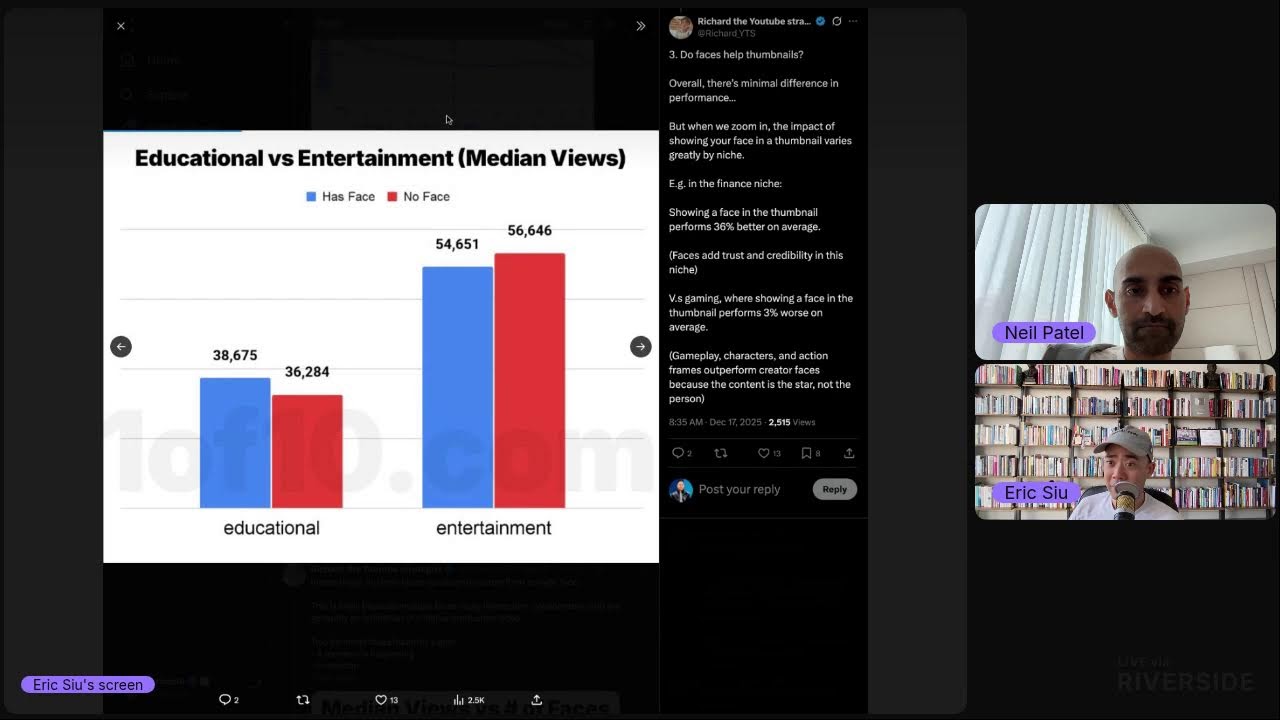
In this informal, end‑of‑year podcast episode, Eric Siu and Neil Patel discuss a wide range of marketing topics, reflecting on what worked and what didn’t in 2025 and looking ahead to 2026. They start by comparing SEO for traditional web search with the emerging AI‑driven search experience, concluding that the core principles—building great sites and content—remain unchanged even as platforms evolve. The conversation then shifts to the surge in “storyteller” job titles, citing Wall Street Journal data and historical examples (IBM, SAP, Microsoft) to argue that storytelling is becoming a strategic differentiator in an AI‑heavy world. Both hosts share personal storytelling frameworks, referencing South Park co‑founders, the hero’s journey, and classic copywriting formulas (soap‑opera sequence, StoryBrand, Storyworthy). They debate when storytelling adds value—more effective for consumer‑facing offers than for high‑ticket enterprise sales, where de‑risking and hard data dominate. The latter half of the episode dives into YouTube strategy. Eric presents findings from a study of 62 billion video views, highlighting optimal video lengths (15‑25 min for most business content, longer videos (>1 h) performing best on average), title‑length effects, and differences between educational and entertainment thumbnails (faces, text, and word count). They discuss practical implications for their own channels, including cross‑platform upload limits and the impact of thumbnail text on view counts. The hosts also critique high‑pressure sales tactics, sharing a personal anecdote about a “blue‑link” messaging service that used aggressive urgency language, which they both find counter‑productive. Finally, they compare AI research tools—ChatGPT, Perplexity, and the fast‑growing Grok—agreeing that tool choice is context‑dependent. The episode wraps up with a brief personal aside about family dynamics and a reminder to publish internal performance charts. Key takeaways: 1. SEO fundamentals persist despite AI‑driven search changes. 2. Storytelling is resurging as a hiring focus; founders should develop storytelling chops themselves. 3. Storytelling works best for consumer‑level offers; enterprise sales rely on de‑risking and proof points. 4. YouTube success hinges on video length, concise titles, and thumbnail design (faces help for strong personal brands; text can hurt). 5. Avoid high‑pressure urgency tactics; focus on helpfulness and referral when appropriate. 6. Choose AI tools based on the specific research need—Grok for rapid deep‑dive, Perplexity for quick summaries, ChatGPT for versatile assistance.
Chapters
For this to be live, but we're going to go live. It's Friday, 2:00 PM. Neil is recovering from a fever, 102 degrees, I think. But you know what? We're not going to disappoint you guys even though we're going into Christmas. It doesn't matter. The show must go on. So wherever you're calling in from right now, leave a comment. We'll wait. But this is almost like an end-of-year type of episode. So it's December 19th as of this recording. We're going to be talking about some of our best marketing wins, biggest marketing wins, our biggest marketing losses, our best cut this year. I don't even know why I put that in there, but that's in there. And best work investment of the year, favorite AI tool of the year, coolest moment of the year, biggest L of the year as well. What we changed our mind on this year, what we gamble on. That'd be a fun one as well. So where do you— Neil, I'll give you the option here because I took the liberty of putting some ideas in here. What looks interesting to you to get started on here?
Best work investment of the year.
Okay. Best work investment of the year. I'll go because I have some stuff listed here. So I was traveling, I was coming back from Santa Barbara today. I was on the treadmill today. I was writing all these ideas. And so we'll start off with this. So best work investment of the year for me is peer groups. And what I mean by this is we've talked about groups such as YPO or EO, and I've talked about groups I'm in, We call it the Tuluminati, where we have some of the mutual friends in that group, but we've been meeting since 2018. What I mean specifically by this is I mean being very intentional about the peer groups that you're in. And so I've actually been cutting the peer groups I've been involved with this year. So earlier this year I was in a YPO SaaS group. Okay, I cut that. I was in a, let's just say I was in an in-person forum. I cut that as well. And the reason I cut those from my life, I would say you're almost like, we have our own little peer group. by doing this podcast in person with Noah, right?
Yeah.
But I've gotten a lot more intentional, just trying to figure out, okay, what are we trying to get out of this? Okay. So for example, with you and me, sure, we get to record this podcast. It's fun. We have Noah there as well, but we get to eat after and we get to catch up on life. And that's something we get to do every week. And this is a forcing function for us. This podcast, I think in my mind also keeps us sharp when it comes to new marketing stuff. So we're not going to fall behind because you and I have become a lot more operational within our businesses in different ways. Why do I keep the Illuminati group with Syed, Yaniv, these other people? Because we've been doing it since 2018 and all we care about is eating good food, doing sports activities, and helping each other with our businesses. We don't care to party. I don't think anybody in the group really drinks as well. And so I'm good with that. Now, other groups, the reason why I left— What's that?
I'm just laughing because I know some of your other groups really love drinking.
Yeah. So some other groups, and I have no issue with this, it's just not for me, right? But some issues, some of these other groups, I would say maybe their mission is more so to party. Or I would say some of these other groups, I could tell people weren't as bought in and it was like pulling teeth for me to plan out an agenda for a retreat and get people rallied around it. So if I have to pull people, it feels like pulling teeth. Or if it feels like maybe I'm not aligned with the values, maybe I don't want to— I've been through, you and I have kind of been through little phases of partying in maybe our 20s. That's okay. That's when it makes sense to cut. So I would just say that a lot more intentional, a lot more deeper with the groups that I have right now. And I think a younger me would've said, hey, peer groups are amazing, but joining more so for quantity of groups versus quality is not a good bet. So that's what I would say. How about for you?
My best work investment, and I started doing this towards the end of Q3, early Q4, was a weekly, if not twice a week lunch meeting. So I get hit up for lunch meetings often. I generally always say no. And I'm not saying you should meet up with everyone because you have to evaluate your time. Your time is precious. It's worth money. And I now have a much more open mind to meeting people. Even if they're not in my industry, even if they won't be a potential customer. I try to meet like-minded, smart individuals, even if they're in different spaces. I've learned a lot from them. I made a lot more connections. The networking's been great. And I would say for every 10 of those meetings, 2 to 3 result into some sort of benefit, even if I wasn't trying to get a benefit. So for example, The benefit could be intros to potential customers, investor introductions, introductions to other things that make my life better. Like I met up with a guy named Mustafa a week ago and he's like, oh, you travel a lot, right? And I was like, yeah. He's like, you need to use this credit card. You're going to save a lot on your hotels and you'll actually get better hotels. I forgot what the name of the card was, but it's $1,000 a year. And he's like, it's much more beneficial than your Centurion card and you'll save a lot. And he has a Centurion card. So I was like, oh, this is cool. Yeah. So I've put in investment for work, not necessarily cash-wise, but to me it is as equivalent to cash, is meeting people 1 to 2 times a week and new people every single week. And I found that to be very valuable. It's just I kind of have to force myself to.
I screwed up on this. I had it on the wrong, all these things, I had it on the wrong line. So my actual best investment this year is in people. And what I mean by that is people that we've hired this year have been great. A lot have been there, done that. You have an amazing executive team. I think our leadership team has certainly gotten a lot stronger. And I think we've been a lot more intentional about the people that we're bringing in. And the other thing that you have labeled here, best work investment of the year. We're not talking about work investment, I guess.
Oh, I thought you were talking about work investment. That was what my answer was.
I think these two kind of go hand in hand. 'Cause if you look at the two that I have highlighted over here, best investment this year is people. And then best work investment of the year is micromanaging the talent bar. And so you have Mike Kamo who handles the level of people that you bring into the team. For me, I think when it comes to having a high talent bar or a knack for talent, I think I'm pretty good at it. And what I've noticed is me micromanaging the talent bar has yielded a lot better results than any other recruiter. I think certainly you want to have a recruiting team. You certainly want to have a people team. But I think my strong belief here, I don't know if you disagree with, I think you need at least one of the founders micromanaging the crap out of that talent bar because that's all you have at the end of the day. And even what you're talking about too, meeting people for lunch or me talking about peer groups, it all comes down to people. And I think younger version of us might've thought that we could just build software and then hide in a cave. But the older we get, it's like the world goes around because of people.
Yes. And I would say my best investment every single year in business is actually people. I think people has always been number one. Good people really do make a huge difference. bad people, oh my God, they bring on more bad people and then it snowballs and compounds.
Yeah.
I'll give you a great example of this. We were doing a meeting with our software division. What's wrong, Emma? You got hurt? Okay, so I was, I was in a— she doesn't want to do her homework. Um, but, uh, I was in a meeting with some of the people in our software division and they were just like, you know, the goals we set for next year aren't good goals. We don't think they're aggressive enough. If we look at the investments we're making, we should increase the goals that we've set because why would we aim for these mediocre goals? And my co-founder and I were on that call and he said right away, he's like, that's music to Neil's ears. And I'm like, it is. Those are the type of people I love working with. Yeah.
I remember back in the day when I was at— I remember you I remember you would talk about working with certain people and then whenever you had someone on your team that's like, I'll figure it out, that's when you got really happy. And so those are the types any founder likes. It's the I'll figure it out people because there's different levels of people here. I'm not going to go through management 101, but you have people that sit there and maybe do nothing. That's the lowest level. Then you have people that will sit there and point out the problems. And then the higher tier above that is people who point out the problem but offer a solution. But even higher than that is people that have figured out and solved the problem and just told you, this is what happened. And so I guess it's no secret for us. I think the final thing we'll call out here is when you think about like a Steve Jobs, Steve Jobs once said that if you have an A-player engineer, they can do the work of not just 1, 5, 10 people, but we're talking about 100x. But when you hire B-players, B-players don't like hiring people that are smarter than them. And then what ends up happening is they hire C players and you have the bozo explosion. So that's why I think you got to have, for you it's Mike, for me it's me, being super close to the talent bar. And it might irritate your team with you saying no to people at the very end, but you have to do it because you're protecting the castle and the people are really the main moat that you have.
Yeah. And I think people have this misconception, or people in not just marketing, but in business in general, have this misconception that I got this budget, this is what I want to spend for this role, I can't go above that. Sometimes you can get better people for less. Sometimes you'll get better people, but they'll cost more. And you can't just look at a budget as this is what someone in this role should get paid. It's also what value can they provide? Because if that person is 3, 4, 5x better than, you know, 3, 4 other people, you can also save money too. And we've seen that firsthand. We've seen it where when you pay the right people more, you don't need as many people in and overall it's cheaper. And I've also seen it on the flip side. I was talking to Syed, more so texting Syed, and I was like, dude, this is what we're getting done on the dev side for WordPress. Is it good, bad? What's the rates, et cetera? And he was just like, he's like, you're overpaying by a lot. And then in turn I'm like, man, things are moving really slow. And he was pretty much saying, I can get someone to move way faster for like a third of the price. Yep.
So anyway, all that to say, guys, I don't think we saw it this way in the beginning because Neil and I as marketers, we tend to think that marketing is everything. But again, guys, people, people is everything for everything across the board, which actually brings me to my next point. One thing I changed my mind on this year is This actually goes into the coolest moment of this year for me as well. But what I changed my mind on this year is that relational wealth is way more valuable than monetary wealth. I think I've always kind of felt like that, but I think nothing crystallized it more than at my mom's funeral. You were there. It wasn't until I actually started to think about it and put together her speech, I was like, yeah, all she did was chase wealth, but it was relational wealth. I think that will probably stick with me forever because I actually thought about it. You look at people at the very end, all the regrets of the dying. Nobody regrets— nobody's like, oh, I wish I would've worked more. A lot of the stuff they talk about ties in with relationships, ties in with people. I'll tie that in with coolest moment of the year too. I think it's the level of support I got when my mom passed. You were there. You were at the funeral. Yaniv and Syed flew over. Syed flew over from Florida. Yaniv flew over from Arizona. It was unprompted. I didn't ask you. You're just like, hey, I'll be at the funeral.
Right.
I think that level of support I got, I think was really cool. And the amount of snacks I got was really cool. The amount of flowers I got was really annoying. So lesson for everyone too, if you're going to give someone something for funerals, don't give flowers. And guess what? Funny story. Who are the people that gave me the snacks? It was the women that sent snacks. And this is not saying these are women I'm dating or whatever. These are friends, right? So these are girlfriends that sent me— I was like, why didn't you guys send flowers? Every man sent flowers. They're like, Because we know how annoying it is to get a bunch of flowers and then you have to take care of all of them and you have to manage them, right? So they sent me really, really good snacks. So pro tip. Go ahead, Neil. What you changed your mind on this year?
What I changed my mind on this year? I go back and forth on this every single year, but some years I'll be like, I travel too much. I need to stay back more home with the family. The traveling, is it really worth it? And then I start ramping it back up and like, oh guys, we need to travel more. I would say I changed my mind on that a few times in 2025 and 2024. My goal in 2026 is just to travel a lot, not for fun, but for work and try to do whatever it takes to make the business grow faster. Being on the road, I hate to say it, when I look at a lot of the large clients we've Landed, like those Ozempics of the world.
It's Eli Lilly.
Uh, I don't know who Ozempics were, um, owned by, but whoever owns Ozempic—
Novo Nordisk.
Novo Nordisk, there you go. So they heard my speech at Web Summit in Rio a few years before, and then eventually I ended up getting hired.
Oh, that's a nice one.
And when we keep looking at the brands that hire us A lot of them come from events and the events, it takes like on average what I'm hearing from like a, or, or let me rephrase, not generating business. I'm talking about the right type of business. So for us, that'd be enterprise RFPs. You know, you're trying to go for like the jugular, trying to get larger accounts, 7 figures, 8 figures. Sometimes they're 6 figures, but ideally you're looking for 7 to 8 figures to start off with. And you tend to mainly get those from RFPs. When we look at a lot of the RFPs, they come from relationships and speaking at events and networking and meeting people, but it takes like a year and a half to 2 years to get included into a lot of RFPs from when someone hears a speech. So it's a very long sales cycle, not to generate business, right? Because there's some people who hear us when I'm speaking and they hire us within 3, 6 months. I'm talking about getting RFPs for larger type accounts in the marketing world. Bigger deals tend to go through RFPs. It's just how it's done, and it's a procurement-led process. It usually takes a while to get included in those, but people need to not only hear you from speaking events, but learn from you. Emma, relax. Don't worry. Don't get frustrated, baby. It's okay if it doesn't work. I'll work on fixing your iPad. Don't worry. Come on. Okay, anyway, so this is what happens when kids start using technology to do their homework. Their school gives them an iPad, or we have to—
are you fixing it right now?
Are you fixing it right now? Say hi, Emma.
Emma, what shirt are you wearing? It looks like a Sriracha shirt.
No, what is the search or shirt?
Common Ground.
Yeah. Who got Daddy sick? Was it you or William?
It was you, Emma.
William started it first.
You got him sick.
It's cool. And then William got you sick.
And then Tom and Alan told him Marian's song.
It was for her performance today.
Yeah, we all were in a rainbow.
Red was kindergartners and orange was first, and I'm orange.
I love it. Cool. I love it. Um, fix the iPad. I'll, I'll, I'll, I'll take it next. So, okay, as we continue with Emma on— Emma on screen. Emma, you're gonna be famous from this. You're gonna be on YouTube. So So I would say the funny thing that Neil's talking about with what he changed his mind on is he always has a thing where he's a little schizophrenic. Emma, look up what schizophrenic means. So with his home, for example, he keeps going back and forth. Should I live in LA? Should I live in Vegas? Should I build this home over here? Should I sell this home over here? And then one year he's like, should I travel more? Should I travel less? Should I travel?
Yeah.
So there's always one thing where he's schizophrenic on, At least one thing, at least. Always one thing, at least, but it's usually one main thing.
Yeah.
Yeah. Okay. So I'll continue on while you fix Emma's iPad here. So I'll go with favorite AI tool of the year, and mine is Granola. Let me tell you why I like this Granola, this Granola, Neil, because what I've noticed, okay, let's even use it in the context of relationships. Okay. In the context of relationships. So let's say you and I, Neil, we're having a debate. Okay. When you have a granola that's listening to the conversation, it can be an indifferent arbiter and it can just say where it thinks you're wrong or where it thinks I'm wrong. And for me and you, we're okay being wrong, right? But also when I have it sitting in a leadership meeting and it also lists how each person thinks from a systems thinking standpoint, where it thinks each person is at and what each person needs to work on, it's correct. And it's more objective. When you bring that up, there's not much emotions. Because Neil, if I were to give you feedback and sometimes you might disagree with it, then it's going to get emotional. But when you have an AI that's in there being the arbiter, you can't really blame the AI. You can't really get upset at it. And so for me, having Granola in it, and I can ask questions around all the transcripts that I've had, and I can also ask questions on things that have been high leverage or low leverage or things I shouldn't work on anymore. It's extremely powerful. And I haven't seen any other thing that's like it so far. So what about you? Favorite AI tool of the year?
Nano Banana.
You using Nano Banana?
Uh-huh. For images, for ads. I get involved in my own ads.
You?
Yeah.
Wow.
I think it's been great. Um, it's way better than— I, I read something, it was at TechCrunch, I think it was TechCrunch, that talked about how, um, OpenAI is releasing something that's way better than Nano Banana when it comes to images. I haven't seen it yet or used anything from OpenAI that beats it so far. But when we run ads, images help a lot. I know a lot of people do video-based ads. We also do image-based ads. You can still get a lot of traction from it, but Nano Banana has really helped us fine-tune images at scale that are quality. Most of the AI images for ads, and we've done this for a long time, most of them suck. And I'm assuming you agree with this. Um, Nano Banana isn't perfect, a lot of failures, but we found that it's— it produces better results, uh, and you can take it from there and modify it and then, you know, start throwing things up. But it helps us test faster because the quality, it meets a minimum bar, the minimum bar that you really need to start testing images.
Dude, I'll give you a second one because you mentioned Nano Banana. I love that NotebookLM leverages Nano Banana now and the presentations you can make. Imagine you and I are putting together decks for our talks. We obviously have our own design aesthetics, but to take a couple of YouTube videos that I watch that have interesting data, or I can take some long-form PDFs and then I can have NotebookLM make a presentation from it and I can also edit that presentation using Manus. That's crazy because you and I, we leverage a lot of data from different sources. I know you pull from your own data sources too, but to be able to have, I think, even more dense, and when I say dense, more data-driven decks when you're doing talks. For example, Neil did a talk at HubSpot this year and it was all decks. Sorry, it was all graphs throughout the presentation.
Yeah, charts.
Yeah, charts. And it did well. And I think we're going to see a lot more of that. We're going to see much better presentations. Because of Nano Banana and because of NotebookLM.
Yeah, I would agree with that. What I'm noticing on the presentation end, we've used some of the AI apps to help you make presentations. A lot of them are off and you still have to make a lot of tweaks. We haven't found one that just is really good. And with the human intervention that you have to have to fix a lot of the issues, we still see it saving time, but not much, like 15, 20% for the type of presentations we create, Max. It's still better than nothing though.
Yep. Oh, we forgot to— I forgot to ask you this one. What's your coolest moment of the year?
I don't know if I have one cool moment. I can't even think of one cool moment.
I had to think about this one. So if it comes back, you can just lock it in when you have it.
Yeah, I don't think I really have a cool moment, but just in general in life, I would say I'm content. I always want more, but overall I'm pretty satisfied. I could always feel like I could do better, network more, close more deals, make more money, but just generally I'm content. The hard part, and Eric, you know, has experienced this as well, when you're an entrepreneur for a long time and you've done somewhat okay, a lot of things lose their pizzazz.
Yeah.
Right? So it's because like you get numb to a lot of stuff and you start seeing it over and over.
But I would say, I mean, how about like a personal moment? Even if it could be like Emma or William doing something and you doing something with it. Like, what's the coolest moment? Because for example, like the— or passing sucks, but that was a cool moment when I— when everyone came together.
So this wouldn't be a cool moment, but I would say it was an enlightening moment for me. Um, a buddy of mine, I was talking to him on the phone and my daughter busts out like a spray bottle and she starts spraying water on my keyboard and computer. I'm like, Emma, you can't do this. This is gonna mess it up.
Yeah.
And, uh, he was on the phone and I wasn't yelling, but like I was a little irritated. And he said, you're so lucky. I'm like, why? He's like, I, I would kill to have, um, a kid, you know, that sprays my computer or anything with water. He's like, you're blessed you have 2 kids. He's like, I wasn't able to have any kids.
Yeah, I'll tell you, this is a cool moment right here. I have a picture of you, Emma, and us doing a podcast here. See, this is a cool moment. That's what I mean by cool moment.
Yeah.
Yeah.
So for me, that was enlightening. I was like, it's perspective. Like, yeah, I'm blessed. Maybe I was a little irritated, but yeah, I'm actually quite lucky.
I have— yeah, save that picture. I just sent it to you. Now you're going to get poo-poo from Emma because I'm calling it out. But anyway, okay. So next one here, what would we gamble on? So if you had, let's just say, you know, X amount of dollars to just throw at something right now, what's the one thing you would gamble on?
Gamble from a work perspective?
Investment standpoint. So you and I kind of joked around Solana, right? What would be that?
Yeah, this is not financial advice, but I would probably bet on more crypto or crypto, whatever you want to end up calling it. Other than that, I would invest more in just doubling down on really good people. You know, extra $10 million a year for 3 years, I would go hire $10 million worth of amazing—
It's not a gamble, dude. You kind of know it's going to work or not work quickly. You can cut it.
No, but dude, I've hired a lot of amazing people and it usually doesn't work the way I think in most cases, or people will tell me hiring amazing people helps a business grow. Uh, yes, he has a lot of books. He's smart.
He reads a lot.
Unlike Daddy. Daddy doesn't read enough.
No, I don't. I read a lot.
Okay. So when I've hired amazing people in the past, what I found is they typically don't produce the results as quick as I want, and some don't produce the results at all. And what I found is it's not just about hiring amazing people, it's about hiring amazing people at the right time. Sometimes a business isn't ready for it. And I'll give you an example of this. So I was talking to my CEO, Mike G, and he was talking about one of his buddies and his buddies are interview— he's interviewing at other agencies. I was like, man, I know you talked about having him for a global role and we have so many global clients in different countries working on cross-selling and then, you know, bridging accounts from country to country, you know, division to division, and it would help with the land and expand. He's like, great idea. He would be great for that role. He's just like, we're a year to 2 years away from really needing it. He's like, we have global accounts, but they're not big enough global accounts and they're going to be harder to land and expand. I'm like, what do you mean? He's like, that role's really effective when you can generate a lot of 8-figure accounts. He's like, for 7-figure accounts, it's not as effective. For 8-figure accounts, you can really balloon them up and make a massive ROI from it. And he's like, if you look at us, He's like, we get 7-figure accounts, but he's like, it's not like every day that we're getting 8-figure accounts knocking on our door. And he was just saying, wait till year 10. We're at, we just finished year 8 this year. So I was like, cool. So great candidate. If I hired him, it would be a waste of money. That's why I say if I had $10 million for like 3 years straight, I would make a ton of hires and just be patient.
Yeah. So what I would say to that, one, I, this might maybe practical for people, but I actually have a note, an Apple Note on who to hire and, you know, also for when, right? Because sometimes it's 2, 3 years out or so. Sometimes I continue to talk to someone, it's like 3 years or so. Now to that point, I still look at it as us making an investment. You never know with people. You're lucky if you get it right, I don't know, 50%, 70% of the time. I actually did the math on ours. We have a 70% success rate in the last 12 months. But all that to say is I think the best investment, not financial advice, at least for us, is to plow it back into our own businesses. That's why I don't look at it as a major gamble because we're betting on ourselves. But if we're to gamble, again, not financial advice, we'd probably be messing around with crypto right now. Something that's maybe not altcoin crazy, but maybe a little that's up the stack, like a Solana, for example, that has more room to run. But anyway, that's just me and just Neil and I just messing around with crypto. So we have another one here. How about best, biggest marketing win for 2025?
My biggest marketing win. I would have to say is doing, and we were doing this in 2024 and even in 2023, but we ramped it up more and more, has been doing in-person meetups where we handpick the right type of enterprise companies and we give speeches to them in different countries. So there may be like 20, 30, 60, whatever people in a room and we'll give speeches and build relationships that generates a lot of revenue for us in the long run. If I look at my leads year over year, it's funny because I got a message from Saulo who heads up marketing and he's like, dude, we need to run more ads. Leads are down. And I'm like, you're just looking at a total count. Let's say leads are down 30%. I don't know what the number is. And then I was breaking down, I asked him the question, like, do you know the RFP numbers in 2023 just in the United States? He's like, 16, 17. I was like, 16. That's right. And he, I was like, what about 2024? He was like, We got a 50% increase. It's like a little bit more, 25. And then he's like, okay. I'm like, what are we at for 2025? And he's just like, 38 the last time I checked, maybe 39. No, I was like, we actually hit 40. So I was just like, maybe we'll get 41 before the year ends, but I doubt it now because we only have around, call it 11-ish days before the year ends. But when you look at the RFP count, those are the right type of leads. And more of our RFPs are larger in size. There are more services and there are more regions where they need help in. So it's like, yes, you're looking at total leads, but you're not looking at the type of leads we ideally want. Because if you look at the ideal type of leads we want, it's actually up drastically globally.
Yep. I would say for us it's outbound email. And what I mean by this is we work with a company called Sales Automation Systems. So they did a great job, but we decided to kind of take it in-house. More so my sales team wanted to take it in-house.
Yeah. And you, because that means you think you could do it better.
Well, I mean, the reason, and I'll give kind of my reasoning for this and maybe some of them will listen to this, but the reason I set us up with Sales Automation Systems, they actually take a commission. And I knew that tax would be so irritating to my sales team, but I wanted to get it going because I've been talking about outbound for a while, but we weren't really getting much movement there. I was like, okay, I'm going to go with them. We're going to place a tax on your commissions. So you're just like, screw that, right? And then now what's happened to their credit, to the sales team's credit now, we're taking it in-house and it's because what sales automation systems does is it's great. It's very, I think we probably hit 300,000 or 400,000 emails. I think we got 200, I want to say 200 or 250 responses from it. And we actually, I think we closed maybe 3 deals from it. And these are all ICP fit. These are, Because we're targeting more B2B, especially B2B SaaS. And so that's what I would say. They were very good at staying on top of the different offers. In addition, I'll tell you what worked. The $105, not $100, but $105 Amazon gift cards, that still gets people to respond because show me the incentive, I'll show you the outcome. So yeah, I've been surprised because in the past I've tried to make outbound work and it just never works. So credit to sales automation systems. If you guys want to try it first, I would certainly recommend it. Because they've done great for a lot of companies. Go ahead.
What was your deal? Okay. So you ended up sending out Amazon gift cards to potential email, potential customers. So sales automation systems or whoever you're using now internally, you would go pull a list together of ideal companies. I'm assuming you're doing account-based marketing. You would then target the specific individual and you would start giving them offers and stuff like that, like free Chipotle or Amazon gift cards. I'm assuming you tried $100 and you know $100 doesn't work. So hence you said $105 is better.
More so, $100 still works, but because so many people are doing it now, you want to stand out a little differently, right? So some people will send AirPods. Like I know of a B2B agency that actually sends AirPods. I'd rather just give them the money. And we do the gift card, plus we try it with different offers. One might be for Carrot, one might be for ClickFlow, one might just be for—
Oh wait, wait. You're giving them an Amazon gift card in exchange for what?
To get on a call with us.
Okay. And then for every phone call that you do, how many end up signing up?
Yeah. So the only numbers I have for you is we've closed 3, and this is like, we started with them 3, 4 months ago or so. And then 250 people responded, 3 closed.
So 3 out of 250, which means you still have more in the pipe. At 250, you sent $105. So $26,250 in gift cards. Right. I'm assuming that sounds right. And out of the 26,250, you're also paying sales automation systems.
So how many— No, no, no. Sorry.
Sorry.
Sorry. So 250 replied, but it's a certain percentage of them that got on the call. I just don't have that number right now. Yeah.
And you closed, so you didn't have to give all of them a gift card?
No. So let's just cut it in half. Let's just say $13,000 in gift card spend.
Okay. So $13,000, you closed 3 deals. What was the total contract value of the 3 deals?
I couldn't tell you off the top of my head. I can say each deal averages, let's just say each deal averages around $20,000 to start.
Per month or one time?
Per month.
Okay. So you close, call it, you know, $300,000, $700,000, or what is it called? I don't know. My math's bad today.
It's okay.
$780,000, $720,000? You close $720,000 in revenue, cost $13,000, and then you had to pay Sales automation.
Let's throw another $20,000 on top for our sales automation systems. So let's say we paid $33,000 or something like that.
And they closed it or do they pass it off to your team?
No, we close it.
So you have to pay double commissions to your team and sales automation systems.
Correct. And that's the tax that my sales team didn't like. Yeah.
So they would get paid less commission.
Yeah, exactly.
Right.
But again, I knew that would apply pressure to really get it going once it really starts to hurt. Right. But what I would say is, again, I believe it's, we closed 3 deals and I do know The amount that we paid, the $33,000, that is in fact accurate.
So yeah. $33,000. Okay. And then plus internal commission. So it's worth it.
Yeah, it's worth it. And then now it's like, okay, how do we just ramp into it? How do we just micromanage this process more? Because you're constantly having to test different offers and you're constantly having to rewarm email boxes and things like that. So outbound works. Because what's interesting to me, Neil, is when I see some of the responses, because the responses come through Slack and I'm staring at them, I'm like, oh, A lot of people are like, oh yeah, our strategy is actually changing this year. We'd love to talk right now. Our strategy is changing this year. So sometimes it's not even about the gift card. Sometimes it's just hitting people at the right time because 99% of people aren't ready to buy in market typically.
Yeah, that makes sense.
Yeah. Okay. Now let's switch over to biggest marketing loss. I'll start first on this one and then you can go next. I think our biggest marketing loss this year was actually on the carrot side of things. And what I mean by that, so Caret's my LinkedIn account-based marketing product, which still gets leads and still gets customers by the way, but it's a very niche feature. And what's interesting to me, Neil, is I've actually talked to a handful of people at competitors recently who have worked at similar type of companies and they've all since left those companies. And they said that it's just really hard to sell in that niche. And that's why those companies aren't growing that much. And so had we done more, had I been, I think, more involved with customer development in the beginning, I think we would've gotten to that insight faster. So I would say that biggest marketing loss is not doing enough customer development because we still have a great product, but I would say it's more of a niche feature than it's like a full-fledged product.
Yeah, I would say my biggest marketing loss for 2025 is, it's a toss-up between 2. The one for the agency would be we didn't do enough local marketing, like in countries like Italy and Germany and places like that to make it well known. And when I say didn't do enough marketing, we had boots on the ground, but a lot of the events that had our ideal customers in those regions weren't willing to pay me to speak and they're used to charging speakers and like to Mexico and stuff and we should have done it. You can pick up a lot of great customers from these events. They charge everyone. I really do believe we should have done it. I would say that was a big mistake on my end in 2025, but we're going to change that in 2026 and we're going to try paying to speak. I've never done that before. We usually always get paid. I'm not talking about airfare and hotel. I'm talking about airfare, hotel, and money.
Yeah.
So it's going to be a total 180 where I had to pay my own airfare, my own hotel and pay to be on stage, right? So I'm curious to see how that goes.
But it's good that you, you don't have such high ego where you're just like, oh, I'm not going to do that. So whatever works for the business.
Yeah, whatever works for the business. Um, my— I might— in a dream world, I wish it was we could pay to speak and it wasn't me who was on stage and someone else could speak and it would perform just as well. I'm not saying that I'm the best speaker or anything like that, uh, but if it performed as well, I'd be so excited because then I wouldn't ever have to travel to speak speak and other people can do it for me. We do have some amazing speakers, just we don't have an amazing speaker for every single country. And on the software side, I would say one of the biggest marketing losses was we didn't invest in product. I had so many calls with my team this year on marketing and the people running marketing and software, they're like, we're losing traffic on some of these softwares. We need to run ads more competitive. And I'm like, guys, Software marketing works very different. If you have an amazing product, you just get more popular without doing tons of marketing because we already have a big enough base. If your product sucks and it's not keeping up with the Joneses and everyone else at the competition, you're going to lose traction and you're going to lose visitors over time. And I'm like, what you need to do is not spend as much money on ads and marketing. What you need to do is take that money and just create more products and release them for free, and it creates a better flywheel from a marketing standpoint. than it does to go and run paid ads, at least for software.
You know what? One of our— I'm talking about both of us— our biggest loss this year is not having someone on top of our podcast, the work that we do on the advertising side, because there's a lot of good advertisers and I wish we just had someone to kind of man it, but we don't. And finally we're getting some deals through, but it has to be you and I kind of doing the dirty work, which is fine, but I wish we just did something sooner about it. And I'm just looking at some of the comments here, by the way, because I can see chat. Hey, I read about Neil Patel back in college around— he's a legend. It was a use case around health supplements.
He's the GOAT.
And then Paz Vrai asks, are you guys getting into SaaS? Yes, we both have SaaS products. Neil has 3 of them, AnswerThePublic, Scout, and Ubersuggest. I have ClickFlow and Carrot.
Yeah.
Anyway, do you agree with that? Marking loss for the both of us, Neil?
Yeah.
Yeah. Okay. So final 2 here, and then we can move on to some of the topics, the other topics we have. No, I think that might be it. Is there anything you want to add to this one before I continue?
Go for it.
Okay. So did you see— I mean, okay, this is a good topic for us to talk about. So the topic here is how to make millions from podcasting. So there's a good Good couple of examples here. Acquired.fm, they charge, I think, $2 million per quarter for it to own the mid-roll, or maybe $2.5 million to be the primary sponsor.
Wow.
Yeah. That's a lot of money. Lenny's Podcast. Lenny's Podcast used to be more of a product podcast, but it gets a lot of downloads now. He sells mostly ads to companies like, I don't know, a lot of tech companies that you would know, like Notion, for example. The Founders Podcast is sponsored by Colossus, which is they have to invest the best podcasts. I think these earballs, not earballs, but these earlobes, these ears are very valuable ears just because of the caliber of people that you're listening to. Acquired, the reason I even came up with this topic on how to make millions from podcasting is because one of the co-founders of the Acquired podcast is like, I don't know why more people don't copy our long-form way of doing these business analyses. I would even argue, Neil, that our podcast, we have done well with advertising in the past on this podcast. I would say that I see this podcast as a touchpoint. I don't think it's the last touchpoint when it comes to driving conversions, but at least for our sales team, they say 60% of people know of us because of the podcast or because of YouTube or because of something else. And so I do believe this is a very valuable touchpoint because I'll tell you what, Neil, one last thing. I got so many messages. I don't know if you did, but I think I got 10 messages in the last day or two because our feed was messed up on Apple. And so many people were messaging saying, hey, I listen to your stuff all the time. Hey, it's not working. It's not working. It's not working. So I know we're doing something great here. And I know for a fact that we've actually driven millions from this podcast, not just from advertising, but on the actual customer side.
I don't think I got one message.
Maybe because they know you won't respond.
I try to respond. It's also people that can't find— well, my email's not that hard to find, but a lot of people—
You don't check your LinkedIn messages or your Instagram messages, right?
I actually check Instagram messages.
Yeah, but not from general people, right?
I do. I check all of them.
You do?
I get a lot of leads. 3 to 4 leads a day on Instagram.
Really?
Uh-huh.
Wow, that's a lot.
If I had my phone right now, I'd pull it up, but my daughter took it.
I believe you. I believe you.
Um, and like, they'll tell me budget and everything. Like, no joke, 3 to 4 leads a day.
Will you ask them to budget yourself? Uh, are your teams managing your Instagram?
A lot of people have my Instagram login.
Yeah, it's good to know. It's good to get that reminder every now and then.
The LinkedIn, I check probably 3, 4 times a week. We also get good leads from there.
Yeah. LinkedIn has been great for the DM type leads. Instagram, I can't say I've gotten good leads from Instagram. Anyway, but that's how you make millions from podcasting. It can be either a product or service you sell on the backend, or you can sell ads for very expensive. And when you have a long-form podcast like an Acquired, or I don't know how much Founders makes, but Lenny's podcast as a solopreneur, I think he does well for himself. I think it's extremely valuable attention. Now I want to go to, do you remember that That AI law firm, Harvey?
Uh-huh. They raised a lot of money.
If you want to check how much they raised real quick, I'm going to tell you something. So, um, Harvey just hit $100 million ARR, okay? $8 billion valuation. 50 of the top AmLaw 100 as customers. I guess that's the top law firms. Um, so this guy—
Last round, October 29th, 2025, $150 million at an $8 billion valuation.
Okay. So Akash Gupta, and then who backed them, by the way?
I don't know. And before that, they raised $300 million at an $8 billion valuation. I think a lot of the who's who is investors in it. Sequoia led the $300 million round.
Andreessen Horowitz, Kleiner Perkins.
They're probably in it. Yeah, I can't see all of them, but—
I see Coatue's in there too. Yeah, Andreessen's in there, Kleiner Perkins, Sequoia, Coatue, and EQT.
Elad Gil, he's in a lot of popular companies.
Yep. Cool. So the reason I'm calling this out, um, Akash Gupta tweeted this out. So again, $100 million in ARR, $8 billion valuation, 50 to top MLOps, 100 S customers. But here's the problem. So, you know, Microsoft, uh, Copilot, when you look at usage for Copilot, you look at Office 365. So 400 million users have paid for Copilot subscriptions 2 years after launch. Less than 2% of people of those users actually use it.
Hmm.
And this is the same thing that you're seeing with Harvey too. People aren't really using it. They're just paying for it. And I think what the point here is, how's Harvey going to grow into it? Because you have a lot of people that are just paying for this stuff and not using it. And I remember maybe 2 weeks ago or so, someone was talking about how they bought these— it was satire. It was like, I'm a CMO and I bought 2,000 Microsoft Teams subscriptions or AI subscriptions to make it seem like I'm doing something with AI. And then when someone asks me, I just say, hey, progress is moving up and to the right. We're looking at usage. And so it's a lot of, I almost want to say it's almost theater. It's almost AI theater. That's what I would say it is, to make people feel like they're doing something with it. Yeah.
And I'm not saying Harvey's a bad company. It's probably a great company, but you're not worth $8 billion when you do $100 million in revenue, even if you're doubling every year. It's too much. Even if you're tripling every year, Your valuation is just astronomically high because $100 million in revenue does not mean $100 million in profit. And I was watching Orlando Brava, I believe his last name is, from Thoma Bravo, the big private equity fund that gobbles up most SaaS companies. He's like, look, the problem with AI is the valuations. It's not that these companies are bad. It's like if you have a $10 billion valuation and you have $100 million or $50 million in revenue, he's like, You know how much more revenue you have to add to get to that $10 billion number? He's like, it's just really unrealistic. And he's like, people are just overpaying for this stuff. And I, and I think it works for venture capital. I'm not trying to bet against the Sequoias or the Cotus because they can make a lot of bets in their fund and they can have one or two winners and that's all they need to make a crapload of money. It's just like you invest in one Google, one OpenAI, or one, um, whatever it may be, right? WhatsApp was there, right? And it's like, they're fund makers. Not only do they make funds, they return so much, everyone becomes rich off of it. And then the other deals, whether they win or lose, it doesn't matter. And that's a model of venture. But the Thoma Bravas of the world play a different game in which they need most of their deals to work out because they're buying, you know, based off of revenue and profit, and they're allocating large amounts of money, and they're doing later stage. So.
I'm going to read some of the numbers here while you cough. So I was coughing right before. So if we look at trajectory for these guys over here, okay, so $5 million seed round in November 2022, okay? And then it rolled it out to 3,500 lawyers by early 2023, then $21 million Series A, then $80 million Series B, then $300 million Series D at a $3 billion valuation. That was this year in February. Then a $300 million Series E at $5 billion 4 months later, and then $160 million more at $8 billion in December.
Wow.
So $760 million raised in 2025 alone. Now, a former Harvey employee claims that retention hovered around 35%. And then you have on R, so Reddit, r/legaltech, practitioners report that usage concentrates among junior lawyers and return use is low. A Harvard Business School case study from March 2025 explicitly states that while Harvey had successfully focused on aggressive customer acquisition, Retention was now the key challenge. And so all that to say is I hope it works out for them. I think they're smart people. They've got the runway to figure it out. But I feel like we're seeing more and more of this happening with whether it's Copilot or Harvey or something like that. You want to make sure whatever it is that you're building with AI, someone earlier asked us what we're doing with AI. You want to make sure it's sticky and people are coming back to use it. That's the name of the game. It's not monthly recurring revenue. It's almost monthly recurring value.
Yeah. What do you mean? Um, by Copilot. What were the stats again from Copilot? Because it's included in your Office subscription, right? Or your Microsoft subscription.
Yeah, so what I'm seeing here is this: Microsoft cut Copilot sales targets by 50% last month after enterprise customers refused to move beyond pilots. Less than 2% of Office 365's 400 million users have paid Copilot subscriptions 2 years after launch.
So we've tried company-wide a few of these different versions, whether it's, you know, GPT, or you want to use Gemini for your corporate or Copilot. We find a lot of people use them, but not as much as one may think. And I've even went in there with a few of my people. I'm like, why aren't you using it heavily? Let me see what you do on a daily basis. And I told them in advance, this won't, you know, affect how I judge you or anything like that. I'm just trying to understand how people are using it so that way I can get better penetration throughout the organization. And what I found is When they showed me how they used it, it wasn't bad. It was just, it would create a lot of slop for them. And then they're just like, man, the amount of time it takes to fix it. It doesn't mean that it won't eventually penetrate into the corporate world. I just believe the technology isn't there yet where a lot of people can rely on it for majority of their tasks, at least in marketing, right? I'm not saying it won't get there, but that's what it is as of now.
Yep. So anyway, I mean, I think we're going to see a lot more of this in the interim. I do fully, and I think you believe this too, that it will get there. I just think sometimes you don't want to put the cart before the horse. And don't get me wrong, I'm the first one to be extremely excited and optimistic about AI. Neil's a little more pessimistic when it comes to new things, but it's good. It's good to have a balance. So speaking of AI, I read this tweet over here from Jason Lenkin. So basically AI-infused teams are 3 times more productive.
Yeah.
So let me just share this. Let me share my screen with you over here. Can you see this over here?
Yeah.
Okay. So Jason Lemkin, okay, 5 things every CRO, CMO should know. He did a, I guess, so top 5. AI agents are better than middle-of-the-pack SDRs now. Not the best, but better than average. That's enough to change everything. Number 2, deploying the first agent is your job. If you haven't trained one yourself, you're becoming obsolete. Number 3, pick 2 vendors, not 10. Each agent takes 30 days to train. Bake-offs of 8 to 10 are impossible. Number 4, don't sign until you've talked to your forward-deployed engineer. Deployment support greater than features. What a forward-deployed engineer means is they just have an engineer that's helping you with setup and onboarding. And number 5 is AI-infused teams are now 3 times more productive. Kyle's team at Owner, I think it's owner.com, is proof. $3 million quotas now. And so I'm curious from your side right now, What are you testing with new sales stuff? So I'll give you an example. I'll start from our end. So we use a blue texting link. You know how when you get a text on iPhone, it's blue, right? So we use a tool called Link, L-I-N-Q, and our response rates on that are 70%, I think, if not even higher. So imagine you have a lead come in and they get a text to their phone and it looks like an iPhone. We have people, prospects that actually thank us for texting them because they believe it's real. So that's one example. And then we're also looking at what other— we built some agentic workflows internally we use to quickly qualify people and move them along. And even visitors too. I think Salesforce just acquired Qualified GTM or something like that earlier this week. And that's one of those agents that will scan your entire website, look for ICP fit and try to nurture people even though they haven't raised their hand. What are you guys doing around that right now?
Sure. So a lot of the stuff you're talking about, like sending text messages, emails, we were already doing beforehand. What AI has done is just helped make the content better and more personalized at a faster rate. I went over some of these numbers with one of our divisions, and one of our divisions in the United States saw around a 13 to 14% increase in sales, in revenue per rep. From AI. We haven't seen what, or maybe I'm misunderstanding what Jason Lemkin, I believe his last name is, is saying in which people are getting 3x more efficient. We're not, we are seeing more efficiencies, we're seeing more revenue. He's not, he didn't claim that people are seeing 3x more dollar value. It just sounds like people are able to do more. We haven't seen like 20, 30, 40% lifts in revenue per sales rep because of AI yet, at least.
You know what's funny? You want to talk about good customer support? So we're on— so the co-founder of Restream actually just messaged me. I forgot we're on Riverside right now, but he's like, hey, I noticed your current stream isn't coming through Restream. I wanted to check in if anything didn't work. I don't know if this is AI or not, but that's pretty damn good.
That's pretty good.
And I just messaged him. I was like, what's not working right now? Anyway, so let me show you this. ZoomInfo, maybe there's 2 ZoomInfo topics this week because I think they're suing Apollo, which is one of their competitors. We can talk about that, but I also want to bring up this piece over here.
Oh, is it better to Zoom?
ZoomInfo.
Oh, ZoomInfo. I thought you meant Zoom, the—
Yeah, yeah, yeah. The sharing.
Yeah, the video.
Yeah, yeah, yeah. Okay. So Henry here, who's the founder of ZoomInfo. So last quarter we spent about $1.4 million on AI tokens, an all-time high, and the ROI wasn't what we expected. So basically he spends $1.4 million on tokens and he's revealing what the The sales ROI is. Okay. So here's where the spend went and here's where it actually moved the needle. So he actually, I don't know, this is like a fake invoice due made by ChatGPT because why would you have it all in one invoice? But anyway, I digress. So he says, number one use case for the $1.4 million in spend on AI, it's telling the reps who to call today and why. So we're using AI to sift through millions of signals and tell reps who to talk to today and why. The signals that we found matter. Job changes, so new decision makers equals new opportunities. Buying committee changes and intent signals, active web research, and pricing page visits. The big ROI drivers are helping our customers with daily prioritizations so that they don't have to go fishing for actionable info. So at ZoomInfo, we've seen a 25 to 32% increase in meeting quality and op creation when AEs are sourcing using our AI tools. Win rates also jump from 16 to 20% to 30%. What do you think about that?
That's not bad. And if it's holding true, but he's saying his tool, so he's trying to pitch his tools to the market.
Yep. Okay.
I'm confused what other people are really seeing versus a company talking about the results from their product, because I think the results are going to be more better when he types it out versus what people see.
Fair point. Number 2, writing outreach that doesn't sound automated. Fair point. These things would all be built into ZoomInfo. So We're moving from 20 segments of 1,000 to 20,000 segments of one, not quote unquote VP of IT at Enterprise Insurance Messaging, but John at State Farm, who we talked to last year, who competes with 3 of our customers with context pulled in automatically. Customer ROI here ultimately comes from better response rates and higher close rates by being more relevant. Buyers care when you show you care. I would say the things we're talking about here, Neil, with what he's talking about is how do you apply this for your own company? And maybe not look at his numbers as much because to Neil's point, his numbers are for his own product.
So let me say this, okay? This is just my gut inclination. I have no data on this. You know, and Zoom, when you look at Zoom info, if their Air product was helping people close 20, 30% more, do you think their growth in their SaaS product would be crazy because people are just generating a lot more revenue?
Absolutely.
Okay, when I look at their quarterly revenue from September 2025 over September 2024, 4.74%, uh, percent growth. Um, June 2025 over the previous year was 5.25%. Um, March was negative growth, negative 1.24%. December 2024 was negative 2.31%. They're close to, if you average it out, close to just being flat.
You know what's interesting? So I think this is very, the very beginning for them. I think maybe let's look at this. I think last week's video, um, I think we'll see a lot of this AI ROI start to come into place. Maybe in 2027, it'll be a lot more pronounced. So I think the jury's still out because it sounds like they're just getting into this because I'm looking at number 3 over here and this is them using it internally. So turning sales calls into usable data. And you and I already do this, but every sales call, so ours and customers, is recording using Chorus and becomes structured data, objection patterns, competitor mentions, deal risk, coaching moments. We found the benefits of this are huge. 25 to 30% faster ramp time for new reps, and 10 to 15% larger deal sizes through better discovery and value articulation. The average rep sells more like the best rep. And again, guys, I think in my mind, I just look at this top 4 as how can you apply this for yourself? I think that's the most practical thing.
Go ahead. Well, I'm just looking at their stock, and when I look at their 2023 revenue numbers is $1.24 billion. 2024 was $1.21 billion. So a little bit of a decline. 2025 is closer to the 2023 numbers. Now the year's not done, but, um, it looks like they'll be, you know, closer to 2023 numbers by, call it, a few percentage points. That's my rough guess.
What if they just started on this, this journey?
It could be, but I just don't see it. They would be pushing it really hard to the public markets and creating this narrative, and they would update their revenue forecasts Because when you're a publicly traded company, you let people, you give them hints or you let the analysts know like what range you think your revenue is going to be in the next quarter, the quarter after, and that starts getting incorporated into the stock price.
Yep. Okay. Last point over here. So I think jury's out. I think we'll see how things turn out in 2027. We'll come back to this. Hopefully. Last part here is speeding up low-value engineering work. Every engineer at ZoomInfo has IntelliJ and VS Code with Klein. AI handles the unglamorous stuff, boilerplate code, refactors, and test coverage. We've seen 25-30% faster execution on these routine tasks, which frees senior engineers to focus on system design and real product innovation. Our biggest lesson so far has been that if your data foundation is garbage, AI just helps you move faster in the wrong direction. You won't get AI working, quote unquote, Until you have contextual customer prospect data centralized and you can actually build on top of it. So yeah, here we go. We're still early and we're trying to build a lot of things, but these have been the highest ROI drivers by a mile. For a lot of you, you've listened to this stuff on this podcast already, but I think it's a good reminder. These things are worth testing. That's my key takeaway from this segment.
Yeah. And maybe ZoomInfo is only doing it with one division of their business because they have many divisions. And if it works so well, they'll roll it out and then they'll start seeing more or revenue gains, but I'm with Eric. And when I say I'm with Eric, I'm with Eric on the notion that most businesses are going to know better by sometime in 2027 what AI is really doing for them from a cost savings and revenue generation aspect. I think we just need a little bit more time. And on a random side note, you know, Christian's the one who got ZoomInfo their money.
Who's Christian?
Christian. Skiller from Cascadia, the investment.
Is that the one that we met at dinner? I don't know. I don't know who you're talking about.
Oh, that's another guy from Seattle. He's a venture capitalist. I introduced you to Christian a long time ago. He's an investment banker, but he's the one who got them their money.
Oh, cool. Nice.
And it wasn't ZoomInfo. It was like Discover.org or something like that. They bought ZoomInfo and then they changed the name because ZoomInfo had a stronger name in the market.
Yep. Yep. Makes sense.
Okay.
So Did you, did you see the Google rep that said AI SEO is basically the same thing as traditional SEO?
Uh, no, but I kind of agree. There are some nuances, but even if there's nuances, it doesn't matter. It's like saying SEO isn't the same 5 years ago as it is today for Google, because of course algorithms change and you have to adapt. It's the same thing. SEO is very similar. It's just you have to adapt and pivot.
Yep. So there's not much for us to add here, but I think I got this from, um, so Rusty Brick, you know, Rusty Brick, um, was it not?
What's the site called? Barry Schwartz Search Engine Roundtable.
Search Engine Roundtable. Exactly. So the tweet is now deleted, but he actually showed a picture of a guy talking at— I think Nick is one of the Google reps. And he basically said, look, it is SEO. On optimizing for AI search, Nick Fox said it is the same as what you do for optimizing for web search and Google search. It is SEO. Build great sites and great content, he said. Nick Fox said the way to optimize to do well in Google's AI experience is very similar. I would say the same as how you do to perform well in traditional search. And it really does come down to build a great site, build great content. And so to your point, I would say there's nuances. Every 2, 3 years or so, SEO becomes different and there's like a big thing that happens. But that's no different than the paid channels. That's no different than a lot of these channels.
Yes. Because you could say, oh, paid advertising is not the same. It isn't the same. Now you spend money on Instagram to sell products where they purchase on Instagram without ever leaving. Right? You weren't doing that years ago. Does that mean Instagram is no longer— it's no longer ads? It still is. It's like SEO is. It's just adapted in the tactics and strategies you have to do adapt because there's multiple platforms and algorithms change.
Yep. And live shopping. Okay. Oh, short form came out. Okay. Now Instagram's different, right? So these things always evolve. I think it's the people that complain that those are usually the ones that don't want to evolve. Um, and speaking of which, Did you see the Wall Street Journal piece and how they're looking to hire more storytellers?
I did not.
It's okay. Let me pull this up for you. Neil's a little under the weather today. I'm going to pull this up for him. So here, Neil. Go for it. So this is again from Akash Gupta. So the storyteller job title doubled on LinkedIn in one year. And then Wall Street Journal just did a piece on how people are trying to hire more storytellers. So Vanta is paying $274,000 for a head of storytelling. Okay. Executives mentioned storytelling on earning calls 456 times in 2025, up from 359 in the last year. Everyone thinks this is a marketing trend. The actual story spans hundreds of years of professional storytelling, and the current spike is a reversion, not an innovation. The job title dates to medieval Europe. And so I think what's worth calling out here is in a world where things are going to be a lot more AI heavy, you want a way to stand out. That's what marketing is at the end of the day. How do you go about standing out? So look, IBM had a Chief storyteller in 2010. SAP had one in 2013. Microsoft brought on Steve Clayton.
I don't know who that is.
So all that to say, Neil, I think you and I, I would say, let me just speak for myself. I wouldn't say I'm the best storyteller in the world, but we're constantly out there, constantly trying new things. And that's our way of storytelling because we share examples of how things are going.
I think I'm actually a pretty good storyteller.
Do you? Okay. I don't think I'm a good storyteller. You should share some of these dynamics around storytelling then.
Yeah. So with storytelling, I used to do a lot of storytelling when I used to write a ton of blog content. And with storytelling, you want to take people through emotional rollercoaster, what I found to be super effective. It's not just the hooks. It's about the ups, the downs, being super descriptive so they feel that they're there. You have the happy moments, the sad moments, the scary moments. You know, the exciting moments, and what you really, what you're really doing with storytelling—I hate to say this—is you're creating content with more fluff. Seriously, like if you just think about content that has tons of storytelling, it's just a lot of fluff, and it goes against what a lot of the LLMs like when it comes to content. They like content that's short, to the point, that just has the data, the facts, whatever. Point, you know, someone is interested in, it just highlights it. Structured data just makes it as quick as possible. But I found if you want to captivate readers, you need to do storytelling. And a great example of this is MrBeast. My son, who's 4, loves watching MrBeast videos on YouTube. He doesn't know who MrBeast is, but he now kind of knows MrBeast videos. Okay. And what he loves about it is the stories that they tell. Oh, uh, if you do this with this Lamborghini, if you can have the Lamborghini survive, you'll do well. And oh, this is so-and-so, he was on a previous MrBeast, uh, show. He almost won a Lamborghini, but he lost it at the last minute because of this. We're gonna give him a chance to win it back, right? Like, they really, uh, tie in storytelling into the whole thing, which keeps people engaged. And even when they're doing like the Lamborghini contest, they'd be like, oh, uh-oh, He lost on this phase last time in which, you know, will a train go through the Lamborghini and crush it? He's going to have to do it again. What did you learn from last time? What are you going to do differently? Right? And I think storytelling works really good for video format as well.
So here's what I say about storytelling. There's a really great video on YouTube with the South Park co-founders. And it's a very simple video. It's about 2 minutes or so. And they're talking to a group of students saying, When it comes to storytelling, what you're looking for is, let's say when William tells you a story, it's, hey, Daddy, and then this happened, and then, and then, and then, and then, right? That story is, you start to tune out after a while. But if there are more buts in it where it's like, Daddy, this happened, but then this happened, but then this happened over here, it gets crazier and crazier and crazier. That sucks people in more and more and more. What you're trying to do ultimately is you're trying to create tension. What happens with the best shorts that you see? There's tension. There's a hook that sucks you in. And there might be something that maybe inflames you, maybe something that you don't agree with politically or something like that. But storytelling is really good at keeping tension. And then what Neil was kind of talking about earlier was the hero's journey, right? You start at the very beginning and then maybe the hero believes something and then the hero runs into a challenge and then he goes on the journey or he or she goes on a journey. And then what happens is maybe they get a setback. And then what eventually happens is there becomes a climax period. And then the story resolves, right? And so I'm kind of oversimplifying it a little bit, but I would say the fact that these companies are hiring more storytellers, ideally, usually the chief storyteller is the CEO. You wanna have at least one chief storyteller in your company. And I think if your founders lose the juice there and you're looking to hire a chief storyteller, I'm not saying don't hire a chief storyteller, but I think the founders, at least one of the founders needs to learn how to tell stories at least decently well.
Yeah, I don't know who created it, um, but I learned a lot about storytelling. I forgot who the writer was. He had this, uh, soap opera writing formula and he was a copywriter and he would take—
Ben Settle?
Who?
Ben Settle?
I don't think it was him. Um, and this guy would just try to incorporate elements from soap operas when he was writing sales copy and it worked really well.
You know, um, what's a great book too? So I actually did— you know what's funny? You haven't I actually went to a storytelling seminar before in 2018 or 2019. It's from a book called Storyworthy. That's— oh no, no, it was a different story. But Storyworthy is a great book to learn how to tell stories. But I think more than anything, you can read all the books you want. You can watch all these South Park videos and watch people talk about storytelling. I think you have to practice yourself. Because I remember one time, Neil, we were at a dinner and you were making fun of my storytelling. This is a long time ago. This is like 14 years ago or something like that.
Yeah.
And you're like, because my storytelling was so bad, you're like, hey, Eric, tell a story. Tell a story. It was so bad. So, oh yeah. Donald Miller's book. Donald, that's the session that I went to. StoryBrand. Okay. So StoryBrand is Donald Miller's book and he has these seminars you go to. And I, well, Neil, do you remember Eric Rivera, pet guy?
Uh-uh.
Okay. Well, he went with me and then my former VP of marketing, Zach, went with me. And so StoryBrand's a great book. I would say Storyworthy, I would say is, at least for me, a simpler book to think about storytelling. But anyway, go ahead.
Yeah. When I Google soap opera series and sequences, the only thing I really see is ClickFunnels, and it's the Soap Opera Sequence That Sells.
Is it Russell Brunson's then?
It's— the person who created it was André Chaperone.
Yeah. Don't know who that is.
Me neither. Yeah. But the concept works really well. I've used it a lot to sell.
Do you, I mean, when I think of, okay, when you think about your ads, okay, let's continue on the storytelling thing. And then I have an SEO thing we can talk about to wrap things. But when do you weave storytelling? Because I don't think you're weaving storytelling into your webinars or your ads, are you?
No, we don't weave it in anymore. Storytelling and things like— we do kind of in our pitches, but not as much. Enterprise pitching is really different. If I'm selling a product for $99 or $200 and I'm trying to sell to a mass audience, I think storytelling works really well. When you're selling someone a million or $2, $3 million You know, worth the services and you're dealing with procurement, they're like, here are requirements and what is going to be the results and the potential ROI? Like it's more black and white and you have tons of decision makers in there and it's not as much storytelling. It's more so come with proof on why you can actually deliver on this promise that you're making.
That's what we call de-risking.
Yes. And I think that's how enterprise sales are because it's like, I've had so many, I get so many of these messages on Instagram and email every single week. Hey, we can help you grow your business 20, 30% by fine-tuning your sales process. We'll teach you how to sell better. We'll do workshops. We helped X, Y, and Z company, like, you know, and it's all this bombtastic stuff. You know, Ramit Sethi loves using that word, or that's where I at least got it from. And it's just like, dude, by me using these bombtastic words and by telling them like, hey, if you don't want it, no problem. I only got one slot left. And if you want it, you need to pay upfront and claim it now. None of that shit works with enterprise. Enterprise be like, okay, sounds good. Goodbye.
I got to say something right here. You had nothing to do with this, but I got to say something. This is actually calling a company out. I'm not going to name names actually, but there's a software that we tried to buy recently. Usually sometimes I like to test these things, but they were so high pressure. I was like, dude, you got to stop this direct internet marketing style where you're putting pressure and saying, hey, it's expiring tomorrow. We need you to do it right now. And you keep calling me and texting me every minute of the day, it doesn't work. Neil and I were both taught this style a very long time ago.
It's terrible.
It doesn't feel good for you doing it. It doesn't feel good for the other side too. You want to think of yourself as someone that's trying to be helpful. If you're not, and by the way, sometimes you're not going to be the one that can help. That's okay. You can refer it to somebody else, but don't try to just win everything because what happens is when you don't leave any room for the other person, You end up causing resentment and they end up saying negative things about you. And I'm not going to name names here. I really want to name names, but I'm not going to. But it was a really bad experience.
Do I know?
I'll just say this. It was one of the blue link, blue text messaging companies. And I'm not going to confirm or deny.
I don't know them.
Yeah. We'll just leave it at that. Yeah. Okay. One more thing before we take off here. This guy, Richard, the YouTube strategist, he analyzed 62 billion views from 2025 to find out what makes a video go viral on YouTube. So I'm going to share this because I think it'd be interesting to talk about our YouTube strategy for next year. So why are you smiling?
My daughter, it's hilarious. This is a random note because we're going to go to my mom's house for Christmas. So my daughter asked my wife, Hey, uh, is there gonna be a Christmas tree at Grandma's house? And this is— we're not gonna go on Christmas Day, we're going this weekend, so before Christmas. And my wife's like— I said, I don't think they will have a Christmas tree. And then my daughter's like, she said, oh, is it because they don't have enough money? Like, she's learning a concept now because she— our kids, my kids grew up in a house of privilege. I'm not saying I'm the richest person, but I've done decently well, where I think they've grown up in privilege with drivers, cooks, nannies, etc. And we're trying to teach them, like, we cut a lot of stuff off— no more drivers, no more cooks, etc.— but, uh, like, make them do their own chores. No one makes their bed, they have to make it themselves. But it's more so like we're trying to teach them the concept that, like, life is tough. So now they're like looking at everyone else and like, oh, do you know, when she was at my mom's house last time, she gave her very little ice cream because my wife said don't give too much ice cream, she doesn't want them all hypered up. With tons of sugar. And then my daughter goes to my wife and be like, oh, it's because they don't have a lot of money, so you get small scoops.
That's funny.
And I don't mean in an arrogant way. Like, my, my daughter is actually like— she's trying to understand that not everyone has everything, so you should be kind and appreciative. It's just she's really young, so sometimes kids do it in a cute way because they don't understand.
Yeah, totally. You see my screen?
Yeah, I see it. That chart looks really cool. I like the coloring. Copy it. Okay.
So I think what's interesting for you and me is, so median views. Okay. So 80,000 median views, like 170-minute video. Okay. A really long video, but let me go down. Let me get some interesting data points here for you. So, okay. It studied 323,000 outlier videos, 50,000+ channels, 300+ data points per video. And it cost us $10,000 to create. So how long should your videos be? So more than 50% of the videos we studied were shorter than 15 minutes, but shorter does not equal better. In fact, longer videos, 1 hour plus, tend to perform better on average. And for videos under an hour, the sweet spot is 15 to 25 minutes. So there's one thing they have around education. Check this part over here. So this graph, you can see that for business over here, the sweet spot is actually 28 minutes. And I have to imagine, That a lot of these business ones are, they might even be podcasts. So tech is like 28 minutes, business is 28 minutes, finance is 21 minutes. But your videos and my videos, typically my videos right now are anywhere from 8 to 15 minutes. How long are yours on average, you think?
I just tried a YouTube video that was 56 minutes long. It was one of the worst performing videos with 4,000 views. It should have been more of a podcast. It really was more of a podcast style than a YouTube type video.
Yep.
Uh, what I mean YouTube type video, I'm talking about like the normal style you and I do where we're just teaching.
Yep.
Uh, but what I found is I like videos under 15 minutes. Want to guess why?
Why?
Because I can upload it to all the platforms.
That's fair.
Because the moment it gets long, I, I can't upload on all the platforms. And LinkedIn, you can't upload I think more than 10 minutes if it's your phone, but they give you a little bit more time I think 15 minutes if it's a desktop computer.
This one's useful for people, uh, title words versus median views. So if your title word count is, uh, 5 or less, uh, median views is 65,000 for the high performers, and then it goes down over time. That's interesting, isn't it? I feel like that's kind of interesting.
Yeah, we actually have an internal chart on something different. Our results I think are somewhat similar but a little bit different. I should actually publish it.
Yeah, you should. Okay, and then, um, okay, when we split display educational versus entertainment content, a big difference appears. The title length matters far more for entertainment videos than it does for educational ones. This is because educational content is watched with intent, AKA I want to learn X. So as long as the title clearly signals the topic, extra words don't hurt performance much. Okay, that's interesting. Entertainment content is clicked on impulse. The title has to create curiosity, trigger emotion, win attention and sanity. I think this is actually a very helpful one because most of the time we're looking to teach and educate. And you, we're looking for people in a different mindset.
Yes, I agree with that.
Do faces help thumbnails?
Uh, no face, has face, educational helps more, entertainment hurts. I, I think the faces are more so if the person has a strong brand. Like if you have a strong brand like MrBeast or Gary Vaynerchuk, I think it helps. Yeah, Michael Jordan.
Should you include text in your thumbnail? So 84% of the videos in our report included text in the thumbnails, but actually thumbnails with text get 19% fewer views on average. Interesting. That's interesting. I should just take this and Grok and just give us all the insights and just have it in like bullet point.
Yeah. Yeah. You should actually do that.
Yeah. I'm here. I'm going to do it right now. Hey guys, real time. If you're watching on YouTube, summarize the main points into neat bullets. So we can use this for future YouTube recordings.
Dude, I was talking with Mike, my co-founder today, and our team was talking about Perplexity. I'm like, man, very few people use Perplexity. I'm like, if you're gonna show marketing data, people only really care for Google and ChatGPT or Gemini and Google. And then I'm like, if you had to put a third, I would actually put Grok.
I think it's context dependent. I love Grok. I love ChatGPT, just different use cases. I do, um, I do use Perplexity quite a bit because the deep research is pretty fast. It's like 3 minutes long.
Have you seen the stats on the growth rate for some of these apps? Grok is actually growing extremely fast.
The Grok with a K, right? This one, this one that I'm on right now?
Yeah.
Uh-huh. You want me to text you this? Not that you would care. I'll just email you this. This is— I think this is helpful. Like, I'm going to send this to my YouTube team after.
Yeah, shoot me an email on that.
Yeah, cool. All right.
That's it for today.
Is that it for today?
Yeah. What do we shoot? 1 hour 15 minutes?
Yeah, 1 hour 15 minutes. Okay guys, that's it for today. Uh, um, Neil came in sick. Thank you, Neil, for doing this sick. And we'll see you guys next week. Um, hopefully we'll be in person. So goodbye.









