Partnership Strategies for Agency Growth
This content was created by Eric Siu. This content was uploaded by Eric Siu. This is a YouTube coaching call titled "Partnership Strategies for Agency Growth" (uploaded Oct 8, 2024) from the Agency Owners Association, hosted by Eric Siu and Neil Patel. The excerpt is an English group Q&A/coaching session with multiple agency owners (Scott, Terrell, Matt, Noman, Nathan and a moderator labeled as Speaker F) covering partnership and white‑label strategies, client retention and churn, landing & expanding services, vetting partners and quality control, going upmarket and AI opportunities for dev/AI agencies, SOPs and tools (Coda), EBITDA/accounting for owner salary, and brief promotional mentions of Single Grain and the Agency Owners workshops.
Chapters
All right, so we have a little treat for you.
So this is a coaching call from the Agency Owners Association. This is a group that Neil and I have for agency owners to help you grow faster. So if you're in the agency space, you are a services business, this is applicable to you. It's a little preview of a call. It's probably 10, 15 minutes or so, and you get a sense for what it looks like to be in the group. If you want to learn more about the group, you can go to marketingschool.io/agency. Again, it's marketingschool.io/agency. Hope you enjoy the episode.
Anybody here, feel free to raise your hand or just type into chat whatever question you have. And we got like 45 minutes or so, I think. So, Scott.
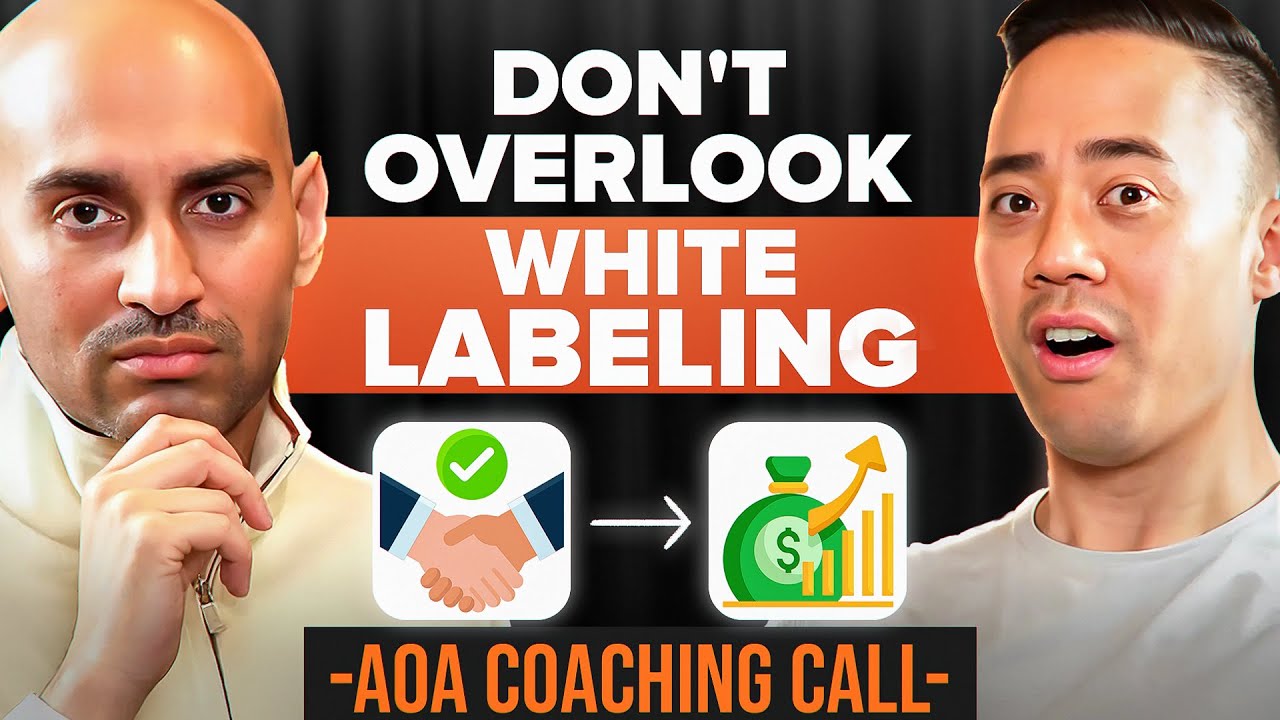
Okay, so I'll go first. Just a follow-up to what Neil was talking about. So obviously when you partner up, let's say in this setting, you have agencies that are doing various different services. And so when you partner up or you introduce each other to clients, there's no overlap in services. So that's great for acquisition and kind of growing your revenue top line and whatnot. But when it comes to the other points that you brought up is that offering 3, 4, 5 services. Now, when you bring in another agency and you set it up as a partnership, are you saying that you should white label it or you should introduce agency as a standalone agency? But then that would not really contribute to the deal.
You white label. You do not introduce them as standalone. You white label. Yeah.
Okay. Got it. Cool. Yeah. That was a question just to clarify. Yeah.
And it makes a big difference on revenue because what you'll find is they're paying you more, but it's not in the more part because your margins are decreasing because a lot of that money's going out because it's getting white labeled. But what you'll find is they stay a lot longer. See, everyone in this room is generating revenue. Let's say you make $1 million and everyone has to keep filling up their pipe to keep getting more customers.
Yeah.
What happens if you had the same amount of customers, but instead of $1 million, they paid you $2 million?
You're like, how?
They're not going to pay me double. No, I'm telling you, they just pay you twice as long. So if you had half the amount of churn and your revenue doubled over time because you just kept clients longer, your business really does change. The biggest problem with smaller agencies is not closing revenue. Everyone believes they need to close revenue. It's actually the problem of keeping the accounts. Very few of you guys are keeping accounts for 4 or 5 years, right? You may think you have some accounts that are long, but if you look at your average tenure of an account, it's much, much lower and churn is extremely high. Well, if you're losing half your clients per year and instead you can, if you, Kept your clients instead of for 2 years, you kept them for 4 years. That makes a huge difference on revenue. And the easiest way to get them there is you sell them multiple services. Even if you're not collecting a lot of that money, you're still keeping them much longer, which in theory makes you more cash.
Got it. Yep.
Awesome. Thanks for that, Scott.
Agency owners, if you want to grow faster, my partner Neil Patel and I, we are hosting live agency owner workshops in Beverly Hills, and you're going to learn how to get more clients. You're going to learn how to take yourself out of the day-to-day. You're going to learn how to recruit the right people, and you're going to be hanging out with like-minded people such as yourself. So if you want to learn more, just go to marketingschool.io/agency. Again, it's marketingschool.io/agency, and we'll see you on the other side.
Terrell, you're up next.
Awesome. Awesome. All right. So I suppose it's an interesting question. So I have a dev background and a lot of experience with product. If you guys were in this new AI age and you had a tech background, you have kind of a dev agency, what would you be looking at? Would you be looking at SMBs, be looking at startups, enterprise, and then also trying to keep deal cycle as short as possible so we can collect cash as kind of quick as possible?
I'll take it first. So Adam, I think what you're doing, because you said you're an AI dev shop, right? I would try to I would try to go more mid-market enterprise, basically upmarket. And to Neil's point on the partnership angle, like, you know, for example, someone like Neil, he has the logos that you're potentially interested in. And if you come up with a bunch of ideas, like, I'll tell you what, I was with a couple of— I was with the YPO client yesterday and he's like, dude, all the stuff you talk about with AI, like, we want to do all of it. Let us be your guinea pig. Another client said that a couple of weeks ago. All the things you're talking about, like, we want to do it, right? Let us be your guinea pig. So people are like, throwing themselves out there right now, right? I think it's just a matter of who's actually receptive to doing it, but many of these businesses are open to doing it. So Neil, do you have anything to add there?
No, I think you pretty much answered it spot on. There's just a lot of people that are willing to do deals. You just got to figure out who you can convince.
Yeah. Terrell, if you got some good stuff to send to Neil and I, throw some, like 3 of your best ideas. Take a look at Neil's logos, take a look at my logos, or you can even just ask in the community. And that could be like a starting point for you.
Yeah.
And I want you to start thinking about this in a very different way. Instead of thinking about it like, oh, I'm going to partner with these guys. Yeah, I got to pitch them to try to convince them. Start looking at it from the perspective of them. They have customers. Their customers want them to continually innovate and do different things than the competition. If you can help them do that, you're providing a lot of value and they'll see value with you.
Awesome.
All right, love it.
I'll definitely send some things your way.
Cool. Looking forward to seeing you in the community. Noman had posted in the chat, how do you ensure there is quality service? I think he was referring to Neil's comment on landing and expanding, and then expanding out different regions. Noman, did you want to just follow up on that really quick?
Yeah, so just partnering really does make a lot of sense. But some— sometimes what happens is if you white label a service, Like they may not like adhere to the same level of customer service that your agency does, or, you know, they might just say, hey, I just want to chat through Slack or, you know, WhatsApp channels, and that may not meet the needs. So how do you ensure there's quality engagement with your clients?
You have to vet all of that beforehand, and then the account management still needs to happen on your end. You control the client relationship. You don't want someone else to control your client relationship. So you still need to do the account management. Someone is doing the other work that you don't provide, and you are representing that work to the customer through your account managers. But you need to make sure the quality of the work is great. And the way you do that is you pre-vet people, look at their work, their case studies, talk to some client references. This will all give you an idea if they're going to be a good partner or not.
Thanks, guys.
All right. Quick note. This is about my company. It's called Single Grain, and Single Grain is an ad agency where we're focused on driving innovation. We'll talk about a couple of new strategies. And if you need help with marketing, great. If not, here are a couple of new strategies that you should try out. One is programmatic CRO. So we are doing programmatic conversion rate optimization on our site. So it's building products that will automatically optimize your site to increase conversion rates. We're also auto-optimizing, auto-updating from an SEO standpoint. And we're constantly thinking about what else we can do in terms of enriching the visitors that are hitting your website and also tailoring custom messages for them using AI. And so there's a handful of things that we're doing from a marketing standpoint And our mission is just to drive more innovation. So if you wanna learn more, just go to singlegrain.com, grain like rice. So singlegrain.com to learn more, and we'll see you inside. Cool, cool.
Let's send it over to Matt.
Yes, hi, happy Friday everyone. So I'm in the process right now of improving our SOPs to basically being able to onboard new clients and staff more effectively and just to scale up. So my question for Eric and Neil is, how do you organize SOPs at your agencies? Do you use any tools and how do you get employees on board so that they participate?
I'll keep it short and then Neil, I don't know if you wanna add anything, but we use Coda 'cause everyone likes, so I'll give you the tool first. It's a nice dopamine hit, right? And then we tell people we will fire you if you don't check our standards of excellence, you don't initial it. You don't read these things and initial it, we will fire you. So compliance, right? And like, we have something— I'll take it one step further, Carlos. Because in the past, when we've kind of been haphazard about it, when people are like, if you don't take it seriously, then they're not going to take it seriously. And so we haven't had to fire anybody for this, to be very honest. But when you say something like that, people take it a lot more seriously. You don't have to do that. It's just what we do. It's what works for us. But But Neil, feel free to add anything if you want.
It's also onboarding and training. Creating the right expectations from day one really helps people follow processes.
So Eric, that was, you said Coda with a K?
Can you drop it in the chat?
Is that a software?
I'll drop it in the chat. It's a software. So we used Notion before, but we found Notion kind of restricting.
So we used Coda instead. So coda.io.
Awesome.
And just a quick follow-up question, I think it's gonna be a quick one. When it comes to calculating EBITDA for digital agencies, is this just basically net profit? And how do you account for owner's salary when you do this calculation, if you can help me with that?
Owner salary is an expense, and that goes against your profit, your EBITDA. And you want to make sure it is accurate, or not accurate. You want to make sure it's a market salary. See, if you're doing a deal and you're working with someone, and they're saying, "Hey, I get paid 100 grand, and my profit is a half million dollars." Well, if you know the reality is they should be getting paid 200 grand, you want to adjust it from a half million in profit to 400 in profit, and then getting paid 200 because they're not going to continue working for you or with you if they're only getting paid 100 when the market rate is. So why would you buy something with $500 in profit when it really is only $400?
Yeah.
Thank you for that.
And the reason you got to look at EBITDA is because a lot of people have debt.
There's—
during COVID a lot of countries put out stimulus programs and a lot of startups and agencies took them. So a lot of people have debt on their balance sheet and you got to pay that off. It's really hard to get deals done when they have too much debt and very little EBITDA.
Cool.
Thank you, guys.
Let's send it over to Nathan.
Cool.
Hey, good to see you guys. So I have a landscape question. So we run growth for some of the big AI newsletters, and it's kind of been an open question, like, are there big agencies or agencies in general that are doing a really good job of attacking the process and tooling of how do you take a big company and use AI better? And do you guys know anything about that landscape beyond just the Accentures of the world, who I'm sure they already have the relationship with the CIO or the— generally in a marketing and sales context, let's say, like those orgs. Who's doing a good job of improving those orgs with AI?
The only one I would have given you was Accenture. But Neil, go for it.
OK. McKinsey is trying to do some really cool stuff with AI. Actually, all the The big players are. But what are they doing? Honestly, I don't know much. You're just reading the articles. But a lot of them are seeing a decline in growth, but they're growing because they're cross-selling a lot of AI stuff into these organizations, and that's how they're getting growth in this bad economy.
Yeah. Have you seen— just super quick follow-up. I see those firms. I used to work for one of them, and generally it is, yeah, it's a lot of like hammers looking for nails. Is there anyone who is smaller that you've just seen logos pop up? That are going after that?
Bounteous. Check out Bounteous. It's another agency that's doing a lot with AI. They merged with another agency recently. I don't know what their headcount is, but I think they have like 4,000 or 5,000 people at this point. It's something ridiculous.
Nathan, check out sierra.ai. So this guy was, his name's Brett Taylor. He was high up at Facebook, high up at Salesforce, and a great investor. So he started this new conversational AI company and he's working with a lot of interesting logos. And I think he's really trying to custom build these for everyone. And I think that's the angle, right? If you're Accenture, you're McKinsey, you have the relationships, it's more so you, and you understand our businesses well and you're just like, hey, have you thought about this angle? Have you thought about this angle? Hey, what if we did this over here? And then you're charging it basically at cost or maybe even for free saying, hey, like, you know, we're gonna guinea pig this and you need to give us a little more slack here and we're gonna make mistakes and you gotta be okay with that. Is that cool? Okay, great. And, you know, the bigger you are, the more you have to CYA, cover your ass.
Cool.
Thanks.
All right, guys, that wraps up our call for today. If you're watching this live, you can always go to marketingschool.io/aOA and you can apply for the community. We'll see you next time.









