Scaling Trust: Webinars, Live Events, and Relationship Marketing
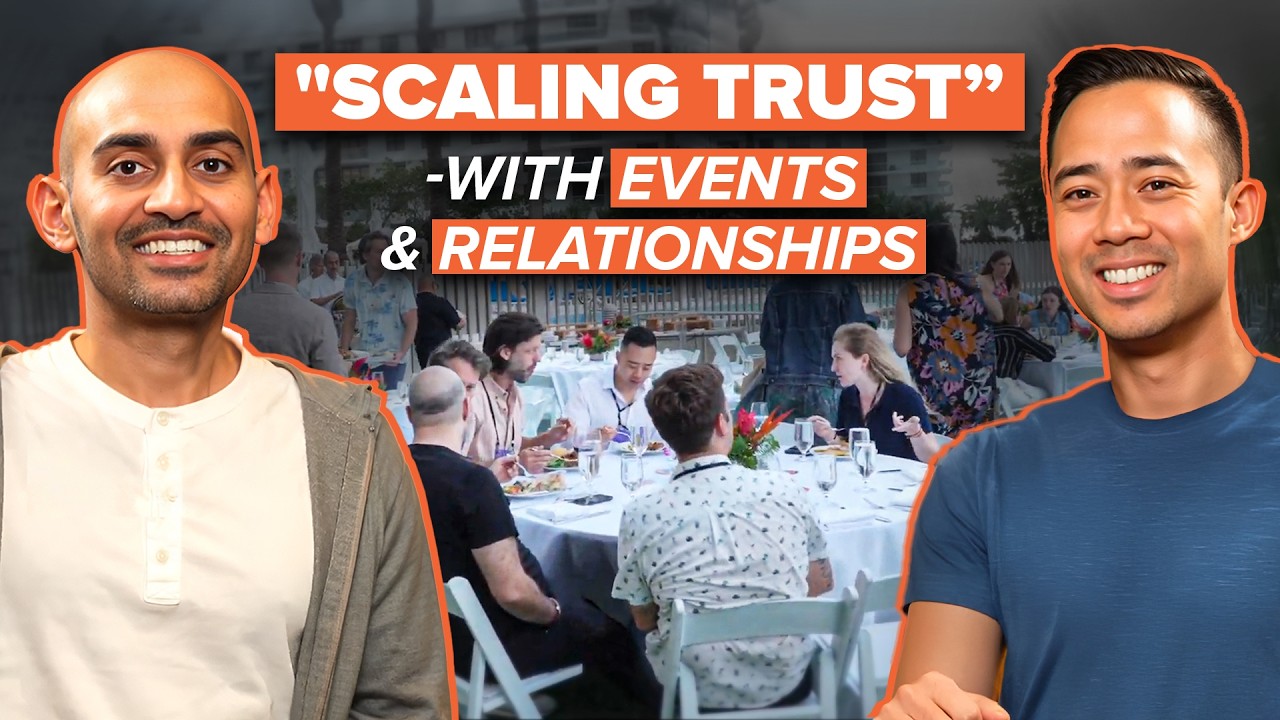
Eric Siu and Neil Patel discuss B2B growth through webinars and live events. They cover webinar metrics like registrations and concurrent viewers, tools like Restream and StreamYard, and how curated dinners and happy hours build trust and pipeline. Real examples include enterprise deals and practical tips for guest selection and follow-up.
Chapters
All right, so we're going to talk about how to grow your revenues using dinners, webinars, and live events. So Neil and I, we've been throwing these dinners, these webinars, these live events, and yesterday I actually joined your webinar a little bit on YouTube. I saw it streaming. I was like, oh, he has a lot of viewers. So I clicked on it and there's, there's all these subtle nuances, but especially if you're in B2B, these are the things that continue to work over time. If you're thinking, Oh, what type of old marketing still works today, still crushes it today? It is absolutely these types of events. And I look at webinars as a live event. I look at in-person as a live event. Dinner, I look at as a live event as well. Happy hour is also a live event. So maybe we can start from the easiest first and then go all the way to hardest. And I actually think webinars would be the easier place to start because you don't have to worry about real-life logistics.
So my webinar yesterday, before we dive in, was on the gate— Google reset. I actually have the numbers from my teams. 11 total registrations.
11,000?
11,000. They're rounding when they give me these numbers, but you can see it here on my phone.
Yeah.
5,000 US, 6,000 international. US bottom of the funnel. They didn't send me international bottom of the funnel. US was 20 DCs, 2 pitches, 1 contract set. Keep in mind, this is before the webinar even aired because this was at 6:24 AM. I log in at 7:45.
Our start time is Oh, you log in early.
Yeah, 15 minutes because the other speakers are there, just making sure everyone has transitions down, audio's good. So we do just a few checks beforehand because sometimes some people's internet just sucks. So then we'll switch who's presenting and managing the deck, but that's not that bad. 20 potential pitches or 20 potential, not leads, 20 people who—
Who got pitched, saw the webinar.
Or no, 20 people who didn't even see the webinar who were talking to already and based on their company size, budget, et cetera, they're already qualified. So those are our discovery calls, but they're already pre-vetted before they go to a call.
Yeah.
Okay. And that's before the webinar. I don't have the post-webinar numbers. It's usually much larger post-webinar, but this is just people who are registering for the webinar and opted to talk to us before we even hosted the event.
Yeah. And it makes sense. It's one of the most scalable ways to build trust. And the other thing is, if you're looking for an agency at some point, you get to meet some of Neil's team. You know, some people will know Neil already, but it's, it's cool that you get to see the founder and you get to see the team and you get to see the dynamic. And if you like the information, then it makes it way easier to want to get on a phone call. And the fact that you're doing these webinars actually shows that you're going the extra mile. And if you look at how you do it, you have these little scans on the side, these QR codes on the top right and then on the bottom right, and then you guys are bantering with the team. I think it's a really nice way of showing your team off without being too salesy. Yes.
And if our favorite part about the webinar, and this is where we collect the majority of the leads, is actually during Q&A. So we try to hold at least 10 minutes for Q&A. People ask questions, you answer them. We have a guy named Colin who vets the questions and picks the ones that are popular and that are good quality that he thinks would represent the majority of the people on the webinar. And what we found is if you pick the right questions that are applicable to a lot of the people on the webinar, And they're technical or there's something that a lot of people have top of mind and you give an answer that shows you're good at what you do, you're smart without trying to brag, it ends up generating a lot of QR code scans.
Everything in sales is a trust-building exercise and webinars are one of the best ways to build trust. And same thing with Q&A. If you can answer it well, you're building trust. Every little bit that you're doing is building trust. And let me ask you this, with these webinars, are you mainly, I'm assuming most of the attendees or registrants are coming from your email lists, which a lot's driven from SEO. Are you still driving paid traffic to it?
No, we don't drive any paid traffic to webinars.
But you were spending a couple thousand bucks each webinar before.
We did test that out. We were generating leads from it. It looked like it was profitable, but what we found was more profitable was just sending an extra email to our email list saying register for the webinar.
But also, I mean, the context here is Neil has a couple million people on the email list.
Correct.
You clean it, right? If you don't have that, I think it still is profitable to drive traffic. And you guys did mostly Meta, right? And I'm assuming the CPAs were like $10 a pop, $15 a pop?
No, it was less than $10 a pop for Meta.
$8 a pop?
No, it was less than that.
$5 per registrant?
I don't know the number, but I know we were paying less than $8 a full registrant on Meta. So as we scaled up and fine-tuned, at the very beginning, it was costing us an arm and a leg. At one point, I know we were paying over $20 a registrant, but we quickly fine-tuned the campaigns.
So, okay, let's call it $5 or so. If you're trying to get 2,000 registrants, then you might be paying $10,000. And then your show-up rate's like what, 30%, 40%?
So we had 11,000 registrants simultaneously. We usually have between 4,000 and 5,000 people at any given moment watching the podcast.
And a big chunk of that's YouTube because I saw 8,000 people simultaneous yesterday.
Oh, so 8,000. I didn't check yesterday, but It's not actually YouTube. YouTube is where everyone's driven through. So what you're seeing, whatever program we use, it streams it on YouTube. So all the counts go through YouTube, even if it's not, even if you're logging in through whatever app.
Your high point yesterday was 8,600. That's what I saw. Got it. Yeah. So anyway, I think, look, this is, it's, and even Jason Lemkin from SaaStr, he founded EchoSign, sold it to Adobe. It is the gift that keeps on giving. And in fact, more people should be doing it. I don't know why more people don't do it. Like, you know who does a really good job with it? I think, I think you do a pretty good job with it. I think Nathan Latka does a good job with it. And so his is, you know how like Tony Robbins has all these screens behind him and you can see people's faces and stuff and he's like on a podium. So he has that and he'll like pull people, hey, come on over here. And it's like this, it's like, it's your— he's constantly changing. It's like a spectacle, right? You know, okay, we're going to switch over here. Okay, Neil's going to come on for 5 minutes over here and share his best growth tactic. And then it's going to go over to Noah over there and then this, and then it's like goes for the whole hour and then it's done, right? And then I was on Adam Robinson's webinar last week and he had I saw the thing, it was about 11,000 registrants. And so a couple hundred people showed up. So not as many people as yours, but it's not nearly as dialed in as yours, which I want to talk about the software that you use in a second. But his was basically, he starts 5 minutes, he picks someone random from the crowd, they get to pitch their product or whatever it is. Then it goes into like a Q&A with me where they're interviewing me and then I'm doing some screen shares here and there. And then there's maybe 10 or 15 minutes for Q&A afterwards. But that's how it works and that works well for them. So you have to decide what format works for you. And, but I think what's helpful is not enough people do what you do with the, using Restream. And I think that's a lost opportunity. So go ahead, feel free to talk about it.
Yeah, so I can talk about the Restream, but I think there's one important factor that I think most people get wrong with webinars is people think it's about how you promote, it's about the ads, it's about How you sell during the webinar. What we found is the most important thing, and this is going to be silly, it's can you have a presentation on very timely-based content? So for example, my webinar yesterday was about the Great Google Reset. I forgot what the rest of the title was, but that was the start of the title. And when you look at like the Great Google Reset, everyone's wondering right now what's happening with Google with AI mode. Okay. And we talked about how Google's changing and all the new features they're launching and what marketers can leverage to do well in today's new climate with AI overviews and AI mode and all the changes Google's making to YouTube as well as paid media and all the settings and all the cool functionality and software. You guys, you, you get the point. It doesn't matter if I do the same promotion and we do the same types of promotions and we use the same process each and every single time, but if the topic isn't good, You're screwed. And it's not about like, is my title clickbaity? Is it catchy? It's really, are you hitting a topic that's on people's mind right now? Like our next webinar. And when we do a webinar towards the end, we showcase our next upcoming webinar and the date, scan the QR code. And we use QR codes for everything on our webinars. They take their phone, they scan the QR code.
What percent register?
I don't know. I don't have that data. My team definitely does because they track it all. And I know this because when we were using QR codes, One time I swiped my own QR code. I'm like, what the heck is this transferring? This is taking too long. And like, oh, we have all of this done for tracking purposes. But my next webinar is on—
Dude, where's my traffic?
That's what I wanted to call it. I think my team called it like, where's my traffic? Like how to recover something with AI or whatever. But I wanted to call it, dude, where's my traffic?
You know?
And I was vetoed on that one. I thought that was clever though. But yeah, I think the timely piece is super important and that's the biggest mistake companies get wrong. You can't just do a webinar on like, dude, you do ABM and when you do ABM, you know, ABM's been beaten to death. You are smart. You wouldn't do a webinar just calling it ABM.
I don't think I've ever talked about ABM stuff on its own. It, and it's funny, right? Because my team has come up with a lot of these ideas and it says ABM. I'm like, and then all my ideas are more related to yours because you have to talk about what's on people's minds. And then if you wanted to float in the ABM piece here and there, you can do that creatively and it'll get them interested in it. Anyway, but you can't lead with it because that topic is, it's kind of old.
So not, not just old. You had a LinkedIn post that went viral related to your ABM product.
It's got to be new though. That's a new thing for ABM.
Yes. But you had 2,000+ comments, was it?
1,300 comments, 700 likes or something like that. Okay.
So it was a lot. Yeah. 1,300 comments is a crap ton. Excuse my language. What was your angle to that post? Because ABM's beaten to death.
Yeah. I think the headline was LinkedIn doesn't allow you to run ads like this, ABM ads like that, like, like this, um, or run personalized ABM ads until now. And then, then you have to click more to see more, right? And then it shows the thing and it shows a picture and like, oh, if you want this, comment now so you can run your ads within minutes instead of weeks. Yeah.
Yeah. So it was really timely because a lot of people were interested on how they can run Personalized ABM ads on LinkedIn. It's been an issue for a long time. People pay a ton of money for software. Some of your competitors are generating well into the 9 figures in revenue. So I was like, cool. But if you just talked about like, here's a cool ABM strategy that you guys should check out, I don't think it would've done well.
No. And you know what, what sells? It— fear sells too, right? So the, oh, SEO is dead, or like, where's my traffic? Or things like, like it gets people to click and then you, but, but You got to make sure you deliver. And if there's anything I think we've done well over the years, even though we're very different people, is skating to where the puck is going. And that's what people are looking— again, people, it's hard to find people who are consistent over the years. And I was thinking about this the other day. This is like a little tangent. If there's anything, I think I said this to someone, I was like, you know, I might not necessarily be the best marketer in the world, but I'm consistent, right? And that's the same thing with— at least you're very consistent. I'm not gonna say whether you're the best or not. I don't think you're the best.
No, I agree with you.
You wouldn't say you're the best either, right? And so it's like, But if you look over the years, like all these people who have started podcasts and things like that, they're just inconsistent. Yeah. So that's all it is. Just be a little more consistent and you're good to go. But that's a webinar piece. You want to add anything else? You're using Restream. What else? You're getting there 15 minutes early.
We don't use Restream anymore. What do you use? I'll have to pull up my calendar invite because I did a webinar this week. They make me go to StreamYard.
Oh yeah.
StreamYard is good. And it wasn't because Restream is bad or anything like that. It was just buggy on, I forgot which portion was buggy, either connection or audio or QR codes or something. There was something that was buggy on it. My team couldn't figure out how to fix it and we kept having issues when we were going live on the webinars.
Oh.
Or, oh no, I think it could have been the connections. Like sometimes it would show that we're connected to LinkedIn, but it wouldn't stream on LinkedIn and people would be pissed off being like, we signed up, where is it? And then our team would have to do things like toggle it on and off again.
Uh, StreamYard's more reliable, but Restream had more of the peak features, I think. Right. 'Cause it had that cool little, uh, QR code scan.
We have that on StreamYard too.
Oh, okay.
So, but it doesn't have the counter.
Okay. Yeah.
I haven't seen the counter yet. Maybe it has that feature, but I have not seen the counter. Yeah. Restream, the quality for me was better. It was just buggy when we were streaming to all the platforms. Yeah.
Well, look, so, okay. Is, is there anything else? I mean, you, you sent an email 7 days before and you send, uh, 24 hours before.
We start 2 weeks before.
Okay.
So we won't do a webinar within 7 days. We do 2 weeks before. So if we're leading up to a webinar, we do roughly 4 emails.
Yeah.
You know, 2 in the 2 weeks prior, 2 within the week of the webinar. And for the people who are registering, when the webinar's about to start, they also get an email that it's about to start. If we have their phone number information and stuff and opted into all this stuff, we will notify them through SMS that, hey, it's about to start. That's how we get High attendance rate. But here's the kicker. Like you saw, how many people did I have live?
Roughly 800 concurrent.
So it's, those numbers are skewed. And the reason I say it's skewed, even though I had 11,000 registrants, it's also leveraging my YouTube profile.
Mm-hmm.
It's also streaming live on LinkedIn. Those counts won't show up on YouTube. So people can just go on LinkedIn without registering. Same with X, same with, I think Instagram we stream as well. I think we stream on Facebook. I know we stream on TikTok because I keep sending them my code every 2 weeks. So I don't know how many people are watching live, but it's probably more than the amount of registrants we have, but it's a combo from both.
And then each time, so you have a couple thousand people show up, how many discovery calls does it lead to?
For us, if we don't get at least 5,000 people to show up, it's a failure. And I would say in total from a webinar, I don't know the number of discovery calls, we're aiming for at least $400,000 in revenue.
Okay. That's $400,000 in new pipeline generated, right?
I don't know what you mean by new pipeline generated. Are you talking about potential? Are you talking about— Closed contracts.
Oh, so from each webinar, you're expecting $400K in closed contracts?
At least that's our goal. If we don't hit $400K, we look at it as a failure. Got it.
Great.
So I don't, I don't know what that means for top of funnel on total number of leads, total number of calls, and then pitches. And I I just get a number from my—
I'm trying to think if there's any other nuances. You're texting them as well?
I'm texting them as well.
Yeah. Ahead of the call. Um, and then post-webinar, is your team look— they're looking through all this because we do this, right? Remember we've spoken at conferences and when they give us the attendee list, we'll send them the slides and say, hey, book a call with us. You do that after, right? Post-webinar, or your team will look through the attendee list and look for ICP fits.
I know. I don't know if we send them an email with the deck and say, hey, book a call. I do know that we, uh, look through the list and look for ideal customer profile.
Yeah.
That I know we do. And then they start building relationships with those people. A lot of those sales cycles, call it, are 6 months plus where you're building relationships. So when I'm talking about like $400-ish grand close from a webinar, I'm talking about we do a webinar, within 3 months we're looking for at least $400 grand.
Yeah.
The relationships we build with enterprise brands that take longer, that's cherry on the top, but a lot of that revenue doesn't kick in until a year later.
Yep. Okay, so that's webinars. Now the next hardest one.
Oh, and one really quick thing. I'll give you an example of the enterprise one. I was in Latin America. Lady's like, I really wanted to work with you. And she's like, I brought you into, you know, she saw a webinar. That's how she first learned about us. She speaks perfectly great English. She runs all of LATAM. She, at whatever current large global 5,000 company she was at, She tried to get us in to do a pitch and work with us. They didn't have the budget, so didn't work out. She then went to Oracle. She then tried to get us included. She, we, we did not win the contract, but she really wanted to work with us even though she was running all of marketing. There's other people involved that vetoed her. And then she now is company that's one of the largest, I don't even know what category they're in. They're in a lot of different categories, but let's call it the founders are.
Hmm.
On the, I would say not even Forbes list, but Forbes 100 richest people in the world, right? So they're up there and we got a contract, but you're talking about from watching a webinar to roughly a year and a half to 2 years. And I'm not really more than that.
Maybe 3.
Probably 2 plus, because you have to think about switching of the jobs. Yeah, probably easily 2 plus years.
And here's the thing, this is not even for sales deals, but when you look at really valuable recruits too, sometimes it takes 2, 3, 4 years to bring someone that you really want to bring in too. So this is a very long game.
And guess what the contract value was?
Millions?
Starting off was, what was it called? Like, I'm trying to convert the currency. $370,000, $380,000. Test project, one division. We did really well. And now we're talking about scope that is around $1.1-ish million USD. And then if we do well, we would get more regions, more divisions. This is just for LATAM. I think we can globally grow the contract to $5, $6 million.
Yep. So guys, the reason we're— we haven't even moved on to dinners and live events yet, but this stuff takes time. And but when you win this deal, it compounds and it expands and it becomes 10— it becomes worth tens of millions, but it takes a long time to get these going. That's why you can't be in a rush. You really can't rush any big deal. No.
Yeah, you can't. The big ones just take a long time, dude. When you look at your Care ABM solution, What's your average sales cycle for a large enterprise hitting you up? Not a startup, I'm talking about an enterprise company that does at least $100 million, because that's probably your ideal customer.
Yeah.
They have a lot of people, they're willing to spend a lot of money.
I'll give you 2 examples actually. So initially it was like, hey, we'll come back when the timing is right. And then when I was gone during the last couple of weeks when I was kind of inactive, but still active, 4 people came back and closed on their own. 2 were companies, one was publicly traded and one does over 9 figures a year. Um, but the sales cycle on that one, you can call that, they talked to us in freaking December.
So the first part you said is, oh, I'll come back when the time is right. Was that your team saying that or was that them saying that?
They said that. Yeah. They're like, we really like this, but the timing's not right right now.
That was all those deals?
Yeah.
Okay. And then go back, go back with the number count.
Yeah. So 4 of them came back and auto-closed themselves basically. And this is to, to a pilot.
What, what do you mean auto-closed themselves?
So we already had sent them, we already sent them the pilot information like months back, right?
Including proposal?
Yeah.
Including proposal.
Yeah. And so they just came back 'cause it's a pilot. There's not a lot of risk there, right? But it did take them, we're talking, yeah, close to 6 months to get this deal done. But usually it would take them even longer. But keep in mind, Caret's only been around since like last November, December.
Yeah, it hasn't even been 1 year.
No.
And, and you said, was it 1 or 2 of 'em were publicly traded?
2 were publicly traded. Yeah.
With good market caps. Yeah. Yeah, that's great. So you can have expansion opportunity. Yeah. And have any gone through the pilot yet?
Yeah, actually, there's a couple. So there's a couple now we have them on MRR. So they're like paying. And so it's cool. But what we've realized from this, and we can talk about this later, is that ABM itself is a nice hook in, but they actually want to— a lot of these people spend on like Meta and LinkedIn and they want to do more general marketing. And so they're like, can you just enlarge it and let us do more besides ABM? And we're like, yeah, because they like running the ads in there. I'm like, oh, okay. So.
We'll see how they like running them or do they want you to run them?
They like running the ads in there themselves. If sometimes it's their paid media manager and sometimes they're like, dude, can you just do it for us? So we actually have a couple of managed services deals that we're proposing as of, as of this week, we started proposing managed services. So it flows back into the agency.
Yeah. So it all fits together. Yeah.
And you want it to do all your things fit together. You were talking about Ubersuggest at the end of it. I don't know if you want to talk about some of the new Ubersuggest features coming out before we move on to How to Crush It with Dinners and Live Events, which I think I'll probably be talking more there, but go ahead.
Yeah, so I would say within the next 30, maybe 45 days, I hope no more than 2 months. I'm really pushing for 30 days. We're changing up Ubersuggest in 2 main ways. The first one is if you're a business, technically you should be a business or have a website if you're using Ubersuggest. But the first main way is if you want to actually track your business on these LLM platforms like ChatGPT, where You can put in your URL. We'll suggest your brand name. Like if you put in ubersuggest.com, it'll automatically fill in Ubersuggest because we assume that's your brand name. You can change it if you want. And then we'll suggest the category that you're in. So it could be like marketing tools or SEO tools. If you put in ubersuggest.com, if you put in Nike, it would be apparel or shoes or something like that. You can change the category as well. It will then give you prompts and It can give you 10 prompts, 20 prompts, 100 prompts. The list can keep going on and on, and it'll tell you how many times you're mentioned versus your competition. We're adding an intent on those keywords, sentiment. Are you positive or negative? It's also running that prompt multiple times because if you run it once and then you run it again, a lot of times you get different responses. If you run it 10, 20 times, you can see what companies and competitors they're really mentioning on average.
Yeah.
And then you can see how you're doing and stacking up versus your competitors. And what are some of the areas and prompts that they're getting notoriety in or mentions that you're not? So that's all on the brand tracking side. And we can run that, those reports for you automatically on weekly basis or monthly, and you can remove prompts or add prompts, of course. And then we're also making changes to the keyword research report because our main usage of Ubersuggest is someone goes to ubersuggest.com, puts in a keyword, they get tons of data on SEO data, but we all know that Google, even though is the big, you know, 1,000-pound gorilla or whatever the phrase is, we know that people are using AI versions of search like AI mode, ChatGPT. So what we're going to be changing to the AI overviews is adding in data for LLMs and then traditional search.
Hmm.
And my team started sending me stuff and I don't know what they're going to add in the first version, But some of the stuff is like, let's see, prompt intent, you know, like what type of prompt is it? Informational, transactional, et cetera. Trend data, if the prompt's growing over time or if it's decreasing, the difficulty to get mentioned in that prompt, like how difficult it'll be. A brand ranking description, brands that appear most frequently, total number of unique brands mentioned within those prompts. So you know how likely you are to get mentioned. There's visible triggers description. I don't know what that is. Output type breakdown description. That's like the format type could be like step-by-step guides or definitions or any of that. Let's see, related prompts, content gaps, of course, when it comes to prompts and recommended descriptions and even like data on how you can rank. But these are just some of the things that they already have included along with like things like sentiment that I also talked about.
And this competes with like the Profounds of the world, these other tools, right? Yeah, but you'll just get a lot of the data for free without creating an account. And you'll, so you can get, there's a free option and you have a $9 option, right?
That's going to be— No, it'll be free, non-logged in. Then you get more free stuff if you log in, so you can get more usage and more data and more prompts. And then you can upgrade if you want even more data on top of that.
This is great. See, the thing is, the, these other tools are charging hundreds of dollars.
$4.99.
$499?
A lot of them are $499.
There's a $499 and there's a $399, I think, or $299 for the other one. But you're coming in lower, which I like. We have a mutual friend that does the same thing as well with his products.
Yeah, I know who you're talking about.
And it works well for him. Here's the problem with most marketing agencies. They don't understand what is happening with the world of AI. With my agency, Single Grain, we think about agentic workflows. We think about creating agents for the future. When we We think about SEO, we think about creating different products such as internal linking products or content consolidation products. And on the other side of things, we think about building products such as Care. We just think about making marketing easier overall. If you want to stay at the cutting edge of marketing and at the same time leverage the power of AI, go to singlegrain.com and we'll see you on the other side. So I'm going to talk about how to grow your revenues by throwing dinners, because again, webinars, conferences, dinners, they go a long way, especially if you're in B2B. It crushes for closing because you're actually building relationships and relationships go a long way. People remember how you made them feel. That is the saying. And so I've been doing dinners for a very long time. Neil comes to a lot of these dinners and I think I've got it pretty down pat now.
Yeah.
I've been doing them probably start of 26 years old or so, and now I'm 39. So I've been doing it 13, 14 years or so. And I'll give you a couple of things that work for me when I throw these dinners to have a good one. One, The very first dinner that I threw was directors of marketing and CMOs, because I wasn't like an entrepreneur yet. I was still like 26 years old. And so my thing is, if you're going to throw a dinner, always make sure that the people are around the same level, because you can't invite like an intern and then invite like an entrepreneur and then invite like a director. It's just, you're not going to talk about the same things and people are going to hate you for that. So you got to curate a really good group of people. Okay. Ideally you feed them. Ideally you're the one paying for it. The first time I was broke, so we only had a half-eaten bag of chips. And so we're just sharing my, I think it was like a, You know, Lay's potato chips.
That's cool though. Something's better than nothing.
But they loved it. They loved it. The key thing is the content. Going back to the content again, right? You talk about make sure the topics are good. So let's say, Neil, you came to the dinner, you had to bring the who you are, what you do, and then one thing you're— what are you struggling with right now? And also like the best marketing hack that you have right now, right? Everyone likes hacks.
Wait, can we go back a little bit?
Yeah.
You decide if you want to do a group, the group could be like CMOs or directors or VPs or even just entrepreneurs, because I'm assuming you've done entrepreneur ones too. All the time. Yeah. And some of them are related to a specific category like D2C, or some of them are just broad.
Yep.
How do you— okay, you got the list. Let's say you're going after VPs. How do you know who to invite? Because there's so many people in companies.
Yep.
And how do you get at those people if someone's not well networked like you are? Because when you first started off, you weren't well networked. No offense.
No network.
Yeah. And you got access to these people and you got them to come to dinner. So what's the process for that?
Yeah. Great question. So I'll give you an example. This was maybe 1 or 2 years after I did the first one, right? But there's this one dinner where I remember I got 3 customers from it and I did this in SF, right? So we had, this always worked, especially if you have agency clients or software clients. So you invite 3 or 4 or 5 customers. So half the group is your customers. The other half is people that you'd like to, that you're targeting, right? And then what you do is you say, hey, this is going to be a CMO dinner. It's going to be, it's a private dinner. Always say private. People, for whatever reason, private gets them, right?
Yeah.
So it's a private dinner. It's going to be CMOs, it's invite only, it's amazing people. Here's who's coming so far. Are you in? Right? I got one spot for you. Are you in? So it makes it seem super exclusive and they feel really special, right?
And you do this over email?
I do this over email. Yeah. And it always, I always, so I might overextend a little bit and invite like maybe 15 or 20 people, but I'm aiming for 10 really at the end of the day. I always end up filling it. Does that make sense?
I'm a little bit confused. Maybe I misunderstood you. You're saying these are the people who are attending or invited?
These are— so I will have like 5 guaranteed that are in already, right? And I'll say these people are in.
So how'd you get the 5 in at the beginning?
Yeah, so I, in the beginning, I started doing the podcast, right?
And then, or let me rephrase, how does someone else go get the 5 people in when they don't have a podcast and an audience?
Well, I didn't have an audience yet. I was still starting out, right? So I got the first initial 5. I said, hey, it's going to be great food. It's going to be CMOs. I didn't name who was coming yet, right?
I said, this is who's—
I said, I said, we're going to be at this restaurant. It's going to be these types of people that will be there. I'm handling the bill and are you in? And then once I got 5 bigger names to agree, then at the same time I was reaching out to other people, I'll just start to include them. And then without fail, I would be able to get 10, even though I only reached out to 15, 20 people.
Oh, so it wasn't that hard?
No.
So you reach out to initial group, call it like 5, 10 people. Some of them are naturally going to say yes, because you're saying these are the type of people. Once you have enough key people that said yes, you then And then when you're sending the remaining emails, you're starting to list the people out instead of saying, these are the type of people. Exactly.
And then I say, look, it's easy for you. It's a great restaurant, great people, just show up and then we'll— we're going to talk about marketing, right? Or I'm starting to do these AI founder dinners in LA, which, you know, obviously you're invited, but the criteria for this one is everyone has to be good at AI and everyone has to give me their tactics, right? And I have to approve. And so that's a little different, but let me rewind. So I started doing this bag of chips and the whole agenda was basically, hey, what's your biggest marketing challenge? What's your biggest marketing hack? Who are you? What do you do type of thing, right? And then we kind of went around the table, everyone shared for like 10, 15 minutes a pop, right? And we basically gave them advice or we like ripped them apart or we shared our experiences, right? And then sometimes I'll just have like general entrepreneur dinners where it's just entrepreneurs and what, who you are, you've seen these, who you are, what you do, one thing you need, And one thing you can offer. And then, then I just connect everyone afterwards. But if you start doing enough of these, people start to see you as the connector. And I just, in the beginning, I used to split the bill. I just found it way easier to just pay for it. But you also, if you're starting out, maybe you can't afford to pay for it and that's okay. Half-eaten bag of chips, right? So the second time we did it was I ordered Mediterranean food for everyone, right? Didn't break the bank, but at least it was a nice move from my end. But you got to start somewhere is my main point.
How do you control the bill to make sure that it doesn't go crazy? Because people start ordering tons of drinks and all this kind of stuff.
It's a good question, Adam. Yeah. So you say what I do is usually it's like drinks are either ordered by you, you'll take care of it. All the food ordering is I take care of it too. Right.
And then what you're not saying, not only do you pay for it, but you're saying you order the food yourself for everyone. Like you do family style.
I do family style.
Wow.
Yeah. But you have to build experience to get there. Like we have a mutual friend who loves ordering for everyone. I think I've just gotten used to doing that.
We have a mutual friend that loves ordering for everyone?
Yeah. Oh, maybe you're not there. Longer hair.
Oh yeah.
Yeah, yeah. He loves ordering. He always over-orders too.
I know the always over-orders.
Huh?
I've been to a restaurant with him in, was it Miami?
Yeah, maybe.
I think it was Miami. It was this place where it was exclusive. I could be wrong.
Zizi's.
Was it Zizi's?
No, I brought you there and I ordered.
Oh, that was you.
I ordered for everyone. Yeah. Yeah. So I've gotten good at ordering for everyone.
Oh yeah. The other person is how you got the membership.
Oh yeah. Yeah. We signed up together.
Yeah.
Yeah. Yeah. Yeah. Yeah. Yeah. Yeah.
Yeah.
We'll lead us right there. But my, my point, so even there we did a dinner too, right? But when, when you do these things eventually, like, 'cause everyone asks me, oh, how do you build a network? That's how you build a network. And then going back to the SF dinner just to wrap this up and then we could move on to live events. I think we got, we got 2 publicly traded companies and 1 analytics company that ended up selling to Google, I think. And that was because of that one dinner.
So it was probably Google Urchin?
No.
There's a different analytics company that's—
Looker?
Looker sold to them as well, I believe. So let's talk about you getting clients. You got 3 clients and how many people were roughly there?
10.
10. I'm assuming this was a high conversion rate because you remember it.
Yeah.
Higher than your normal or average?
Yeah.
What did you do to transition them from, you know, if I recall correctly, who you are, what do you do are the questions you're asking, plus what is your biggest marketing challenge?
Biggest marketing challenge and also biggest marketing hack because it's information sharing.
Okay. Yeah. And then people are helping each other.
Yeah.
How did you transition that being at a dinner and it being casual? I'm assuming it would've been really awkward right there to be like, hey, we should work together. Let me get your phone number and let's pitch you. Like, I'm assuming you weren't that direct because that's not your personality.
No, no. No, you don't do that. So they hit you up afterwards because you remember that book Influence, the Robert Cialdini book, right?
Yeah.
So if I do you a favor, inherently you feel like you owe me something already, which is why Neil doesn't really let you buy him food often. And I don't like people buying me or doing me favors either because then immediately I feel like I owe you, right? So the whole idea here is like, I just seek to give and you're the same way too. I seek to give without getting anything back and it keeps compounding because it's like, oh, what else do you need? Because I actually do follow up on the things that they're challenged with. And I do try to help them. I make introductions. Eventually it's like, oh, by the way, we actually need marketing help. You know, are you the one, right? Or who can I talk to? And, you know, sometimes we can take it on, sometimes we refer it out, but it's fine. I don't have any expectations there. I think you actually do a better job of this where it's like when you did the webinars, oh, scan for this one over here. If you need to talk to whatever, scan over here. I think we needed, we should in the future do a better job of just probably calling out, hey, this is Single Grain that actually sponsored this. Yeah. Yeah. Right.
Yeah, I agree. Yeah. And then when you got those 3 businesses to pay you, did it take a long time to close them?
Those actually all happened in less than a year.
That's pretty quick because it's outbound, or I look at it as outbound. You're building relationships and networking.
Yeah. And then I will say one of those that closed, that person went to another publicly traded company and followed us and then went to another company that raised a bunch of money and followed us. So she followed us 2 more times after that.
A large chunk of our clients are from employees who changed jobs and they were, we were working with them at the previous company. That is actually how we have gotten a lot of our clients. Another interesting point of view is we have a, we're a small company. I consider it small. You know, people consider 9 figures depending on what country you're in, a large corporation. I consider that small.
In America. Yeah.
Because you look at like Nvidia and just, it's like, okay, Even if I got to a billion in revenue, which I'm not at, I would start becoming a small large company in my eyes, right? Because you look like Nvidia or Google. I was looking at Google's earnings. They do over $300 billion a year in revenue. If I got to a billion, and I don't know if I'll get there—
That's 0.01%.
One, yeah, one 300th of a percent. It's just like, and by the time I get there, what are they going to do? $700 billion? You know, maybe even more. One of the ways we get it, because we have 1,000+ people, that's small in comparison to Google, Nvidia, you know, the list goes on and on.
Microsoft has 250K and they've cut some, but yeah, 250K.
Yeah.
Yeah.
We're so tiny compared to them.
Yeah.
And when you look at it, some of our employees leave to work at other clients and corporations, and then it actually solidifies our relationship with that company that is paying us. And then we make more money over time, or they hop around to another company, or they They left and like, hey, I want to go corporate instead of agency side, and then they hire us.
Yeah. Let me ask you this, this is a side question. How often do people boomerang back to MV Digital? Like they leave and they come back. You see it happen decent amount?
No, the really good people we try not to let go.
Of course not.
Yeah. The average people, let's not even talk about the bottom performers. Every organization, I don't care what size you are, there's always people who are your A players, B players, C players, and then you shouldn't have anything under C, but people tend to, especially when you get large. We try to keep our A players forever. When you want to talk about like C players specifically, some of them go other places, or even some of the B players or B-minus players more specifically, and not a big portion, but a good chunk, call it like 15, 20%, try to come back after a few years. And we tend not to Rehire B players and C players.
Yeah.
If an A player leaves and wants to come back, we will rehire an A player.
That's what I'm asking. How often do A players leave and then come back?
I don't, I can't recall when we've had an A player leave. Okay.
Well, that's great. Then you do a great— that's another thing we should talk about, how you retain these A players.
It's actually a cheat code and I don't know how to retain them. The cheat code is, is I hire really good executives, like a good CEO, who runs the organization. I let them run it their way. I stay in my lane. Like I work more on the software side than the agency side.
I'm not talking about—
The money side? And M&A, but when I say like M&A, there's not that much time I can spend on M&A on a daily basis.
You're saying you don't really get involved in the people side?
I don't get really involved in people side, but on the agency side, I do get involved with clients and work, but I don't get involved in like day-to-day operations being like, this is how you should do your job better, or this is what you could be doing. Like I try not to meddle too much because what I've learned is I have my way of doing things and I may believe that my way is right. Other people have their way of doing things and they may think their way is better than my way, but if they get the job done just as efficient as me, produce the same amount of results, who the heck cares? Why should I meddle in the first place? All that's going to do is just create friction. And because I stay out and the CEO tends to work with people he's worked with And past organizations that have been top performers.
There's a relationship there. Yes.
And he takes care of them.
Yeah.
So they'll come and it's very unlikely that they leave.
That's good. That's good. That's a whole nother episode for another day. Okay. Now look, the funny thing that I told you that this first episode would be like 20, 30 minutes. This first one, we're still not even done yet. It's already, it's been 30 minutes already.
More. We started at—
33. Oh, 40. It's been 40 minutes. Yeah. Okay. So let's wrap this part up and then we can move on here.
You're going to go to the live events? Yeah.
Yeah, and I'll make it simple. So live events, I just did a live event. Okay, so here's how to grow your revenue using live events. So just did a live event.
Wait, do you want to clarify live event being a conference?
Conference, yes, like a user conference. And you've got these 2 I want to hear from you.
Not a live webinar.
Yeah, not a live webinar. Okay, so here's how you grow your revenue using live conferences or live even user conferences. So we both have experience shares here. So the recent one I did was more of me assisting YPO, and that one was 100, call it 185 people that showed up, and then we did it in Miami. So I will just say that of that one, we probably, I think we added 4 deals from that one maybe, and maybe 6 in the pipeline or something like that. And that wasn't the intention, but that's just, it happens like that. You know what I mean?
Yeah.
Or there's a bunch of agencies that want to partner up. There's this guy that does direct mail. He wants to do something. I'm sure we're going to do something. So there's a lot of angles here.
By the way, Eric's not He knows that even though that wasn't his intention, one of the reasons he partnered up is because he knew that it would also generate business.
Yeah, which is why I was okay not getting paid for it. And I'm okay with all the profits going to YPO. And I was okay even sponsoring my own event and, you know, paying partially for my own ticket and that type of thing. And because I knew the long-term benefits would accrue, right? And so the way to look at webinars or live events or dinners is that sometimes it might not happen immediately, It's going to— sometimes it's going to be delayed. But everything we've done, like the relationship Neil and I have, it's been 14 years or so. We've learned over the years, even though we might not be the best with people management, both of us, is that everything comes down to people at the end of the day. And if you can control the event, the agenda, you can control the activities and all those things, you become the node and everyone looks to you. Just like when you're hosting your own dinners, your own webinars. But I want to know from your side too, you do these— These events with internationally, right? These live events.
Yeah, we call them conferences, but yes, we do conferences globally. And I actually understand what you mean by live events because conferences is a bad term, not a bad term, but not an accurate term because a version— we do 2 types of live events. One is a conference like you and I speaking at HubSpot's conference. The second is we'll invite our clients and potential clients and we'll give a presentation. network, maybe provide some drinks or pastries depending on the time of the day. I just did one in France. It was morning, so it was pastries and like juice and stuff like that. But when I do it in Brazil, it tends to be more in the evening. So it'll be like alcohol and appetizers.
Okay, great. So look, and we'll just give you a couple tips because we did for webinars and dinners, so we can finally move on here. So when I do my conferences, one, we try to do it at a nice spot. So that was on the St. Regis on the beach in Belle Harbor in Miami. It was a nice spot, right? We tend to just try to make the food buffet style. But more importantly, it's the quality of the conversation. So we try to leave a lot of room for networking. So we had this speed networking thing in the very beginning where everyone was networking for like 5 minutes a pop. And then we do leave a lot of room for breaks for people to talk to each other. And then more importantly, if you're going to try to draw people to your events, usually you want to have a really good topic. And what is a good topic usually is if you can get the latest marketing speakers, because this is a marketing conference, and they'll talk about the latest things such as AI. That is how this event ended up breaking records from all the previous events that happened. I think it was a big part was one, it was Miami, but 2, the speakers were really good and that's related to topical relevance. Yep. Yeah.
What do you end up doing with the contact records after? Because I've seen your emails.
Yeah.
So when you're doing a co-event with people, you negotiate, or when someone's doing an event and you're speaking, you try to negotiate where you can get access to the email list or they send a blast depending on the privacy laws and the locations of the individual.
Yeah.
But what do you typically do in that email blast? Because I've seen you generate revenue from that.
We couldn't do much with this one. We did send an email and I even got in trouble for this one still, but we did send an email saying, hey, here are the slides. If you want to catch up at any time, just let me know type of thing. It wasn't saying book a call with my agency or whatever. Right. And even in our goodie bag, we had this little thing. It's like, because we didn't have like any physical thing to give away, but I'm like, okay, well, we can put something in there. It was just a card to say, okay, here's like a free trial or something like that. But that was basically it. And that actually did generate calls. So, but I, someone complained to me that I was soliciting for business and I'm like, but I just shared my slides and I said, thank you for coming to the event. Here's the slides. And then like, you know, feel free to reach out if you need anything. My co-champion Jesse did the same thing as well, but I got in trouble for it. So, yeah.
And Tim also got in trouble too. That one was funny.
Did he?
Tim Soulo, remember?
What did he do?
For Ahrefs? Because he was, they said he was too promotional.
Oh yeah, dude. That, that, I don't know, man. It's like, it's like, where do you draw the line then?
Like— And he also paid to sponsor.
Yeah. Like he flew all the way from Ukraine. Or not, sorry, not Ukraine. Singapore.
Singapore. Singapore.
Singapore.
Yeah. I'm with you. I'm like, Tim, you paid for it. Who cares what they say? You promote as much as you want because at the next white people marketing event, they'll want you to sponsor.
And like, also don't treat a member like this that did this for free and put in all this heart and soul, like effort while like, you know, he was going through family stuff too. And so he just left me with a really bad taste.
By the way, he has a really cool kids' book. If you have a kid, check out Ahrefs' kids' book. I don't know if you can buy it or where to get it. Hit up Tim Soulo if you want it. Tim, I'm sorry for all the mentions or people hitting you up from this, but it is a cool kids' book. I don't know if they'll send you one. I thought it was really cool. They're competitors. So for me to say that, I actually, I do genuinely like Tim. I don't know the founder, but I love Tim. And I thought the book was really cool.
Hit Tim Soulo up on Twitter or X. He's very responsive and And I had Brazilian food with him afterwards, after we did a podcast. It was funny. We debated about AI and then we went to eat Brazilian food. So yeah. Okay. All right. You pick the next one. That was almost a 50-minute topic.
The next one's pretty quick. Did you see the stats on Google AI Overviews on Search Engine Land?
No.
There was a case study that they had. Did you know that AI Overviews, because typically they're always at the top, right? And I think it was only 2% of the time they weren't at the top. It's now shifted to 12.4% of the time. AI overviews are not position 1.
They're trying to shift it below the sponsored ads?
Not necessarily sponsored ads. They're trying to shift it to what they think is going to benefit people the most.
Okay.
It's like showing people also ask at the top, or where are they putting it? Just sometimes depending on the query type, an AI overview may be helpful. Maybe they're not sure. So then they may— I bet you they're trying to figure out, should we show AI overviews even if it may not be the exact thing, but just put it somewhere in the middle?
Yeah.
is always showcasing it at the top.
Dude, it's fascinating. Yesterday, because I opened my mom's phone, right? There's some stuff I need to take care of. And I opened these AI Overviews, it was in Chinese. I was like, whoa, like, they're getting ahead of it. They're pretty all over. I'm like, the fact that they have it for Chinese already means that it's— they're very serious about it.
Yes.
Yeah. Well, okay. I mean, I don't really have much to say besides like, yeah, that makes sense because Google tests a lot. But other than that, I don't have a reaction.
No, but going back to Google, I was talking with Steve, you know, from My Wife Quit Her Job. Is it My Wife Quit Her Job?
MyWifeQuitHerJob.com, yeah.
Yeah, so he has a podcast. I was on his podcast earlier.
Steve Chu, yeah.
Yeah, yeah, good guy. And we were talking about Google AI overviews and AI mode and how Google is going to adapt. And, you know, I know you and I are on the same page. We don't think ChatGPT is going to kill Google, but we also don't think Google's going to kill ChatGPT. We think it's going to coexist just like You know, YouTube, Instagram, Snap, TikTok, et cetera. But we were talking about AI mode and Google AI Overviews, and a lot of people have been discussing this one. They're just like, what do you think the platform is going to be for search? And I was like, well, if you really look at it, there's an app. You can have the ChatGPT app or a Google app. It really is just a box or a bar, and you're just typing in search query or prompt. And it doesn't matter what you want to call it, a prompt and a search query or a keyword that you're typing in, it's the same thing. The only thing that's different is it's evolved in which a keyword could be more descriptive or a sentence, and the platform is now able to answer it thoroughly and accurately or much more accurately than they could before. And I was like, I don't think it's going to— and I'm curious in your take, I don't think it's going to be AI mode, right? Which was a version of ChatGPT. Or a traditional search result with 10 blue links or a part blue links with AI overviews. I believe Google with the technology they have and even ChatGPT, they're sophisticated enough to figure out what you're typing in, what you're looking for to be satisfied, and they'll adjust the type of view and the screen and how they display everything, whether it's like an AI mode or traditional result or a hybrid with AI overviews. Versus this is going to be the default view. Because if you're just looking for the weather in Los Angeles, California, or 2 2, do you really care for the 10 blue links?
No.
Right?
Yeah. And they've— to that point, they've been doing that. They've been going in that direction already. And now when you search emojis, you can actually— it'll show it in like the top, right? And so I think where you're going with this is every experience is going to be customized just with how all this technology is going. And that's And that's how B2B marketing has been going too. Like people talk about ABM, like that's just personalization, but everybody wants personalization. And the technology has gotten there now where everyone has a high-speed connection. And you know, everyone's using tokens now to generate all these different results. And it's the costs are getting cheaper too. So why would you not just have a personalized result for everyone, which then also will continue to decrease website traffic?
Yes, but the conversion data that everyone's showcasing, whether it's Ahrefs or some of the graphs that I put out on my X profile, the conversion data to visitor ratio is through the roof. Like the conversions are not as much as organic search, but it's getting up there like half to more than half. And the visitor count is, call it like 1/20th. So it's showing that the conversions is through the roof. So even if your traffic goes down, you need to optimize to be included in these LLMs because it's driving a lot of revenue.
You know that, I think last week we talked about this $30 billion a year revenue company that reached out and they were like, yeah, well, we saw this article that was listed in Perplexity and it was tied to one of our blog posts about agentic workflows or whatever. And I don't know, it just goes to show you that behavior is changing because again, it came through Perplexity, which cited one of the blog posts.
So, and to clarify, Eric said $30 billion. It's a massive-sized corporation and they're hitting him up trying to work with him all because of an article found on an LLM blog Yeah.
Yeah. And so, well, so what do you do in this scenario? I think you keep on doing what you've been doing for a while. You don't just drastically try to change things. And this is where I kind of put AI SEO as a grift, right? And this guy actually wrote this out, but I think the topic itself, oh yeah, we're going to do LLMO for you, AIO for you, GEO for you. And what we've been discussing is like, look, all this stuff is still very much the same traditional SEO. It hasn't changed that much. Yeah.
I agree with Eric on this. I do think there's nuances and Eric knows this as well. We're not saying it's 100% exact, but there's slight nuances. I'll give you an example from Steve from My Wife Quit Her Job, although I could have got the domain name wrong. He told me today that he sells wedding handkerchiefs.
Yeah.
And on his e-com site, he changed one of his headlines or taglines or something like that. And he included, they've served over 120,000 weddings, all right, which is a big number. So now when you ask the LLMs, what's the best handkerchief company for weddings? He comes up and a lot of them say they have done over 120,000 weddings because they're pulling from a website.
Yeah, yeah, yeah.
And the reason I point this as an example, and this is an example of a nuance, and traditional SEO was kind of like this in the early days, in which if I create articles on like the best SEO SEO agency all around the web, and I include my own agency, I'm much more likely to show up in ChatGPT and being recommended. But just like how Google's algorithm has adapted over time, I believe ChatGPT's algorithm is going to adapt over time, and they're going to start putting weight on like a New York Times more than neilpatel.com, unless it's talking about something marketing specific because that's the vertical I'm in. But generally speaking, New York Times should have more authority than me. Much bigger company, they spend much more time, they do more research. Hopefully All their data and information is accurate. But I believe they're going to start having different weights. And that's going to start adjusting how people show up in the results.
Yeah. I mean, look, we'll see what happens over time. But the reason I call AI SEO a grift right now is just because SEOs back in the day, they used to make it seem like this black magic thing. And it's really not. And so I think the people saying, oh, we'll get you number 1 on all LLMs, that's why I call it a grift because you're selling, you're overselling yourself. And that makes the entire industry look And so guys, you heard it from us here first or maybe second or third, but it hasn't changed that much right now. Like, look, I get it. 95% of ChatGPT results are updates or they've been refreshed in the last 12 months or so.
And I get it.
For AIO rankings, you need to have good, you know, H1s. That's still traditional SEO. And I just want to make sure I repeat that so you guys understand whenever, whatever someone's trying to sell you, AI SEO, And they're trying to make it something, this, like this complex thing, they're probably grifting you.
Yeah. So I have 2 more points on this. The first one is, is my co-founder Mike's in London right now meeting with all our European divisions and specifically the sales division. So they're talking about sales strategies and stuff like that. And they're talking about how we pitch SEO to companies for LLM platforms. prompts because they want to hear about it. And you know this better than anyone else, a lot of it's repackaging. Companies get really excited, like, oh cool, how are you going to do this? And then we break down all the traditional SEO tactics as well as the nuances, right? The slight differences, uh, because there's different weights on some of the factors to really get them results. And they're like, oh, this is boring. They're like, you don't have a quick way just to get us mentioned in every single prompt? And they're like, no, it's not that simple.
Yeah.
And they get really disappointed. But the example I like giving with AI and how SEO has really evolved, because it all revolves around content, and I'm curious to get your thoughts. 20 years ago, would you agree that when you create content, a lot of it was keyword stuffing?
Yeah.
You would create content for robots.
Yep.
You put in the keywords.
Spinners, all that stuff.
Yes.
Yeah.
Okay, and then 10 years ago, we started really creating—
Skyscraper content.
Yes, and content for humans, and we focused on humans more than anything else. Readability, flow, storytelling, super in-depth. You agree with that, right? And then would you agree in today's world, we create content for humans, but we wrap it for AI, in which it has to be usable for humans, but it has to be wrapped in a format that's easy for AI to digest and just take out the nuggets and give people the answers right away?
Yeah, which is, I mean, look, the whole, you know, 20 years ago, 10 years ago, and then What you're saying is we've been optimizing for these engines.
Yeah.
Yeah. So, but ideally, these things get smart enough where you just optimize for humans.
Yeah.
Yeah. But look, okay, that's what it is. You have this piece over here though, which is also from Search Engine Land on why every marketer needs frenemies. I'm curious what you mean by that.
Yeah, that's not from Search Engine Land. I put the link for the wrong one. That was supposed to go on the AI overviews on the 12.4%. But Dude, would you agree that Tim Soulo and I are competitors even though we focus on more SMBs with our software than Ahrefs and they focus on more larger corporations?
You guys are indirect competitors in my mind because you're just focused on this. Your software leads into your agency. That's the main goal.
Yes, but we're still selling software to the same customer.
You did take some of his market share. Yeah. Yes.
Yeah. And he takes my market share as well. They're larger than us from a software perspective. They generate more revenue. And even SEMrush, and I don't know who Moz is owned by now, but it's owned by someone.
Constant Contact.
Is it Constant Contact?
Uh-huh.
The email provider?
Yeah, look it up.
I didn't know that.
Look it up.
I thought it was like some publishing company.
You're not even curious to look it up. Usually you look these things up.
No, I don't care anymore. Moz hasn't made tons of, at least from what I've seen, maybe I'm wrong. I don't think they've been making tons of changes.
I haven't heard about Moz in a while.
Yeah.
So yeah.
But when you look at even you and I, we're friends. I would say we're very close friends.
Mm-hmm.
Uh, from my perspective and your perspective. But would you also agree we're competitors?
Yeah.
Right?
Yeah.
Eric just won a customer that we lost.
We did?
Yeah, I don't know who, but someone told me. It was over GEO and they're just like, we should update one of our neilpatel.com to include that in services so it makes it easier for us to actually show the companies we had it because the lead came in from neilpatel.com.
Oh, that's funny.
And I was like, cool. So I didn't ask him who the client was or anything like that. But the reason I think marketers need frenemies is, dude, when you ask me questions about my business and you can, you know, vocally talk about what you've asked, but you've asked everything from how I structure comp plans. Would you agree with that?
Yeah.
To how I run my sales teams.
Yeah.
To how we pitch.
I'll ask, yeah, I'll ask straight up, what is the exact structure of that comp plan? How did you structure this deal over here? Yeah.
Yeah. And I'll tell Eric. And if he hits up someone on my team and they don't tell him, he usually calls me and I'll give him the answer.
Yeah, yeah. I got to hit up your sales leader. I was like, oh, okay. Makes sense. So I called Neil after.
Yeah, like if they don't tell him, like I'll tell Eric. We're really good friends. And if I have questions on something and I ask Eric, he tells me. And do you think you telling me hurts your business that much?
No, because let me give you the main reason. The main reason I don't care Is, and I don't mind telling, is because there's so much business for everyone.
Yes.
And we gain a lot more from deepening the relationship than me trying to gatekeep stuff. And if there's anything that irritated me more in high school than any— that irritated me the most was people that gatekept these like rock bands and like, oh no, we can't tell you, otherwise it'd be too mainstream. So I don't try to gatekeep this stuff. Yeah.
Although I met a lot of your high school friends.
You did? Yeah. You met some elementary school friends too.
Oh, cool.
Yeah.
But I think just having frenemies is really good. Then they'll turn into friends and not even enemies.
Yeah.
Because they can guide you and give you advice and help you out. And I think that is super important and it just helps you make a lot less mistakes with your marketing and helps you grow faster.
It's different perspectives too. And again, there's, you don't want to be friends with people, by the way, who gatekeep this stuff because they have a smaller view of the world. You want people who think there's abundant business for everyone, which there is. The world's so big.
That's true. And I think you break down a very important caveat in which we are going after big markets. If you're selling something and you're in a very tiny niche, one, you should think about a new market, but 2, helping out someone can just really crush your business. If you look at what Eric and I do on Marketing School, we even talk about changes to our business before we even roll them out, which means someone who's listening could just copy, but we don't really care.
It doesn't matter because if you, by the way, this is a side note, if you keep copying someone, it's fine, but just keep in mind you're always going to be following someone. But I'll tell you what, it works for the Chinese. And so like you do copy at a certain point until you start to innovate. So like it does work.
Yeah, that was the Uber example. Travis on the All-In podcast, I think it was a conference. Was it a conference?
No, just All-In podcast.
It was a podcast?
Yeah.
He talked about, I'm pretty sure it was the in-person event.
I'll bet you it's a podcast. I'll go with you. I'll bet you this, everything sourdough cookies.
No, you're probably right.
Yeah.
Eric doesn't typically bet unless he's gonna win.
Yeah.
If you play poker against Eric, he doesn't play poker for fun. He plays poker for winning. No, I play poker. And it's very calculated.
But I'll tell you what, so he said he had a floor of people, and I think in the Uber SF office, and it was all of, all Chinese people and the way they work, they work like animals. Right. And in China, Eric means that in a very respectful way. Yeah. And I'm Chinese, guys. So like, I mean that in a respectful way. So I, but in China, he was just saying like Didi and all these other companies, the moment they launched something, a week later, they had the same thing, right?
Yeah.
But it did get to a point where they just like, you just can't copy anymore. So you have to innovate. So it can work. But it's just not what we do. And I don't look down on it. It's just whatever works for you. Yeah. But by the way, going back to SEO real quick. So Vercel actually put out this post on how they are adapting in the world of LLM SEO. So because we talked about SEO so much, let me just read their final thoughts over here, then we can react to it. So they have this blog post over here says there's no shortcut to LLM SEO. Concept ownership isn't built in a week. It's a strategic moat that takes discipline and a new mindset to build. We're moving on from search ranking to answer shaping. You're not just optimizing for humans, right? So they're just saying at the very end, Don't optimize in isolation. Don't chase hype. Call it LLM SEO, language engine optimization, whatever. But you want to make sure that you own a concept clearly, consistently, and with the right structure so models understand it well. So I think what it's trying to say, you know, you know how like Brian Dean came up with the skyscraper technique? Like that is a concept. I think the more concepts you can own, inbound marketing, conversational marketing, things like that, you can own more brand share because a lot of the stuff right now, they are favoring brands.
Yes, they are favoring brands. Yeah. That's why we push so hard on the search everywhere optimization.
Yeah. And I just copy it. Yeah, it works. Yeah, it's great.
We tested on our homepage on NP Digital.
I saw it.
It drives more leads.
Really?
Yeah.
What's the increase in conversion rate?
It wasn't much around like 16, 17%.
But still, that's a lot.
We don't know the quality yet. There's one issue with it though.
What?
People then look at us and we're starting to see the leads from it because we've been, we've been running this test for a bit, they think we're purely an SEO shop.
Oh, that's not good.
It's not good. So then when we look at the leads that are coming in, we're getting more leads, but the leads are willing to spend less money with us than they were traditionally because before we showcased how we were Performance Marketing Agency of the Year, we showcased creative examples, we showcased paid examples, SEO examples in a carousel. The conversions were lower, but people are looking for a full funnel. And so on our end, we're actually going back to a carousel and we're revamping our story. The Search Everywhere Optimization, we think is really good for the software tools like Ubersuggest and AnswerThePublic to get them in like, hey, we'll help you optimize for all the platforms. But we think for the ad agency doing the full service global agency of the year, like it just works. It works and it creates bigger RFPs. But dude, the moment I made that change from then to now in the United States, we were getting Uh, roughly 4 RFPs a month, and it just could be coincidence, but I'm at zero.
Wow.
Since the change.
Well, also we're going into summer, which slows down for agencies.
Yes.
Yes.
And that's why I said it could be the time or it could be something else.
There's always a lot of variables. There's a lot of variables.
Yeah. But also when we look at the leads that we're getting, the Search Everywhere optimization tends to be more SMB focused. Well, when I looked at the previous NP Digital leads, They tended to be larger companies.
Yeah.
So less leads, but they're more qualified.
Yeah. By the way, does your, do your software sales slow down in the summer?
Self-service sales? Uh, not too much. Exactly.
Yeah.
But enterprise does.
Enterprise slows down.
Enterprise software sales slows down for us.
That's your Scout.
Uh-huh.
Yeah. How much does it slow down?
A lot. Our business comes, it doesn't come to screen, what region That's America.
USA.
I don't know the exact percentage. I know Europe more, but if I had to guess, like Europe declined 70-ish plus percent during the summer, like 70 plus. US, if I had to guess, 40 to 50% decline. I'm just spitballing here, but I know it's significant. I know US is not as bad as Europe from a decline, but it's somewhere around 40, 50% of that, I guess. Wow.
Wow, that's crazy. Well, I hope it doesn't work out that way for ABM software, but things haven't slowed down that much for us yet. It's starting to slow down for you guys now?
I think it comes with, I don't mean this in a bad way, scale. Your software's so new and it's a hot commodity that—
I'm talking more agency side right now.
Oh, agency side. Yeah.
I can start to, I think I'm sensing the slowdown coming, but has it happened to you yet is my question?
Oh, it's already happened to us.
Okay.
of our agency revenue is enterprise. Our SMB division, if I had to guess on slowdown, 15 to 30%, I'm guessing. Yeah, somewhere in that range.
That seems about right.
It's, it's, it's not too high. It is a high percentage, but it's nowhere near as enterprise.
Yeah. All right. So I wanted to take a moment to tell you about my podcast co-host Neil's agency called NP Digital, and they work with a whole host of global companies or a global organization. Also, Neil has SEO tools such as Ubersuggest and AnswerThePublic. All you have to do is go to npdigital.com to learn more, and we'll see you on the other side. This has been a hot topic on my mind. And I guess today's gone by really quickly. Wow. So okay, look, if you want to be promoted, this is one thing that's been sticking in my mind, you either do it, or you don't. If you don't do it, stop wanting it, right? So if you want to become a VC, you want to become a C-level executive, well, guess what, C-level, you're going to own a P&L, you're going to be recruiting people, you're gonna be hiring people. No, no, no, there's It's not just, I'm going to hand it off to HR. No, no, no, you're going to be there recruiting. Like that means you're probably going to be talking to people on the street, you're going to be meeting with people, right? And a job basically at the end of the day is it's a list of responsibilities. And guess who has to clean up most of the work at the end of the day? It's the CEO, right? Or even you as co-founder of the company, a lot of the stuff bubbles up to you that you don't want to deal with that you have to deal with, like random bank stuff or things like that, right? And so, but a lot of people, I think, you know, when you go into the workforce, you're trained to think, oh, I want to be promoted, I want to become a VP, But that actually means more responsibilities. And I don't think people actually understand that. They just say that they want it. But when you say, okay, well, it's going to require you to do X, Y, and Z, it's like, oh, well, that's not what I thought it was. And I don't know, this has just been bothering me a lot because people, the level of entitlement, I just can't take it. Yeah.
So let's go back on this. If you want to be promoted, You're saying do it or don't, but what if you're in a corporation? Let's say I'm someone at Single Grain and account executive.
All right.
I'm working with clients. Eventually I want to be the VP of client services and manage a team. Eventually then I want to go from there to be a COO, and then I want to go to be the president. And then maybe one day CEO, if you'd be open to it. This is a hypothetical.
Yeah.
So what would I need to do in this scenario to get promoted?
You know what's interesting? Let me experience share. Let me, because I can, I've lived this experience.
Okay.
Okay. I'll experience share and you tell me if this answers the question or not. And then if not, I'm happy to answer more. So I've told you this story where when I've worked for startups before, when it was 4-day work weeks, I would work 7 days a week because I cared so much about the company and I'd work like 80+ hours a week, but there was no incentive for me to work that hard. And I had to learn all these other things that my CEO never taught me to learn, but I went to do it and I, you have to figure it out. You have to MIH, you have to make it happen over time. And so that's how I continued to grow. And then eventually it led to this thing, right? Which was Single Grain. It's like, okay, well how do you operate this company that's failing? And like all these things, it's like, oh, how do you deal with these people problems? Oh, what? SEO's not working anymore. Oh, what do you do in that situation? Oh crap, a bunch of people are quitting at the same time. Oh, what do you do? Oh, we're not getting any leads anymore from Neil. Okay, what do you do, right? And everything's crumbling. And guess what? Tough shit, figure it out. And most people just aren't willing to do that, right? And I'm not saying I'm the most amazing thing. It's just you have to have a lot of resilience, a lot of grit, but don't expect these things to be handed to you if you're not willing to just— that's what I'm saying. Do it or don't. Yeah, just figure it out.
Look, I get what you mean. I agree with that.
Well, it's the same thing for you. Like when you're in your teens or so, like you were working your ass off and like you suffered And you paid the price for it and you got kicked in the nuts every day. And so like, do people think this is going to be easy?
I still get kicked in the nuts every day.
This is what business is. You get punched in the face every day. You're eating glass. You get kicked in the nuts every day. And sometimes it's just not fun, but like suck it up.
And I want to share a little about the Single Grain story because at one point I was a 10% owner in Single Grain. So the way Eric came about with Single Grain is My cousin and one of our mutual friends, AJ, were owners in Singapore.
And everyone's on good terms?
Everyone's on good terms.
Yep.
No one has issues with each other. And then one day Eric gets introduced to them somehow that he should work there. He starts working there and becomes a partner and he helps them in some of the areas that they're struggling with, like churn, growth, expansion.
I think you even moved to San Francisco for the company, I went to San Francisco and visited a couple times, and then I got Sujin to move down to Santa Monica.
Oh, okay. So then you didn't have to move up there.
Yeah.
And then one day there was financial issues with the companies, not necessarily that clients weren't paying or the company wasn't making revenue, just a misappropriation of funds. Would you probably say that's probably an accurate representation?
No, I mean, I think it was, I mean, it was Misuse of funds, I would say. I mean, I don't know if it's fair to say that.
You're trying to think about how to politely say it.
Yeah, I don't want to call anyone out.
Yeah, no, no, no. I'm not saying who or anything like that.
Okay.
So, and because of the misuse of funds, let's just call it that because it is somewhat accurate. Eric shaking his head.
Nodding my head, you mean.
Nodding his head. I was like, cool. Me and my co-founder, my, me and my brother-in-law, Heathen, we each own 10%. We didn't care. We're just like, cool, you guys can have the company, whatever, do whatever you want with it. Because when it comes to friends and family, you know, money isn't everything. And sometimes people make mistakes and they don't— nothing was ill-willed. No one did any of this kind of stuff intentionally.
Yeah.
It was just an accident.
And like, if there was ill will, like we wouldn't be talking to some of these people.
No. Yeah. Yeah.
And so everyone still talks to each other.
Everyone still talks. It was just, yeah. So a mistake was happened by someone on an accident, but it was a big mistake.
Yeah.
And Ethan and I just bowed down.
Bowed out, you mean?
Bowed out. Yeah. AJ, I think bowed out.
He bowed out earlier already.
He already bowed out earlier.
Yeah.
Eric said, actually, no, I want to keep going. And keep in mind, no one was going to leave the clients drying anyway or hanging. That was going to be taken care of. But it was like, who wants to end up running it? Eric's like, I'll take over the company. I'll run it and I'll spend the— I think you bought out the co-founders, right?
Yep.
So he gave some money and he—
Well, it took the fee upfront. The structure was $1 for your shares, $1 for Hiten shares, and the rest was seller finance. And the contingency was if the company failed, I would owe nothing.
Yes, but I don't think Hiten and I ever wanted anything, right? I think we had to do a dollar.
You had to do a dollar for legal things.
Legal purposes. So we took our dollar. I don't know if we did, but if I did, I should get it back.
Well, you sent me a dollar back because I gave you a knife once. And your wife was like, you got to send a dollar. She sent me a dollar on PayPal.
Yeah, because it cuts friendships or something like that.
Anyway, continue your story.
So Eric took it over. The first year was hell.
Yep.
The second year was hell too, right?
First year and a half, 2 years was absolute hell.
How many times did you almost go bankrupt in that time?
I was perpetually almost bankrupt.
Yeah.
Yeah.
And then you eventually got it to work.
Yeah.
And then you started making millions in revenue.
Yep.
Then it started to grow into tens of millions.
Yep.
And even through those periods after the first 2 years, you had some scary moments in between too.
Yeah.
Even though you're growing, the bad economy, things going down.
Oh my God. Getting attacked everywhere.
Yeah.
Yeah. Yeah.
And then, but now things are looking better.
Yeah.
Uh, you bought some companies that didn't work out, which cost you an arm and a leg.
Yep.
And set you back because it was a ton of cash.
Yep.
But it just goes to show that It's not easy. And if you're either willing to do it or you're not, and I think that's what really separates the winners from the losers. You know, like I was talking to Steve earlier from My Wife Quit Her Job. He went to Stanford and we were talking about education and college. And I was just like, yeah, by the time my kids have to go to college, I don't think college will be necessary. His kids are on the borderline where they're applying to go to college.
Yeah.
So it's like a little bit different now, But call it 10, 15 years from now, I don't think there's a point to go to college unless you are in a profession like a doctor that requires that.
Engineer, architect.
Those, I don't think you need to go to college.
Oh yeah, probably not given all the AI stuff.
Yeah. Engineer, I don't think so.
You mean a software engineer? I'm talking about like a structural engineer.
Yeah, structural engineer and all that. I don't think you need to because every city code's different. I don't think you're going to learn that kind of stuff from going to school. I think you'll just learn from using the software.
Key point, you could be right there, but key point is doctors, maybe nurse, you probably still need to go to school.
Lawyers. I think you still have to go to school, right? But yeah, either you're going to do it or not. And I don't think it's if you could get into Stanford or Harvard, no hate on anyone who actually went to Stanford or Harvard. I think it's just more so, are you going to do crap or are you not? And just people are lazy.
Here's my key point. So like, I know with you, for example, if you needed to go through a lot of like you've been through a lot of pain, right? And so, and also like, let's look at my CTO, for example. I know he can take a lot of pain, right? And so the phrase from the Four Seasons founder Excellence is the capacity to take pain. And that's all it is at the end of the day. And if you can develop that resilience, not even gene, but that resilience within you, you will become unstoppable. And here's where I want to leave it off, and this will be the last topic here. So if you want to get rich, here's how hard you need to work. And so I talked to some people recently. The question I always ask them when I interview them is like, tell me about a time where you worked your absolute hardest. Like, oh man, yeah, yeah, I remember one time I was working like day and night. It was crazy. I was like, so how many hours were you working per week? Like, you know, 40 hours. I'm like, all right. But then you talk to some people, like they're serious. Yeah. I'm like, oh, all right. And I'm like, yeah, this interview's done, right? But you'll talk to some people who train for like Navy SEALs, for example, they'll wake up 5 in the morning and they'll train till like 12:00 AM, right? Or someone that worked for Goldman Sachs, like 100 hours a week sometimes, right? And like, that's not my expectation. But bare minimum, like you think about your 20s or even your teens, for example, how hard, how many hours were you working per week, you think? I don't know. 80 plus, right?
Teens?
Maybe early 20s.
Yeah, teens, 'cause I still had school at the time. I know I was working more than 40, but school took up a good chunk of my time.
So that's still, you had a full-time job while you had school, right? But then you got into your 20s, 80 plus hours, right?
Easily.
Yeah. That's my point.
'Cause I was working more than 10 hours a day, 7 days a week. Yeah, I think I was working probably close to 14-hour days, 7 days a week.
But work was kind of, at least for me, work is play. I don't know how you felt about it, but my point of saying this is that here's, you actually need to work 70, 80+ hours a week in your 20s if you want to get ahead. And that's your time to, because you're rich in time, so you might as well use that time and not get distracted. And I think, you know, you start to get into your 30s, I guess we're basically 40 now. You're 40 now. I'm 39, basically 40, right? We don't work 70, 80 hours a week anymore, but there's a, you got You gotta suffer at some point, right?
Yeah. I'm laughing because I'm like, I don't even know how many hours I work, but it's definitely not 70, 80 hours. I'm not saying it's more. I'm saying it's a lot less. I don't think I work less than 40 hours a week. I don't count my hours. I know there are some weeks I work less than 40, like next week I go to Disneyland for a few days straight. So, you know, that'll take a lot of the time away from working and I prefer to just work than go to Disneyland in the hot heat walking around. But dude, let me ask you a question. Would you go back working 70, 80 hours a week right now?
No.
Even if it would make you double the money?
No.
Yeah, same here. Someone asked me that the other day because they were touring my house that I'm building and I'm like, I'd rather sell the house than go back to working 70, 80 hours. They're like, really? I'm like, life is chill. If I just cash out on a lot of the stuff I have and liquidate some assets, I'm like, life is chill. I'm not willing to go back to work that hard. Well, your desires change over time.
Because when I first met you, it was more, you know, money was more of a desire, like a higher desire, right? That now family time is more of a higher desire for you. So like things, desires change over time. And for me, I like playing the game, but I also like playing the high leverage game. So I'm not doing low leverage things, right? So with ChatGPT all the time, I'm like, hey, how high leverage was my day today on a scale of 1 to 10? If it gives me an 8, I get really pissed and I try to drive it to a 9, but that's a separate thing. But The point is we're not trying to work that amount of time, but if you do want to, and we're not saying we're the richest people or wealthiest people in the world, we're just saying that from what we've seen from either ourselves or our friends, their 20s, you're working 70, 80 hours a week, if not more.
My daughter last night was crying in bed, so I go in and I'm like, Emma, why are you crying? And I'm like, what's wrong? And she's like, nothing. I'm like, did you pee or anything like that? Every once in a while she'll have an accident, but very rarely.
Oh.
And like, call it 2 times a year, right? I was like, do you want anything? I'm like, why are you sad? And she was like crying and like, it was sad crying, not like upset or whining. So as a parent, you don't wanna see your kids cry. It's a shitty feeling. Like, and I asked her, I'm like, did you do anything? Did I do anything? Did mom do anything? And she goes back and says, she's like, I don't know. I'm like, are you sick? She's like, well, my stomach's grumbling a little. I'm like, what is it? You can tell me. And she's like, no, there's no point. in telling you 'cause you're not gonna change. And I'm like, I'm like, well, I couldn't just leave her because I can't have on my conscience that my kid's crying because of something that she believes I won't change. So then she tells me, you know, when are you gonna spend more time with me? And I spent time with her yesterday, like her dolls. She has hangers for all the doll clothes, and we were going over her dolls and dressing 'em and then playing some Legos. I ate dinner with her, you know, played with her after, read some books. I took her to school this morning, right? I take her to school or pick her up. They go to summer camp right now. And she kept crying. She's just like, when are you gonna stop traveling? And I'm like, I'm home for the next 10 days. Next week I'm going to Disneyland with you, 2 straight days. We're gonna do some cool activities. I'm not gonna always be on my phone. And she's like, I get that. She's like, I don't mind you traveling. But when am I just going to get my dad? And I was like, you know, I'll stop working when you have kids and I'll spend way more time. And she says, why do I have to wait to have kids? And I'm like, well, one day you'll appreciate how hard dad worked to make your life easier than my life was. Because my parents worked hard like yours, but they didn't have money when they came here, right?
Mm-hmm.
Your parents struggled.
Yep.
Eric's mom was very generous. She would sell homes for commission because she was a realtor and they weren't the lowest income, but they weren't rich. She would give back some of her commission to help people fix their house or pay for their washer and dryer or their fridge, just because she knew what it was like to struggle. And, you know, this is like, it's the right thing to do. And she did that and she worked hard, but Eric has a much better life now. My parents, similar things. They struggled. I had a tough life growing up, but it wasn't that bad compared to my parents. And then my kids have a much easier life. So I was like trying to explain to my daughter how she'll appreciate it. And she was just like, but I don't need much. I just need you. And I was like, okay. I'm like, I won't wait for you to have kids. I'm like, I'm 40. Give me till I'm 45 and I promise I'll slow down.
Wow.
And it doesn't mean I'll stop, But I'll figure out how to be half of the time of what I am today because my kids don't care for the money. They want me.
Realistically, you have everything you need.
Yes. Financially and everything like that, I think I'm okay.
I just think it's, you enjoy playing the game and that's the thing. It's if you can make work play, you've already won many times over.
Sure. Like if I sell all businesses, homes and everything, I don't— You'd be bored on your I would be bored out of my mind, but then my kids would be good for the rest of their life.
Yeah, well, trade-offs.
Yeah, but it's not even about the money. It's more of, I think you nailed it. I don't have purpose in life other than working. And family is a purpose, and I love my kids, and I love my family and wife, but it's, I don't know how to explain it. Work gives a different purpose, and I can't give up that purpose because that purpose was my first child.
You know what's interesting? So my mom was useful. So Noah here and Neil were at the funeral. Thank you guys for coming last Saturday. She was useful to the very end and she struggled in the very beginning, but she got to upper middle class, right? Which is pretty damn good being an independent woman, right? Like that.
And so— Wait, she was a breadwinner too for everyone listening, right?
She was a breadwinner and like—
In a male-dominated society back then.
Yeah, breadwinner, tiger mom. And it's interesting because my grandfather was a very powerful Taiwanese senator. I realized how powerful he is like recently. The grandfather told my mom, he's like, Yeah, he should have been a man because it was a very male-dominated society. But all that to say is that even till the very end, it's— dude, I think even— so 4 weeks until her body started getting really weak again, she was still driving things, working. Even when she was really sick, she was still driving things, right? And so to your point, if anybody's read Man's Search for Meaning, it is purpose at the end of the day. And your purpose could be your kids and it also could be work at the same time. So I think if you communicate that, this is my thought, I'm like— Emma, Emma, you're my purpose. You're a big piece of it, but work is also a big piece of my purpose. And for her right now, her purpose is you, like the family.
Yes.
And so it's like, you know, for you, you've kind of divided it a little bit. So anyway, let me know how that goes.
No, well, I didn't try that. Yesterday she was crying and I'm like, would it make it better if you're sleeping in mommy and daddy's bed? And she's like, uh-huh. She had a big smile. She's like, will mommy be okay with this? Like, yeah, mommy's chill with whatever. Technically mommy's the more strict one than me, but I put her in the bed. I told him, I texted my wife because she was on the phone dealing with some other school stuff for the kids. And you're saying, okay, sounds good. She's like, I hope she's not sad. Because none of us want our kids to be sad. Even Eric, he doesn't have kids. He wouldn't want my kids to be sad or any other random person's kids. But then it all worked out and she was happy. Yeah.
All right, guys. So that is it for today. Please don't forget to rate, review, and subscribe, and we'll see you tomorrow. Bye.









