SEO Strategy: Why 'Versus' Pages Are Your Secret Weapon
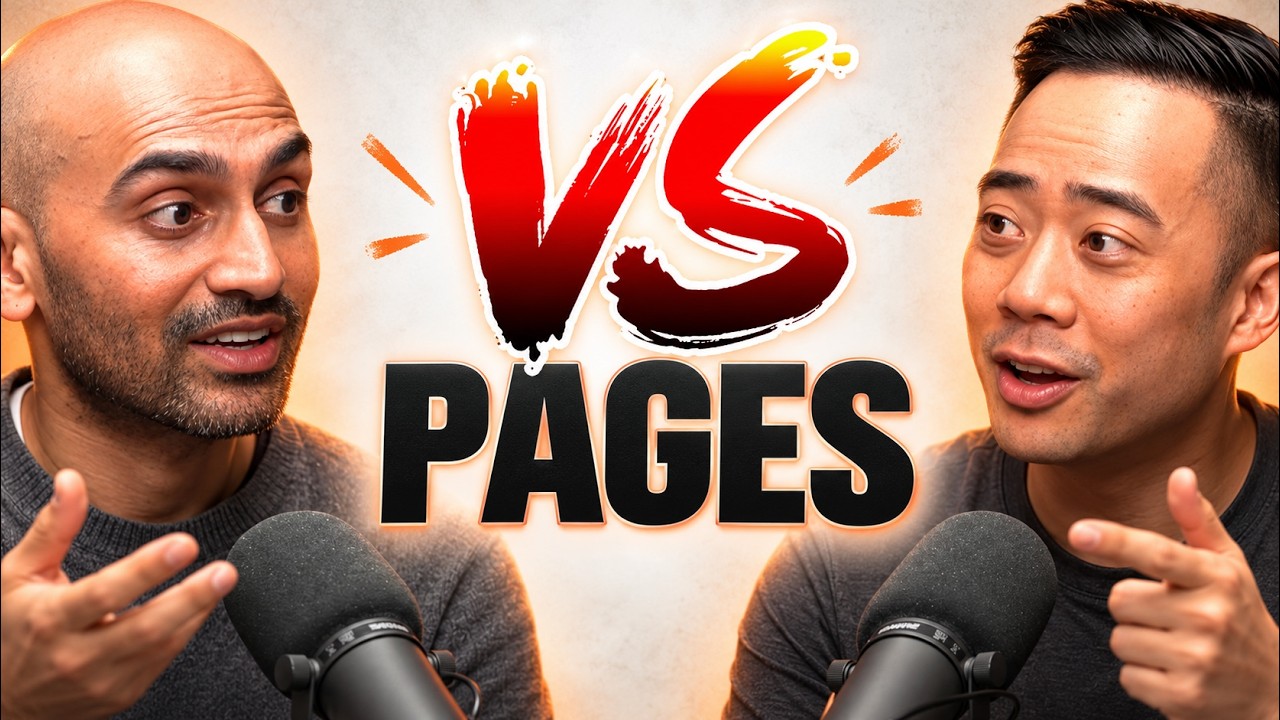
In this conversational YouTube episode, Eric Siu and Neil Patel discuss how "versus" and "alternatives" pages can be a high‑ROI SEO tactic, especially when generated with AI. They walk through a practical workflow: using Claude or other LLMs to identify top competitors, build comparison pages, and create audience‑specific guides, then measure sales lift (e.g., 6 PayPal sales in 3 days from 19 pages). They stress the importance of publishing the content beyond your own site and using AI‑driven outreach tools (GrokBot, Instinct, Muse) to secure backlinks. The conversation pivots to the crowded AI‑agent market, comparing products like Instinct, Muse, GrokBot, JEV, and OpenClaw, debating monetization paths, potential acquisition by Apple, and the lack of sustainable moats—only user‑setup cost remains a barrier. They cite data from Thibault’s Outrank.so showing link‑exchange volume correlates with click‑through gains (24% lift with 0‑9 links, 115% with 400+ links). The hosts also touch on personal branding, handling industry criticism, and the need for classifiers to curb hallucinations. Throughout, the tone is informal, anecdotal, and data‑driven, with a mix of optimism about AI‑enabled SEO and caution about scalability and competition.
Chapters
So, um, I saw this post from Noah Kagan over here and he mentioned, uh, so Noah Kagan from AppSumo. So he said, new thing you must steal today, I shipped SEO, 19 SEO pages for my $20 Mac app. Um, and so since then, 6 PayPal sales in 3 days. 2 types of pages every product needs. So we're talking about if you're going to use AI for this stuff to make AEO SEO stuff, you might as well try to generate ROI from it, going back to our main point. So what do you say? Competitor pages, guys. So these are versus pages. So Rhino versus WhisperFlow, WhisperFlow alternatives. So I guess he has a WhisperFlow alternative. Okay. And then he has best product for, you know, X, for lawyers, doctors, ADHD students, right? Paste this into Claude Code. Find my top 5 competitors, build a versus page and an alternative page for each. Then write 10 best product for audience guides. Be honest and say when a competitor is better. Copy this layout. It's clean. So This, by the way guys, I'm not saying this is the end-all be-all. What I'm saying is this is a good example if you want to prove to your manager or your founder, your CEO, whoever it is that you're working with directly, just show them this. Hey, I shipped these things over here, we got this ROI over here, and I am ready to scale it if I can spend X amount of dollars. If we spend X amount of dollars, I think I'm going to get Y return and we should do this, right? Not just, I need more token spend. There's 2 things here that you guys can adjust with the strategy if you want it to work really well.
I'm not saying it doesn't work, but it can work even better. The first is figure out how you can reach out to other websites and convince them to publish this content. So it works really well if it's not just on your website. That's A, because if you look at most queries, whenever you search for Claude or ChatGPT or whatever it may be, majority of the time they're looking off of your own website, right? They're looking on other people's websites. They do a lot of fan-out queries. The second thing is If you ask ChatGPT or Claude a question related to your space and you're seeing the results that they bring up, if you are comparing other businesses that aren't on that list, it's not going to do as well compared to comparing businesses that they're already recommending. So what we see is, let's say you had 50 articles that you created. You wouldn't want to just create 50 articles on your website, but I'm just giving you a hypothetical because if you have too much junk content, it actually hurts you. If you create articles on your website and you're comparing products that ChatGPT and Claude aren't referencing a lot, they tend not to pull from what we see your content as much compared to if you're referencing competitors that they tend to pull more often for the queries you're looking for. That gets you included much faster from what we see.
By the way, I mean, You know what you can do to do that? Just people listening to this, this is a very simple thing to do now because when you use something like a GrokBot, you can just literally take the transcript from what Neil just said right now, dump that into GrokBot and say, just build this for me, right? And then you can just continue to iterate on it over time and have it handle the outreach for you. You can keep tweaking over time. It gets smarter over time too, right? And so to Neil's point, yes, the LLMs have gotten smarter about this because if you think about it, Oh, all these people are gaming the system. Oh, how are they gaming the system? Oh, they're just posting listicles on their websites, their own sites, and then citing their thing as number 1. Well, that's pretty easy to spot. So you, like, they've evolved. Like, I'm not saying this doesn't work, by the way, and Neil's not saying it doesn't work either. It does. But to, like, if you think about it, how have— how has Google always worked? Well, they realized that people used to just spam their own stuff, like when they spam keywords on their site. So what happened? They realized that links were the answer. And this is the new way of links, right? It's the same thing, but new again.
Yeah. And speaking of listicles and comparisons, we see comparison articles, even though listicles, we see them being cited more, just from a one-to-one, from a revenue standpoint, we see the comparison articles drive way more revenue than listicles.
That's interesting. So While we sit on— by the way, let's go back to Instinct for a moment, right? So if they're growing 10% day on day, so Instinct, just so everyone knows, it's an agent that you can manage inside of your iMessage right now, and there's not any setup that's needed, and it's always being proactive for you, right? It's like, for example, it reached out to a bunch of people to speak at my AI summit, right, which is happening next month. And so that part is cool, and a lot of people are— I think, Neil, this is interesting. If you basically, if you use the product for like 1 or 2 weeks, about 40% of new users will put in their credit card information, right? Which is already pretty big. And so there, when I think about that, if you're growing 10% a day and, you know, you're compounding really quickly, that's why these VCs are willing to give you money too. And plus you have to pay for compute costs too. But the challenge with his business too is like, you have to decide if you want to make that compute bet or not. And then the other challenge too is, When you're up against Meta Muse, I mean, you're up against GrokBot, and then, you know, Google supposedly has their own bot. I think everyone's gonna have their own bot coming out. How do you stand out, right? And so, um, I think for him, he's got to figure out his path to monetization. He's not going to just try to collect, um, you know, like a, like a, like a sliver of payments. He's not, he's not trying to play the payments game. But it's interesting to me, when you have the users coming in, the world is your oyster. Um, so I think it's worth talking about because, uh, he's got some interesting challenges.
Well, he has a big waitlist, so I think that helps with their growth rate because you can choose how many you want to let in. I look at that business as you're going to have tons of competitors over time. I'm not saying he's going to lose or win. Time will tell. I'm a little bit of a different entrepreneur and I'm wrong probably majority of the times. Like I would've never made that, what, $13 billion bet that Facebook made on Scale?
Scale.
Yeah. Or $11 or whatever it was. It was something like that. If I was Instinct and I can sell the business for $12 or $15 billion, I would sell it to like Apple and let them just plug it in and give away a lot of it for free because Apple has the cash flow. And I bet you someone like Apple would be like, this is a great fit. We struggled with Siri. Sure, let's spend $10 billion. I know $10 billion or even $15 sounds like a lot of money, but to Apple, it actually—
Nothing to them.
Not that much money. Yeah. And it's a perfect fit to their product. Like unlike the scale acquisition that Facebook did, And it's working out so far with Muse. This is a direct fit into Apple products, and it just totally makes sense. Even if it costs $20 billion, I was just like, we should just pay $20 billion and just buy this company.
And they can afford the compute too, right? And so, and they have the hardware, they have the infrastructure for it.
They have everything. It would make their iPhones so much better. Like, this is great.
My bet, Neil, is he'll probably sell it. You know why? Because he knows it's so competitive and it's so tough that that's probably— and I don't think he started this thing to sell it. And he's saying all the things right now, like, you know, we're going to keep going, blah, blah, blah. But I, I'm a, I would bet you on this one that he would sell it. Do you want to take that bet?
I agree with you. I'm the one who first started with he should sell the company.
Let me bet you on your own call.
But like, I honestly think the best place for this company is Apple and Apple would pay for it. You could also say Google as well, but like Apple has their own coming. Yeah. Apple needs to do something really cool in AI. And if you look at what Apple does is they tend to just create beautiful products that are simple and easy to use. That's their game. They make complex things look very simple and beautiful. And this is, they're taking something very powerful and making it simple because you can just talk to Siri or text Siri back and forth. And I'm like, this would just blow up and more people would want to buy Apple phones because of it.
You know, here's my take on this. Here's, here's, here's what I actually think as we're talking through this right now. And then I'm going to share something from Sam Leeson, I think from The Information. I actually think that if you have Apple's resources, this isn't hard to build because you've seen so many versions of this. By the way, I'm not saying— I'm sorry, I'm not an engineer, right? But I'm just saying that there's so many versions of this already, right? You have OpenCLAW, you have Hermes. Muse is built off of the learnings from OpenCLAW, right? You have GrokBot. GrokBot came out in a month, right? So my take on it is if you're paying a lot of engineers a lot of money for this, you should be able to put this together, especially if you have the infrastructure. You have to compute for it. And so maybe they might not buy it, right? And so let me just share this with you, Neil. This actually relates to the topic that we're on. So Sam Leeson from The Information says, there is no moat in AI agents. None. I will die on this hill. New More or Less is up. So I guess that's his podcast. So he says, I switch between Muse, Instinct, and DOTS at basically zero cost. I basically do the same thing every day. One GitHub repo, a few databases. and feed the thing, my, my, uh, the new thing, my contacts. Done. If the cost of writing software is going to zero, API integrations are not a moat. The only moat left is user setup cost, which means winner takes some, not winner takes all. Guess who sets up this stuff, Neil? Services, right? Uh, Adrian's point: AI collapses— I guess this is, uh, his podcast co-host. So Adrian's point: AI collapses value the second an idea works. So Jev, which just came out recently, got reverse engineered in 48 hours, and the people who built it captured nothing. My take, play that to the limit and you get Middle Ages 2.0. Everyone builds a castle, hoards data, ships black boxes that self-destruct if you open them. Dave says humans don't work that way. We'll see. Meanwhile, Brit's Instinct started— I guess that's somebody else he works with. So Instinct, the agent that we're talking about, started talking to Dave's Instinct and they didn't text for a day. She says it's killing humanity. Nobody said that about FaceTime. No. Funny enough, Neil, our mutual friend, I'm having my Instinct and his Instinct coordinate our trip right now, our founders retreat that we do annually. And Jess said, The only benchmark that matters is if the agent logs into school software, syncs 3 kids' after-school schedules, and Muse does 90% of that. By the way, I'm pretty sure this was written by AI, but I think that's the challenge right now, right? That's why I said instinct. I think other people might just build it, and I think they might, I don't know, it might not work out if they don't come out with a big differentiator, because I don't see a major differentiator right now.
Even Muse, dude. So I've played around a lot with Muse, And I use most these tools for more business purposes than marketing purposes, I would say. I'm assuming you would agree with that. Yep. And when I look at Muse, I had to compile a list of every single M&A advisory shop, banker that sells agencies. And I did this for Europe. I did this for the United States and I did it for Japan. I worked on it to be very, very specific on what I'm looking for. The size of the banking shop, the deal sizes that they've done in the past. If they've done too big of deals to exclude them from the list. I got very specific because if they're used to selling companies for $200 million, I'm not buying companies for $200 million. I'm not rich enough to do that. So I'm getting very specific because I don't want to waste my time. Muse goes and creates a list, and I do this for all 3 regions. And the reason I have it start with the United States is I know the US really well. Like, I know a lot of the players in this space. And then I start having it fine-tune, I refine it. Once I do that, it's connected to Gmail from a perspective that it can just create drafts. Right? So I'm not letting it just blast my contacts or anything like that. I have removed access from my Gmail since. It ended up creating me drafts. And when I say drafts, I'm not talking about like 20, 30, or anything like that. I'm talking about hundreds. It was actually less than 300. And when I started going through them, I found a few issues. And I've told it to not give me generic email addresses. Like if it can't find it, let me know or exclude those companies. It didn't do a good job of that. It sometimes sent me the email addresses in these companies of people who are in communications department, which breaks the whole model because I told it if they have too many employees outside of 5 or 6, I said the max is actually 10, exclude them from the list. If you have people and you're an M&A advisory shop who are just in communications and they get your messaging out, You have more than 10 employees typically, right? So it didn't classify the employee count right. It gave me a lot of firms that aren't even M&A advisory firms. It gave me a lot of companies that don't specialize in agencies when I asked them to only give me companies that have done past agency deals and please double-check and remove the ones that haven't. And I was very specific. I didn't say traditional agency. I said digital agencies that specialize in SEO, GEO. I actually did not say GEO, it was too new, but SEO, paid media, social media marketing. I gave the list, right? Email marketing, et cetera. And what I found is I started sending out a lot of the drafts. I started going through 10, the first batch. And when I went through the first 10, I only sent out 2 out of the 10. And then I started going through the second 10. And I was even more picky. I started actually going through each and every single website and doing my own research, and I sent out 1 out of the 10 from the second batch. After that, I deleted the rest of the drafts. I was just like, this is just costing me so much time. It would be cheaper to pay a human to do this than it would using Muse.
Real quick, if you want to acquire customers faster and more efficiently this year with the latest strategies and tactics, Then check out singlegrain.com. That is my ad agency. Again, www.singlegrain.com. Check it out. And if it seems like a fit, we'll get in touch and help you with a free marketing plan. Yeah. So here's what I'll call out with this. So let me share my screen real quick and then I'll tell you kind of how I think about this. So this is from Evry and this shows a personal agents comparison. So those of you that can't see the screen, there's a comparison with Dot versus Gemini Spark versus GrokBot versus Hermes versus Instinct versus Muse versus OpenClaw, right? So I think the thing to call out here is each of these has their own unique use case. I will also say the model that Meta uses is not necessarily the greatest right now. And by the way, even if you're using a frontier model, it's still going to hallucinate quite a bit. Now, what I would say with Neil's build is I would actually just put JEV in. JEV as a classifier, this is why they say 0% hallucinations, because they'll do a lot of this classification at scale. Yeah. Where it's too expensive or too slow for these frontier models to do it, or even like Muse's— like, sorry, Meta's open source way. So that's what I would do to add in, because what I'm doing right now with people who engage on like a LinkedIn post that I have that has like 2,300 comments on it, right? So I'm like, oh, who could we actually— who has actually engaged there? So signal-based selling, right? Who's actually engaged like 2 or 3 times that seems like they're a good fit to work with us based on our recruiting page? Now I can do that using a Jev, right? For Fractions of a penny, right? And then not only that, I can look for— by the way, Neil, you have a nice audience. How do we look at all the people who follow you that have the size of the agencies that you're looking for, right? Or like even those M&A advisors, right, that might follow you as well. And so that's all happening at a very high level with, you know, no hallucination, little to no, right? And it's a fraction of a penny and it happens very quickly too. And I was kind of messing around with this the other day. I was like, okay, well, I'm doing this event. I can see who's coming to this event. I'm like, I just cut and pasted it. Then I'm like, who is actually like ICP fit, right? Boom. Like in like, I don't know, like a minute or so and like a fraction of a second, I could easily see, oh, this company is in this region over here. They do $1.3 billion and they have this many employees, blah, blah, blah. And I'm just like, having a classifier is a must. And I think that's going to be built into all of these models eventually. So yeah.
Yeah, no, I think you're spot on with this. And people don't mind paying, but they want the job done correctly. It's just like someone giving you— a team member giving you AI slop. It's like AI giving you slop just makes you pissed off and it just wastes a lot of your time. And it was like, this was just a bad use because if you look at how much time I spent with Muse and yes, even works in the background and you can shut off your computer and it still works on there and through their servers, I still wasted a lot of my time. And when I say wasted a lot of my time, I was giving Muse feedback. Throughout the whole process, I probably spent 45 minutes to an hour easily, and I was just pissed off after, right? And that's not even going through the drafts. I'm just talking about just working with Muse. And I was like, man, this was just a really terrible experience. But it goes down to what that guy said on X. I actually don't have any loyalty to any of these products. It's not like me actually buying a physical product like a Nike or Chanel or Louis Vuitton. And I know we also discussed our affinity to those brands probably wasn't as strong, at least with Nike for Eric and I, to where we were with kids, right? Humans are more open to switching ever than before.
I have an affinity to Erewhon.
Yeah, you love Erewhon. You always wear Erewhon cap and you always save the jars. But I learned from you, the jars actually give you back money.
Yeah, that's why I keep them all, because each one's $3, man.
Oh, you get $3 back for each one?
Yeah, I have, I have so many of these jars that
Yeah, dude, I started saving them from all our soups because I was like, wait, because remember you took us for lunch and then you're like, no, no, I got this. And I was trying to pay you like, no, no, it's free. And then you come with all these charts. Yeah, I loved it. But, but no, it's just like, it's spot on. I don't think we have affinity to any of this, which is why Insync should just sell to Apple if they could get an offer.
Agreed. By the way, Neil, let me show you this. This guy, uh, Thibault Maker. So he's a, he's an engineer, right? I think he's a developer by trade, but he has this tool called outrank.so, which is an SEO tool. Um, so this is Interesting. So check this out. So you know how SEO Twitter, you know, they kind of poo-poo on a lot of things, right? They have a lot of opinions. So his tool sells links. They allow you to, like, if you're part of his ecosystem, you can actually put your site up to, you know, exchange links with other sites, right? And technically, this is against Google's terms. But here's what he said, right? So he's like, 3 weeks ago, SEO Twitter decided to— decided Outrage burns domains, right? So they're all talking crap about his tool, right? So our signups fell 26% by the next day. Not going to print ahead, that didn't hurt. But that really affected me. So I set this mission myself to help founders with my products. So I was really nervous about us potentially harming domains because he's an engineer, right? He doesn't know about this SEO stuff. So then he's— but because he's an engineer and he's data-driven, he's like, you know what? I pulled GSC data for Google Search Console for our users. I asked AI for a full analysis and grouped them by how many of our backlinks they received, meaning how much they used outrank. Okay. So if you got 0 to 9 links from his ecosystem, 24% of Google clicks jumped since joining. And if you got 400+ links from his ecosystem, 115% Google clicks jumped since joining, right? So he says the more you use his tool, obviously, right, the more you grow. But what's interesting to me, Neil, is he starts showing these numbers, right? So he's like, okay, here's a chart that shows clicks per how many months since they joined Outrank, right? So let's take a look at this. So you can see in the purple over here, right, since joining Outrank, like month 1, month 2, month 3, you can see over time by month 11, it's 2.37x. And you can see their impressions jump by 3.8x. Now that's not it, Neil. There's a little more here. So before we react to this, so he says, look, more exchange links, more growth. So 0 to 9, 24%, 400+, 115%. The sites that fell by links received, shared declining websites now at half or less of their best 28-day window. 0 to 9 links, 42.5%, 150+, 21.7%. So I just think it's— nobody has really shared this data before. And I think it's helpful to at least look at this.
Yeah, no, it is really helpful. And I'm not saying you should do link exchange or break Google's policy, and nor is Eric saying that. But I think this guy Thibault makes a good point about one thing in which if you go to X or you go to LinkedIn, you're going to get a lot of hate depending what industry you're in. If you're building something good, and I'm not saying you should break people's terms of use or policy or do something that won't work in the long run. But if you really believe you're building something good that's going to change people's lives or is going to do something amazing, if you're going to get hate on it, it's okay. Just move on and ignore it. And I've learned that a long time ago because I get a ton of hate and probably not as much anymore because my brand isn't as big as it used to be. And Eric would send me the articles or links of just people hating on me and he would see them before me and he would send them to me because he knew I wasn't really checking them out or looking. But my solution in the past, because people be like, how does it not affect you? I'm like, you just don't look. You just move on and you just keep doing what you're doing and you build the best company you can and you do what's best for your customers and you don't worry about what competitors or other people in the industry are going to say if they're going to be negative and just haters all day.
This just goes back to the personal brand thing, right? Like forget about worrying about the personal brand that much. Just do. Like as long as you're doing, you're accomplishing, you have a team that's following you. Like by the way, that's a big thing though. If there's people that work with you, That means that they actually appreciate your leadership, right? So let me, let me add one more thing around this too. So it says sites that fell by links received. So it says some connected sites have SEO decreasing traffic, which is orange below, and most were going down before they started using Outrank. And again, the more backlinks received by Outrank— let's just take Outrank out— the more backlinks you receive, the slower the decrease is, right? So you and I have always known that. We're not saying exchange links. We're not saying buy links or anything like that. We're just saying if you can build something useful, it can get a lot of links, like a linkable asset. Like a lot of people are giving away these tools now. It used to be back in the day calculators, but because you can build anything with AI now, the bar is getting higher, right? And so I like, you know what I like about this thread the most, Neil, is all these people talk crap about him, but then what happened is you don't see the SEOs coming in to poo poo on him because you know why? He's got the data, right? Data does a good job of shutting people up.
No, even if he has the data, you'll see the SEOs poo poo on him just in different places.
Yeah, well, not here anymore, right? So, but like this guy over here is like, numbers like that are hard to argue with. Uh, like this guy's like, okay, this does not match my experience. Well, anyway guys, that's it for today. We hope you enjoyed it and we will catch you tomorrow.
More from Eric



Even Beverly Hills Can’t Escape These Grocery Prices #shorts #business #inflation