Shake Shack vs Chick-fil-A, TikTok ban strategies, Facebook's most important historic event, & more
Eric Siu and Neil Patel discuss Shake Shack's campaign against Chick-fil-A, the potential TikTok ban and who might buy it, and Facebook's most pivotal historical moment. They also cover community membership businesses, Meta's VR hardware, and streaming platform strategies.
Chapters
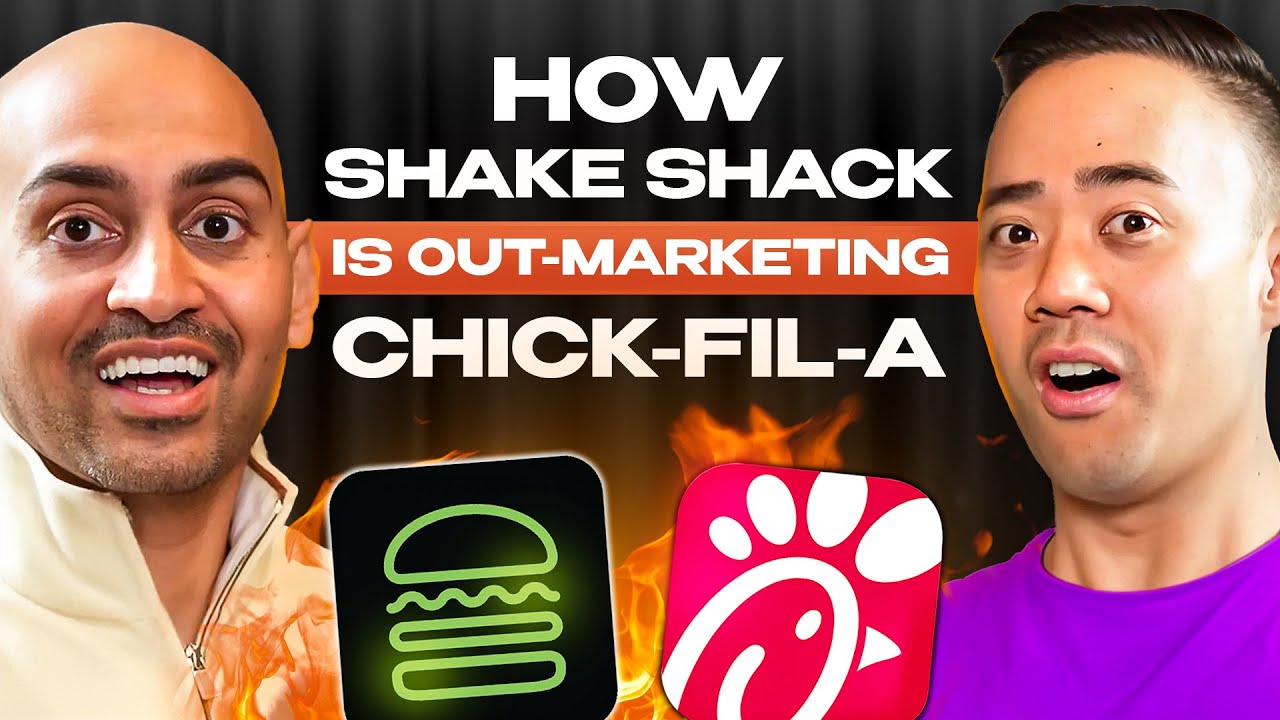
I'm looking at a picture here. We'll pull this up on YouTube. But did you know that Shake Shack is doing a promotion that's targeting Chick-fil-A?
No.
So here's what this, this image looks like. I'll show it to you. Shake Shack is offering free chicken sandwiches on Sunday. And so basically, for Chick-fil-A—
Ooh!
For Chick-fil-A— you eat chicken too.
Yeah, I'm gonna go get this.
Chick-fil-A doesn't offer— they're not open on Sundays. That's why they're targeting them.
But it's free. Do I have to order anything else or is it just free?
No, they— the bet is that you're going to buy more stuff and there's zero chance that you're just going to buy one.
Is it one per person?
Uh, probably.
Oh, I'm going to go this Sunday.
Yeah, see, look, I just, I just sold Neil with an ad. You can thank me later, Shake Shack. Their chicken sandwich is pretty good. During the pandemic, I'll reward myself every Sunday because I live right above a Shake Shack. And I'll get two, two chicken shacks, okay? And ten nuggets, and that would be my gift.
I love it when you said free.
Yeah. Well, yeah. With you have to use the code Chicken Sunday.
Okay, one minute, one minute. This is can you text me it?
It's Chicken Sunday, dude.
I know, but I didn't remember. I gotta text people.
Chicken Sunday, Chicken Sunday. Okay.
Free chick no, not Chick-fil-A. Free Shake Shack.
Oh yeah, free Shake Shack chicken. Chicken Sunday is the code. Those of you listening are probably going to do the same thing now.
Is it?
It's a really— the chicken shack is great.
Now, I'm going to get this every Sunday. Is it only one time or you can go every Sunday?
Dude, I don't know. I haven't done this yet.
Yeah, that's a good deal.
Neil and I were talking on the phone about this the other day, but I was just telling Neil some of the numbers of these school groups. So Sam Ovens was fortunate enough to— I was fortunate enough to— he let me invest. It was cool. So I hope school continues to grow. But there's these school groups, S-K-O-O-L, for anyone wanting to—
Thank you.
And these are like communities, right? These are like private groups. Like, you can use like Circle.so, you can use SKOOL. Alex Hormozi invested a significant check, it seems like, into SKOOL. And so, um, there's these groups that are doing like $500K a month, $258K a month. And I showed Neil this one group, it has like 2,000 people in it paying $129. And this group is basically about how to like get women and make money. Um, and then there's another group for how to make money online for French people. And that group has 300 people in it. And they charge $999 a month, right? So that group's basically doing like $300 grand a month. And so these groups are just communities at the end of the day, and people are longing for community. People are longing for connection because a lot of people are just working from home now, right? So, um, I think this is interesting. That's why we created the Agency Owners Association group. If you go to marketingschool.io/agency, you can learn more about it. Um, and we have our MRR is growing. It's now at $3K. See, last time I told you it was like $2,200 or something, right? And so, so I was like, it's gonna grow, it's gonna compound slowly.
Wait, so, so here's the disconnect. So every week we record this podcast. And then Eric tells me, oh, you know, we got this agency program. What is it called? Agency?
Agency Owners Association.
Agency Owners Association. He's like, it's growing. So I was like, okay, cool. I thought Eric was charging people like $5,000 a year or $10,000 a year or something. I don't know what he was charging. And we were just making some money, or he was making some money. I was like, all right, whatever. And then he's like, oh, our MRR keeps growing. And he keeps saying MRR. I'm like, I don't know what the heck he's talking about. If you're doing in-person event, you're charging for the in-person event. Where the heck is the MRR? So then the other day we were on the phone and he's just like, our MRR is growing. It's at $2,000. And then I asked him like, what do you mean MRR? And he's just like, oh, we charge a monthly fee or annual fee?
Monthly fee.
Monthly fee. And it ends up breaking it down or Do they pay upfront or just monthly?
It's just monthly, $149. And I'm going to keep upping it to $200, $250 to $300. I'm going to keep upping it.
Yeah. Or you could charge annually, but you can't charge annually on it.
They don't have that option.
Oh, they don't have that option.
They should have that option. They don't have it.
Yes. Because then you can just—
You can just discount 20%.
Yeah. And when Eric was going through this process, I was like, oh cool. He's like, it's recurring. And I was like, oh, now I get what you mean by MRR. At first I just thought you were charging like $5,000, $10,000 and be like, Cool, we're meeting up and we can discuss how to grow agencies and we bring a lot of them together and we all figure out how to grow each other's agencies.
And by the way, I actually, we share some of our lead flow with people in the group. And so basically based on how you engage, you're qualified to get lead flow. And so we have a community manager that handles that, right? So we're trying to gamify a lot of it. And then the more value we add to the group, the more we'll charge for it. So join now while it's cheaper. But then what we'll also do on this podcast is because we can be very transparent about this, We'll just share how it's growing and what we're doing to grow it over time. And you guys can watch us build a community from scratch in public. And you can just take whatever it is that we're doing that you like, and hopefully you get to grow one too. All right, real quick, I need to tell you about the group that Neil and I created called the Agency Owners Association. And this is a group that's similar to entrepreneurial organizations such as YPO or EO. By the way, Neil and I are both in YPO, but we thought it'd be really cool if we're able to create a group that's dedicated to agency owners to helping them scale. So you can be at 6 figures, 7 figures, 8 figures. We have different groups for different levels. All you have to do is go to marketingschool.io/agency. Again, that's marketingschool.io/agency and you can go there to apply. And I will tell you right now what we're doing is there's an online community. We do calls every now and then. There's stuff that we share in there that we don't share publicly. And you can, at least the online community, you can cancel at any time. So you can go there to learn more about it.
And that being said, back Did you see that Meta opens up QuestOS to third-party hardware makers?
I saw that in passing. Can you explain it?
Yeah, so Meta has their devices for virtual reality. You guys may have seen them. And, you know, these are like, think of like Apple Vision Pro. I don't know how many people actually have the Meta devices, but think of Apple Vision Pro. And what they're pretty much doing is licensing out their software. So then that way your operating system, think of like Microsoft Windows, but for anyone who is creating these virtual reality devices, hardware, or whatever it may be, you can run on Meta's OS system. I think it's a cool concept. I do think virtual reality is going to be big. Not yet. Like if you look at the Vision Pro, no one talks about the Vision Pro anymore. I got my niece and nephew a Vision Pro. You know how many times they use it?
Like 2?
They use it more than 2, but like, ask them, like, every once in a while we use it. People slowly stop using them. Heathen has one, right? My brother-in-law, he barely uses it.
Oh, you bought it for his kids?
No, I bought one for his kids. He has one for himself.
Yeah.
I bet you he barely uses it. I haven't asked him, but I would bet a million bucks that he barely uses it.
He probably doesn't use it much.
No. So then like, when you look at these devices, they're too big, they're too clunky, they're not really integrated in your daily life.
You're talking— so there's the Oculus, which is a little clunky, but their Ray-Bans are not. It's just sunglasses. And I saw a video the other day where there's a girl wearing a Ray-Ban. She's walking up to like a monument and she's like, Ray-Ban or whatever, tell me what this is. And then it identified the building that she's looking at.
Yes, but the problem is, is people want the technology in the big device in the small Ray-Bans.
Yes.
And that's not there.
And eventually it'll get there, just like everything gets there. Like, remember the computers we used to buy were huge and super heavy?
Or the TVs. Yeah.
And now you have it here. Yeah.
And like the big boxes and stuff.
But now it's all in here. Yeah, so yeah, it'll happen.
But that's the problem, is people want the technology of the Vision Pro and Ray-Bans, and it's not there yet, and it'll take many, many years to get there. But eventually, I think it will.
It might be Meta that can get there. I mean, the stuff they're doing now, like open sourcing LLaMA and then the virtual reality stuff, it's like they're pretty impressive in terms of their, their pacing right now. So we're just idiots for not buying when they're at 14. I think it was as low as 12, the PE. Anyway, let's move on.
Yeah, but I think it was less than 10 at one point.
Alright, so I wanted to take a second to tell you about Leveling Up Founders. This is an event/mastermind for people doing 7, 8, 9 figures. These are founders that are doing that amount. And we've been doing this event for a couple years now. We've had amazing speakers. But more than anything, it's about the people. What I mean by that is like-minded people want to hang out with like-minded people. And this is the best spot to connect with people of a certain caliber, and we vet every single person that comes through. So if people are— even though they make a lot of money, but their character, we don't really align with that, we're not necessarily going to let them in. We do this event in Beverly Hills, and it's happening in the beginning of August. All you have to do to learn more about it is just go to levelingup.com/founders. Again, it's levelingup.com/founders if you want to hang out with amazing people. Neil, my podcast co-host, is going to be there. I'm going to be there. People like Syed Balkhi, he's He will be there as well. And again, it's going to be a great time. levelingup.com/founders to learn more. And we'll see you inside. We should tell people what, what they should do about the TikTok ban.
Uh, I think people should do nothing about the TikTok ban.
Exactly.
Some US company will buy it.
Exactly.
You don't have to worry.
They have to divest in 12 months. I'm sure something will get figured out. Like, worst case scenario is they have to divest. The other scenario is like they'll just settle some in some way, shape, or form.
Okay. TikTok is a Chinese company. All right, you're from China, correct? You're—
no, no, no, Taiwan and Hong Kong.
Okay, my bad, but basically China. Okay, so you know, but you know the culture of a lot of people in China, correct? And I would say this is universal culture, by the way, but we'll just say China because it's a Chinese company. Let's say TikTok is worth $100 billion. Easy to say, somewhere around there.
Yep.
Do you think Any person in China would let go of $100 billion?
No.
Yes. Do you think any person in the world would let go of $100 billion?
No.
Exactly. Either zero or $100 billion. You'll take $100 billion or $80 billion or whatever it is. It doesn't matter if you're Chinese, American, Indian, Mexican. It doesn't matter what nationality you are. No one's going to let that money go away. Someone will buy it just like last time when Trump tried to ban it and you had Oracle trying to step up. I believe Walmart was trying to step up and there's a few companies like, yeah, we'll buy it together. And you're going to see the same thing, but they'll pay more money because TikTok is bigger now. And when you look at it, it's not really a thing of, is it going to get banned? It's the question of, is it going to be Chinese-owned? Oh, not going to be Chinese-owned? Cool. Who's going to own it? It's going to be some American company because the US doesn't want someone else to own access to a lot of the data. And then instead of— and then people are like, oh, it won't be TikTok anymore. Probably still be TikTok and have a licensing deal or whatever, but instead the U.S. government will have next to choke here in America instead of next to choke somewhere in China where they can't really choke them.
I think look that yeah yes I think this will all get worked out at the end of the day I think TikTok has the best algorithm versus like Instagram Reels or YouTube Shorts because when you look at YouTube Shorts or Reels it's just a lot of random stuff TikTok does a good like now I don't use TikTok that much I don't know if you do but when I remember I would get sucked into a cycle when I used to like look at it a little bit it's like it was pretty spot Spot on, and I can see why people would just use it on and on. It's too valuable to just let it go to zero.
What's funny is the ideal buyer of it is a Google, a Microsoft, a Facebook.
I don't know, an Oracle? Yeah, Oracle is the thing.
But these buyers will never be able to buy it because the government is going to say monopoly, antitrust, or whatever they're going to call it. I don't know what it's actually called from a legal aspect, but they don't want Facebook to own more social networks. It probably would be easier for them to just say, Facebook, you own it. If we're upset, Mark Zuckerberg, we have our neck to choke.
Do you remember, do you know what the most, the single most important event is in the history of Facebook?
Buying Instagram for probably a billion bucks or $2 billion?
It's a good guess, but no. So, so here, here's what it is. And he talks about this on the podcast too, but Peter Thiel actually confirmed this. This is actually back in 2023. So, The most important single event in the history of Facebook— this is from Peter Thiel, by the way, popular investor— was in July of 2006. We were about 2 years into the company's history and we received a $1 billion acquisition offer from Yahoo. The company had about $40 million in revenues, no profit. It was just a college site. The management team was a little bit nervous about a 22-year-old CEO, and there were about 3 of us on the board, and 2 of us thought maybe we should take the offer. Now, let's just pause for a second. Would you take the offer at that age? I certainly would.
I would have too.
Okay, exactly. Because we're not as smart as Mark Zuckerberg. So let me continue on here. So Mark started the board game—
Actually, honestly, I wouldn't have taken an offer. I would have asked for $2 billion. Because at that time, Facebook was growing like a wildfire. And you saw what MySpace sold for. And MySpace, you know, I don't know if MySpace sold for after or before, but either way, MySpace was a piece of crap compared to Facebook. I would have tried to get $2 billion.
My point is we probably could ask for $10 billion, right? But point is we would have settled around $1 to $10 billion, right?
Yeah, I didn't even need $10 billion. I would get $2 billion. Exactly. If you had a gun to my head, I probably would have taken the $1 billion even though I'm saying $2 billion.
Exactly. So we would have, we would have tapped out, right? So, um, Mark started the board meeting with saying, well, it's just going to take 10 minutes. We just have a quick formal board meeting to turn this down. And we both, we both said we should talk about it more. And we had a 6-hour-long discussion about pros and cons of doing it. It was like, Mark, you are 22 years old, you would make a quarter of a billion dollars. There are many things you can do with this money. Zuckerberg said, I don't know what to do with a quarter billion dollars. I mean, I guess I would start another social networking site, but since I already have one, why would I sell it? The key point that Mark made that convinced us not to sell was that there was a whole series of specific products that the company was going to be launching in the next 6 months. They were clearly not valued by the would-be acquirer. And we thought, you would know, we would probably be safe waiting and they shouldn't— and they wouldn't go away that soon. And we would— we could go on, go ahead and do this. Sorry, got a little jumbled there. The only one big thing was Mark believed in what he was working on.
And if you—
if I think about the podcast that he was just on, he talked about this, this moment. And he's like, look, and we've talked about this too. It's like, okay, you could sell.
Yeah.
But what else would you be doing? It's like, well, no, I would go back and do the same thing. I'm having a lot of fun. I like the people that I work with. Why would I stop? Like, what would I do with the money?
Yeah, I had the same option as his, but for less money. And I said no. And people, you know, were telling me, you're crazy. This is a lot of money.
We talked about this. Like, what else are you gonna do?
Yeah. What else am I gonna do? I love what I'm doing. And they're like, I'm like, it gives me purpose in life.
Yeah.
Like, so you don't want to sell? I'm like, no. Yeah.
And so that was the single most important event because it would have been game over if he sold. Yeah, yeah.
But I have no investors.
Yeah. Yeah. So I didn't have to have a 6-hour board meeting. Well, I mean, but keep— so the $1 billion, like the 25% would have gone to him. So that's just some math for you guys, right? Like a lot of people talk about raising VC and all that. But you've raised before, right? You know, I've raised some money. At the end of the day, well, you raised VC, so you had a board. You know what it feels like. Like, there's a difference between bootstrapping and VC. Do you want to tell people what your experience is?
Bootstrapping is you do whatever you want. VC is you got a board who can help guide you and they can give you money to help grow faster. It's great. There's also drawbacks because if you have bad board members, they can derail the company and create issues or try to replace people. There's pros and cons. I think venture capital makes sense for a lot of businesses. If you're trying to build something really massive—
You're swinging for the fences?
Yes. Not just swinging for the fences because these days there's cloud and AI. There's a lot of technology that makes it cheaper to create these businesses. But if you're creating something that requires a lot of money, like, hey, I want to build a ChatGPT, go raise money. It's too hard to do that without someone else's money. But on the flip side, if you're in a big TAM, but you can build a nice-sized business without raising anyone, anyone else's money, and it's not really needed, like you don't need tons of capital, you should bootstrap. I prefer bootstrapping, but I don't like dealing with authority and someone telling me how to run a company. Mm-hmm.
You also don't like dealing with— you also don't like dealing with people management too.
Yes. And I also don't like doing board meetings or any of that. It's not my style. And every time we've had private equity offers, I always tell them I'm not interested. A lot of times they want to meet up in person. And I meet them in person, I get my free meal. Like this Sunday, I'm gonna go to—
What do they feed you?
Last time was a Four Seasons meal.
Nice.
It was at a restaurant there. I was like, all right, this is cool. Actually, no, the last one was in Marina del Rey. They brought food to the office. It was really good.
And most of these guys are pretty sharp.
They're pretty sharp. Yeah, I didn't care for— I was just getting to know them. They weren't necessarily trying to do a deal with me. I wasn't trying to do a deal with them. I'm like, let me just go get my free food. But I prefer it when they come to me and we do a free meal.
Yeah, it's more convenient.
Yeah, yeah, like pick a restaurant in Beverly Hills. I'm like, all right. But either way, I'm a cheap date because I don't really eat fancy food for them.
You don't eat a lot.
No, you don't drink and you don't eat a lot, so you're cheap.
Yeah. Yeah. Um, this will be the final thing we can talk about. Do you know about the Amazon Oh By the Way offering?
No.
Okay, so back in the day when Amazon was moving into Prime Video— so keep in mind, they had, they had Amazon Video On Demand, that didn't work out. They had Amazon Unboxed, that didn't work out. So when they— you know how Amazon Prime, you pay $80 a year for it right now or whatever, they give you all the videos? Like, have you seen Fallout?
Fantastic.
Yeah, it's great. So good. You finished it. So good. Um, okay. So anyway, with Amazon Prime, they weren't, they weren't like, oh, we're going to charge you more money for this. It's just like, it's rolled into the cost. Right. And the whole thing with this is like, you know, they're not, once they pay for like the hosting and everything else, like, you know, this marginal cost, like everything is just profit afterwards. Right. They just need to acquire more users. And so Amazon, what they said back in the day was like, cause they had to compete with Netflix. Like, oh, by the way, like you guys get this, this free, uh, library of content from MGM and all the new content that we're producing is just included.
Right.
Um, and it's, it's nice to see that Netflix did that back in the day too. So when they had the DVD subscriptions or the DVD where they shipped you the DVDs, there's a lot of costs tied in with that.
Yeah.
A lot of variable costs, right? Um, eventually, so when they started, they launched streaming, they're like, oh, by the way, you guys get streaming too. Eventually streaming overtook their, their DVD rental business like very quickly and Netflix became, became Netflix. But it takes, again, guts to be able to make that bet and look into the future. And do it like an oh, by the way type of offering. Because trying to charge people a separate thing, there's more resistance to it.
Yeah. And the cool thing that Netflix did, and Amazon tries to do this as well, they continually try to kill their own business and try to reinvent themselves. I think that takes a lot of guts. It's hard to do. But when you're doing that, it's really hard to be like, oh, you got to pay for all this. They test it out. And if it gets traction, then they figure out pricing later time by increasing things or adjusting things or removing options. Yeah, that model's worked out really well.
Like Mark Cuban likes to say, how do I kick my own ass? That's what people should be thinking about all the time. So that is it for today. I mean, let us know what you think and go to marketingschool.io/agency to learn more about the Agency Owners Association. Please don't forget to rate, review, subscribe. You know, we meet in person for this. We've got Brad from recordeditpodcast.com and yeah, we'll catch you in the next episode.









