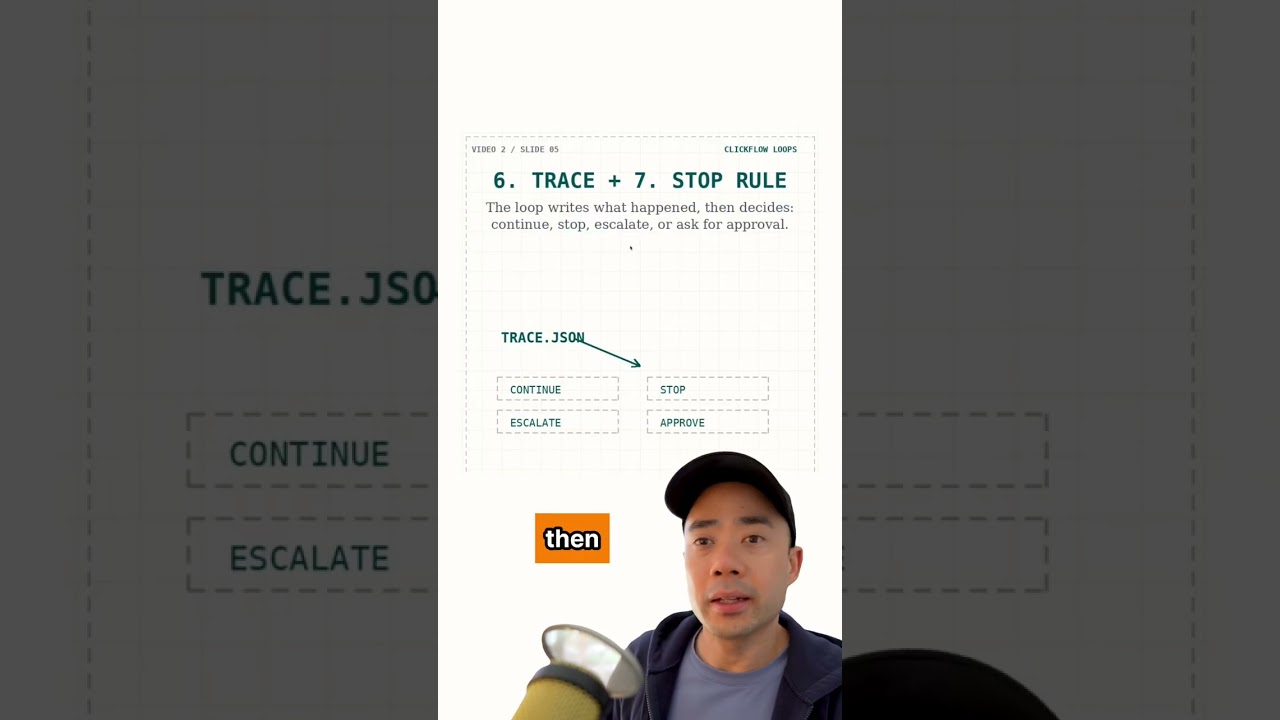
A framework for AI loops has seven parts: state, target, observe, action, eval, trace, and stop rule. The speaker walks through optimizing page load time from 100 ms down to 50 ms, showing how to measure the gap, make one change at a time, and define when to stop or escalate.
Chapters
Everyone's talking about AI loops, but nobody's talking about how to actually implement them. These are the 7 important parts to help you scale a lot faster. Every AI loop has 7 parts. You have state, you have target, you have observe, action, eval, trace, and stop rule. State is just how things are going right now. Target is where you're trying to go. So for example, you want— your target is you want all your pages on your site to be 50 milliseconds. State is maybe you're at 100 milliseconds. Observe is you are observing, okay, the gap actually, the difference right there is actually 50 milliseconds. Then you want it to act. So basically the loop will inspect reality before it starts, then it changes one thing at a time so the result can be evaluated. Then you want to eval, and eval is basically the definition of success. You want to have a specific number there in terms of where you're trying to go. And then you have number 6 and 7. So you have tracing and then you have stopping. Stop rule is very simple. When does it stop? When does it actually escalate? When does it seek for human approval? And then trace is basically determining and writing down what happened. If one's missing, you don't have a loop. If you want the skill, which is our Loops Creator Skill, as well as a repo template for this, just comment loops and we'll send it over to you.