The AI Layoff Narrative Just Collapsed (New Data Came Out)
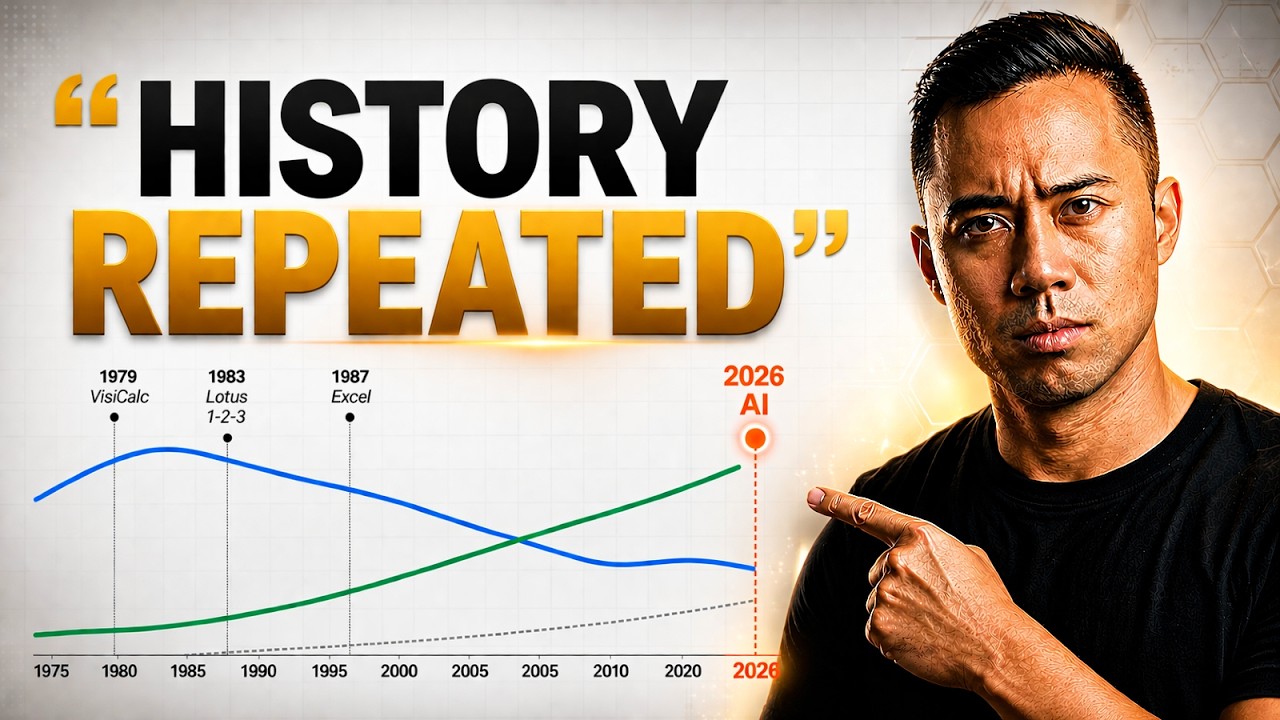
AI won't cause mass job loss. Radiology saw record residency slots and 48% salary rises after AI adoption. Historical data shows automation displaces routine work but creates more higher-value roles: spreadsheets killed 400K bookkeeping jobs but created 1.3M accountant positions.
Chapters
Most people are saying AI is going to cause mass unemployment. You have companies like Anthropic, leader in AI, they're saying 50% of job displacement. And you have a lot of doomers out there. You have a lot of people trying to put policy in place that are holding AI back. I'm here to tell you that all these people are wrong and all the doomerism is misplaced because there's hard data from historical data and even with AI data as well that proves that it's actually going to go the other way. Stay till the end. You're not going to want to miss these charts and this history. Check this out. Radiology. By the way, when radiology— when AI was taking over radiology, people were like, oh my God, radiology, all these people are going to lose their jobs, right? And this is just all the scans that people have to do. So check this out. In 2016, the godfather of AI said we should stop training radiologists because AI will soon do their job better. If you fast forward to 2025, radiology jobs are at record highs. Residency spots just hit a new all-time record. And average radiologist pay is up 48% since 2015, now around $520 grand a year. So look at this. Let's just look at this. So radiology, this is what it was before. And then all, all other devices over here. Okay, so in 2024, 70%, 78% of all cleared AI-enabled medical devices were for radiology. So look at how much this has been growing. It accounts for the majority of all these devices over here. Radiology covers for most of it. But not only that, the jobs are growing as well because the reality is it's not so much about doing the scans. It's more so about these radiologists. They need to talk to the clients. They need to figure out angles to help their customers. And that is their job. Their job is not just scanning. That was part of the job before. That was the task. So the reality is AI created more demand and AI took the monotonous, boring robotic tasks Away from the human, so they can focus on human things. Companies aren't gonna stop hiring humans to do robot things because the robots can now do them now. Now you look at the bottom over here, so it just says in high stakes, high demand jobs, AI tends to act as a productivity multiplier and a demand amplifier. It just shifts the burden of the real people working there away from the rote labor and more towards the big picture. So you think about nurses, for example. Nurses, do you want them to do all the stuff that all the scans that maybe the AI can handle? No. Maybe you want the nurses to handle more of the talking to the customers, being there for the customers, being empathetic. Being empathetic for the customers, spending time with the customers, that's what means a lot. Now let's shift this over to looking at drivers, right? People are like, oh, Uber drivers are going to be replaced by AI. The reality is maybe the driving portion as a task will be replaced, but that driver can still assist the human in other ways. They can help them pick things up, they can pick up their kids, they can help them with other tasks, maybe other physical tasks that maybe the human can't handle, right? Maybe the person that they're serving, they can't handle. So there's a lot of opportunity here. So this chart over here, this is from Coatue. 1900 to 1960, you had the adoption of the tractor, which decimated farm employment but led to the greatest expansion in US history. So check this out over here. In 1900, you had 12 million agricultural workers, 41% of the workforce. This green line over here goes down, down, down, down, down over time. And now 1970, 3.5 million, 2% of the workforce is in agriculture. By the way, I'll tell you, even before this, the amount of humans in agriculture, about 98% or so, I believe that was— that's what it was. So it took a very long time for it to come down. And you look at manufacturing in the blue over here. Okay. It's kind of, you know, it's Goes up a little bit, holds steady, goes down, and then it shoots up, and then it continues to go up, right? So while agriculture lost 8 million jobs from 1910 to 1970, new industries gained 46 million jobs in the same time period. So again, you don't want to hire humans to do robot work. And in this case, there was automation here. So was it exactly full automated robots? No, but you had a lot of the stuff that these devices could take over where you wouldn't have to have as much human labor doing the work anymore. Okay, and so that's, that's the leverage that you see over here. And you have other jobs over here, by the way. Look at this. Other jobs: retail, trade, professional services, construction. This dotted line over here that goes up. It's because all these other people, they figured out to work on other jobs that were more exciting. So it's not like you have to do these jobs forever, right? Once you have technology come in, the technology can take on the stupid stuff that you don't want to do. So that's, that's this piece over here. Now let's move on. So 1980 to 2022, spreadsheets diminished one job while adding others. Okay, so bookkeepers— check this out over here in the blue line— bookkeepers, it goes higher, higher, higher, higher, higher. And then these— so VisiCalc, Lotus 1-2-3, and Excel— these are all spreadsheet softwares. And then what happens is the bookkeepers start to go down, down, down, down, down, down, down, down, down. But while 400K bookkeepers disappeared at the advent of the spreadsheet era, 1.3 million accountants and financial analysts were added. So you get a 3x return on displacement. That's a good way of looking at this, right? So it's a return on displacement. So I think, sure, there might be some short-term job displacement, but long-term everything ends up okay. And, you know, yeah, this took some time. I mean, look at this over here. So you go 1980 to 1990 or so, that's where this displacement happens. That took around 10 years or so. So computers said to zap clerical jobs over here. So that was in 1986. But then you have financial analysts that goes up. So net-net, it's a win. You go back over here for a moment over here. So like 1917 to little before 1943 or so. This is a very long time. It's not like this stuff happens overnight. The last one you saw 10 years, this one's over a period of close to 30 years or so. Quick break. If you want to run personalized LinkedIn ads and have personalized landing pages to convert your customers at a much higher rate on LinkedIn, check out Karrot. That's karrot.ai. Karrot allows you to do things that LinkedIn ads does not allow you to do right now. Check it out. There are publicly traded companies such as Semrush and Sitecore that are using this right now. And you can use this to get ahead because if you don't use this, it will take you weeks, if not even a little longer than that, to make these ads. Because again, you cannot do this on LinkedIn. So again, go to www.karrot.ai and we'll see you on the other side. Now, the last example I'm going to show you over here, let's go to ATMs as an example. So in 1973, the New York Times predicted ATMs would cut bank teller jobs by 75%. Instead, teller employment grew by 81% from 1970 to 1988. You know why? Because they opened more Banks, right? They opened more banks. So after spreadsheets emerged, bookkeeping roles declined. So all that to say is that this is what's happening with AI. It's just short-term job displacement, and there will be a return on displacement. 60% of today's jobs are occupations that didn't exist in 1940. Okay, so look at this. So professionals, whatever that means, that's very vague, right? Occupation that didn't exist 1940. So that's way more managers. Okay, so what is this over here? This implies that 85% of job growth over the last 85 years has been driven by the creative destruction process. As human beings, we're always trying to improve our condition with the technology that we build, the products and services We offer. We're trying to make life easier for people. And that means that technology is going to get better over time, which means that we're always trying to creatively destroy ourselves. And some people don't like it because they like the comfort that they're in. But in order to advance, you have to creatively reinvent yourself all the time. And so for people to be saying it's going to eliminate jobs, there's going to be mass unemployment, there's going to be mass displacement, maybe for a little bit. If history tells you anything, we have been able to, as humans, we've been able to navigate the waters every single time. And these charts show exactly what I'm talking about over here. History leaves— it leaves clues, right? And history rhymes. It often rhymes. It doesn't repeat. But it rhymes. So I would just encourage you to think in this way because it's a lot more productive and it'll help you grow a lot more. And by the way, if you want to learn how to get ahead of all this, if you want to learn how to leverage OpenClaw and Hermes and all these other AI agents to grow a lot faster, check out this video over here.









